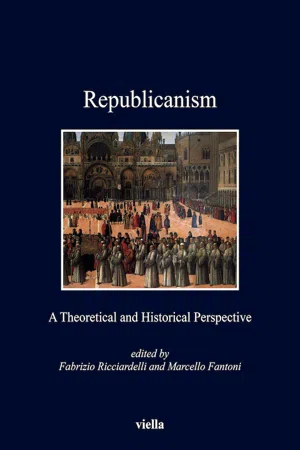
eBook - ePub
Republicanism
A Theoretical and Historical Perspective
- 329 pages
- English
- ePUB (mobile friendly)
- Available on iOS & Android
eBook - ePub
About this book
We live in a world in which almost all states purport to be republican. Very few adhere to the Ciceronian concept of res publica, understood as "that which belongs to the popolo (respublica respopuli) […] and which has the observance of the law and the commonality of interests as its foundation". The concept of republicanism is traditionally connected to the principle that true political freedom consists of not being subject to the arbitrary will of any man or group of men, and it requires equality of civil and political rights. Republicanism has attracted scholars who aim to develop insights from the classical republican tradition into an attractive political doctrine suitable for modern pluralistic societies. The volume examines republicanism from an historical and theoretical perspective after many years of scholarly investigation and debate.
Information
Subtopic
Early Modern HistoryIndex
HistoryII. The Republican Dilemma
Fabrizio Ricciardelli
The Italian City-States and the Roots of Democracy
1. Introduction
Towards the end of the 11th century, in the cities of central-northern Italy and southern France an original form of self-government emerged in the shape of the commune. Despite being sustained by the social classes wielding the greatest political, economic and military control, the commune also expressed the desire of the community as a whole to cast off the yoke of episcopal and seignorial power that hampered its development through bonds of dependence of different kinds. The new political organ was an association of citizens bound by oath. Unlike the feudal oath, this bond was of a substantially egalitarian nature, although it did not rule out clashes and conflicts. The origin and evolution of the commune was marked by the balance of two opposing tendencies: the citizens’ awareness of being a community and the ambitions of the leading families vying with each other for the control of power. The commune emerged from a temporary compromise within the ruling class; the resulting harmony provided the basis for the creation of the government organs and for the relational dynamics between the most eminent citizens and the rest of the population.303
While feudal and monarchical structures persisted in most of the countries of central Europe, in many Italian cities forms of government of a republican stamp emerged. This went very much against the tide of the monarchical governments, which the subjects deemed legitimate since they had been placed by God in the hands of men. Unlike what was happening in Italy, in Germany the princes enjoyed privileges and exercised territorial power because they had originally been royal officials with gifts of land, while the Church owned around one-third of the territory. Imperial cities and territorial cities developed in these lands, the former directly dependent on the Emperor and the latter under the dominion of a prince or an ecclesiastical lord. Many German cities continued at length to be subject to the control of the bishops, and even when episcopal power was weakened in the course of the 12th century, the development of autonomous forms of government continued to be substantially obstructed. Conversely, the cities that came within the orbit of the grand ducal dynasties thrived at the expense of the Empire, although they continued to govern in line with essentially monarchical principles. In France and England too, any independent developments of the cities were both late and modest. They came up against the king’s ambition for superior power, and the division of the land into large principalities hampered the development of civic autonomy.304
The German, French and English cities had a much less homogenous social composition than those of Italy. Driven by the work of the merchants and craftsmen, the Italian cities succeeded in concentrating the power of the lords in the rural hinterland. What distinguished the Italian city-republics from the rest of European monarchies was the application of one of the basic principles of contemporary democracies: namely, that all political offices must be elective and held for a limited period of time. Obviously, this is not to say that such forms of government included regular democratic elections in the modern sense. The right to vote was a privilege of the few, restricted to male heads of household who were required to demonstrate possession of considerable property within the city and to have been born in the city where they took part in political life.305
The distinctive feature of the civic governments of central-northern Italy is the shifting character of the political institutions and the continual review of the systems of participation and exercise of power. To find one’s bearings in the endless series of changes of regime, alternation of systems, major and minor reforms marking the experience of the individual cities, it helps to refer to the breakdown based on the history of the institutions of civic government. The three phases are: the consular phase (late 11th to late 12th century), the podestà phase (late 12th to mid-13th century) and the phase of the popolo (mid-13th to the 14th century).306
The communal experience in Italy can be considered as an initial form of democracy. However, the term democracy is never used in the communal sources which do, instead, make ample use of the term res publica. Among the definitions of democracy elaborated within the field of political science, there are two that adapt better to pre-modern societies. In one, democracy is understood as a form of government in which the question of “how many” govern is crucial; in the other, democracy is instead defined as a mode of government where the accent is on “how one governs”. In the first case, the answer has to verify that there are neither just one nor a few governing, since this would be tantamount respectively to monarchy or aristocracy. In the second case, the point is to check that the power does not descend downwards, monitoring whether or not it is exerted through imposition, and whether or not the laws are made by people other than those they are made for, since, if so, it would be autocracy.307
Democratic is the adjective applied to a political regime that has the common good as its priority, in which all citizens participate in decisions directly or indirectly and in which such decisions are taken by majority. To assess the democratic nature of communal government in the three phases to be taken into consideration here, two complementary aspects of the citizens’ political identity need to be taken into consideration. These are: participation in the res publica, that is, the manner in which individuals access political life, and exclusion, namely the manner in which they are, for various reasons, excluded from it. The metaphor of the feverish woman who tosses and turns in her bed in the vain hope of finding relief from her suffering, used by Dante Alighieri (1265-1321) to define what we would now call the Florentine constitution, is, unfortunately, a magnificent rendering of the condition of the society under analysis.308
2. The consular commune
Communal power was originally vested in the arengo (or parliament), namely the assembly made up of all free landholders. In addition to deliberating on the most important political matters – war, peace, finances and justice – the principal function of this assembly was the election of the consuls, the non-professional governors appointed to manage civic policy. The appearance of these magistrates in the documentation is generally taken as proof of the establishment of the communal institution. This came about...
Table of contents
- Abstract
- Series page
- Title page
- Copyright page
- Contents
- Introduction
- I. Republicanism and Political Value
- II. The Republican Dilemma
- III. Republican Principles
Trusted by 375,005 students
Access to over 1.5 million titles for a fair monthly price.
Study more efficiently using our study tools.
Frequently asked questions
Yes, you can cancel anytime from the Subscription tab in your account settings on the Perlego website. Your subscription will stay active until the end of your current billing period. Learn how to cancel your subscription
No, books cannot be downloaded as external files, such as PDFs, for use outside of Perlego. However, you can download books within the Perlego app for offline reading on mobile or tablet. Learn how to download books offline
Perlego offers two plans: Essential and Complete
- Essential is ideal for learners and professionals who enjoy exploring a wide range of subjects. Access the Essential Library with 800,000+ trusted titles and best-sellers across business, personal growth, and the humanities. Includes unlimited reading time and Standard Read Aloud voice.
- Complete: Perfect for advanced learners and researchers needing full, unrestricted access. Unlock 1.5M+ books across hundreds of subjects, including academic and specialized titles. The Complete Plan also includes advanced features like Premium Read Aloud and Research Assistant.
We are an online textbook subscription service, where you can get access to an entire online library for less than the price of a single book per month. With over 1.5 million books across 990+ topics, we’ve got you covered! Learn about our mission
Look out for the read-aloud symbol on your next book to see if you can listen to it. The read-aloud tool reads text aloud for you, highlighting the text as it is being read. You can pause it, speed it up and slow it down. Learn more about Read Aloud
Yes! You can use the Perlego app on both iOS and Android devices to read anytime, anywhere — even offline. Perfect for commutes or when you’re on the go.
Please note we cannot support devices running on iOS 13 and Android 7 or earlier. Learn more about using the app
Please note we cannot support devices running on iOS 13 and Android 7 or earlier. Learn more about using the app
Yes, you can access Republicanism by Fabrizio Ricciardelli,Marcello Fantoni in PDF and/or ePUB format, as well as other popular books in History & Early Modern History. We have over 1.5 million books available in our catalogue for you to explore.