eBook - ePub
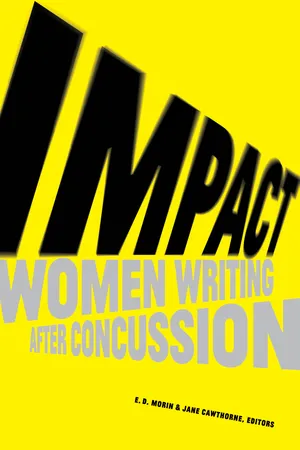
Impact
Women Writing After Concussion
- 248 pages
- English
- ePUB (mobile friendly)
- Available on iOS & Android
eBook - ePub
About this book
In Impact, 21 women writers consider the effects of concussion on their personal and professional lives. The anthology bears witness to the painstaking work that goes into redefining identity and regaining creative practice after a traumatic event. By sharing their complex and sometimes incomplete healing journeys, these women convey the magnitude of a disability which is often doubted, overlooked, and trivialized, in part because of its invisibility. Impact offers compassion and empathy to all readers and families healing from concussion and other types of trauma.
Contributors: Adèle Barclay, Jane Cawthorne, Tracy Wai de Boer, Stephanie Everett, Mary-Jo Fetterly, Rayanne Haines, Jane Harris, Kyla Jamieson, Alexis Kienlen, Claire Lacey, E. D. Morin, Julia Nunes, Shelley Pacholok, Chiedza Pasipanodya, Judy Rebick, Julie Sedivy, Dianah Smith, Carrie Snyder, Kinnie Starr, Amy Stuart, Anna Swanson
Available on many channels, including Libro.fm.
Information
Subtopic
Medicine BiographiesIndex
Literature
In Exile I Draw the Tower Card
When I injured my brain
it was barely spring.
Now it is mid-October
and getting up at eleven
is a big accomplishment.
Last month I counted
the five hundred extra
hours I’ve spent sleeping
in this new state
where sunlight augurs
pain. I lose simple thoughts
before I can finish them
and feel lonely without
my mind. I’m always asking
whoever I’m talking to
what was I saying?
When everyone went
back to school I stayed
home, stopped having
goals, stopped dreaming
of putting my body
in a body of water. I tried
to edit what I wrote
and was bad at it, the kind
of bad trying harder
can’t fix. I felt useless
and alive. I watched
the doctor type prognosis
unknown and let hope
ghost me. Remind me where
the soul lives? How to tell
body from mind?
Ups and downs, I say
when asked if I’m recovering
in crowds I get dizzy
and sweat from the noise
and movement of bodies
around me. I am a woman
who holds her head
slightly off centre,
always comes alone,
is relearning most things.
Where to begin?
Lost
I AM LOST. I squint beneath my sunglasses, shade my eyes with my hand and try to look around without moving my head too much. I see a bench, sit down and try to think, try to separate one strand of thought from another and follow it through. I can feel my brain working. I’m on the main street near my house and I’ve been outside for—I’m guessing—ten minutes. I can only be four or five blocks from home.1 Rising anxiety makes it difficult for me to know what to do.2
My phone is like a talisman in my pocket and I want to call my husband, but I don’t know his number.3 Then I remember: it’s in my phone. He answers and I’m so relieved. I say, “I’m lost. Can you help me?” I tell him what I’m looking at and he guides me home.
I don’t even remember why I left the house. Did I need groceries? Did I want a walk? Was I bored? Sometimes, I’m fine with letting days pass in the void. But I’m not used to being unproductive.4 And the isolation makes me sad. So I go out. Maybe that’s why I went out that day, to try to quell the sadness. Everyone I have seen so far has different advice. One doctor says to do what I can without allowing myself to become symptomatic. That’s a guessing game I lose almost every day. Another says to rest in a dark and quiet room. One tells me to sleep whenever I want, whenever I can, because the brain heals while sleeping. Another says to sleep only at night. I follow the advice that appeals to me because I begin to suspect that no one really knows anything.
I cry on the way home.5 I try to be discreet about it. The last thing I want is to have some kind person ask if I need help. Yes. I need help. I need more help than anyone understands. I need more help than even I understand. But I don’t want to be looked at. I don’t want to be assessed. I don’t want to be judged. Because I will be found wanting. I’m beginning to feel like my mother, who was a fearful woman and quite possibly agoraphobic. She had a very small life and treated every outing like a series of potential disasters. I do not want to become my mother.
Maybe that’s why for a long time, I was heavily invested in passing as a non-brain-injured person. I still can. I look fine. But if I’m honest, all too often passing does more harm than good. I don’t get the help I need.6
My inability to navigate is part of a larger constellation of symptoms that have to do with executive functioning. About eighteen months into my concussion, a neuropsychologist will use the phrase “disorganized thinking.” I couldn’t have found that phrase on my own, but I recognize it as correct. Someone else says “non-linear thinking.” That works too. Everything comes to me as a tangent, a diversion, a footnote. Even before that, an occupational therapist will tell me I’m having trouble “sequencing” and I will spend six months doing puzzles and worksheets that match items in column A to column B and playing with blocks like a child. I will learn to replicate patterns. In the months ahead, I’ll ruin countless meals because I can’t follow a recipe. When I bake, I might as well lay all the ingredients on the counter and slide them straight into the garbage to save time. I’ll “develop strategies” to “cope with my deficits” and they will backfire. (Is the baking soda on the counter because I used it already or because I still need to use it?) But on this particular day, the day that I am lost just blocks from my house, failed baking is still ahead of me and all I can think to do is call my husband to help me get home.
| The first time I got lost was the morning after the car accident. My husband and I were in Vancouver. He was there for work and we used his trip as an opportunity for both of us to visit our daughter. The morning after the accident, he had meetings. I got up after a miserable, sleepless night spent reliving the shock of impact, sore everywhere, bruised, but grateful no one was seriously hurt. I had no idea.
I didn’t see the accident happen. I was in the passenger seat looking at my phone, navigating us to the place we were staying. (Recently, I have wondered if I get lost all the time because I was using my brain to navigate when it broke, and, since those neural connections were in use, it was this part of my brain that took the biggest hit.) The rental car was wrecked. At least that wouldn’t be our problem for long. Luckily, we had insurance. Some paperwork would take care of it.7
That next morning when I went outside, I couldn’t understand why the sun was so bright. I walked a bit until I realized I wasn’t sure where I was and, if I walked much farther, I wouldn’t find my way back. The thought came with that odd hair-standing-up-on-the-back-of-my-neck feeling, that kind of intuitive jolt that says “pay attention.” I figured I must still be in shock, so I turned around and went back to where we were staying. I told myself that resting for a day after a car accident was something any reasonable person would do.
The following day we returned home to Toronto and while my husband had completely shaken off the accident, I had not. Could shock last two full days? My brain was foggy. I noticed that I couldn’t understand the signs in the airport pointing to gates and baggage claim. I didn’t say anything because I couldn’t understand what was happening to me.
I started to realize I might be in trouble.8
| Three and a half years later I still get lost, although rarely in my own neighbourhood. And when I do get lost near where I live, I’m only a little lost. It’s more like a brief disorientation than being absolutely adrift. I get my bearings and I’m on my way again. I’ve learned not to panic.
In unfamiliar places, I’m hopeless. Left and right were uncertain concepts for me until well into my second year.9 And don’t get me started on north and south or east and west. It makes travel difficult. People are kind, though. They offer directions when I ask. I try not to dither. What no one realizes when I ask for help is that I can only retain the first instruction they ...
Table of contents
- Cover Page
- Title Page
- Copyright Page
- Dedication Page
- Contents Page
- Brainstorm: how we got here: E. D. MORIN & JANE CAWTHORNE
- I | Where to Begin
- II | Am I Getting Better
- III | No Longer the Person I Was
- IV | I Dream of Swimming
- V | Carried Through All That
- Acknowledgements
- Notes
- Contributors
Trusted by 375,005 students
Access to over 1.5 million titles for a fair monthly price.
Study more efficiently using our study tools.
Frequently asked questions
Yes, you can cancel anytime from the Subscription tab in your account settings on the Perlego website. Your subscription will stay active until the end of your current billing period. Learn how to cancel your subscription
No, books cannot be downloaded as external files, such as PDFs, for use outside of Perlego. However, you can download books within the Perlego app for offline reading on mobile or tablet. Learn how to download books offline
Perlego offers two plans: Essential and Complete
- Essential is ideal for learners and professionals who enjoy exploring a wide range of subjects. Access the Essential Library with 800,000+ trusted titles and best-sellers across business, personal growth, and the humanities. Includes unlimited reading time and Standard Read Aloud voice.
- Complete: Perfect for advanced learners and researchers needing full, unrestricted access. Unlock 1.5M+ books across hundreds of subjects, including academic and specialized titles. The Complete Plan also includes advanced features like Premium Read Aloud and Research Assistant.
We are an online textbook subscription service, where you can get access to an entire online library for less than the price of a single book per month. With over 1.5 million books across 990+ topics, we’ve got you covered! Learn about our mission
Look out for the read-aloud symbol on your next book to see if you can listen to it. The read-aloud tool reads text aloud for you, highlighting the text as it is being read. You can pause it, speed it up and slow it down. Learn more about Read Aloud
Yes! You can use the Perlego app on both iOS and Android devices to read anytime, anywhere — even offline. Perfect for commutes or when you’re on the go.
Please note we cannot support devices running on iOS 13 and Android 7 or earlier. Learn more about using the app
Please note we cannot support devices running on iOS 13 and Android 7 or earlier. Learn more about using the app
Yes, you can access Impact by E. D. Morin, Jane Cawthorne, E. D. Morin,Jane Cawthorne in PDF and/or ePUB format, as well as other popular books in Literature & Medicine Biographies. We have over 1.5 million books available in our catalogue for you to explore.