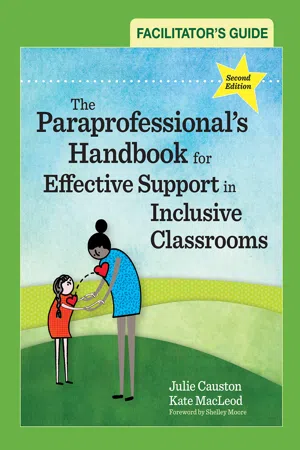
Facilitator's Guide to The Paraprofessional's Handbook for Effective Support in Inclusive Classrooms
eBook - ePub

Facilitator's Guide to The Paraprofessional's Handbook for Effective Support in Inclusive Classrooms

  1. 56 pages
  2. English
  3. ePUB (mobile friendly)
  4. Available on iOS & Android
eBook - ePub

Facilitator's Guide to The Paraprofessional's Handbook for Effective Support in Inclusive Classrooms

About this book

Effective training for paraprofessionals is critical to the success of inclusive schools—but planning professional development sessions can be a complicated, time-consuming process. That's why inclusion experts Julie Causton and Kate MacLeod created this digital Facilitator's Guide, an essential companion to The Paraprofessional's Handbook for Effective Support in Inclusive Classrooms, Second Edition.

User-friendly and comprehensive, this guide is your one-stop resource for effectively planning and delivering six 1-hour live or virtual training sessions on critical topics, each aligned with one or more chapters from the book. You'll use the guide in tandem with the book to lead meaningful discussions with staff, communicate immediately useful information on scheduling and preparation, and enhance on-the-job knowledge and skills of the paraprofessionals you work with and/or supervise. Complete with step-by-step instructions and a package of online support materials, this invaluable resource is the key to preparing paraprofessionals to thrive in inclusive K–12 classrooms and provide effective, respectful supports to their students.

  • Helps you teach the skills that matter. These sessions will help paraprofessionals master every key facet of their complex role, from professional collaboration to academic and behavior support.
  • Cost-effective. Once the paraprofessionals in your school have their copies of The Paraprofessional's Handbook for Effective Supports in Inclusive Classrooms, Second Edition, purchase this single digital product. You'll have everything you need to conduct six hours of successful training: a manual plus access to the downloadable support materials.
  • Easy to customize. Whether you're looking to train just a few paraprofessionals or plan district-wide professional development, the sessions can be easily tailored to your needs.
  • Works with your schedule. Sample schedules for whole and half-day sessions are included, so you can plan convenient and efficient professional development for your school or district.
  • Can be live or virtual. Flexibility matters in today's world, so these sessions were designed to be equally effective when delivered face-to-face or remotely.

Conduct training sessions on 6 critical topics:

  • The Paraprofessional, Inclusive and Special Education
  • Collaborating With Others
  • Rethinking Your Students—Presuming Competence
  • Academics and Social Supports
  • Providing Behavior Support
  • Developing Student Independence and Supporting Yourself

The digital Facilitator's Guide includes everything you need: A manual, complete with checklists, talking points, activities, and frequently asked questions · Presentation slides for each session · Video clips from the authors introducing each session · Email templates to communicate with attendees · An editable certificate of completion

Need more in-depth training for paraprofessionals? Check out the virtual, on-demand PD for Paras course with Dr. Julie Causton and Dr. Kristie Pretti-Frontczak. Get four recorded expert trainings, each one 45 to 90 minutes, with prompts for reflection and discussion. https://www.inclusiveschooling.com/pd-4-paras/

See a sample clip from Session 1

Frequently asked questions

Yes, you can cancel anytime from the Subscription tab in your account settings on the Perlego website. Your subscription will stay active until the end of your current billing period. Learn how to cancel your subscription.
At the moment all of our mobile-responsive ePub books are available to download via the app. Most of our PDFs are also available to download and we're working on making the final remaining ones downloadable now. Learn more here.
Perlego offers two plans: Essential and Complete
  • Essential is ideal for learners and professionals who enjoy exploring a wide range of subjects. Access the Essential Library with 800,000+ trusted titles and best-sellers across business, personal growth, and the humanities. Includes unlimited reading time and Standard Read Aloud voice.
  • Complete: Perfect for advanced learners and researchers needing full, unrestricted access. Unlock 1.4M+ books across hundreds of subjects, including academic and specialized titles. The Complete Plan also includes advanced features like Premium Read Aloud and Research Assistant.
Both plans are available with monthly, semester, or annual billing cycles.
We are an online textbook subscription service, where you can get access to an entire online library for less than the price of a single book per month. With over 1 million books across 1000+ topics, we’ve got you covered! Learn more here.
Look out for the read-aloud symbol on your next book to see if you can listen to it. The read-aloud tool reads text aloud for you, highlighting the text as it is being read. You can pause it, speed it up and slow it down. Learn more here.
Yes! You can use the Perlego app on both iOS or Android devices to read anytime, anywhere — even offline. Perfect for commutes or when you’re on the go.
Please note we cannot support devices running on iOS 13 and Android 7 or earlier. Learn more about using the app.
Yes, you can access Facilitator's Guide to The Paraprofessional's Handbook for Effective Support in Inclusive Classrooms by Julie Causton,Kate MacLeod in PDF and/or ePUB format, as well as other popular books in Education & Inclusive Education. We have over one million books available in our catalogue for you to explore.

Information

Year
2021
Print ISBN
9781681254517
eBook ISBN
9781681254838
Edition
2

SESSION

1

CHAPTERS 1-3

The Paraprofessional and Inclusive and Special Education

This session is foundational for understanding the roles and responsibilities of the paraprofessional and the legal, practical, and philosophical aspects of inclusive and special education.

Learning Objectives

By the end of this session, attendees should be able to:
  1. Understand the roles and responsibilities of a paraprofessional.
  2. Define practical and philosophical elements of inclusive education.
  3. Use an individualized education program (IEP) at a glance and identify questions about the IEP for students they work with.
  4. Identify challenges with labels and understand how to think more expansively about students.

Materials Needed

  • Book
  • Parking Lot (virtual or hard copy)
  • Sample IEP
The Parking Lot
To keep your group of paraprofessionals on task during discussion, we recommend having a “Parking Lot” where PD attendees can write down questions as they come up for later discussion. We park the questions there as they come into our minds so we don't lose them and can address them later!
You can create hard copies of the Parking Lot to distribute to the group, have a virtual Parking Lot such as a Google Doc, or create one using the chat feature of video meeting software.

Leader Preparation Checklist

  • Two weeks before your first PD session, send out the introductory e-mail to your paraprofessionals. An e-mail template is provided in Appendix C, or you can download the template through the Download Hub on the Brookes Publishing website.
  • Read Chapters 1-3 and have a copy of the book ready to use during this session.
  • Prepare a Parking Lot for paraprofessionals to write down unanswered questions, whether your meeting is in person or virtual.
  • Prepare a sample IEP to share and review during the IEP at a Glance activity.
  • Review the Key Terms and Frequently Asked Questions for Chapters 1-3.

Key Terms

  • Inclusive education is when human diversity is valued and celebrated and students with and without disabilities learn together in the general education classroom.
  • Least restrictive environment (LRE) is identified in the Individuals with Disabilities Education Improvement Act (IDEA) of 2004 and means that, to the maximum extent appropriate, a school district must educate any student with a disability in the regular classroom-with appropriate aids and supports and alongside the student's peers without disabilities-in the school they would attend if the student did not have a disability.
  • Supplementary aids and services are used to support a student with a disability in the least restrictive environment. Review Figure 2.2 for a list of possible supports.
Figure 2.2. Supplementary aids and services.
From Villa, R. A., Thousand, J. S., & Nevin, A. I. (2013). A guide to co-teaching: New Lessons and strategies to facilitate student learning (3rd ed., pp. 198–201). Thousand Oaks, CA: Corwin Press, adapted by permission of SAGE Publications.
In The Paraprofessional’s Handbook for Effective Support in Inclusive Classrooms, Second Edition, by Julie Causton and Kate MacLeod. Copyright © 2021 Paul H. Brookes Publishing Co., Inc. All Rights Reserved.
Figure 2.2. (continued)
From Villa, R. A., Thousand, J. S., & Nevin, A. I. (2013). A guide to co-teaching: New Lessons and strategies to facilitate student learning (3rd ed., pp. 198–201).
Thousand Oaks, CA: Corwin Press, adapted by permission of SAGE Publications.
In The Paraprofessional’s Handbook for Effective Support in Inclusive Classrooms, Second Edition, by Julie Causton and Kate MacLeod.
Copyright © 2021 Paul H. Brookes Publishing Co., Inc. All Rights Reserved.

Frequently Asked Questions

Review the following questions your paraprofessionals might ask.
Chapter 1: Commonly Asked Questions About the Role of Paraprofessionals
  • Q. To whom do I report?
  • A. Typically, a paraprofessional reports to the special education teacher to whom they are assigned. After that, a building principal or director of special education would be next in the chain of command. However, you will also work closely with general education teachers and related services providers (e.g., occupational therapists, physical therapists, speech-language pathologists), and they may provide guidance as well.
  • Q. How can I obtain a copy of my job description?
  • A. You can typically find this online. If not, request a copy of your job description by talking to someone in human resources or by asking the director of special education. Most districts will provide you a written job description if you do not already have one.
  • Q. Am I allowed to lead a small-group discussion?
  • A. Yes, you can lead a small-group discussion or review material with students under the direction of a certified teacher. You are not typically allowed to introduce new material, but you can reinforce material taught previously by a certified teacher.
  • Q. Can I teach an entire class by myself?
  • A. A paraprofessional generally does not teach an entire class new material, but you could be responsible for reading a book aloud to the class or supporting the work of the entire class, under the direction and supervision of a certified teacher.
  • Q. Who is ultimately responsible for the education of the student I am supporting?
  • A. The special education teacher and general education teacher assigned to the student are responsible. The terms case manager and service coordinator are sometimes used to refer to the special education teacher assigned to the student.
  • Q. Should I work from written plans?
  • A. Yes, you should work from written plans. If you don't have written plans, you can request them from the special education teacher with whom you are working. It is important to note that the plans provided will not account for every minute of the day; instead, they typically consist of a schedule and tasks for periods of the day.
Chapter 2: Commonly Asked Questions About Inclusive Education
  • Q. Is inclusive education really best for a student with disabilities?
  • A. Research has consistently shown that the inclusive classroom ...

Table of contents

  1. About the Online Materials
  2. About the Authors
  3. About Inclusive Schooling
  4. Introduction
  5. Session 1      Chapters 1-3
  6. Session 2      Chapter 4
  7. Session 3      Chapter 5
  8. Session 4      Chapters 6 and 7
  9. Session 5      Chapter 8
  10. Session 6      Chapters 9 and 10
  11. Appendix A
  12. Appendix B
  13. Appendix C
  14. Appendix D
  15. Appendix E
  16. Appendix F
  17. Appendix G
  18. Appendix H
  19. Appendix I
  20. Appendix J
  21. Certificate of Completion
  22. Back Cover