The second volume in a prominent new series on Buddhism and science, directed by the Dalai Lama and previously covered by the BBC.
Science and Philosophy in the Indian Buddhist Classics compiles classical Buddhist explorations of the nature of our material world, the human mind, logic, and phenomenology and puts them into context for the modern reader.
This ambitious four-volume series—a major resource for the history of ideas and especially the history of science and philosophy—has been conceived by and compiled under the visionary supervision of His Holiness the Dalai Lama himself. It is his view that the exploratory thinking of great Indian masters in the first millennium CE still has much that is of interest to us today, whether we are Buddhist or not. These volumes make those insights accessible.
This, the second volume in the series, focuses on the science of the mind. Readers are first introduced to Buddhist conceptions of mind and consciousness and then led through traditional presentations of mental phenomena to reveal a Buddhist vision of the inner world with fascinating implications for the contemporary disciplines of cognitive science, psychology, emotion research, and philosophy of mind. Major topics include:
-The distinction between sensory and conceptual processes and the pan-Indian notion of mental consciousness
-Mental factors—specific mental states such as attention, mindfulness, and compassion—and how they relate to one another
-The unique tantric theory of subtle levels of consciousness, their connection to the subtle energies, or “winds,” that flow through channels in the human body, and what happens to each when the body and mind dissolve at the time of death
-The seven types of mental states and how they impact the process of perception
-Styles of reasoning, which Buddhists understand as a valid avenue for acquiring sound knowledge
In the final section, the volume offers what might be called Buddhist contemplative science, a presentation of the classical Buddhist understanding of the psychology behind meditation and other forms of mental training.
To present these specific ideas and their rationale, the volume weaves together passages from the works of great Buddhist thinkers like Asanga, Vasubandhu, Nagarjuna, Dignaga, and Dharmakirti. His Holiness the Dalai Lama’s introduction outlines scientific and philosophical thinking in the history of the Buddhist tradition. To provide additional context for Western readers, each of the six major topics is introduced with an essay by John D. Dunne, distinguished professor of Buddhist philosophy and contemplative practice at the University of Wisconsin. These essays connect the traditional material to contemporary debates and Western parallels, and provide helpful suggestions for further reading.
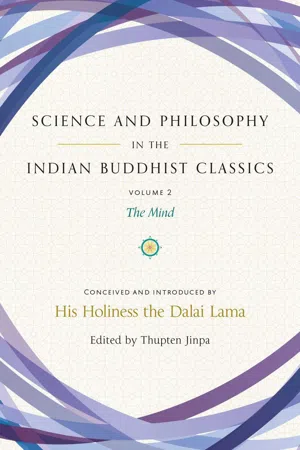
eBook - ePub
Science and Philosophy in the Indian Buddhist Classics, Vol. 2
The Mind
- 550 pages
- English
- ePUB (mobile friendly)
- Available on iOS & Android
eBook - ePub
Science and Philosophy in the Indian Buddhist Classics, Vol. 2
The Mind
About this book
Information
Topic
Teología y religiónSubtopic
BudismoTable of contents
- Cover Page
- Title Page
- Contents
- Preface
- Introduction by His Holiness the Dalai Lama
- Part 1. Mind
- Part 2. Mental Factors
- Part 3. Gross and Subtle Minds
- Part 4. Mind and Its Objects
- Part 5. Inferential Reasoning
- Part 6. Training the Mind through Meditation
- Notes
- Glossary
- Bibliography
- Index
- About the Authors
- What to Read Next from the Dalai Lama
- About Wisdom Publications
- Copyright
Trusted by 375,005 students
Access to over 1.5 million titles for a fair monthly price.
Study more efficiently using our study tools.
Frequently asked questions
Yes, you can cancel anytime from the Subscription tab in your account settings on the Perlego website. Your subscription will stay active until the end of your current billing period. Learn how to cancel your subscription
No, books cannot be downloaded as external files, such as PDFs, for use outside of Perlego. However, you can download books within the Perlego app for offline reading on mobile or tablet. Learn how to download books offline
Perlego offers two plans: Essential and Complete
- Essential is ideal for learners and professionals who enjoy exploring a wide range of subjects. Access the Essential Library with 800,000+ trusted titles and best-sellers across business, personal growth, and the humanities. Includes unlimited reading time and Standard Read Aloud voice.
- Complete: Perfect for advanced learners and researchers needing full, unrestricted access. Unlock 1.5M+ books across hundreds of subjects, including academic and specialized titles. The Complete Plan also includes advanced features like Premium Read Aloud and Research Assistant.
We are an online textbook subscription service, where you can get access to an entire online library for less than the price of a single book per month. With over 1.5 million books across 990+ topics, we’ve got you covered! Learn about our mission
Look out for the read-aloud symbol on your next book to see if you can listen to it. The read-aloud tool reads text aloud for you, highlighting the text as it is being read. You can pause it, speed it up and slow it down. Learn more about Read Aloud
Yes! You can use the Perlego app on both iOS and Android devices to read anytime, anywhere — even offline. Perfect for commutes or when you’re on the go.
Please note we cannot support devices running on iOS 13 and Android 7 or earlier. Learn more about using the app
Please note we cannot support devices running on iOS 13 and Android 7 or earlier. Learn more about using the app
Yes, you can access Science and Philosophy in the Indian Buddhist Classics, Vol. 2 by Thupten Jinpa, Dechen Rochard,John D. Dunne in PDF and/or ePUB format, as well as other popular books in Teología y religión & Budismo. We have over 1.5 million books available in our catalogue for you to explore.