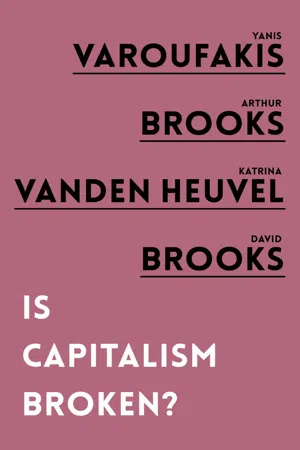
Is Capitalism Broken?
  1. 128 pages
  2. English
  3. ePUB (mobile friendly)
  4. Available on iOS & Android
eBook - ePub

About this book

'We need to organise politically to defend the weak, empower the many and prepare the ground for reversing the absurdities of capitalism.'

– Yanis Varoufakis

'Capitalism over the past twenty-five years has been an incredible moral good.'

– David Brooks

The Munk debate on capitalism

There is a growing belief that the capitalist system no longer works. Inequality is rampant. The environment is being destroyed for profits. In some western nations, life expectancy is even falling. Political power is wielded by wealthy elites and big business, not the people. But for proponents of capitalism, it is the engine of progress, not just making all of us materially better off, but helping to address everything from women’s rights to political freedoms. We seem to stand at a crossroads: do we need to fix the system as a matter of urgency, or would it be better to hold our nerve?
Tools to learn more effectively

Saving Books

Saving Books

Keyword Search

Keyword Search

Annotating Text

Annotating Text

Listen to it instead

Listen to it instead

Information

The Future of Capitalism
image
Be it resolved: The capitalist system is broken. It’s time to try something different . . .
Pro: Katrina vanden Heuvel and Yanis Varoufakis Con: Arthur Brooks and David Brooks
December 4, 2019
Toronto, Ontario
RUDYARD GRIFFITHS: Ladies and gentlemen. Welcome to the Munk Debate on Capitalism. My name is Rudyard Griffiths. It’s my privilege to have the opportunity to help organize this debate series and to once again serve as your moderator.
I want to start by welcoming the North America–wide television audience tuning in to this debate right now on CPAC, Canada’s public affairs channel. And with our partners in the United States, WNED and their PBS sister stations. It’s great to have you as part of the program. A warm hello also to our online audience watching right now at munkdebates.com and via the website of our exclusive social media partner, Facebook. Thank you for tuning in.
And finally, hello to you, the over 3,000 people who’ve filled Roy Thomson Hall for yet another Munk Debate. On behalf of the Munk Foundation and all of us working at the debates, we so appreciate your support for more and better debates of the big issues of the day.
Now, tonight is a bit of a milestone for this series. This evening marks our twenty-fifth consecutive debate. Quite an accomplishment—twenty-five debates. That’s pretty good. Our ability, year in and year out, to bring to this stage some of the world’s sharpest minds and brightest thinkers would not be possible without the public spiritedness and the generosity of our founders and hosts tonight, the Aurea Foundation and the Munk family. Thank you for keeping this series going. I think Peter would have enjoyed this debate. I’m sure he would have had a few opinions about it.
So, why are we convening this debate now? Of all the various topics we could have confronted this autumn, why did we turn to capitalism? Well, something is clearly happening in our politics and in our culture when it comes to public perceptions of free markets, capitalism, and free enterprise. More and more of our fellow citizens have come to believe, quite simply, that the capitalist system no longer works. They blame it for fuelling rising, if not rampant, economic inequality and stagnating living standards. They believe, many strongly, that capitalism is poisoning the planet for profit. And they are genuinely worried about how capitalism is concentrating in the hands of a few wealthy and powerful elites increasing amounts of democratically unaccountable power. In short, I don’t think it’s a stretch to say we’re living through a moment when we as a society are experiencing a crisis of faith in capitalism as an engine of economic, social, and human progress.
But, as we’ll hear tonight, capitalism’s defenders feel that blaming the capitalist system for society’s problems is the moral panic of our time. They see free markets rightly as having lifted hundreds of millions of people out of abject poverty around the world. They believe that capitalism is a powerful tool to clean up the environment, to spread human rights, to promote political liberty, and to encourage all the kinds of technological breakthroughs that have made our lives immeasurably better. We know that.
For capitalism’s proponents, the answers to these real and urgent problems that our society faces, such as the environment and economic inequality, is more liberty, more free markets—in short, more capitalism.
So tonight we challenge the essence of these arguments by posing a simple motion, “Be it resolved: the capitalist system is broken; it is time to try something different.”
Arguing in favour of tonight’s motion is one of the world’s leading socialist democratic thinkers. He’s a member of the Greek parliament—I think he’s got a budget coming out tomorrow that he’s going to have to comment on—he was finance minister of Greece during the Eurozone crisis, and he’s an internationally bestselling author. Ladies and gentlemen, please welcome to Toronto, Canada, Yanis Varoufakis. Thank you, Yanis. Thank you.
Well, one great debater deserves another, and Yanis’s debate partner tonight is one of America’s leading progressive voices. She is the publisher of the storied Nation magazine, a Washington Post columnist, and the acclaimed author of numerous books on economics, politics, and international affairs. Ladies and gentlemen, Katrina vanden Heuvel.
Speaking against the motion is Harvard professor, best-selling author, and the star of the Netflix hit documentary The Pursuit—ladies and gentlemen, Arthur Brooks.
Joining Arthur on the Con team for this debate is the celebrated New York Times columnist, author, and the person we turn to regularly on PBS stations to try to understand the big issues of our time. Ladies and gentlemen, please welcome our final presenter, David Brooks.
It’s now time for us to have our first audience vote on the resolution, “Be it resolved: the capitalist system is broken; it’s time to try something different.” And here are some preliminary numbers. Interestingly, public opinion in this hall, I would say, is virtually split within the margin of error: 47 percent in favour of the motion, 53 percent opposed. So, we certainly have a debate on our hands.
Now we’re going to see how fluid opinion is in this audience. We’re going to ask you a second question: Are you open to changing your vote over the next hour and a half ? Is there something that either one of these teams of debaters could say that could conceivably let you vote in a different way when we come to our final vote on the resolution at the end of tonight’s debate? Let’s see those results: 79 percent are open to changing their minds. So, we have an audience of creative thinkers who are willing to consider what they hear from these two teams with sharply diverging points of view.
Let’s move now to opening statements. We’re going to have six minutes on the clock for each one of the debaters. And, according to debating convention, we’re going to have the team arguing for the resolution speak first. Yanis Varoufakis, you have six minutes on the clock. Let’s have your opening words.
YANIS VAROUFAKIS: Good evening, Toronto. Good evening, ladies and gentlemen. We have a great debt of gratitude to capitalism. Capitalism liberated us from prejudice, superstition, backwardness, feudalism. But at the same time, we owe capitalism blame for unbearable inequality, unsustainable debt, brazen authoritarianism, and, yes, catastrophic climate change.
There’s no doubt that capitalism produced immense wealth, but it produced it on the same—exactly the same—production line on which it manufactured new forms of deprivation. It lifted billions of people from poverty, but it created new forms of desperation for many others.
When asked who is the worst enemy of capitalism, I never respond by pointing to the Left. We leftists are a bunch of losers. We have a tendency to fall prey to authoritarianism—look at the Soviet Union. Capitalism is not threatened by the Left.
The liberals look to all these billionaires who are now angst-ridden, watching their stash of cash rise exponentially while wondering how they will enjoy it in a world in which the majority are sliding into precarity. They are not going to change anything either because, however much money they give away, they will never do anything to jeopardize the dynamic process by which their privileges are being reproduced.
What about liberals? American liberals? Small-l liberals, or social democrats in Europe? They’re also impotent because they have their own diagnosis. They think that the problem with capitalism is that, on our behalf, it has purchased efficiency at the expense of injustice. No. The problem with capitalism is that it is particularly inefficient at using the fantastic technologies and wealth that it produces. The problem with capitalism at the moment is that it is seriously undermining itself, and so becomes its own worst enemy. It is undermining humanity’s capacity to share the prosperity of planet Earth.
Remember the Soviet Union? That awful contraption? It has as much to do with the principles of socialism as today’s really existing capitalism has to do with free-market ideology—nothing whatsoever. We do not live in a small-town, front-porch community where the butcher, the brewer, and the baker, through acting in their self-interest, pursue the common good. We live in a very, very different kind of world.
We live in a really existing capitalism, which is against free markets. It has been against free markets since the invention of electromagnetism, which gave rise to the Edisons, the Fords, the grids, the network companies, the mega-companies, the big business cartels that were fantastic at usurping states, replacing markets, and fixing prices against the interest of their own supposed ideology. It is anti-liberal. It is compelling young people today to think of themselves as brands instead of as human beings—if they are not obliged to work zero-hour contracts under wages that make the idea of personal freedom, personal space, and personal development a cruel joke.
Really existing capitalism today is utterly inefficient. Think of the mega-banks that were necessary to fund the mega-corporations, how they have created fictitious capital based on mountain ranges of debt—of unsupportable debt that periodically goes through a spasm. Think of what has been happening since the financial collapse of 2008, where we have a world today with the highest level of savings in the history of humanity, and the lowest level of investment in the things that are essential for human dignity and for the planet.
And really existing capitalism is profoundly anti-democratic. We have captains of industry and masters of finance who accumulate war chests with which they effectively buy politics, buy campaigns, and capture regulators.
Ecological destruction is an essential aspect of this techno-structure. Markets were never designed to protect public goods like the environment. They were only designed to create private goods. There is no way that this corporatized, financialized capitalism that we live in can ever value the scarce resources of our nature, of our environment. This capitalism will assign a near-zero price to it and therefore deplete it until it’s gone.
Ladies and gentlemen, the really existing capitalism that we live in has a lot more to do with the Chinese Communist Party than Adam Smith. It is based on this grand divide between those who work in corporations but have no power, and those who have power but do not work in the corporations. Think about Google. An employee of Google, the moment they enter Google, however happy they may be on campus, they exit the market. They enter an economic planned system. It’s a bit like the Gosplan, the Soviet planning system, only with brighter colours and better food. And think about our great corporations like Apple, General Motors, Ford. They’re more like hedge funds that manufacture some stuff.
RUDYARD GRIFFITHS: Arthur Brooks, you’re up first for the Con team. Six minutes on the clock for you.
ARTHUR BROOKS: Thank you. What an honour it is to be here with my partner, David Brooks. We have lots of Brookses on our side. And Yanis and Katrina, on the other side, are people I have tremendous respect for and have had for many years.
I’m on the capitalism side of this debate because poverty is the thing I care about the most. I was raised in a politically progressive family in Seattle, Washington, which is practically Canada. I made my living as a musician all the way through my twenties. I neither knew nor cared about economics and held no brief whatsoever for the free-enterprise system. But I had a question that always nagged at me. I remember the haunting images of poverty that came from the East African famine of the early 1970s when I was a young boy. It was the first time most Canadians and Americans had ever seen the face of true, grinding poverty—the boy with flies on his face and a distended belly in National Geographic magazine. You remember it; so do I. It haunted me, and you. I wanted to know what could be done, but the implication was that nothing could be done, that the world couldn’t get better.
Well, I grew up, and it seemed like the attention paid to that boy and the poorest people in the world had waned. I asked, had he been forgotten? Had the poorest been forgotten?
In my early thirties, I decided to find the answer to what had happened to the poorest people in the world since I was a child. And I found something that shocked me and changed my life.
I had assumed, like two-thirds of Americans and probably most Canadians do, that poverty had gotten worse since I was a child. I was wrong. According to the best data in the world, compiled by the World Bank and economists at MIT and Columbia University, since 1970 when I was a young child, four-fifths of starvation-level world poverty has been eradicated.
Even living on a dollar a day or less, adjusted for inflation, there has been an 80 percent decline in poverty, for the first time in human history. That is a humanitarian achievement beyond our wildest dreams.
I had to know why. I was a musician, but I became an economist—from the sublime to the dismal—to find out why. By the way, as a musician I never would have had the opportunity to play this hall!
Two billion of my brothers and sisters had been pulled out of poverty since I was a young child. What happened? I’m going to tell you, because I found the secret. And if we know the secret, we can do it again, because we need the next two billion and the next two billion. My friends, it’s in our hands.
Five forces did this: globalization, much maligned today; free trade, despised on the Right and the Left; property rights; the rule of law; and the culture of entrepreneurship that brought your ancestors to this great country—that pulled two billion of your brothers and sisters out of poverty. That, my friends, is the essence of how capitalism saves lives.
Now, I am no radical. I will not stand up here and tell you that we need no regulations. I will not tell you that we do not need reform. I will not tell you that capitalism is perfect, because it isn’t. But let’s remember the truth here.
This is not a partisan or political statement. We have a humanitarian opportunity to repeat the achievements of the past fifty years. Not by getting rid of capitalism, or even curbing capitalism. No, we need to spread capitalism more widely. We need to push it into the corners of the world where it doesn’t exist. Why? Because people need to throw off the tyranny of their poverty and the tyranny of the leaders who want to hold them down in statist regimes so that they cannot live up to their Godgiven potential. Like your...

Table of contents

  1. Cover
  2. Title
  3. Contents
  4. Pre-Debate Interviews with Moderator Rudyard Griffiths
  5. The Munk Debate on the Future of Capitalism
  6. Post-Debate Interviews with Moderator Rudyard Griffiths
  7. Acknowledgements
  8. About the Debaters
  9. About the Editor
  10. About the Munk Debates
  11. About the Interviews
  12. Copyright

Frequently asked questions

Yes, you can cancel anytime from the Subscription tab in your account settings on the Perlego website. Your subscription will stay active until the end of your current billing period. Learn how to cancel your subscription
No, books cannot be downloaded as external files, such as PDFs, for use outside of Perlego. However, you can download books within the Perlego app for offline reading on mobile or tablet. Learn how to download books offline
Perlego offers two plans: Essential and Complete
  • Essential is ideal for learners and professionals who enjoy exploring a wide range of subjects. Access the Essential Library with 800,000+ trusted titles and best-sellers across business, personal growth, and the humanities. Includes unlimited reading time and Standard Read Aloud voice.
  • Complete: Perfect for advanced learners and researchers needing full, unrestricted access. Unlock 1.4M+ books across hundreds of subjects, including academic and specialized titles. The Complete Plan also includes advanced features like Premium Read Aloud and Research Assistant.
Both plans are available with monthly, semester, or annual billing cycles.
We are an online textbook subscription service, where you can get access to an entire online library for less than the price of a single book per month. With over 1 million books across 990+ topics, we’ve got you covered! Learn about our mission
Look out for the read-aloud symbol on your next book to see if you can listen to it. The read-aloud tool reads text aloud for you, highlighting the text as it is being read. You can pause it, speed it up and slow it down. Learn more about Read Aloud
Yes! You can use the Perlego app on both iOS and Android devices to read anytime, anywhere — even offline. Perfect for commutes or when you’re on the go.
Please note we cannot support devices running on iOS 13 and Android 7 or earlier. Learn more about using the app
Yes, you can access Is Capitalism Broken? by Yanis Varoufakis,Arthur Brooks,Katrina vanden Heuvel,David Brooks in PDF and/or ePUB format, as well as other popular books in Economics & International Business. We have over one million books available in our catalogue for you to explore.