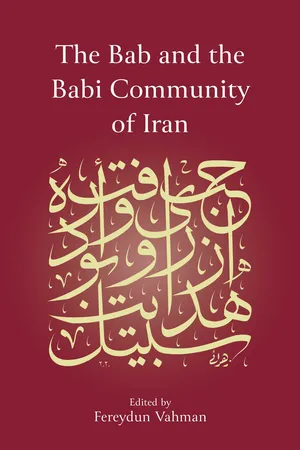
The Bab and the Babi Community of Iran
eBook - ePub

The Bab and the Babi Community of Iran

  1. 448 pages
  2. English
  3. ePUB (mobile friendly)
  4. Available on iOS & Android
eBook - ePub

The Bab and the Babi Community of Iran

About this book

In 1844, a young merchant from Shiraz called Sayyid ‘Ali-Muhammad declared himself the ‘gate’ (the Bab) to the Truth and, shortly afterwards, the initiator of a new prophetic cycle. His messianic call attracted a significant following across Iran and Iraq.

Regarded as a threat by state and religious authorities, the Babis were subject to intense persecution and the Bab himself was executed in 1850.

In this volume, leading scholars of Islam, Baha’i studies and Iranian history come together to examine the life and legacy of the Bab, from his childhood to the founding of the Baha’i faith and beyond. Among other subjects, they cover the Bab’s writings, his Qur’an commentaries, the societal conditions that underlay the Babi upheavals, the works of Babi martyr Tahirih Qurratu’l-‘Ayn, and Orientalist Edward Granville Browne’s encounters with Babi and Baha’i texts.
Frequently asked questions

Yes, you can cancel anytime from the Subscription tab in your account settings on the Perlego website. Your subscription will stay active until the end of your current billing period. Learn how to cancel your subscription.
At the moment all of our mobile-responsive ePub books are available to download via the app. Most of our PDFs are also available to download and we're working on making the final remaining ones downloadable now. Learn more here.
Perlego offers two plans: Essential and Complete
  • Essential is ideal for learners and professionals who enjoy exploring a wide range of subjects. Access the Essential Library with 800,000+ trusted titles and best-sellers across business, personal growth, and the humanities. Includes unlimited reading time and Standard Read Aloud voice.
  • Complete: Perfect for advanced learners and researchers needing full, unrestricted access. Unlock 1.4M+ books across hundreds of subjects, including academic and specialized titles. The Complete Plan also includes advanced features like Premium Read Aloud and Research Assistant.
Both plans are available with monthly, semester, or annual billing cycles.
We are an online textbook subscription service, where you can get access to an entire online library for less than the price of a single book per month. With over 1 million books across 1000+ topics, we’ve got you covered! Learn more here.
Look out for the read-aloud symbol on your next book to see if you can listen to it. The read-aloud tool reads text aloud for you, highlighting the text as it is being read. You can pause it, speed it up and slow it down. Learn more here.
Yes! You can use the Perlego app on both iOS or Android devices to read anytime, anywhere — even offline. Perfect for commutes or when you’re on the go.
Please note we cannot support devices running on iOS 13 and Android 7 or earlier. Learn more about using the app.
Yes, you can access The Bab and the Babi Community of Iran by Fereydun Vahman in PDF and/or ePUB format, as well as other popular books in Théologie et religion & Histoire du Moyen-Orient. We have over one million books available in our catalogue for you to explore.

1

The Bab

A Sun in a Night Not Followed by Dawn

Fereydun Vahman1
On 9 July 1850, before a densely packed and clamoring crowd that had gathered on the rooftops of the barracks of Tabriz, Sayyid ʻAli-Muhammad Shirazi,2 known as the Bab—a youth of thirty-one who had claimed to be the Qaʼim and had brought a new religion—was executed by firing squad. The hostility of the Bab’s enemies was such that, rather than return his body to his family, they threw it into a moat on the outskirts of the city so that wild animals might feed on it. This may well have been the first death by firing squad that was carried out in Persian history. This prophet of Shiraz was put to death at a time when his nascent faith had thrown people throughout Persia into a state of excitement. The execution of the Bab set in motion a series of events that would be just as astonishing, bloody, and ruthless as his own death had been.
In stark contrast to the frenzied upheavals which the manner of his life and the nature of his claims incited among the people of Persia, and the profound grief and horror that seized his family and his followers as a result of his death, the birth of the Bab in a calm and peaceful spot in Shiraz—the upper chamber of the home of Mirza Sayyid ʻAli, his mother’s uncle—brought abundant joy to his family. The first child of the Bab’s parents had died just a few days after birth. In accordance with the prevailing custom, when his mother began to go into labor, she was taken to the home of Mirza Sayyid ʻAli, so that this newborn might live3—and it was this same newborn who would later bring to humanity such novel concepts that they inaugurated a new chapter not only in the annals of Persian history, but also in the history of the world’s religions.
Sayyid ʻAli-Muhammad was born on 20 October 1819 to a family of reputable merchants of Shiraz. His father, Sayyid Muhammad-Reza, had a shop in the bazaar of Shiraz. The genealogy of the Bab indicates that six generations of his paternal ancestors were all Sayyids of Shiraz, some of whom also ranked among the celebrated clerics of that city.4
The mother of the Bab, Fatimih Bagum, came from a family of renowned merchants of Shiraz. Both her paternal ancestors and her brothers, the maternal uncles of the Bab, were all Sayyids. Hers was a respected family that enjoyed wealth and means. Among her brothers, most of whom would later become Babis and even Bahaʼis, were Haji Mirza Sayyid Muhammad (known as Khal-i Akbar in Bahaʼi literature), Haji Sayyid ʻAli (Khal-i Aʻzam), and Haji Mirza Hasan-ʻAli (Khal-i Asghar). To this list of the Bab’s maternal relatives must also be added Mirza Sayyid ʻAli, the paternal uncle of the Bab’s mother, in whose home he was born, and whose daughter, Khadijih Bagum, he would later marry. All these men were engaged in commercial enterprise, both in Persia and beyond, and they each operated their own businesses from the various cities of the country.5
The family of the Bab had a residence in Murgh-Mahalleh, one of the better districts of Shiraz where the reputable merchants of the city lived. The traditional makeup of communities in Persian cities was based on a very close relationship between the local bazaars and mosques, and this relationship took on a particularly religious form in the district of Murgh-Mahalleh. Abbas Amanat makes reference to the conflicts between the Haydari and Niʻmati groups, which in those days had become rampant between the districts of Shiraz.6 In order to assert their own dominance, and also that of their supporters, the majority of the ruffians in every district would brawl with their opposing groups. The reputable merchants and families typically kept their distance from such conflicts, unprepared as they were to risk sacrificing their fame and wealth by openly associating with either side. Instead, these merchants and families worked to support one another; they formed guilds both as a show of solidarity and also as a means of ensuring their commercial success.
At a young age, the Bab lost his father, who died when he was forty-nine.7 Following the death of her husband, and in accordance with the instructions he had left in his will, the Bab’s mother went with her young child to live in the home of her brother, Haji Sayyid ʻAli (Khal-i Aʻzam). From then on, Sayyid ʻAli-Muhammad, the Bab, remained in the care of his maternal uncle.8
There are stories which attest to the inquisitiveness of the Bab’s mind in his childhood, as well as the exceeding rigor with which he carried out the religious obligations of Islam. We have exact historical dates for most of the significant events in the Bab’s life; these have been recorded, with remarkable precision, in his works such as the Persian Bayan, the Arabic Bayan, the Sahifih-yi Bayn al-Haramayn (written in response to Mirza Muhit Kirmani), the Qayyum al-asma, and others.
The Bab was five years old when, one day, his uncle enrolled him in a religious school headed by one of his friends. Shaykh ʻAbid. Mulla Fathullah, who was a schoolmate of the Bab’s and served as the class monitor, gives the following account:
When the Bab was brought to the school, we beheld a child with narrow limbs and a feeble body; he was dressed in a green tunic and a skullcap made of cashmere, walking hand in hand with his uncle. Arriving behind them was a male servant, bearing a plate on which were placed some sweets and a copy of the Qurʼan, which he presented to the instructor.9
Owing to his burgeoning mental development, his abundant talent, and superior mind—and because he was enrolled in a religious school that could not meet his intellectual needs—there was an air of dissatisfaction ...

Table of contents

  1. Biographies
  2. Acknowledgments
  3. A Note on Transliteration
  4. Preface
  5. 1 • The Bab
  6. 2 • The Worldview of the Báb
  7. 3 • The Shaping of the Babi Community
  8. 4 • From a Primal Point to an Archetypal Book
  9. 5 • Interpretation as Revelation
  10. 6 • The Social Basis of the Bābī Upheavals in Iran (1848–53)
  11. 7 • The Babi–State Conflicts of 1848–50
  12. 8 • From Babi Movement to the Baha’i Faith
  13. 9 • “The hand of God is not chained up”
  14. 10 • Babi-Baha’i Books and Believers in E. G. Browne’s A Year Amongst the Persians