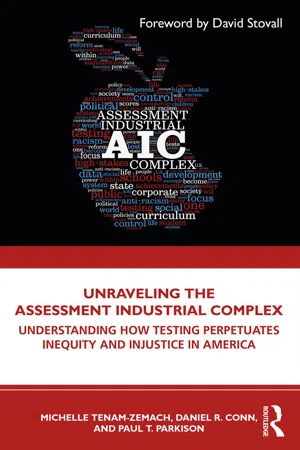
This book offers a comprehensive critique of how the assessment industry and standardized testing adversely impact students, teachers, and society. The authors present the case that the interconnected developments of the testing industry and the Assessment Industrial Complex (AIC) have effectively anchored American schooling to testing. Using an antiracist lens, the authors deconstruct the AIC, exposing the neoliberal agenda of education reformers and how proponents utilize the rhetoric of testing, and the data extracted from them, to normalize the reliance on AIC systems. This critique further exposes education reformers' ideological agenda, their hypocrisy, and how they grossly profit from the AIC at the expense of society's marginalized and most vulnerable students. The COVID-19 pandemic, society's racial unrest, and anti-testing movements have aligned to underscore the need to examine systemic oppression and the impact it has on society through our education system. This text exposes how standardized testing perpetuates these injustices and provides the opportunity to disrupt the systems they rely upon and bolster the societal resistance that is needed.
eBook - ePub
Unraveling the Assessment Industrial Complex
Understanding How Testing Perpetuates Inequity and Injustice in America
- 160 pages
- English
- ePUB (mobile friendly)
- Available on iOS & Android
eBook - ePub
Unraveling the Assessment Industrial Complex
Understanding How Testing Perpetuates Inequity and Injustice in America
1
INTRODUCING THE ASSESSMENT INDUSTRIAL COMPLEX
How This Book Came to Be
Each of us began our journey in the education system at different points in time, even as early as the 1990s, a time before or at the emergence of “hyperstandardization, hyperaccountability, and neoliberal school reform” (Royal & Gibson, 2017, p. 1). We recall a time when testing was not the raison d’etre of education and the focus of classroom activities. So we understand the parallel right-side-up world that focused on human relationships in the classroom and student learning, what it looked and felt like, and what our purpose as educators was. None of this implies that schools before hyperstandardization were perfect. Students of color were ignored, as were those who had learning disabilities, and equity was not a common term associated with the system of education (Ravitch, 2001). Tests were implemented, and the data were not always used to serve all students. Nevertheless, as Koretz (2017) reminds us, “Our heavy-handed use of tests for accountability has also undermined precisely the function that testing is best designed to serve: providing trustworthy information about student achievement” (p. 6).
Moreover, curriculum and assessment have a unique and intriguing relationship. As complex assemblages on their own, when viewed in interaction, the relationship creates a field of education that is dynamic, heterogeneous, and transformative. Fundamentally the idea of complex assemblages is that there does not exist a fixed and stable ontology for schooling and education that proceeds from “atoms” to “molecules” to “materials.” Instead, social formations are assemblages of other complex configurations, and they, in turn, play roles in other, more extended configurations. Deleuze and Guattari (1987) provide a strategy for considering the “line of flight or deterritorialization” (p. 89) of these assemblages. As complex systems (assemblages), we can consider the interminglings of their components in defining education: the component of the school and the student body; the components of teachers and administrators and those of the students and parents; the components of the district and state administrators and those of the state policy-makers and the assessment industry; the body of state academic standards and the body of the high-stakes assessments and accountability metrics; the “weapons and tools assuring a symbiosis of bodies—a whole machinic of assemblages” (Deleuze & Guattari, 1987, p. 89).
It would be an error to assert that academic standards determine the school curriculum in some causal relation or interaction. Academic standards are not powerful enough to even reflect the curriculum as enacted. What regulates the interaction and intermingling of academic standards and the curriculum is the high-stakes testing and accountability regimes. When a standards-aligned lesson is taught, the heterogeneity of the students’ and teacher’s experiences enters the lesson along with the standardized content. Tests are meant to reign in this diversity. Even a technologic or instrumental view of assessment makes a mistake if it considers the tool—the tests themselves—in isolation. The tests only exist in relation to the interminglings they make possible, or that make them possible. Tests are inseparable from the amalgamations that define schooling and education within the machinic assemblage of the Assessment Industrial Complex (AIC) hegemony. The AIC not only produces, sells, and distributes the tests, but it embodies the ideology of the powerful. Curriculum becomes constrained by the functioning of the tests. The tool has been assigned inappropriate attributes that have come to anchor schooling, education, and the curriculum to them. The relationship is reversed in this amalgamation. Curriculum has become the tool of assessment.
Through this relationship, the test determines what should be taught and takes on the dominant role. For example, the “backwards design” model (Wiggins & McTighe, 2005) calls for curriculum to focus on standards, objectives, and assessment. Although this may not have been the intent of Wiggins et al., school districts have used this framework to drive curriculum decisions around students’ standardized test scores. Au (2007), for example, found
a significant relationship between the implementation of high stakes testing and changes in the content of a curriculum, the structure of knowledge contained within the content, and the types of pedagogy associated with communication of that content. These changes represent three types of control that high-stakes tests exert on curriculum: content control, formal control, and pedagogic control. (p. 262)
This relationship imposes what and how teachers teach. Consequently, teachers must now design their curriculum and base their curricular decisions on items that they anticipate will be on the test and to primarily focus on improving upon deficits according to the testing data. This relationship is problematic for a variety of reasons, and we explore some of these reasons throughout the book. Still, it is especially problematic that a test determines what we should teach without first attending to the cultural and pedagogical needs of the students. This implies what we choose to test matters more than the students themselves.
Despite the number of years we as educators have been involved in the field of education, we nonetheless shudder at the examples of abuse and emotional and symbolic violence (Bourdieu, 1979; Saltman, 2018) testing has brought to stakeholders in our education system and society. According to Saltman (2018), symbolic violence is “the devaluation of one’s culture, knowledge, language tastes, and disposition” (p. 113). Historically, these elements were the foundation of curriculum development, but now, standardized testing determines what does and does not constitute as valued knowledge. The test provides boilerplate answers, within a dialogic vacuum, to critical questions of what should be taught and learned in schools. As such, high-stakes testing imposes symbolic violence by reifying forms of knowledge that benefit those in power while oppressing and marginalizing cultures and devaluing their knowledge. The sense of powerlessness also leads to greater susceptibility to the internalization of the values, beliefs, or rules of the game of the powerful as an adaptive response—as a means of escaping the subjective sense of powerlessness, if not its objective condition (Gaventa, 1980). Saltman (2018) further points out:
The student is thus made complicit in her own cultural oppression. This is a cultural oppression that has material effects: the sorting and sifting techniques of the school such as testing are used to position students to do different work and to have different things. (p. 7)
To further exemplify this, Koretz (2017) narrates a scenario where, focusing on test scores, some schools post “data walls” that indicate the performance of students on practice exams utilized to prepare students for their state’s inevitable end-of-year exam. When we reduce the person—each student—to a data point, we dehumanize all children who function within this system. Even those who are “high achieving” are reduced to a data point. Educators strip away the humanity of education in the name of testing. One student, in particular, that Koretz (2017) discussed, traced a row of dots that indicated her scores on the various state standards on her most recent practice tests. “Red, red, yellow, red, green, red. Janie is a child capable of much drama, but that morning she just lowered her gaze to the floor and shuffled to her chair…” (p. 2). Koretz (2017) further states that,
Even an adult faced with a row of red dots after her name for all her peers to see would have to dig deep into her hard-won sense of self to put into context what those red dots meant in her life and what she would do about them. An eight-year-old just feels shame. (p. 2)
This example demonstrates the face of symbolic violence foisted on students whose sense of self is utterly devalued via the symbolism of colored dots. These dots encapsulate a student’s value as determined by an unjust and culturally oppressive system. On a human level, just reading these words evokes pain, and anyone who has lived the life of a teacher, student, or parent knows that this should not occur in the hallowed halls of schools. Another outrageous example Koretz documents focuses on a first-grade teacher, Kim Cook, who works in Alachua County, Florida. She was voted Teacher of the Year in 2012–2013. At the time, the state did not administer its state’s high-stakes annual exam, the Florida Comprehensive Assessment Test (FCAT), in the first grade. Since her school enrolls students only from preschool through second grade, the school board determined that her evaluation would be based on 40% of the “test scores of fourth- and fifth-grade students in another school” (p. 3). Cook and several others were part of a group of plaintiffs that sued the Florida commissioner of education. As Koretz points out, “They lost.” (p. 3). Strauss (2019) revisits two of the most “absurd and appalling” (paragraph 1) stories that were an outcome of the relentless focus on standardized testing during the 2010s. In the first story, she narrates an event that occurred in 2013 when Florida’s DOE required a nine-year-old boy, Michael, who was missing a part of his brain, to take a version of the FCAT. Michael was both blind and mute and could not comprehend basic information. Yet, according to the Florida DOE, every child must be evaluated and sit for the test. Michael was forced to take the test, which, according to Strauss, meant that someone had to actually sit down and read to him the contents of the test. The second incident involved a boy named Ethan, whose parents were forced to not only request a waiver for the FCAT, but they also had to prove that their son deserved it even though he was in a morphine coma and dying.
While these incidents underscore the irrationality underlying the AIC, the most oft-cited data related to the evaluation of schools and their outcomes are standardized test scores. Standardized tests are “maps” that policy-makers use to simplify the complex organizations that are public schools and the knowledge of the living human beings that spend a large portion of their time in them. In the practitioner experience of education and schooling, change and uncertainty, unpredictability, and instability prevail. There is an ever-increasing need for capacities of self-organization and adaptability. Yet, education policy relentlessly pursues standardization, compliance, and accountability, sometimes even at the expense of dying children and their families.
Additionally, testing disproportionately harms our most vulnerable students in severe and enduring ways. For example, Goodman (2018) points out something well-known in the field of language acquisition: English Language Learners (ELLs), who often have experienced multiple forms of trauma, struggle with achieving academic language proficiency, on average, for 5–10 years. Yet, they are forced to take high-stakes tests in an “environment that is unforgiving to newcomers and their particular challenges. They score an average of 20–50 percentage points below their native-English-speaking peers…” (p. 58). As Goodman notes throughout his book, many ELL students originate from countries where extreme violence and suffering occur, and these students are often traumatized as a result of their experiences. Despite their trauma, our current requirements for testing in public schools are immune to considering these realities and, thus, further traumatize students through forms of symbolic violence that are the demands of hyper-accountability and the testing regime.
One of the authors of this text personally attests to the pain and suffering testing has caused her family. One of her sons recently spent the majority of his junior year in high school studying for the SAT exam in preparation for his college applications. While a strong student academically—he graduated top 2% of his high school class—standardized testing is not one of his perceived strengths. This is incredibly frustrating given that one of his siblings is a “natural” test taker, and the other’s performance correlates with his effort spent prepping for standardized tests (see Koretz, 2017, Testing Charade for an interesting analysis on Test Prep). We will forgo a discussion of why a parent who understands the lack of value of these tests would still allow her child to suffer the indignation and torture of studying for them. More frustrating is that she knows studying for these tests will waste her son’s precious time and lead to nothing productive other than sorting and ranking her child for college admissions (and she does NOT consider this a productive but an evil necessity). The purpose of this anecdote is to demonstrate that, despite her knowledge of the powerful neoliberal forces that control the education system, she too feels helpless to challenge the system at the cost of her son’s college aspirations.
In understanding how symbolic violence functions, even the most educated parents are subject to its pernicious effects, as this author’s experiences demonstrate. The author is complicit in the devaluation of her knowledge and recognizes this material effect; yet, despite understanding her conflict, she persisted in providing her son the tools and means to have access and opportunity through the college admissions process. And there are additional problems that she recognizes as well. First is the damage this test has done to her son’s self-efficacy, self-esteem, sense of purpose of education, and understanding of his value and place in the sorting machine of college admissions. Second, and this is an even larger problem, she recognizes her complicity in contributing to the inequity and injustice in our society. Ultimately, the realities of our current college admissions process are clearly counter-productive not only to our children but also to our society as a whole.
As many narratives as we can find that underscore the negative impacts of testing, in particular, high-stakes testing (the central focus of this book), one must wonder why it persists. Why have we, as a society, accepted that standardized tests, with all their problems and adverse effects, persist as the final arbiter and measure of success? It could no...
Table of contents
- Cover
- Half Page
- Title Page
- Copyright Page
- Dedication
- Contents
- Acknowledgments
- Foreword: Because We Know There Is No Excuse for Doing Nothing
- Introduction
- 1 Introducing the Assessment Industrial Complex: How This Book Came to Be
- 2 Testing and Society: How We Got to Where We Are
- 3 Strange Bedfellows: How Test-Driven Accountability Became Common Sense
- 4 Testing for Profit: Billionaire Boys’ Club, Edreformers, and All Matter of Money
- 5 Students, Teachers, and Testing: An Existential Crisis in the Making
- 6 A Path to Hope and Change: The Time is Now
- Index
Trusted by 375,005 students
Access to over 1.5 million titles for a fair monthly price.
Study more efficiently using our study tools.
Frequently asked questions
Yes, you can cancel anytime from the Subscription tab in your account settings on the Perlego website. Your subscription will stay active until the end of your current billing period. Learn how to cancel your subscription
No, books cannot be downloaded as external files, such as PDFs, for use outside of Perlego. However, you can download books within the Perlego app for offline reading on mobile or tablet. Learn how to download books offline
Perlego offers two plans: Essential and Complete
- Essential is ideal for learners and professionals who enjoy exploring a wide range of subjects. Access the Essential Library with 800,000+ trusted titles and best-sellers across business, personal growth, and the humanities. Includes unlimited reading time and Standard Read Aloud voice.
- Complete: Perfect for advanced learners and researchers needing full, unrestricted access. Unlock 1.5M+ books across hundreds of subjects, including academic and specialized titles. The Complete Plan also includes advanced features like Premium Read Aloud and Research Assistant.
We are an online textbook subscription service, where you can get access to an entire online library for less than the price of a single book per month. With over 1.5 million books across 990+ topics, we’ve got you covered! Learn about our mission
Look out for the read-aloud symbol on your next book to see if you can listen to it. The read-aloud tool reads text aloud for you, highlighting the text as it is being read. You can pause it, speed it up and slow it down. Learn more about Read Aloud
Yes! You can use the Perlego app on both iOS and Android devices to read anytime, anywhere — even offline. Perfect for commutes or when you’re on the go.
Please note we cannot support devices running on iOS 13 and Android 7 or earlier. Learn more about using the app
Please note we cannot support devices running on iOS 13 and Android 7 or earlier. Learn more about using the app
Yes, you can access Unraveling the Assessment Industrial Complex by Michelle Tenam-Zemach,Daniel R. Conn,Paul T. Parkison in PDF and/or ePUB format, as well as other popular books in Business & Business General. We have over 1.5 million books available in our catalogue for you to explore.