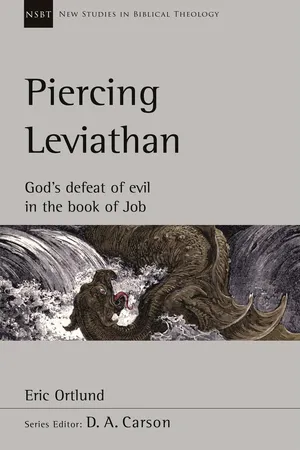
'. his hand pierced the fleeing serpent' (Job 26: 13 ESV)One of the most challenging passages in the Old Testament book of Job comes in the Lord's second speech (chapters 40-41). The characters and the reader have waited a long time for the Lord to speak - only to receive what is traditionally interpreted as a long description of a hippopotamus and a crocodile (Behemoth and Leviathan).
The stakes are very high. Is God right to run the world in such a way that allows such terrible suffering for one of his most loyal servants? Is Job right to keep trusting God in the midst of much criticism? It is difficult for modern readers to avoid a sense of frustrating anti-climax as the book concludes. Eric Ortlund argues that Behemoth and Leviathan are better understood as symbols of cosmic chaos and evil. A supernatural interpretation fits better exegetically within the book of Job and in its original context. It also helps us to appreciate the satisfying climax to the book: in describing Behemoth and Leviathan, God is directly engaging with Job's complaint about divine justice, implying that he understands the evil at loose in his creation better than Job does, that he is in control of it, and will one day destroy it.
- English
- ePUB (mobile friendly)
- Available on iOS & Android
eBook - ePub
About this book
Trusted by 375,005 students
Access to over 1.5 million titles for a fair monthly price.
Study more efficiently using our study tools.
Information
Topic
Theology & ReligionSubtopic
Biblical Studies1
Introduction and statement of the problem
How one understands the book of Job as a whole essentially depends on how one understands God’s speech(es).1
The significance of the Leviathan pericope can scarcely be overstated. It is both the climax and the epitome of what God has to say to Job.2
The whirlwind speeches, more than any other section of the book, appear in the diverse literature written about them like a readerly Rorschach test.3
The problems of the book of Job
Job easily qualifies as one of the most difficult books in the entire canon of Scripture, but the difficulties the book generates are of different kinds. It can be morally troubling for some readers, for instance, to watch yhwh allow the death of Job’s children in the opening chapters of the book to test whether Job loves God or only the gifts God gives (see 1:9). Some cynically question whether the death of Job’s children is a price worth paying for the Almighty to win a bet with the devil. A different problem meets the reader in the debate between Job and his friends in chapters 3–37, for the simple and straightforward style of the narrative changes to poetry that is very complex and frequently difficult to understand. Fortunately, the basic trajectory of the debate is clear: while the friends consistently preserve God’s justice by insisting that Job deserves to suffer as punishment for unconfessed sin, Job accuses God of injustice because God has punished him as a sinner when God knows Job is innocent; at the same time, however, Job refuses to curse God and longs to reconcile with him. Despite this clarity about the general outline of the debate, however, these chapters contain many thorny exegetical, textual and philological questions, and a number of short passages are difficult to make sense of at all.
When yhwh speaks to Job in chapters 38–41, the reader breathes a sigh of relief: finally, after a repetitive and seemingly interminable debate, God himself will settle the matter. But yhwh’s two speeches in 38:1 – 40:2 and 40:6 – 41:34 do not obviously directly address the question animating the debate between Job and the friends. In the first speech, God takes Job on a tour of creation and its different animal inhabitants – but does not say anything explicit about Job’s suffering or his protest against the God who allowed it. And why do Behemoth and Leviathan take up so much space in the second speech? If these two creatures are, as commonly understood, a hippopotamus and a crocodile, in what possible sense is this a satisfying answer to Job? Bernard Shaw was being sarcastic, but it is hard not to agree with him when he writes, ‘If I complain that I am suffering unjustly, it is no answer to say, “Can you make a hippopotamus?”’4 But one’s perplexity only deepens when we read of Job’s response to yhwh’s second speech and realize how different it is from his reaction to God’s first speech: while Job’s first response in 40:3–5 is submissive, it seems somewhat cold and formal in comparison to his unrestrained worship as Job despises himself and says, ‘Now my eye sees you!’5 It is also confusing that yhwh says almost nothing directly about himself in chapters 38–41, but Job responds by claiming better insight, not into Behemoth and Leviathan, but into God himself. What inferences has Job drawn from the complex poetry of chapters 38–41 that prompt such a change? What breakthrough into yhwh’s character and action has Job gained that transforms his unrelenting criticism of God into awestruck worship? Other questions follow from these: If Behemoth and Leviathan are just two more ordinary animals, how is yhwh’s second speech any different from the first, which already described many of the animals in God’s world? And how does describing the physical characteristics of a hippo and crocodile satisfy the initial statement of the theme of the second speech as having to do with God’s justice (40:8)? It is difficult for modern Western readers to avoid a sense of anticlimax in reading the book of Job, just when we most expect a satisfying resolution.
The difficulties of the ending of the book of Job have significant repercussions for understanding the book as a whole and, in turn, can significantly influence how we think about God’s rule over all things in the Old Testament and the continuing presence of suffering and evil. Some scholars go so far as to interpret Job as an ‘anti-theodicy’ in the sense that they understand the book of Job not merely as an ambiguous or unsatisfying answer to the problem of evil, but as demonstrating that God is unjust.6 If this is the case, of course, the most dramatic and pointed discussion of inexplicable suffering in the Bible turns out to have nothing helpful to say about the problem of evil – the book demonstrates rather that there is no answer to the problem. If true, this would have some very sinister implications for how we think about God.
This book will not address all the difficulties of the book of Job summarized above, or the many other questions readers have had over the years (Is Elihu’s counsel helpful to Job or not? Why is Job’s wife not mentioned at the end of the story? etc.). With regard to the difficult poetry of chapters 3–37, a number of commentaries give helpful guidance on technical text-critical, philological and exegetical problems in the poetry of Job.7 Furthermore, although chapters 1–2 remain uncomfortable to read, we quickly learn in those chapters why God occasionally allows his saints to experience horrendous suffering: it is the only way to prove the reality of the relationship, to prove that Job really loves God for God’s sake, and is not merely deceptively flattering God in order to have a nice life. In an important sense, Job 1 – 2 is about the all-surpassing worth of knowing yhwh, a worth surpassing even the value of knowing one’s children. In contrast to this, however, the problem of the interpretation of yhwh’s speeches is one that has continued to bedevil modern commentators and forms the focus of this book. Many commentaries follow the course of the debate in chapters 3–37 in generally the same way (regardless of those very difficult passages), but when it comes to yhwh’s two speeches, widely differing and incompatible interpretations are given, most of which are exegetically and theologically unsatisfying because they cannot explain how the descriptions of Behemoth and Leviathan count as a defence of God’s justice (40:8), nor how this defence moves Job from defiant criticism to abject worship. The present volume attempts to address this interpretative impasse by arguing that Behemoth and Leviathan are symbols of cosmic chaos and evil. It will be argued that yhwh is speaking to Job within Job’s cultural framework, drawing upon symbols common in the ANE and the Old Testament, both in order to assure Job that God is more intimately acquainted with the magnitude and malignity of the evil at work in his world than Job ever could be, and to promise him that God will one day defeat it (41:7–8). Without explaining to Job why he allowed Job’s ordeal and without offering an apology, God implicitly asks Job through the Leviathan speech to trust him in his way of running the world, allowing evil some real but limited agency – but not for ever. In this way, God defends the justice of his administration of creation (40:8), an administration that sometimes allows terrible suffering. And in response, Job worships.
In my opinion, the interpretation of Behemoth and Leviathan as symbols of cosmic evil has very significant exegetical and pastoral pay-offs, giving a satisfying resolution to the urgent issues raised in the book of Job and providing compelling reasons for joyful hope in the midst of unexplained suffering. This position is, however, mostly in the minority. Many commentaries and popular works, whether written from a confessional perspective or not, tend to assume the most natural and obvious way to understand the two creatures yhwh describes to Job at such length is as a hippopotamus and crocodile. Within this larger interpretative context, the present volume will present a ‘minority report’ on Behemoth and Leviathan according to the following plan. I begin with a chapter summarizing the larger background to Job’s suffering in chapters 1–2 (of which Job is, in a tragic irony, totally unaware), as well as the debate between Job and his friends in chapters 3–37. This summary is necessary because yhwh’s answer in chapters 38–41 is not a general or timeless defence of the policies by which he administers creation, but a specific response to the charges brought against him by Job in the debate. A third and fourth chapter will explore yhwh’s first and second responses, respectively. Although God’s speech in 38:1 – 40:2 is generally better understood than the second, it has generated some significantly diverse interpretations (some of which draw sinister conclusions about God) that will need to be explored. The fourth chapter will focus on yhwh’s second speech in 40:6 – 41:34 and the varying interpretations of Behemoth and Leviathan, arguing for their status as symbols of supernatural chaos and evil. A fifth and final chapter will consider the significance of Job’s response in 42:1–6 and his restoration in 42:7–17. Job 42 comes after the Leviathan speech, of course, and that speech is the main focus of this book. But it is in chapter 42 that the question of theodicy takes on especially sharp focus. As mentioned above, the book of Job is, for some commentators, not just an ambiguous answer to the problem of evil, but a negative one, in that it demonstrates that God is uncaring about unjust suffering. The divine speeches play an important role in these interpretations, of course, but a careful reading of Job’s response to the divine speeches is especially significant for them as well. It will thus be necessary to engage with them in relation to Job 42 in order to appreciate fully what the book has to say about suffering, evil and faith in a God who allows them. This engagement will show that sceptical, ‘anti-theodicy’ readings of Job 42 fail exegetically at numerous points. This does not mean, however, that the book of Job should be reinstated as the Bible’s prime example of theodicy. If theodicy is defined as a justification of God’s tolerance and/or guidance of evil for his own purposes, or an explanation of what role evil and suffering have in God’s good purposes, the book of Job counts as a theodicy only in a limited and somewhat ironic way. Only in the larger theatre of Job’s ordeal in the divine council revealed in chapters 1–2 is the reader given an explanation of why God allows such unimaginable pain to overwhelm those who seem to deserve it least. Otherwise, God offers no explanation to Job about why his sufferings were allowed, nor does he seek to justify his decision to allow this pain to Job. As a result, even if it is impossible to read Job as an ‘anti-theodicy’, it is difficult to classify the book of Job as a theodicy in a straightforward way.
This may seem like a discouraging conclusion, and readers may worry at this early stage that the one book in the Bible most obviously addressing the problem of evil has little to say to God’s people who want to remain faithful in the midst of pain. Surprising as it may sound, however, I believe the book of Job presents its readers with immense resources for cheerful and courageous endurance in the midst of unexplained suffering without counting as a theodicy in the strict sense. In fact, my sense is that if the book were to qualify more neatly as a theodicy in the sense of justifying or explaining God’s ways to us, this would hamper the way in which it nurtures joy and courage in its readers. It will furthermore be argued that the way the book of Job goes about this is unique in the canon. Job does not in any way contradict other perspectives on suffering found elsewhere in the Bible, of course. But the book of Job does say something unique about them, and uniquely encouraging. The aim of this book is thus to explore this unique perspective with exegetical precision and with an eye to its rich pastoral implications. But we will have to work our way through the book methodically and slowly in order to gain this perspective. This is no easy task, for the book seems almost intentionally designed to tire and frustrate the reader. There is, however, no other way to access the joy and comfort Job receives at the end of his ordeal except to journey with him through each of the book’s long chapters.
A word on myth
One does not have to read much in the literature on Job before one comes across the word ‘myth’. As we explore the significance of the monsters Behemoth and Leviathan, it will be impossible to avoid this subject. In fact, the issue of mythic language meets us before reading about those creatures, for the poetry of the book often describes cosmic realities in symbolic language in ways that might suitably be called ‘mythic’. One example of this is the way in which the wisdom poem of chapter 28 imaginatively reaches for the outermost reaches of reality (vv. 20–23); the more-than-natural darkness Job calls down on creation in his opening curse is another example (3:1–8). The problem is that the English terms ‘myth’ or ‘mythical’ often mean something obviously false or even silly. This makes them problematic to use in the study of an inspired biblical book. For this reason, I will avoid the term as much as possible. But because this book touches on subjects often described as ‘mythic’, a brief word or two about myth and its relation to the Bible is appropriate.
The most important thing to emphasize at the outset is that myth, in the best and most subtle meaning of the word, refers to symbolic narratives that address cosmic realities of chaos and order. In the ancient world, myth has to do with those deep, foundational realities and archetypal relations between heaven and earth that order human existence but are difficult to state directly and so are usually invoked in symbols.8 According to this definition, the primeval garden in Eden, where the Man and the Woman walked with God and shared his immortality, which we lost because of our sin, and which God’s covenant and temple in the Old Testament intend partially to reinstate, are ‘mythic’ not in the sense that they are unbelievable fictions, but because they pertain to those most basic and primal issues of human life and death, sin and atonement, alienation and homecoming, issues that evoke those deep longings only God can answer. In offering this best possible definition of myth, it should immediately be emphasized that ancient Semites did not think of mythic and historical reality as excluding each other, as modern English speakers tend to do. On the contrary, from an ancient Semitic perspective, the intervention of the gods and matters of cosmic chaos and order were thought to impinge on and affect real life and datable historical events. Any division between ‘myth’ and ‘history’ is a modern idea that would have been foreign to ancient writers – but just such a division used to be common in biblical studies,...
Table of contents
- APOLLOS (an imprint of Inter-Varsity Press, England)
- Series preface
- Author’s preface
- Abbreviations
- 1
- 2
- 3
- 4
- 5
- 6
- Bibliography
- Notes
- Search items for authors
- Search terms for Scripture references
- Titles in this series:
Frequently asked questions
Yes, you can cancel anytime from the Subscription tab in your account settings on the Perlego website. Your subscription will stay active until the end of your current billing period. Learn how to cancel your subscription
No, books cannot be downloaded as external files, such as PDFs, for use outside of Perlego. However, you can download books within the Perlego app for offline reading on mobile or tablet. Learn how to download books offline
Perlego offers two plans: Essential and Complete
- Essential is ideal for learners and professionals who enjoy exploring a wide range of subjects. Access the Essential Library with 800,000+ trusted titles and best-sellers across business, personal growth, and the humanities. Includes unlimited reading time and Standard Read Aloud voice.
- Complete: Perfect for advanced learners and researchers needing full, unrestricted access. Unlock 1.5M+ books across hundreds of subjects, including academic and specialized titles. The Complete Plan also includes advanced features like Premium Read Aloud and Research Assistant.
We are an online textbook subscription service, where you can get access to an entire online library for less than the price of a single book per month. With over 1.5 million books across 990+ topics, we’ve got you covered! Learn about our mission
Look out for the read-aloud symbol on your next book to see if you can listen to it. The read-aloud tool reads text aloud for you, highlighting the text as it is being read. You can pause it, speed it up and slow it down. Learn more about Read Aloud
Yes! You can use the Perlego app on both iOS and Android devices to read anytime, anywhere — even offline. Perfect for commutes or when you’re on the go.
Please note we cannot support devices running on iOS 13 and Android 7 or earlier. Learn more about using the app
Please note we cannot support devices running on iOS 13 and Android 7 or earlier. Learn more about using the app
Yes, you can access Piercing Leviathan by Eric Ortlund in PDF and/or ePUB format, as well as other popular books in Theology & Religion & Biblical Studies. We have over 1.5 million books available in our catalogue for you to explore.