This book starts with the description of polarization in classical optics, including also a chapter on crystal optics, which is necessary to understand the use of nonlinear crystals. In addition, spatially non-uniform polarization states are introduced and described. Further, the role of polarization in nonlinear optics is discussed. The final chapters are devoted to the description and applications of polarization in quantum optics and quantum technologies.
eBook - ePub
Polarization of Light
In Classical, Quantum, and Nonlinear Optics
- 230 pages
- English
- ePUB (mobile friendly)
- Available on iOS & Android
eBook - ePub
About this book
Information
Topic
Scienze fisicheSubtopic
Matematica applicata1 Introduction
1.1 About this book
It is difficult to overestimate the role of polarization in modern optics and photonics. A brief glance at the website of any company producing optical components shows how large the section ‘polarization optics’ is. Polarization elements are used in imaging and spectroscopy, they can be essential in interferometers and light modulators, they are ubiquitous in lasers and laser systems. In nonlinear optics, polarization of light is crucial for understanding the phase matching and for the analysis of the tensor properties of different nonlinear susceptibilities. Polarization is important for liquid crystals, which are part of our everyday life: they are used in liquid crystal displays (LCDs) in computers and smartphones, and in spatial light modulators, installed in beam projectors. The fact that LCDs use polarization can be verified by simply looking at your mobile phone through a polarizer, or wearing polarizing sunglasses (another object familiar to everyone). As you rotate the polarizer, at a certain angle your smartphone screen will become dark.
Importantly, polarization plays the central role in modern quantum optics, quantum information, and in the booming quantum technology. The main reason for that is that the ‘building bricks’ of quantum information, so-called qubits, are so easily realized in the form of polarized photons. The quantum state of a polarized photon is similar to the one of a spin-1/2 particle, or of a two-level atom. Meanwhile, photons are the best carriers of information: they do not easily interact with each other or the environment; this means they can propagate relatively far without being lost or scattered. This is why polarized photons are used in quantum key distribution, one of the most robust quantum information technologies to date.
This book considers polarization of light and its manifestations and use in modern optics and photonics. It is mainly addressed to master and PhD students working in various fields of modern optics, and it is essentially based on the courses we teach at the Friedrich-Alexander University of Erlangen-Nürnberg. A large part of this book originates from the lecture course started at the Lomonosov Moscow State University by David Klyshko (and further continued by Maria Chekhova). In the quantum optics part, this book is considerably based on his work.
After introducing some necessary basics in Chapter 2, we start from the formal description of polarization (Chapter 3) in terms of the polarization ellipse, Jones vector and matrices, and Stokes vector and Müller matrices. Optics of crystals, necessary for understanding the operation of polarization optical elements, is briefly reviewed in Chapter 4. Polarization transformations with waveplates and polarization rotators are then considered in Chapter 5. Chapter 6 is devoted to the manifestations of geometric (Pancharatnam) phase in optics, similar to the Berry phase in quantum physics. Chapter 7 considers structured light, whose polarization state differs from point to point. Chapter 8 deals with polarization at the nanoscale, a subject that recently emerged in connection with the rapidly developing fields of nanooptics and nanoscale nonlinear optics. An overview of polarization elements used in modern optics experiments is given in Chapter 9. Chapter 10 is devoted to polarization in nonlinear optics, its role in phase matching, and its manifestations due to the tensor properties of nonlinear susceptibilities. Finally, the last three chapters cover polarization-based quantum optics. Chapter 11 introduces polarization from the viewpoint of quantum physics, in terms of the Stokes operators and simplest polarization states. Chapter 12 deals with various quantum states of polarized light and related effects. Chapter 13 describes two applications of polarized light in quantum optics: one is testing the foundations of quantum mechanics, the other is quantum key distribution.
Most of the chapters are written in a textbook style and do not require special knowledge. But some of them, namely Chapters 8, 12, and 13, are also intended to give brief reviews of modern literature on the subject. Correspondingly, each of them has an extensive list of references for the interested reader. However, to keep these lists short, wherever possible we cite review papers rather than original works.
1.2 Brief history of polarization optics
Polarization of light was probably known already to ancient Vikings. There is evidence that they used (calcite) crystal, also known as Iceland spar, for navigation. With this ‘sunstone’, as they called it, they managed to find the position of the sun in the sky on a cloudy day. Indeed, light is not polarized when it comes directly from the sun, but it is partially polarized when scattered [4]. This effect can be easily observed by looking at different parts of the sky through polarizing sunglasses or a polarizer: depending on the orientation of the polarizer, the sky appears brighter or darker far from the sun while it looks about the same in the area around it. But instead of a polarizer, one can use a calcite crystal due to an effect called double refraction. An object seen through such a crystal looks doubled; moreover, when light illuminating the object is partially polarized, the two images of the object are, in general, of different brightness. In unpolarized light, the two images will have the same brightness, no matter how one rotates the crystal. As such an object, the vikings could probably use a mark or a scratch on the external side of the calcite crystal. The direction towards the sun could be distinguished as the one in which two images of this mark were equally bright, regardless of the orientation.
Systematic study of polarization started only in the 17th century. In 1669, Bartholin observed the double refraction in calcite crystal and described it in a printed work published in 1670 [7]. Later, in 1690, Huygens declared polarization as a property of light and demonstrated it by placing two similar blocks of calcite one after another. Each crystal split an incident ray of light into two, which Huygens called ‘regular’ and ‘irregular’ [5] (ordinary and extraordinary in modern language), but if the two crystals had the same orientation, no further splitting appeared. Now we know that these ordinary and extraordinary rays are polarized orthogonally to each other, one in the plane of the crystal optic axis and the other one, perpendicularly to it. These effects of double refraction and spatial walk-off will be considered in detail in Chapter 4. An example of double refraction can be seen in Fig. 1.1, which shows this text on a computer screen, photographed through a 3 cm calcite crystal. The existence of only two possible polarization states,1 for instance, vertical and horizontal, follows from light being a transverse wave; this idea was first formulated by Hooke in 1757 and further proven by Young in 1817 [7].
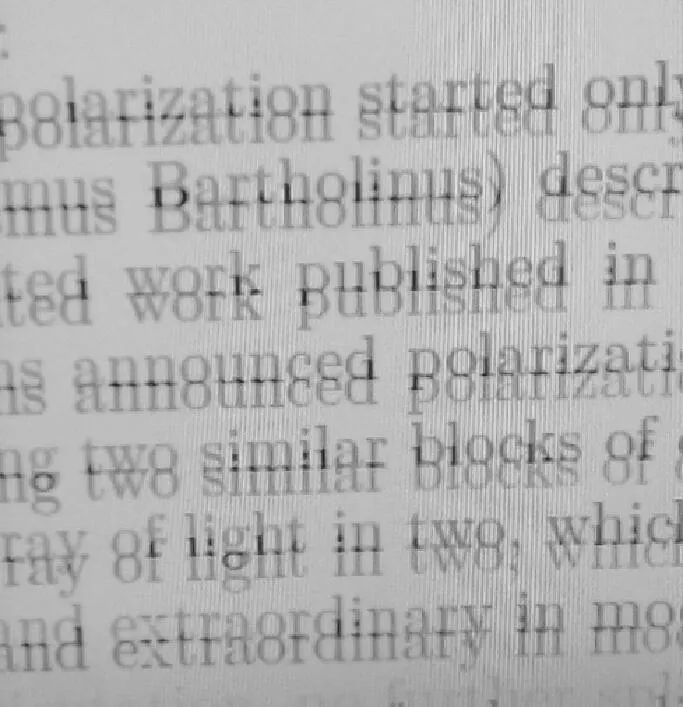
Figure 1.1 Text of this section seen on a computer screen through a calcite crystal.
The 19th century brought enormous progress in the study of polarization. In 1808, Malus discovered that initially unpolarized light becomes partially polarized as a result of oblique reflection from a dielectric surface. The way he observed this effect was by looking through a calcite crystal at the reflections from the windows of the Luxembourg Palace in Paris, where he was an officer of the guard [4], [7]. As he rotated the crystal around its axis, one of the reflected images was extinguished. One can repeat this experiment by looking at an oblique reflection through a polarizer: at a certain orientation of the polarizer the reflected image gets weaker. Figure 1.2 shows a picture of a window in the Luxembourg Palace taken in 2019 through a polarizer selecting vertical (left) and horizontal (right) polarization. The right-hand photo obviously shows an ‘extinguished’ reflection. The same effect must have been seen by Malus. (Unfortunately today’s guards do not let people come close to the fence, and the pictures were taken from a large distance.) The fact that for a certain angle of incidence (Brewster’s angle) the horizontally polarized reflection disappears completely was established by Brewster in 1812.
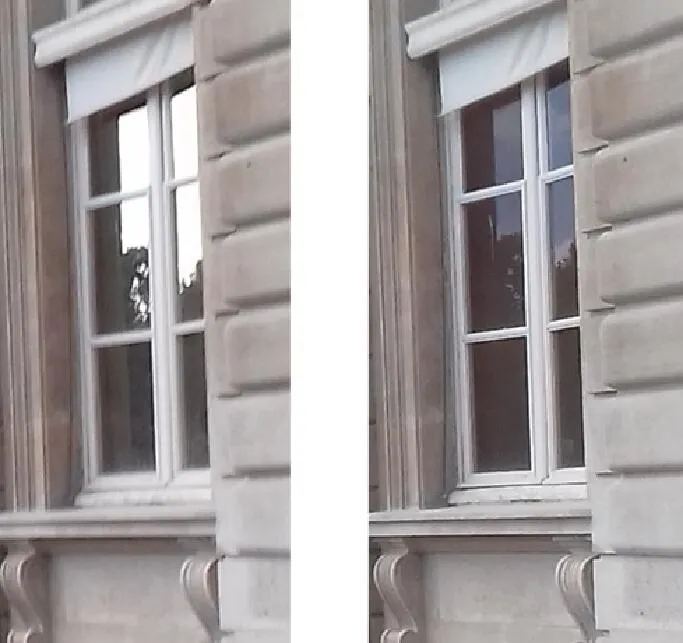
Figure 1.2 A picture of a window in the Luxembourg Palace in Paris taken through a polarizer selecting vertical (left) and horizontal (right) polarization.
Interference experiments carried out independently by Fresnel and Young in 1816–1817 led to a very important result: beams that are polarized orthogonally do not interfere. Indeed, imagine the famous Young double-slit experiment and let the polarization of light i...
Table of contents
- Title Page
- Copyright
- Contents
- 1 Introduction
- 2 Necessary basics
- 3 Polarization of light: classical description
- 4 Optics of crystals: basic concepts
- 5 Polarization transformations
- 6 Geometric phase
- 7 Structured light
- 8 Polarization of light at the nanoscale
- 9 Polarization elements that we use in the lab
- 10 Polarization in nonlinear optics
- 11 Quantum description of polarization
- 12 Nonclassical states of polarized light
- 13 Applications of quantum polarization states
- Subject Index
Trusted by 375,005 students
Access to over 1.5 million titles for a fair monthly price.
Study more efficiently using our study tools.
Frequently asked questions
Yes, you can cancel anytime from the Subscription tab in your account settings on the Perlego website. Your subscription will stay active until the end of your current billing period. Learn how to cancel your subscription
No, books cannot be downloaded as external files, such as PDFs, for use outside of Perlego. However, you can download books within the Perlego app for offline reading on mobile or tablet. Learn how to download books offline
Perlego offers two plans: Essential and Complete
- Essential is ideal for learners and professionals who enjoy exploring a wide range of subjects. Access the Essential Library with 800,000+ trusted titles and best-sellers across business, personal growth, and the humanities. Includes unlimited reading time and Standard Read Aloud voice.
- Complete: Perfect for advanced learners and researchers needing full, unrestricted access. Unlock 1.5M+ books across hundreds of subjects, including academic and specialized titles. The Complete Plan also includes advanced features like Premium Read Aloud and Research Assistant.
We are an online textbook subscription service, where you can get access to an entire online library for less than the price of a single book per month. With over 1.5 million books across 990+ topics, we’ve got you covered! Learn about our mission
Look out for the read-aloud symbol on your next book to see if you can listen to it. The read-aloud tool reads text aloud for you, highlighting the text as it is being read. You can pause it, speed it up and slow it down. Learn more about Read Aloud
Yes! You can use the Perlego app on both iOS and Android devices to read anytime, anywhere — even offline. Perfect for commutes or when you’re on the go.
Please note we cannot support devices running on iOS 13 and Android 7 or earlier. Learn more about using the app
Please note we cannot support devices running on iOS 13 and Android 7 or earlier. Learn more about using the app
Yes, you can access Polarization of Light by Maria Chekhova,Peter Banzer in PDF and/or ePUB format, as well as other popular books in Scienze fisiche & Matematica applicata. We have over 1.5 million books available in our catalogue for you to explore.