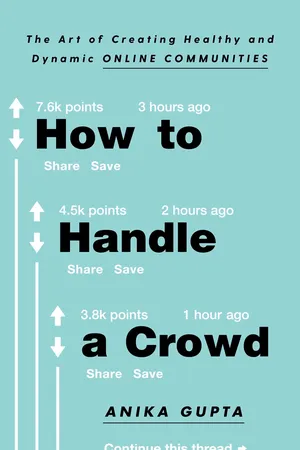
How to Handle a Crowd
eBook - ePub

How to Handle a Crowd

The Art of Creating Healthy and Dynamic Online Communities

  1. 272 pages
  2. English
  3. ePUB (mobile friendly)
  4. Available on iOS & Android
eBook - ePub

How to Handle a Crowd

The Art of Creating Healthy and Dynamic Online Communities

About this book

A guide to successful community moderation exploring everything from the trenches of Reddit to your neighborhood Facebook page. Don't read the comments. Old advice, yet more relevant than ever. The tools we once hailed for their power to connect people and spark creativity can also be hotbeds of hate, harassment, and political division. Platforms like Facebook, YouTube, and Twitter are under fire for either too much or too little moderation. Creating and maintaining healthy online communities isn't easy.Over the course of two years of graduate research at MIT, former tech journalist and current product manager Anika Gupta interviewed moderators who'd worked on the sidelines of gamer forums and in the quagmires of online news comments sections. She's spoken with professional and volunteer moderators for communities like Pantsuit Nation, Nextdoor, World of Warcraft guilds, Reddit, and FetLife.In How to Handle a Crowd, she shares what makes successful communities tick – and what you can learn from them about the delicate balance of community moderation. Topics include:
-Building creative communities in online spaces
-Bridging political division—and creating new alliances
-Encouraging freedom of speech
-Defining and eliminating hate and trolling
-Ensuring safety for all participants-
-Motivating community members to action How to Handle a Crowd is the perfect book for anyone looking to take their small community group to the next level, start a career in online moderation, or tackle their own business's comments section.

Frequently asked questions

Yes, you can cancel anytime from the Subscription tab in your account settings on the Perlego website. Your subscription will stay active until the end of your current billing period. Learn how to cancel your subscription.
At the moment all of our mobile-responsive ePub books are available to download via the app. Most of our PDFs are also available to download and we're working on making the final remaining ones downloadable now. Learn more here.
Perlego offers two plans: Essential and Complete
  • Essential is ideal for learners and professionals who enjoy exploring a wide range of subjects. Access the Essential Library with 800,000+ trusted titles and best-sellers across business, personal growth, and the humanities. Includes unlimited reading time and Standard Read Aloud voice.
  • Complete: Perfect for advanced learners and researchers needing full, unrestricted access. Unlock 1.4M+ books across hundreds of subjects, including academic and specialized titles. The Complete Plan also includes advanced features like Premium Read Aloud and Research Assistant.
Both plans are available with monthly, semester, or annual billing cycles.
We are an online textbook subscription service, where you can get access to an entire online library for less than the price of a single book per month. With over 1 million books across 1000+ topics, we’ve got you covered! Learn more here.
Look out for the read-aloud symbol on your next book to see if you can listen to it. The read-aloud tool reads text aloud for you, highlighting the text as it is being read. You can pause it, speed it up and slow it down. Learn more here.
Yes! You can use the Perlego app on both iOS or Android devices to read anytime, anywhere — even offline. Perfect for commutes or when you’re on the go.
Please note we cannot support devices running on iOS 13 and Android 7 or earlier. Learn more about using the app.
Yes, you can access How to Handle a Crowd by Anika Gupta in PDF and/or ePUB format, as well as other popular books in Business & Business Communication. We have over one million books available in our catalogue for you to explore.

1. Building Bridges

Make America Dinner Again

How I Met MADA

I met Justine Lee for the first time in New York. We’d ā€œmetā€ online months before, while working together on a podcast project about Asian American life. I asked her for suggestions for whom to profile in this book; she recommended herself. Over a couple of hours, Justine told me her story. Since October 2017, she and her friend Tria Chang have run a Facebook group called Make America Dinner Again (MADA). The name pokes fun at partisan rhetoric, but the group has a serious purpose: to encourage understanding and dialogue among people with differing political views. Justine and Tria started the group after the 2016 presidential election, and it now has almost seven hundred members. Those who want to join have to apply by answering a few questions on Facebook; the founders read each application thoroughly and personally. As MADA has grown, they’ve accepted new members with an eye toward political balance; Justine says the group today includes roughly equal numbers of self-identified liberals and conservatives, as well as many other perspectives. The two of them, along with nine other moderators, oversee debates about the most divisive political topics in American discourse. Recent posts include one comparing restrictions on gun ownership to restrictions on book ownership, another asking whether or not a Holocaust-denying school principal should have been fired, and a third asking how San Francisco can humanely resolve escalating rates of homelessness.
Their group is part of a growing movement, born in the run-up to and wake of the 2016 presidential election, focused on building bridges across what seems to be an ever-widening political divide. In any given week, the MADA moderators research and post articles for the wider group to discuss, contact group members one-on-one to offer advice on the tone or content of their posts, or—in Justine’s case—read through short surveys filled out by people who want to join the group. But their real work is trying to shore up common ideals in a divided world, building slim but strong bridges across the divide of partisan opinion. Justine refers to this type of work as ā€œtranslating.ā€ The group is sometimes fractious, sometimes hopeful, and often challenging. But in working there, Justine and Tria have established an interesting online home.

The Lost Art of the Dinner Party

MADA grew out of Justine and Tria’s feelings about the 2016 election. A self-described political liberal living in San Francisco, Justine says she woke up in a daze the day after Donald J. Trump was elected president. She didn’t know how to respond. She wasn’t alone: liberals across the country were torn and dismayed. In a popular blog post written right after the election, political science professor Peter Levine outlined several potential responses that the left could make. These possible responses included things like ā€œwinning the next election,ā€ ā€œresisting the administration,ā€ and ā€œreforming politics.ā€ They also included ā€œrepairing the civic fabricā€ via ā€œdialog across partisan divides.ā€1 This last category is the one that Justine and Tria would come to belong to.
Justine had just finished a public radio internship, which had exposed her to local politics. But she’d found politics to be ā€œinaccessible and a little overwhelming.ā€ Instead she enjoyed the ā€œhuman stories,ā€ in part because ā€œI’ve always believed that there are multiple sides to a story.ā€ That curiosity about other people, and a focus on the human face of political debates, would become the core principles of MADA.
ā€œDialog across partisan dividesā€ sounds great in theory, but is difficult in practice. In a June 2016 study by the Pew Research Center, nearly half of self-identified Republicans and Democrats said they found discussing politics with someone with opposing political views to be ā€œstressful and frustrating,ā€ and more than half said that they left such conversations feeling like they had less in common than they originally thought.2 Maybe just as troubling, at least from a national unity perspective, was that Republicans and Democrats saw each other in a personally poor light, ascribing negative qualities like laziness or closed-mindedness to those on the other side of the political divide.3 Researchers refer to this type of partisan dislike as ā€œaffective polarization.ā€ In a seminal 2012 paper, the researchers Shanto Iyengar, Gaurav Sood, and Yphtach Lelkes demonstrated that affective polarization in the United States had risen dramatically since 1988, as measured by things like whether or not people would be upset if their child married someone from a different political party. In another paper, published in 2019, a group of researchers suggested that affective polarization could have serious consequences: ā€œPartisanship appears to now compromise the norms and standards we apply to our elected representatives, and even leads partisans to call into question the legitimacy of election results, both of which threaten the very foundations of representative democracy.ā€4
In the months before the election, Justine says she saw political conversations break down, time and again, in her own social media feeds. People often talked past each other.
ā€œAnytime there was a news article posted on our FB feeds, we would see it in the comments. People would make a statement in response to the headline. They would come out really strong, with almost no room for dialogue.ā€ The worst, she says, were the comment sections on news organizations like Fox News or CNN, which she says turned into a ā€œa mass of name-calling and trolling and inflammatory language.ā€
Platforms like Facebook had enormous reach and scale, but neither their technology nor their business models prioritized the facilitation of wide-ranging conversations. On the contrary, algorithms that powered popular social media sites often encouraged like-minded bubbles. A popular Wall Street Journal project from the time, called Blue Feed, Red Feed, compared how liberal and conservative Facebook news feeds featured different stories, from different outlets, with different slants.5 ā€œIf you wanted to widen your perspective and see things from a broad range of backgrounds, you would have to go and like the pages yourself. Facebook’s product makes it hard to do this,ā€ Jon Keegan, the project’s creator, told media industry site NiemanLab in May 2016.6
But there was a flip side to the name-calling: entirely homogeneous spaces where people never interacted with anyone who had opposing views.
ā€œIf it was something that was posted on our friends’ feeds… everyone was in agreement, but it almost felt narrower still,ā€ Justine said.
She recruited her friend Tria Chang, a wedding planner who also lived in San Francisco, to host a dinner party for people with opposing political views. Their hope was that under the auspices of a shared meal, Democrats and Republicans might discover even more common ground.
Tria already had experience with unusually tense events—weddings, she says, ā€œare more complex than peopleā€ imagine. A lot of the tension at weddings lives beneath the surface—in part because people repress the ā€œnegative but natural emotionsā€ that they might have about, say, a friend getting married and leaving them behind, or a child embarking on a new and independent life stage. A party among people with different political views can feel the same way: barely comfortable, and then only if people skirt the issues they really care about. Justine and Tria wanted to bring these sources of tension to the surface, and in talking about them, try to make people more comfortable with hard conversations. Doing it within the safe and familiar ritual of dinnertime would, they hoped, make participants feel more secure.
ā€œWe’re sharing a meal together, there’s already this understanding that we’re all coming with good intentions,ā€ said Justine about the choice.
The dinner party carries a lot of weight as a symbol and stand-in for social life. In the bestselling 2000 book Bowling Alone: The Collapse and Revival of American Community, political scientist Robert D. Putnam traces several contributing factors in the decline of American civic engagement over the past several decades. He spends a lot of time talking about the dinner party, noting that ā€œAmericans are spending a lot less time breaking bread with friends than we did twenty or thirty years ago.ā€7 In the ancient world, it was a deep and unpardonable offense to break bread with someone and then betray that hospitality, either in word or deed. Texts from the Odyssey to the Bible describe the dreadful character of—and dire consequences for—ungrateful guests. The ritual of dinner runs deep in our blood, certainly deeper than partisan divides. ā€œFood can act as a conversation starter, but also as a buffer, in some way. If there’s nothing to talk about, if it’s awkward or uncomfortable, you can talk about the food in front of you,ā€ Justine said. She grew up cooking with her family, while Tria organized dinner parties for a living. They liked the in-person element of a dinner, characterized by long and deep discussion—the opposite of the impersonal, quick-take attack culture they saw online.
If the idea of a brief conversation with a political opponent raises most people’s hackles, a structured three-hour dinner probably sounds like torture. Justine and Tria’s initial idea attracted resistance from both conservatives and liberals, Justine says. Activist friends preferred to focus on direct action in response to the election. The two of them knew very few conservatives, so they took out Facebook ads to try to recruit some. The ads, featuring what they thought was an appealing photo and a fun message, backfired. Conservatives—the minority in deeply liberal San Francisco—feared that the dinner invitation might be a ploy to expose or humiliate them. They also had no idea who Justine and Tria were—after all, relationships are built on trust, and Justine and Tria had yet to build any among San Francisco’s conservative population.
The women soon realized that one of the first things they would have to do was ā€œhumanizeā€ the people on the other side of the voting divide, including to themselves. After the election, Tria says she was briefly afraid to leave the house. She associated Trump with sexism and racism, and as a woman of color, she says she felt personally targeted by all the votes that had been cast for Trump. She ā€œfelt this fear brewing in me, and I know that fear can quickly turn to hate and I didn’t want to be walking around filled with hate because that would be… unhealthy for… my community.ā€ In order to build bridges, Tria had to step away from that sense of fear, toward a sense of optimism and openness. They eventually recruited some conservative guests through their wider social network instead. They asked each potential participant to answer a few brief questions in order to get a sense of their goals and discussion style. As the day for their first dinner party neared, they began to think about how they, as the facilitators, could help their guests reach this same attitude of openness and optimism.
They also attended to logistics. Pizza felt like a familiar and neutral food choice, and they chose a restaurant in downtown San Francisco that was easily accessible via transit. On a drizzly weeknight in January, they opened the doors. When attendees made their way to the restaurant’s private room, they found special printed menus waiting for them, as well as dice and kazoos laid out on the tables.
The dice were part of an introductory game. Each side of a die corresponded to a question that attendees could ask each other. Questions included things like ā€œWho in your life has influenced you the most?ā€ and, appropriately for the venue, ā€œGiven the choice of anyone in the world, who would you want as a dinner guest?ā€ The kazoos were to keep things comfortable: if guests needed a moderator to intervene in the discussion, they could toot the kazoo to get Justine or Tria’s attention.
Justine and Tria planned the evening down to the minute, even going so far as to write out instructions and dialogue for themselves in a detailed ā€œrun of showā€ document. The first part of the dinner, right after people arrived, was a time for ā€œsoftball questions,ā€ things like ā€œWhere are you from?ā€ and ā€œWhat made you interested in coming to dinner tonight?ā€ Justine and Tria wrote down the following advice for themselves, the moderators:
Give each speaker our totally absorbed and undivided attention and empathy, whatever they’re saying. Some ā€œheavy talkersā€ will need to be interrupted. Some more shy folks will need to be drawn out. That’s our main job, to ensure that a diverse range of speakers are heard and to perhaps offer a comment or insight here or there.
The document offers a clear perspective on both their strategy and their priorities: for example, they rank communication and listening above changing people’s minds. (In fact, the idea of changing people’s minds doesn’t appear as a goal anywhere in the document, or really, in their moderation philosophy.)
After the softball questions, the group paired off to get to know each other better. They talked about whom they’d voted for in the recent election and why. Afterward, for the final half hour of the dinner, the group came together to discuss more sensitive matters. Justine and Tria wrote down questions like:
  • How do you feel about large-scale protests like the Women’s March on Washington, set to occur after the inauguration? Do you think they are useful; if so, what do you think they can or will accomplish?
  • How do you feel about the likely congressional repeal of the ACA? Will it affect you personally in any way? If so, how?
At the end of the dinner, the moderators passed around sticky notes. People wrote down their hopes and dreams for the country. They put their sticky notes up on a wall, and found points of similarity and difference.
The group ended up discussing only three of the scripted questions. Once lubricated with drinks and food, guests found their own rhythm and the conversation never lagged. At the end, when it came time to share hopes and dreams, the group found several points of commonality, including a dislike for the way the media had covered the most recent election, and a hope for more support for the middle class under the new president.
Reducing partisan distrust is difficult because it’s hard to pinpoint what exactly causes this type of distrust, and also because political identity is complex and interacts with many other aspects of self. Nonetheless, research has suggested that focusing on similarities instead of differences—like Justine and Tria did with their Post-it Note exercise—can help.8 Both liberals and conservatives tend to overestimate the extremity of other people’s political views, even within their own party, so gatherings that bring together those with more moderate views could help counteract that bias.9
Justine and Tria went home exhausted, but also hopeful. Justine felt that the evening provided a powerful counter-response to their critics. It was ā€œjust a… gathering at the end of the day,ā€ she acknowledged, but ā€œit is possible.ā€
They didn’t plan to repeat the dinner for several months. But a journalist who attended the first dinner wrote a story that ran on National Public Radio. Production companies and journalists reached out to Justine and Tria to organize more dinners, and they got emails from interested participants and hosts all over the country. What began as a one-off dinner grew into a series, and eventually into a network, with chapters in several major cities, each chapter headed by a local organizer. But their concept remained emphatically in-person, among co-located participants, until later in 2017.

The Opposite of the Comments Section

It’s not hard to find examples of online political discussions run amok. When Lisa Conn joined Facebook as an employee in the summer of 2017, she wanted to find examples of the opposite: online political discussions that had helped people learn and find common ground. Before joining Facebook, she was a product manager at the MIT Media Lab and worked on a project that tracked how people talked about politics, elections, and policy on Twitter. Like others doing similar work around the country, she and her colleagues found that social media—in theory, a powerful tool for creating community—could also create closed networks of conversation among like-minded people. ā€œGiving the world power to build communities doesn’t necessarily bring the world closer together,ā€ she said. ā€œBuilding communities can actually tear the world apart, by limiting people’s conta...

Table of contents

  1. Cover
  2. Title Page
  3. Dedication
  4. Introduction
  5. Chapter 1: Building Bridges
  6. Chapter 2: Hard Conversations
  7. Chapter 3: All in the Neighborhood
  8. Chapter 4: Bringing the Revolution
  9. Chapter 5: Playing the Game
  10. Chapter 6: For All the World to See
  11. Chapter 7: Building a Creative Community
  12. Chapter 8: Out of the Darkness
  13. Conclusion
  14. Acknowledgments
  15. About the Author
  16. Works Consulted
  17. Notes
  18. Index
  19. Copyright