The Spymasters
eBook - ePub

The Spymasters

  1. 384 pages
  2. English
  3. ePUB (mobile friendly)
  4. Available on iOS & Android
eBook - ePub

The Spymasters

About this book

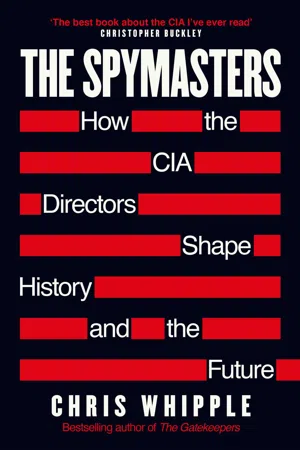
From the New York Times bestselling author of The Gatekeepers, a remarkable, behind-the-scenes look at what it's like to run the world's most powerful intelligence agency, and how the CIA is often a crucial counterforce against presidents threatening to overstep the powers of their office. Only 11 men and one woman are alive today who have made the life-and-death decisions that come with running the world's most powerful and influential intelligence service. With unprecedented, deep access to nearly all these individuals, Chris Whipple tells the story of an agency that answers to the United States president, but whose activities — spying, espionage, and covert action — take place on every continent.At pivotal moments, the CIA acts as a brake on rogue presidents, starting in the mid-seventies with DCI Richard Helms' refusal to conceal Richard Nixon's criminality and continuing recently as the actions of a CIA whistleblower ignited impeachment proceedings against Donald Trump. Since its inception in 1947, the Central Intelligence Agency has been a powerful player on the world stage, operating largely in the shadows to protect American interests. For The Spymasters, Whipple conducted extensive, exclusive interviews with nearly every living CIA director, pulling back the curtain on the world's elite spy agency and showing how the CIA partners — or clashes — with counterparts in Britain, France, Germany, Israel, Jordan, Saudi Arabia and Russia. Topics covered in the book include attempts by presidents to use the agency for their own ends; simmering problems in the Middle East and Asia; rogue nuclear threats; and cyberwarfare. The Spymasters recounts seven decades of CIA activity and elicits predictions about the issues — and threats — that will engage the attention of future operatives and analysts. Including eye-opening interviews with George Tenet, John Brennan, Leon Panetta and David Petraeus, as well as those who've just recently departed the agency, this is a timely, essentialand important contribution to current events.
Frequently asked questions

Yes, you can cancel anytime from the Subscription tab in your account settings on the Perlego website. Your subscription will stay active until the end of your current billing period. Learn how to cancel your subscription.
No, books cannot be downloaded as external files, such as PDFs, for use outside of Perlego. However, you can download books within the Perlego app for offline reading on mobile or tablet. Learn more here.
Perlego offers two plans: Essential and Complete
  • Essential is ideal for learners and professionals who enjoy exploring a wide range of subjects. Access the Essential Library with 800,000+ trusted titles and best-sellers across business, personal growth, and the humanities. Includes unlimited reading time and Standard Read Aloud voice.
  • Complete: Perfect for advanced learners and researchers needing full, unrestricted access. Unlock 1.4M+ books across hundreds of subjects, including academic and specialized titles. The Complete Plan also includes advanced features like Premium Read Aloud and Research Assistant.
Both plans are available with monthly, semester, or annual billing cycles.
We are an online textbook subscription service, where you can get access to an entire online library for less than the price of a single book per month. With over 1 million books across 1000+ topics, we’ve got you covered! Learn more here.
Look out for the read-aloud symbol on your next book to see if you can listen to it. The read-aloud tool reads text aloud for you, highlighting the text as it is being read. You can pause it, speed it up and slow it down. Learn more here.
Yes! You can use the Perlego app on both iOS or Android devices to read anytime, anywhere — even offline. Perfect for commutes or when you’re on the go.
Please note we cannot support devices running on iOS 13 and Android 7 or earlier. Learn more about using the app.
Yes, you can access The Spymasters by Chris Whipple in PDF and/or ePUB format, as well as other popular books in Politics & International Relations & Politics. We have over one million books available in our catalogue for you to explore.

CHAPTER ONE “Stay the hell away from the whole damned thing.”

Richard Helms, Lyndon Johnson, and Richard Nixon
At his transition headquarters on the thirty-ninth floor of New York City’s Pierre Hotel, in a suite with a panoramic view of Central Park, Richard M. Nixon was preparing to become president of the United States. It was Friday, November 15, 1968, and Nixon had been huddling with his closest advisers, meeting with candidates for his cabinet, plotting to bend the Washington establishment to his will. The president-elect was “in the mood of a general about to occupy an enemy town,” wrote author Thomas Powers, “bringing with him a visceral dislike and suspicion of the federal bureaucracy
 because it was in his character to see himself always as surrounded by enemies, obstructionists and saboteurs.” Oddly enough, in Nixon’s mind, no one exemplified the Washington elite—those enemies, obstructionists, and saboteurs—more than the man he’d summoned to meet with him, CIA director Richard Helms.
It would be hard to imagine a partnership less likely to end well, more riven with intrigue and mutual suspicion, than Helms and Nixon. Helms personified the CIA, rising through the ranks of the agency to become Lyndon Johnson’s director for the previous two years. Nixon was still seething about the CIA’s role in his 1960 election loss, convinced the agency had helped JFK invent a Soviet-American “missile gap.” He wasn’t about to let Helms forget it. Worse, in Nixon’s mind, Helms was a member of the “Georgetown set,” a tony cabal that spent its evenings sipping martinis and making fun of the president-elect. (Helms did frequent the living rooms of Washington’s high-society doyennes, but he was quick to point out that he’d never lived in Georgetown.)
In their manner and dress the two men were polar opposites. Helms wore Savile Row suits with kerchiefs and was an avid tennis player and ballroom dancer. (Born with nine toes, Helms had shoes specially designed for him in London when he lived there in the 1930s.) Nixon was fumbling and socially inept, and so sartorially clueless he wore dress shoes while walking on the beach.
Helms arrived at the hotel and was shown into Nixon’s suite. He was greeted there by the president-elect and John Mitchell. Jowly and overweight, Mitchell, who’d been Nixon’s law partner and was most recently serving as the president-elect’s confidant, was about to become attorney general—and would later go to prison for his role in the Watergate scandal. After some pleasantries, the president-elect told Helms he wanted him to stay on as CIA director. Helms thanked him and left, promising not to tell anyone until the decision was made public. A month later, on December 18, 1968, Richard Nixon announced Helms’s reappointment as director of Central Intelligence.
Nixon must have had his reasons. Possibly, he’d been swayed by LBJ’s urging him to keep Helms around as an honest broker. “I’ve no idea how he voted in any election and I have never asked him what his political views are,” Johnson told the president-elect. “He’s always been correct with me and has done a good job as director. I commend him to you.” But beyond Helms’s bona fides, other considerations were undoubtedly at work in Nixon’s conspiratorial mind. It was a mind that Helms could never fathom. “He couldn’t figure out Nixon,” recalled his widow, and second wife, Cynthia Helms. “He just could never figure out what Nixon was up to.” What Nixon was up to, it does not seem far-fetched to conclude, was choosing a CIA director who could be blackmailed into doing his bidding.
Surely, anyone who’d been in the spy business as long as Helms must have something to hide, must be malleable, or vulnerable to exposure. “We protected Helms from one hell of a lot of things,” Nixon would say later, as the White House tapes rolled, implying that he’d kept damaging information from coming to light, that Helms owed him, and it was time to collect the debt. Did Nixon and his henchmen have something on Helms, a secret that would make him do their dirty work on Watergate? The fate of Nixon’s presidency would hinge on the answer to that question.

Richard Helms hadn’t set out to become a spy. Born on Philadelphia’s Main Line, he was sent to a Swiss boarding school and then attended college at Williams. In 1936, as a twenty-three-year-old reporter for United Press, speaking passable French and German, Helms found himself at the Nazi Party Congress in Nuremberg, standing next to the German fĂŒhrer, Adolf Hitler. “At arm’s length, Hitler appeared shorter and less impressive than at a distance,” Helms reported in his UP dispatch. “Fine, dark brown hair, rusty in front, slightly graying along the crown; bright blue eyes, coarse skin, with a pinkish tinge.” Helms was appalled by Hitler’s demagogic narcissism. By contrast he was impressed by the quiet modesty of American track star Jesse Owens, whom he met while crossing the Atlantic on the Queen Mary after his dominant performance at the Olympic Games.
After Pearl Harbor, Helms joined the Naval Reserve. Then, two years before the Nazi surrender, he was summoned to the Office of Strategic Services (OSS) in Washington, D.C. The wartime intelligence service, precursor to the CIA, wanted someone who spoke French and German, had lived in Europe, and worked as a journalist.
The OSS was the creation of William “Wild Bill” Donovan, a dashing figure who led an eclectic band of intellectuals and paramilitary adventurers, running spies and saboteurs behind Nazi lines from its headquarters in London. Helms was sent to Maryland for training (knife fighting, hand-to-hand combat, maintaining a cover)—and finally dispatched to London. There, he reported to a rumpled Navy lieutenant named William J. Casey, the chief for secret intelligence collection in Europe.
Restless, indefatigable, and brilliant, Casey, who would later become Ronald Reagan’s CIA director, was as rough around the edges as Helms was silky smooth; he was so excitable during meals, and his table manners such an afterthought, that he often ended up chewing on his tie. The two young OSS recruits became roommates and sent spies into occupied Europe right up until the Nazi surrender.
By 1943 Helms had given up his journalistic ambitions (he’d wanted to own a newspaper) in favor of a career as a spy. “I now realized that I was hooked on intelligence,” Helms wrote years later in his memoir, A Look over My Shoulder. And he intuited that the OSS, or something like it, would still be necessary after the war: “The need for an effective intelligence service in the turbulent and anything but benign postwar world seemed obvious.” But Helms wasn’t done with Hitler yet. At war’s end, as the Third Reich lay in ruins, while he was on a reconnaissance mission in Berlin, Helms seized a chance to sneak into Hitler’s chancellery. He helped himself to the few pieces of crockery that hadn’t been shattered—and Hitler’s personal note cards. On one, Helms penned a note to his toddler son, back in Virginia.
Dear Dennis,
The man who might have written on this card once controlled Europe—three short years ago when you were born. Today he is dead, his memory despised, his country in ruins. He had a thirst for power, a low opinion of man as an individual, and a fear of intellectual honesty. He was a force for evil in the world. His passing, his defeat—a boon to mankind. Thousands died that it might be so. The price for ridding society of bad is always high.
Love,
Daddy
By then both Helms and Casey were focused on a new force for evil, one they considered as threatening as the Third Reich. The struggle against Soviet communism, starting in Eastern Europe and extending across the globe, would shape the ethical choices they made while working for, and later running, the CIA. They believed the morality of their methods shouldn’t be judged in a vacuum, but against those of the KGB. (Helms disliked John le Carré’s classic novel The Spy Who Came in from the Cold, with its gray compromises and cynical, world-weary protagonist.) Helms’s world was black-and-white: The CIA’s spies were honorable men in a fight against evil.
It was while they were in London that Casey told Helms about an idea hatched by Bill Donovan: the creation of a peacetime intelligence service that would be assembled from the remnants of the OSS. Upon the disbanding of OSS in 1945, several halfhearted iterations were tried—the Strategic Services Unit (SSU), the Office of Special Operations (OSO), and the Central Intelligence Group (CIG). Then, in 1947, the Central Intelligence Agency (CIA) was born, created by President Harry Truman’s National Security Act.
The first Director of Central Intelligence (DCI) was appointed two years earlier. Rear Admiral Sidney Souers became the first man to hold the title; to commemorate the occasion, Truman threw a lunch—and presented each guest with a black cloak, black hat, and wooden dagger. Souers was the first of four mostly forgettable CIA directors plucked from the military; he was followed in rapid succession by Army Lieutenant General Hoyt Vandenberg, Navy Admiral Roscoe Hillenkoetter, and Army General Walter Bedell Smith. Then, in February 1953, Eisenhower appointed the first civilian CIA director, Allen Dulles.
For the next eight years, allied with his influential brother, Secretary of State John Foster Dulles, Allen Dulles transformed the CIA into a powerful cudgel against communism, overthrowing governments in Iran and Guatemala, and serving as Ike’s covert army general in the Cold War struggle.
Present at the creation, Helms would be at the center of the CIA for the next three decades, privy to its secrets, triumphs, and disasters. It was a time when the agency largely did what it wanted and Congress looked the other way. When it was time to renew the CIA’s budget, the director would pay a visit to Senator Richard Russell, chairman of the Appropriations and Armed Services Committees. As one veteran operative recalled: “Russell would say, ‘How much do you need?’ [The director] would say, ‘Well, here’s my number.’ And Russell would say, ‘Well, how about this number?’ And that was it.” It was accepted that spies were mysterious figures who moved in the shadows. All of this would change soon enough.
Few were better than Helms at navigating the corridors of power in Washington, D.C. “He understood how to operate at the policy level as bravely and as ably as anybody I’ve ever seen,” said veteran CIA analyst Charles Allen. An agency legend who joined the CIA in 1958, Allen would become the National Intelligence Officer (NIO) for Warning, and later the Assistant Director for Collection (ADCI). (This is probably a good place to explain some CIA terminology: “Agents” or “assets” are by definition foreigners who are recruited overseas to spy for the agency; CIA employees, by contrast, are called “officers.” Officers in turn may be “operatives” or “analysts,” depending on the division they belong to.) Allen had never seen anyone with a better survival instinct than Helms. During his steady rise through the Directorate of Plans (DP), as the covert operations division was then called, the paperwork for most clandestine missions crossed his desk, but Helms avoided blame for operations that went sour. “Ducky Dickie,” he was called, for his ability to evade responsibility for ill-fated ventures; like a good covert operative, Helms seldom left fingerprints behind.
Operation ZAPATA, the CIA debacle that came to be known as the Bay of Pigs, was a classic example of Helms’s dodging a bullet that might have ended his career. He was aided by a fortuitous turn of events. In 1958 Helms was the odds-on favorite to be named Deputy Director of Plans (DDP). (This was the CIA’s covert arm, later renamed the Directorate of Operations, or DO.) But Helms was passed over by Director Allen Dulles in favor of Richard Bissell. Bissell, a brilliant technocrat, had spearheaded the groundbreaking development of the U-2 surveillance plane. His promotion was a shattering blow to Helms, but it would turn out to be a blessing in disguise—because it would fall to Bissell, as DDP, to plan the ill-fated invasion that would become the CIA’s worst disaster. Sensing a fiasco-in-the-making, Helms, instead of warning against the operation, made sure that he wasn’t in the loop. An office betting pool was started: How long would it take Helms to attend a planning meeting for the Cuba invasion? He never attended a session.
Helms kept a low profile. He drove old, conservative black cars that wouldn’t be noticed. Not even his son knew what he did for a living. “There is nobody who was more artful at dodging questions than my father,” said Dennis Helms, now seventy-seven, a patent attorney in Princeton, New Jersey. “If you asked him the time, he’d give you the weather. He was guided by the principle that if you don’t say anything, then you can’t say anything wrong.” The stories of Helms’s laconic nature are legion. His second wife, Cynthia, recalled that on the eve of their marriage in 1968 she got a phone call from Alice Acheson, wife of former secretary of state Dean Acheson. “She said, ‘You can’t possibly marry him!’ And I said, ‘Why not?’ And she said, ‘He doesn’t talk!’ ”
Despite being the soul of discretion, Helms moved effortlessly from watering holes to embassies to the living rooms of high-society hostesses like Katharine Graham, The Washington Post’s publisher. “He was almost a James Bondian figure,” said Robert Gates, a young CIA analyst who would later become director. “In those days people still smoked. He was a smoker and he drank martinis; he was very suave and clearly was a player in town.” Helms smoked two packs of Chesterfields a day but limited himself to a single, very dry martini. Washington’s literati, among them James “Scotty” Reston of The New York Times and columnist Stewart Alsop, gathered round when the spymaster worked the room, martini in hand. “Run it by Dick,” a New York Times editor once told his star investigative reporter, Seymour Hersh (to Hersh’s dismay). But Helms seldom stayed long at the party. “He knew exactly where the exit was in every embassy in Washington,” said Cynthia.
At his modest suburban house in Chevy Chase, Maryland, Helms threw his own parties: eclectic gatherings of spies, professors, journalists, and diplomats (but rarely politicians). “They used to come on New Year’s Eve, a lot of the old guys in black tie, and we’d play charades,” recalled Dennis, referring to the parlor game in which contestants acted out well-known phrases which the other team tried to guess. “Dad’s friends were a pretty smart crowd: two Williams College presidents, all kinds of people from Yale.”
One regular at these affairs was a CIA legend, a lean, angular, bespectacled Yale grad with a mischievous grin and a mysterious manner. A chain-smoker, he bred rare orchids and designed elaborate fishing flies. At Yale he’d published a literary magazine and befriended the poet Ezra Pound. The phrase he chose for charades, recalls Dennis, was from T. S. Eliot: “garlic and sapphires in the mud, clot the bedded axle-tree.” “So needless to say nobody guessed that, and my mother said, ‘Time out!’ ” The man she banned from future charades games was the CIA’s head of counterintelligence, James Jesus Angleton.
Angleton would cause Helms and the CIA no end of grief in the postwar years. But in the immediate aftermath of the Bay of Pigs, Helms had more pressing problems. For his role in the debacle, Director Allen Dulles had been sacked by Kennedy, who appointed John McCone in his stead; Bissell was gone, too. But there’d still be hell to pay because the attorney general, Bobby Kennedy, was furious, out to avenge the president for his embarrassing humiliation at the hands of his generals and spies. “After the Bay of Pigs, Bobby Kennedy became obsessed, which means Jack Kennedy became obsessed, with killing Castro,” said Burton Gerber, an operative who served in the Middle East and Russia. The marching orders, for Helms and his colleagues, were to get rid of Fidel Castro—immediately, by any means necessary.
This was not a new command. The CIA’s murder plots against Castro had begun under Dwight Eisenhower. The schemes had been delegated to the CIA Security Staff, a shadowy division for off-the-radar operations, and a colorful character named William Harvey. Harvey, a rotund ex-FBI agent who’d had a falling-out with Director J. Edgar Hoover, was a bullheaded operative who seldom let rules interfere with a mission; Harvey almost always carried a loaded pistol in his belt. While stationed in Germany, he’d run an ambitious covert operation: Workers burrowed a t...

Table of contents

  1. Cover
  2. Title Page
  3. Dedication
  4. Cast of Characters
  5. Introduction: “There’s something going on.”
  6. Chapter 1: “Stay the hell away from the whole damned thing.”
  7. Chapter 2: “You know he’s one of them, don’t you?”
  8. Chapter 3: “We were just plain asleep.”
  9. Chapter 4: “That’s the most frightening thing I’ve ever heard.”
  10. Chapter 5: “Never go home at night without wondering where the mole is.”
  11. Chapter 6: “A jungle full of poisonous snakes.”
  12. Chapter 7: “They’re coming here.”
  13. Chapter 8: “It’s a slam dunk.”
  14. Chapter 9: “He died quickly.”
  15. Chapter 10: “You just have to hope that ultimately God agrees with you.”
  16. Chapter 11: “Everyone thinks this stuff is easy. None of this stuff is easy.”
  17. Chapter 12: “I would like you to do us a favor though.”
  18. Epilogue
  19. Photographs
  20. Acknowledgments
  21. Author’s Note on Sources
  22. About the Author
  23. Notes
  24. Index
  25. Copyright