The Story of China
eBook - ePub

The Story of China

A portrait of a civilisation and its people

  1. 624 pages
  2. English
  3. ePUB (mobile friendly)
  4. Available on iOS & Android
eBook - ePub

The Story of China

A portrait of a civilisation and its people

About this book

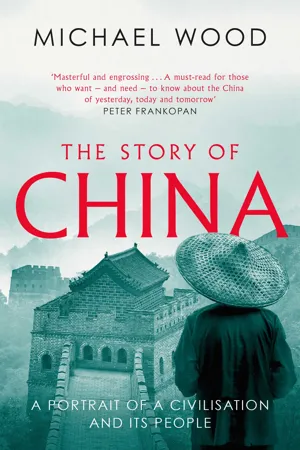
'A learned, wise, wonderfully written single volume history of a civilisation that I knew I should know more about' Tom Holland 'Masterful and engrossing...well-paced, eminently readable and well-timed. A must-read for those who want – and need – to know about the China of yesterday, today and tomorrow' Peter Frankopan China's story is extraordinarily rich and dramatic. Now Michael Wood, one of the UK's pre-eminent historians, brings it all together in a major new one-volume history of China that is essential reading for anyone who wants to understand its burgeoning role in our world today. China is the oldest living civilisation on earth, but its history is still surprisingly little known in the wider world. Michael Wood's sparkling narrative, which mingles the grand sweep with local and personal stories, woven together with the author's own travel journals, is an enthralling account of China's 4000-year-old tradition, taking in life stationed on the Great Wall or inside the Forbidden City. The story is enriched with the latest archaeological and documentary discoveries; correspondence and court cases going back to the Qin and Han dynasties; family letters from soldiers in the real-life Terracotta Army; stories from Silk Road merchants and Buddhist travellers, along with memoirs and diaries of emperors, poets and peasants. In the modern era, the book is full of new insights, with the electrifying manifestos of the feminist revolutionaries Qiu Jin and He Zhen, extraordinary eye-witness accounts of the Japanese invasion, the Great Famine and the Cultural Revolution under Chairman Mao, and fascinating newly published sources for the great turning points in China's modern history, including the Tiananmen Square crisis of 1989, and the new order of President Xi Jinping. A compelling portrait of a single civilisation over an immense period of time, the book is full of intimate detail and colourful voices, taking us from the desolate Mongolian steppes to the ultra-modern world of Beijing, Shanghai and Hong Kong. It also asks what were the forces that have kept China together for so long? Why was China overtaken by the west after the 18th century? What lies behind China's extraordinary rise today? The Story of China tells a thrilling story of intense drama, fabulous creativity and deep humanity; a portrait of a country that will be of the greatest importance to the world in the twenty-first century.
Frequently asked questions

Yes, you can cancel anytime from the Subscription tab in your account settings on the Perlego website. Your subscription will stay active until the end of your current billing period. Learn how to cancel your subscription.
No, books cannot be downloaded as external files, such as PDFs, for use outside of Perlego. However, you can download books within the Perlego app for offline reading on mobile or tablet. Learn more here.
Perlego offers two plans: Essential and Complete
  • Essential is ideal for learners and professionals who enjoy exploring a wide range of subjects. Access the Essential Library with 800,000+ trusted titles and best-sellers across business, personal growth, and the humanities. Includes unlimited reading time and Standard Read Aloud voice.
  • Complete: Perfect for advanced learners and researchers needing full, unrestricted access. Unlock 1.4M+ books across hundreds of subjects, including academic and specialized titles. The Complete Plan also includes advanced features like Premium Read Aloud and Research Assistant.
Both plans are available with monthly, semester, or annual billing cycles.
We are an online textbook subscription service, where you can get access to an entire online library for less than the price of a single book per month. With over 1 million books across 1000+ topics, we’ve got you covered! Learn more here.
Look out for the read-aloud symbol on your next book to see if you can listen to it. The read-aloud tool reads text aloud for you, highlighting the text as it is being read. You can pause it, speed it up and slow it down. Learn more here.
Yes! You can use the Perlego app on both iOS or Android devices to read anytime, anywhere — even offline. Perfect for commutes or when you’re on the go.
Please note we cannot support devices running on iOS 13 and Android 7 or earlier. Learn more about using the app.
Yes, you can access The Story of China by Michael Wood in PDF and/or ePUB format, as well as other popular books in History & World History. We have over one million books available in our catalogue for you to explore.

Information

Year
2020
Print ISBN
9781471175985
eBook ISBN
9781471176005
Topic
History
Index
History

1 ROOTS

The first fact of Chinese history is geography. Today’s China is a vast land, stretching from the deserts of Xinjiang and the Tibetan plateau down to the mountains of Burma and Vietnam and up to the wild expanses of Manchuria and the Yalu River on the Korean border. From Kashgar in the far west of Xinjiang to the capital is 4,000 kilometres by road. North China for much of the year is cold and often grey, while the south is subtropical; one grows millet and wheat, the other rice. The oldest rice in the world has been found in the south on sites dating back to 8000 BCE. With a fundamental divide in ecology and climate, these two great zones of China have been distinct in people, language and culture for millennia, and still are.
Yet vast as these outer lands are, the historic heartland of China is much smaller, lying between the Yellow Sea and the uplands, where two great rivers come down from the high plateaux of Qinghai and Tibet. To the north is the Yellow River, where the early dynasties grew up; to the south the Yangtze valley, the great centre of population, wealth and culture in later history. Under the Han dynasty, the Roman period in the West, the Chinese state first extended its rule outward into the oases of Central Asia, and there was another period of direct rule in Xinjiang under the Tang empire in the seventh century CE. For most of its history, however, the heartland of the two rivers was China. It was only in the eighteenth century that the much bigger shape of today’s People’s Republic was determined by the huge multi-racial empire of the Manchus – the Qing dynasty, which spread its rule over Mongolia, Xinjiang and its Tibetan protectorate.
These days you can journey by train across that heartland, from north to south, in less than a day. Travel has been transformed by one of many amazing recent infrastructure projects, and the high-speed train covers the 2,300 kilometres from Beijing to Guangzhou in a mere eight or nine hours. At a more modest pace, twenty-four hours on the stopping train will suffice to cross the Yellow River plain down to the rich south, to Jiangnan, ‘The Land South of the River’, about which Chinese poets wrote with such feeling. It is a journey not only in space but in time, allowing us to look through the windows and see the deeper patterns of history, the old contours of landscape and civilisation.
The early civilisations of the Yellow River were not near the sea, but in the central plain, close to where the river emerges from the mountains. In the lower reaches were wide shifting flatlands of streams, rivulets, low-lying swamps and great lakes that were teeming with wildlife in the Bronze Age, regions only drained for farmland in the later centuries BCE. So the first centres of civilisation were inland; the sea did not feature in the imagination of early Chinese culture.
Rising in the Qinghai plateau, the Yellow River makes a huge northern arc up into Mongolia across the arid loess lands of the Ordos, the ‘yellow earth’ of eroded windblown silt which exerts its climatic influence on China, as does the Sahara on the Mediterranean. Then, taking a sharp turn southward, it issues from the mountains with sometimes uncontrollable power, rushing down to its confluence with the Wei River and into the plains. There it enters the ‘Middle Land’, where it has changed course on at least thirty occasions in the historical period, bursting its banks in violent floods more than a thousand times, shifting its mouth on the Yellow Sea by as much as 500 kilometres, so that, incredibly, its mouth has been sometimes north, sometimes south of the Shandong peninsula.
So the Yellow River is a constant, unpredictable and often terrifying character in the story of China, nothing like the benign life-bearing flood of the Egyptian Nile, whose rising was celebrated each year with unerring predictability on 15 August, or the Tigris in Mesopotamia, whose summer rising was greeted into the twentieth century with liturgies and food offerings, even in Muslim households. The Yellow River, too, was the focus of religious ceremonies; from the Bronze Age sacrifices and rituals were directed to the ‘Yellow River Power’, the ‘High Ancestor River’. But these were performed out of fear, to pacify and assuage, not to welcome; ‘Will there be no flood this season?’ asked the anxious kings and their diviners in their oracle bone inscriptions. Vestiges of the cult of the River God survive even today, for example at the ancient village of Chayu near Heyang, next door to the Grand Historian Sima Qian’s hometown, where each year in late summer, on the fifteenth day of the sixth lunar month, ceremonies are still held for the rising. Banging gongs and beating drums, the men dance in tiger headdresses and the women make huge steamed buns and elaborate food offerings for the river gods, floating twinkling lamps out onto the darkening river marshes at twilight. Today these ceremonies entertain Chinese tourists, but in the past they were a ‘prayer for safety’, offered up by farmers and boatmen hoping to avert loss of life and livelihood from often devastating floods. The rituals, it is said, have gone on ‘since time immemorial, beyond what any elder can remember’.
Some Yellow River floods were so severe that they changed the course of Chinese history. In 1048, as we will see below (pages 204–8), a giant inundation profoundly altered the topography of the northern plain, while the catastrophe of 1099–1102 saw ‘corpses of the dead filling the gullies and numbered in their millions’, according to an appalled local administrator who saw ‘no sign of human habitation for over a thousand li’. Seven million died in the 1332 flood, precipitating the disorder that hastened the fall of the Mongol dynasty; there were 2 million dead in 1887, more than that perhaps in 1931. Right up to the mid-twentieth century the Yellow River remained an unpredictable killer, and everywhere it has left the traces of its passing. The countryside around Zhengzhou is scored by a tracery of old courses, and though the main bed today is still in places five kilometres wide, even during the monsoon it now musters perhaps only a tenth of its pre-1940s flow. Indeed, in the past forty years or so the river in its lower course below Zhengzhou has dried up more years than not. At the heart of governance since the Bronze Age, then, has been the management of water, and it still is, although the problem today is no longer its barely controllable excess, but its scarcity.
So China’s early civilisations grew up on the banks of the river in the middle plain, where the fear of the breakdown of society due to natural disaster was ever-present, and irrigation could only be managed by a strong state. Not surprisingly, then, the earliest Chinese myths about state origins converge on stories about the control of water, tales that focus on the mythical king Great Yu, ‘the tamer of the flood’. As we shall see, these stories were perhaps handed down orally before the age of writing in the late Bronze Age, before about 1200 BCE, proof of the incredible tenacity of cultural memory in China that reaches back to the Longshan culture of the third millennium BCE. Dramatic archaeological discoveries in the twenty-first century suggest that these myths commemorate events that are still written in the landscape and that show how ecology determined the nature of political power. The ability of kings to organise labour, dig dykes to contain the water, supervise irrigation, look to the heavens for the patterns of weather and climate, and seek validation from the great ancestors, was paramount. This would be the pattern down to the end of empire in 1911, and indeed beyond.

THE ROOTS OF CHINESE CIVILISATION

There were many distinctive regional cultures in China in prehistory, but the most important grew up in the wide wheat fields of Henan, the central plain, the zhongyuan, of the later Middle Kingdom. The Chinese name for their country, Zhongguo, was first recorded by the Western Zhou in about 1000 BCE and denoted this middle land long before it came to signify the whole nation and, in time, even a China-centred world. Indeed, it is possible, as we shall see, that the name originally applied to one specific place. China has many cultures and many narratives, but it has one great narrative, and this is the area where Chinese history, as a shaped, structured story, handed down by the early historians, really begins.
An emerging megacity with over 10 million people today, Zhengzhou lies just south of the Yellow River, under a brown haze of pollution. Criss-crossed by huge freeway intersections are serried walls of vacant high-rises bordering the hi-tech development zones, with their electronics and vehicle plants and the world’s largest smartphone production site, iPhone City. Beyond lie smoke-shrouded steel works and coal mines. But running alongside the inner expressway is a long stretch of massive, tamped-mud walls recalling the city’s role as one of China’s Bronze Age capitals during the Shang dynasty three and a half millennia ago. In terms of history and archaeology, Zhengzhou now promotes itself to visitors as the earliest of China’s historic capitals, the focus of a local ‘Ancient Capital Group’ of eight neighbouring historic sites which are part of a wider ‘Central Plain City Group’, taking the national narrative back ever further into prehistory.
To touch on that deep past we must leave the beaten track. After an hour’s drive along suburban freeways, the traveller enters a different world of long straight country roads between yellow fields, with villages every half-mile. Even up to the 1980s these were often earth-walled enclosures with tile-roofed, mud-brick communal buildings housing extended families. Still today among the gleaming silos, water tanks and warehouses of modern agribusiness one can find clan villages where people plant their strips by hand, in the age-old routine, putting sweetcorn seedlings between the rows of wheat so they have two weeks of root growth before the wheat is gathered in, but escape the scythe. At the edge of the fields are old shrines with long bamboo flagpoles; it is a world that still values auspiciousness. For a while yet these worlds coexist, especially in the minds of the older generation of Chinese people, for whom memory still reaches back before the revolution of 1949 and the brief but violent rupture of the Cultural Revolution in the 1960s and early ’70s.
Two hundred kilometres south, on the central plain, at the lake of Huaiyang near Zhoukou, the crowds are gathering for a festival. A million people, ordinary farming folk from the Henan countryside, converge on a lakeside temple complex to celebrate the cult of China’s primordial deities Fuxi and Nüwa. As the traveller will see everywhere these days, such local cults are part of a dramatic revival of religion in China where three or four hundred million are thought now actively to belong to the main faiths – Buddhism, Christianity and Islam – with many more participating in Daoism and folk cults. This site is one of the oldest; it was already important in the Spring and Autumn period (700 BCE). The main deity, Fuxi, is male, but for well over two millennia he has been associated with a primeval goddess, Nüwa. A thousand years ago, in the Song dynasty, the pair became the focus of an imperial ritual, which was renewed with the current buildings in the Ming dynasty and lasted up to the end of the empire at the beginning of the twentieth century. Here the emperors worshipped not only their own ancestors, but China’s mythic kings and culture heroes: the Yellow Emperor, the Five Primordial Rulers, and the ‘First Farmer’ Shennong, the ‘Divine Peasant’ who taught the people agriculture and is still revered as a deity in folk religion. Here too is a shrine to Yu the Great, the legendary king who first channelled and controlled the Yellow River floods and laid the foundations for the first Chinese state. But behind them all are Fuxi and the goddess Nüwa, the makers of the first humans.
Popular worship here survived among the country people until the 1950s, when the temple fairs were still big events, times for buying and selling, dancing and singing, celebrating the onset of spring in the second lunar month. Then the fairs were stopped and the temples closed down during the Cultural Revolution; the cult statues were destroyed and the buildings vandalised or turned into workshops and factories. In 1980, however, religious practice was permitted again by the Communist Party, and through the ’80s under Deng Xiaoping’s ‘Reform and Opening Up’ policy, secular fairs were once more allowed, in part to encourage local economies. At first the revival came with a high degree of grassroots spontaneity, and the fairs became again places of popular performance, song and dance, storytellers, acrobats, jugglers, crafts and music, as well as gambling, games and divination. Soon popular religion revived and the temples were resacralised, their altars and cult statues restored as these big public fairs pushed the bounds of what the government was prepared to allow in the loosening up after Mao’s devastating attack on ‘old customs, culture, habits and ideas’.
Today this ‘Farmers’ Festival’ is one of the big events in this part of Henan. In the town are grand new pilgrim hotels, their palatial atriums decorated with murals showing the deities and the sacred stories. A reception desk in the marble foyer greets the tour bus visitors with welcome packs, goodie bags containing a map, badges, folders and notes on rituals explaining what the participant needs to do. It is all part of the return of traditional customs to China as the people rediscover their roots. Alongside the lake, the temple complex is a vast rectangle at whose heart are the shrines to Fuxi and Nüwa, the primordial god and goddess. Fuxi is a powerful ancient deity who ‘laid down the laws of humanity’ in the first days of primitive humankind, when, as a Han dynasty text, the Bai Hu Tong, says, ‘there was no moral or social order’. He is the first among the legendary primogenitors of ‘Huaxia’, the culture of the Chinese. The two deities are portrayed on Han dynasty steles with human faces and long snake tails intertwined. Behind the main temple hall is the legendary site of Fuxi’s burial mound, where, at festival time, frenzied but good-natured crowds throw armfuls of flaming incense onto a huge fire in his honour.
Because of her influence on marriage, childbirth and auspiciousness, however, the veneration of Nüwa is the most important of the pilgrimage rituals. She has her own shrine where the cult image shows the goddess holding the chunk of stone with which she will repair the broken pillar of heaven. In her other arm she holds a baby, the first human being, which she made by mixing her own blood with the yellow clay of the Yellow River. In front of her temple a sacred stone is touched by women hoping for children – part of a deep stratum of myth to be found the world over.
Some of the women’s groups in the crowds have come here from Nüwa’s home shrine 20 miles away, where her newly rebuilt temple attracts 100,000 a day at festival time, the country roads blocked by crowds and tractors festooned with ribbons. Her fair takes place in what the pilgrims say was originally a female village. There, hardcore goddess followers can be seen trance dancing as Nüwa takes over the spirits of the worshippers and they sing of ‘Heaven and Earth and the goddess and her daughters’, speaking in tongues on her behalf, giving voice to her thoughts – ‘dancing and weeping, laughing and crying, making wild movements sometimes for hours on end’. In Zhoukou, too, precedence is given to the women’s groups wearing colourful costumes specially made by each local association, who dance to drums and flutes. Most revered are the old women in black jackets who sing and dance with a carrying pole over their shoulders from which hang baskets of flowers. According to these women, their dance was taught to their female ancestors by Nüwa herself and only women know and perform it. Another dance, ‘The Snake Sheds Its Skin’, features sinuous movements in honour of the symbol of Nüwa, like the snake goddesses in archaic Indian religion (perhaps a hint of her primitive origin?).
Their haunting creation songs are uncannily like the cosmogonies of the ancient Greeks:
  • Remember when the world began and all was chaos
  • No sky, no earth, no human beings.
  • Then the god of the sky created sun, moon and stars
  • The god of the earth created grain and grass
  • And with sky and earth separated the chaos ceased.
  • Then the brother and sister appeared,
  • Fuxi and NĂźwa, the human ancestors…
  • They gave birth to hundreds of children
  • That’s the origin of us – the hundred surnames –
  • The people of the world
  • So, people in the world may look different
  • But we belong to one family.
Around the lakeside in the streets of the town, pilgrims mill around the food stalls and open-air kitchens which serve meatballs and eggs baked in incense ash – sacred food believed to have healing power. They bring with them little bags of earth from their home villages, which they empty on the tomb mound, and in return take a small amount back to bless their land. At the souvenir stands, glazed pottery images of the deities are on sale along with baskets of little clay dogs and chickens painted black, red and yellow, a reminder of the story that after she had made humans, Nüwa used the leftover clay to make these two animals. And as for the goddess herself, ‘she is our mother’, the women say: ‘we Han people are all the same family, so this is the ancestral place of the Chinese people’.
In China today, history in all its manifestations – whether the ‘glorious’ new history of the Communist Party’s ‘China Dream’, exemplified in school curricula as ‘National Studies’, or the deep-rooted tenacious and long-lasting culture of the people of the countryside – is on the way back. Shrines like this are being restored all over China, their rituals reconstituted by the older generation, for whom the thirty years of Maoism has turned out to be, after all, only a small period of time in Chinese history.
At first sight such festivals may appear to be merely tourist-board-sponsored spectacles. In Zhoukou the temple website frames the pilgrimage in terms of ‘cultural identity and national cohesion’, things the Chinese government is keen to stress these days. And, indeed, special ceremonies for today’s elites have been newly invented, recycling practices from pre-1911 ritual handbooks; events for the local bigwigs conducted in private, night-time ceremonies with a prayer leader calling out movements and gestures for rows of devotees draped in yellow silk sashes, each bearing a flickering lamp. But the rituals of the ordinary people are another matter. They have been brought back to life from the memories of the older generation, carried on almost seamlessly as before, as the people fill the void left when religion was belittled and dismantled, first under the Republic, then under Mao, seeking a spiritual dimension to life at a time when materialism has swept all before it. After all the shocks and the wholesale changes of the past eighty years, these stories and myths,...

Table of contents

  1. Cover
  2. Title Page
  3. Maps
  4. Dedication
  5. Preface
  6. Prologue: Beijing, December 1899
  7. Chapter 1: Roots
  8. Chapter 2: The Great War of the Shang
  9. Chapter 3: The Mandate of Heaven
  10. Chapter 4: The First Emperor and the Unification of China
  11. Chapter 5: The Han Empire
  12. Chapter 6: The Glory of the Tang
  13. Chapter 7: Decline and Fall
  14. Chapter 8: The Five Dynasties
  15. Chapter 9: The Song Renaissance
  16. Chapter 10: The Fall of the Northern Song
  17. Chapter 11: The Southern Song, 1127–1279
  18. Chapter 12: The Yuan: China Under the Mongol Empire
  19. Chapter 13: The Ming
  20. Chapter 14: The Last Days of the Ming
  21. Chapter 15: The Great Qing: The Long Eighteenth Century
  22. Chapter 16: The Opium Wars and the Taiping
  23. Chapter 17: The Great Chinese Revolution, 1850–1950
  24. Chapter 18: The Age of Reform: From the Republic to Mao
  25. Chapter 19: The Rise of the New China
  26. Photographs
  27. Afterword
  28. Acknowledgements
  29. Notes
  30. Bibliography
  31. Index
  32. Copyright