![]()
POWERING UP THE JET
“If a man does his best, what else is there?”
—GEORGE S. PATTON JR.,
American Army general, West Point Class of 1909
ON THEIR FIRST day at the United States Air Force Academy, the brand-new appointees, who are about to become basic cadets, begin their in-processing at Doolittle Hall, the alumni house of the Association of Graduates, better known as the AOG. Over the years, in-processing has become quite the event, with excited and delighted families accompanying the proud future cadets to the gorgeous Academy setting at the base of the Rampart Range of the Rocky Mountains.
It occurs on the last Thursday in June, when a radiant blue sky can be counted on and a towering Pikes Peak still wears its snow-cap. The atmosphere is festive, with motivational greetings from the superintendent—the three-star general who runs the Academy—and the president and CEO of the AOG, a position I held for nine years. The families enjoy an informational fair inside the building while the new basic cadets are introduced to the history of Academy graduates on the adjoining Heritage Trail. After buying a plethora of Air Force T-shirts, hoodies, and other swag, the families bid their new basics good-bye as they climb aboard buses for the trip up the hill to the Cadet Area.
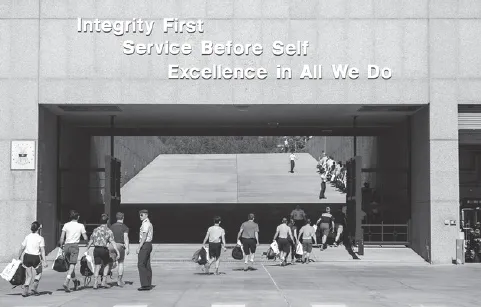
The first half of the ten-minute bus ride is quiet, as the new cadets take in the gorgeous scenery. Then all hell breaks loose as their “Flight to Excellence” begins. The two upper-class members of the training cadre shatter the silence with orders and instructions designed to send the clear message that mediocrity is over and will never be accepted again. As the bus pulls up to the Core Values Ramp in the Cadet Area, the new basics exit and are greeted by both the rest of the upper-class training cadre and the Air Force’s core values. The brushed aluminum letters hang high and prominent over the wall: Integrity First, Service Before Self, Excellence in All We Do.
The new cadets spend what seems to be an eternity enduring shouted directions and “corrections” as it becomes clear that excellence is going to be the standard: excellence in posture and how they stand, excellence in remembering and repeating the required responses, and excellence in obeying each command. Any basics who are slow to adjust get some “extra attention” before they are all led up the Ramp by an upper-class cadet. Their Air Force Academy experience is about to begin.
Basic cadets at the Core Values Ramp on their first day at the United States Air Force Academy. Photo courtesy of the Association of Graduates | United States Air Force Academy.
EXCELLENCE IN MY DNA
Though it was physically tough, intellectually demanding, and mentally challenging, I adapted well to the Academy environment. Wearing my uniform correctly, keeping my room in order, and shining my shoes were not challenges for me. These military chores were extensions of how I had been taught to live my life back home in Orangeburg, South Carolina. My parents, Willie and Pearl, showed me what excellence was by how they lived their lives. My mother handled the finances in the home and ran a tight ship, all while being a sharp dresser and frugal with the limited funds they had. My dad would let me help wash the car, a used 1951 Chevy that he always kept sparkling clean. The subtle but clear messages conveyed that your appearance mattered and taking care of your possessions was an important task. Our home was small but tidy, and keeping my room neat and clean became a part of my DNA. I had regular chores and was expected to contribute to the family’s improvement. Over time we began to live small but growing parts of the American Dream. I can remember when both of my parents graduated from the local college, South Carolina State. My mom graduated in 1956 when I was five years old, and my dad finished a year later, delayed by his service in the US Army. They would both go on to obtain advanced degrees, and that up close example of them working hard and using education as a stepping-stone became an indelible part of my experience.
Having two parents who were schoolteachers was both a blessing and a curse. Though I didn’t appreciate it at the time, I was fortunate to have parents who demanded that I do my best and be the best I could be. Meeting those expectations sometimes meant passing on enjoyable school activities or giving up playtime with my neighborhood friends.
Perfection was never their objective for me; their aspiration was that I would give my all. And my parents were intuitive enough to understand the subtleties of the difference. The rule at home was that I could play with friends or participate in after-school activities as long as I maintained good grades in my courses. If my grades dropped, the restrictions kicked in. If I was playing a sport, for example, I had to come off the team.
In junior high, I was on our school basketball team and had made the starting five. I was also struggling with a system briefly introduced in the 1960s called new math. My dad was pretty good at math, but even he had trouble understanding the concepts when I went to him for help with my homework. When I got my report card, my math grade had slipped from a B– to a C+, and I knew the rule would require me to quit the team. When I showed my dad my report card, he said, “I see you are still battling with that math.” My response was simply, “Yes, sir.” He said, “Keep after it, and you’ll eventually do OK.” I expected him to reiterate the rule and tell me that I was off the team, but he didn’t say anything else. The next day I didn’t know whether I should stay for basketball practice or go home because of the rule. I decided it would be better to ask for forgiveness rather than permission, so I stayed for practice. When I got home, my father never said a word, and I continued to be on the team. Years later, as I reflected on that situation, I realized that my dad only wanted me to do my best, and because he knew I was putting in the time and effort, he was OK with relaxing the rule. Striving for excellence and doing my best was the goal, and in his eyes, I had met the standards.
INTEGRATING HIGH SCHOOL
While my upbringing at home prepared me well in many ways for my Academy experience, going to Orangeburg High School gave me mental toughness and prepared me for the psychological trials and tribulations that every cadet at a service academy has to endure. In fact, in some ways the Academy experience was easier because all my classmates and I were going through the same challenges as a team, and we formed a strong bond among us when we made it through a particularly tough stretch. But there were only twelve African Americans out of twelve hundred students at Orangeburg High, and the sense of isolation and vulnerability made a hostile situation even more intimidating.
There were two segregated high schools in my hometown: Orangeburg High (OHS), the “white” high school on the other side of town, and Wilkerson High School for the African American students, which was one block up and two blocks over from where I lived. Though it was right around the corner, Wilkerson was not my first choice for high school. I had gone to the black Catholic school in my hometown, and after graduating eighth grade I wanted to go to an all-boys’ school, St. Emma’s Military Academy in Virginia. I sent for the catalog but after seeing the costs, I quickly got the sense from my folks that it was going to be too expensive to send me there. I accepted that I would go to Wilkerson, which would have been just fine. It was close, my favorite aunt was on the faculty, and most of my neighborhood friends would be there as well. The passage of the Civil Rights Act in 1964 changed the landscape and unexpectedly gave me another option. Under a program called the Freedom of Choice plan, I decided to go to OHS.
It was a decision that my parents left to me. We certainly discussed it numerous times—the opportunity advantages and social disadvantages, other pros and cons, the true danger that might exist, and how the risks might be lessened. Alone with my thoughts, I vacillated and wavered back and forth. It would be easier going to Wilkerson, where I would be hanging out with my close buddies and be around other people I knew. It’s very important when you are fourteen to be comfortable as a part of a familiar group.
But by helping to integrate OHS, I would be part of something significant and bigger than myself. I would be a tangible part of the civil rights movement—a frontline soldier in the battle against bigotry and prejudice. It was kind of weighty when I thought about it. But deep down, I knew it was essentially the right thing to do to help integrate this school, not only for our African American community but, though they didn’t appreciate it at the time, for the white community as well. When I shared my decision with my parents, my mother looked me in the eyes and said, “William, if you are going to go over there, don’t you shame us. It is going to be hard, but we still expect you to do the very best that you can do every day. And if you do that, you’ll be just fine.” So, with excellence as my charge, I became a part of the first class of African American students to spend all four years at OHS.
I’ll never forget my first day of high school. I left home that morning and walked down to the end of the block to wait for the school bus. I was by myself because I was the only kid from my neighborhood who was going to OHS. As I stood there waiting, I could see several police cars off in the distance with their lights flashing, headed in my direction. My first thought was that there had been an accident somewhere up the road and the cops were headed to that scene. But with no sirens blaring, I thought maybe there was something more nefarious at play. My imagination began to run away, and I surmised that maybe it was a break-in or a robbery. That might explain their silent approach. Well, imagine my astonishment when this caravan of police cars and the school bus stopped right in front of me. This was my federal marshal and highway patrol escort for my first day of school.
I got on the bus, and we picked up a couple of other kids before heading over to OHS. As I sat there taking in the whole scene, I briefly thought that having your own police escort to go to school was actually pretty cool. But that feeling drained away when we reached the OHS parking lot. There to greet us was an angry mob with ax handles and baseball bats who rushed up and began to pound the side of the bus before the cops could move them back. They shouted obscenities and racial slurs and told us we didn’t belong—that we should turn around and go back to our own school.
We got off the bus that day and walked into history. We marched between two lines of screaming humanity, being called names, shouted at, and spat upon. I admit that for a brief moment I wondered why I had chosen to do this and thought about getting back on the bus and going home. But we were there for the greater good. More importantly, the fear of embarrassment from not doing my best, and heeding my mom’s advice to perform with excellence, was greater than the fear of what lay ahead. It was the first day of four of the most fascinating, challenging, and, in many ways, fulfilling years of my life.
Some folks find it surprising that I regarded those years as fulfilling and are amazed that I didn’t take a sense of anger or resentment with me from the experience. In reality, I felt fortunate to have a pilot’s window on human nature and to see firsthand how many of my white classmates, over time, began to change.
THE VALUE OF LUNCHROOM REAL ESTATE
In the beginning we were novelties, and there was a universal sense of how we were to be treated and how the white students were supposed to act. The running yarn was that they were not supposed to get too close to us, as the “black might rub off.” One result was that when we walked down the corridors, the white students would dramatically jump to the side so as not to get too close. In most of my classes, there was an empty desk in front and back and on either side of me. And when I went to lunch and sat at a table that seated twenty-four, everyone else would get up and I would have twenty-three empty seats to myself. I found this particularly amusing, as the lunchroom was usually full and seats were hard to come by. Yet the white students would stand in the aisles and eat from their trays rather than join me at the table.
For several different reasons that coalesced over time, things began to slowly change. Common sense began to take hold in the lunchroom. I distinctly remember everyone getting up on cue when I sat down one day and then a girl reticently sitting back down while saying, “I won’t be too close to him if I sit here on the end.” A few of her friends hesitantly joined her, and that became the new norm—you could sit at the same table but not too close. Of course, the value of a lunch table seat was still at a premium, and in relatively short order the acceptable space between me and my white classmates began to shrink and became just a couple of seats. A little bit of integration was beginning to take place.
TACKLING PREJUDICE
I was the first black kid to go out for the football team, which involved a totally different dynamic. Initially, my fellow teammates attempted to play the same “separation” game that was in play up on campus. But the rules were different on the football field. My coach, Jack Miller, would have none of it. When one of the players didn’t want to have a locker next to mine, Coach Miller told him to go find another sport to play, and that sent a shock wave through the room. The next player assigned a locker next to me had nothing to say.
There were other factors that made football different from the rest of the daily school experience. Of course, football is a contact sport with equal opportunity to hit and be hit. After a long day up on campus dealing with a variety of slights, annoyances, and indignations, I saw football practice as an opportunity to take out my frustrations with the circu...