Are you a real estate agent ready to transform your business? Experts agree that building and operating a real estate farm is the most direct path to success. Like a traditional farm, a real estate farm is a limited geographic area in which you plant seeds via marketing and leads, tend your crops by strengthening client relationships, and harvest the fruits of your labor through repeat business and referrals, resulting in market dominance.
In this essential, step-by-step guide, real estate expert Meredith Fogle shows you how to select a farm area, create farm dominance, and even how to sell an established farm business. You’ll have access to practical exercises, worksheets, and charts, plus secrets of “Famous Farmers”—top-producing real estate bloggers, TV contributors, and market leaders—who share the keys to their success. Farming, for Real Estate Agents is also filled with fundamental principles and systems that can be applied to almost any sales business to immediately increase leads and income.
Whether you’re starting a career and seeking quick success or you’re an established agent looking to achieve top-producer status and transform your business, this innovative book is the only one you’ll need to reap immeasurable rewards from your real estate farm.
SELECTING A FARM area is both a personal and a professional decision, and it is one you should consider carefully. Once you’ve selected your farm, you’ll be investing time, energy, and money into your chosen farm area. Your decision should be based partly on your familiarity with and the feel for the farm you are considering and partly on numerical data.
Choose with your heart
To be truly successful, you’ll need to be involved in and knowledgeable about your farm area. Naturally, it’s much easier to be involved and interested in a community you love. You’ll be marketing to this area, participating in and sponsoring community events, and working within the community to take listing and buyer meetings and to tend to your crop of listings and buyer sales. Many successful real estate farmers live within their farm areas.
Living outside of the community you farm can make this level of engagement difficult, though not impossible. Some successful real estate agents farm communities in which they have lived previously or in which they someday hope to live. Farming a community similar to that in which you live (another resort community, another historic community, another 55-and-older community, another new urbanist community, or a similar condominium complex) can be effective.
Wherever you choose to farm, be sure you have a passion for your farm area. Clients can sense an agent’s level of interest in his or her farm area during the listing or buyer appointment. The passion you bring to your farm can often tip the seller or buyer in favor of working with one agent over another.
Once you begin working in the area you love, you may not want to work anywhere else.
INTERVIEW WITH A FAMOUS FARMER JUDY HOWLIN
Judy Howlin was Kentlands’ first resident realtor and successfully farmed the then-brand-new, new-urbanist Washington, DC, suburban community. Judy served as my mentor, and here she shares insights about how she began farming and how she ultimately dominated her farm area.
What were the most important considerations to you in choosing your farm area?
I chose the community I lived in. It was the area that I knew and liked best.
What were the most important steps you took to secure your position as the top agent in that farm area?
I got to know people in the community in many different ways (other than real estate), all the while letting people know that I was a real estate agent. By being honest, ethical, and knowledgeable in all my interactions with my neighbors and members of the community, I hoped that they would see that I strived for the same in my business. They would get to know me as a responsible, effective person and seek me out when they needed real estate assistance.
Did you face any challenges?
Since it was a very popular and lucrative area, there was a huge amount of (agent) competition. I just had to stay steady and consistent.
What were the most important recurring activities or tasks you included in your business plan to gain market share?
I consistently mailed out original and distinctive postcards with my photo and house photos, notifying the community of my sales and listings to keep the community constantly reminded that I was in the real estate business. I also frequently held open houses in the community because I knew many of the people who would tour through. Since there were so many different types of homes in the community, people really liked to tour houses when they were open. I rarely held open houses in other areas. I produced professional-looking color brochures describing features for each home with photos and floor plans.
What aspect of farming a specific geographic area did you find most rewarding?
I loved the people and the homes in the community. Many people moved from house to house within the community. I was able to know almost all of the homes intimately and many of the people personally. I had many multiple transactions with the same people and the same homes. I was able to secure the largest percentage of the business in the community and developed built-in credibility despite the overwhelming amount of (agent) competition.
Choose with your head
Once you’ve identified an area you love, it’s time to do your research. You’ll need to analyze sales history data to be sure the prospective farm can support your business goals.
First, use this exercise to find out whether the farm you’ve identified has enough turnover to make it worthwhile to concentrate most of your business there.
1. Go to your local MLS and run a history of sales in the neighborhood over the past five years.
2. Find the total volume for each of the past five years (listing and sold volume). Use the space below to calculate the volume for each of the last five years for your neighborhood:
• Year 1 total neighborhood volume: ____________
• Year 2 total neighborhood volume: ____________
• Year 3 total neighborhood volume: ____________
• Year 4 total neighborhood volume: ____________
• Year 5 total neighborhood volume: ____________
3. Find the average of all volume results: ____________
4. Find 5% of the average volume: _________________
5. Multiply the number above by your average commission amount per transaction (remember to subtract any split with your broker): _________________________
6. Find 10% of the average volume: ______________________
7. Multiply the number above by your average commission percentage per transaction: ______________________
8. Find 25% of the average volume: _____________________
9. Multiply the number above by your average commission percentage per transaction: ______________________
The results of the calculations in steps 4, 6, and 8 represent your potential income at various percentages of market share. If you were able to secure 5% market share, could you reach a viable income number? What about at 10%? If 5 or 10% market share represents a viable income amount, this is an area that can support your business, and therefore in which it might make sense to farm. 25% market share or higher might represent a five-year goal you can set now.
Take note of the total volume trend as well. Is total homesale volume increasing year-over-year on average? If so, the time is ripe to jump into this market area.
Vet the competition
Now it’s time to examine your potential competition. Is there room in your prospective farm market for a new agent? The lack of more than one consistently dominant farm-area agent may mean there is room for a new agent to capture market share. A single dominant agent might mean some sellers are looking for an option. Inconsistencies in market share can also indicate there is an opportunity. A market wherein many agents each have a relatively small market share indicates a market ripe for an area expert. How can you find out whether an opportunity to seize market share in a farm area exists? Use your local MLS to analyze market share trends by following these steps:
1. Find the total number of transactions in your prospective farm area for the immediate past 12 months.
Total transactions: ___________________
2. Identify the top five agents by number of transactions over the past 12 months and the total number of transactions for each of these top five agents.
Agent 1: _____Number of transactions: ________
Agent 2: _____Number of transactions: ________
Agent 3: _____Number of transactions: ________
Agent 4: _____Number of transactions: ________
Agent 5: _____Number of transactions: ________
3. Divide the total number of transactions for each agent by the total number of transactions in the farm area for the past 12 months (include both listing side and sell side closed transactions) to calculate each agent’s percentage market share.
Agent A: ______%
Agent B: ______%
Agent C: ______%
Agent D: ______%
Agent E: ______%
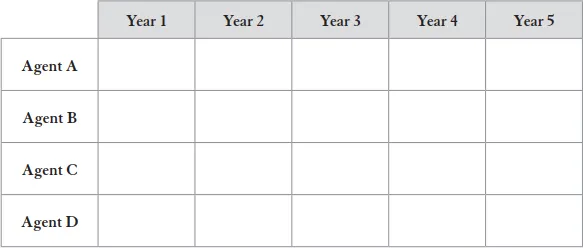
4. Repeat the previous steps for the prior four years to fill in the following chart to examine changing market share over time.
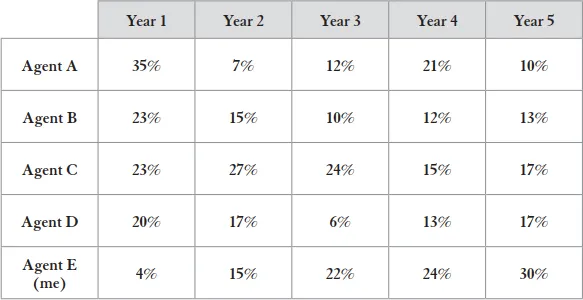
Here’s how the numbers looked as I took over in my farm area.
As the chart illustrates, I started out with only 4% market share as I began to farm the area. However, my research showed that the agent with the largest market share the year I started farming (Agent A), had an inconsistent market share history. The numbers also indicated the lack of one highly dominant agent and no single agent steadily taking over market share. The door was wide open to secure my spot in the farm area.
By year two, my consistent farming efforts were paying off and my market share tripled. Agent A’s roller-coaster trend continued, agent B’s share dipped, while agent C saw a market share jump. Agent D’s share remained fairly constant.
My market share grew nicely into year three as I continued consistent implementation of my farming systems and remained confident that dedication to a c...
Table of contents
Cover
Title Page
Copyright
Dedication
Contents
Preface
Introduction
1. Finding Your Farm
2. Preparing Your Farm
3. Sowing the Seeds
4. Budgeting for Success
5. Harvesting the Fruits of Your First Listing
6. Making Marketing Magic
7. Establishing Farm Dominance
8. Harnessing the Power of Farming Systems
9. Expanding Your Farm
10. Team Farming
11. Becoming a Famous Farmer
12. Selling Your Farm
What’s Next
Acknowledgments
About the Author
Trusted by 375,005 students
Access to over 1.5 million titles for a fair monthly price.
Study more efficiently using our study tools.
Frequently asked questions
Yes, you can cancel anytime from the Subscription tab in your account settings on the Perlego website. Your subscription will stay active until the end of your current billing period. Learn how to cancel your subscription
No, books cannot be downloaded as external files, such as PDFs, for use outside of Perlego. However, you can download books within the Perlego app for offline reading on mobile or tablet. Learn how to download books offline
Perlego offers two plans: Essential and Complete
Essential is ideal for learners and professionals who enjoy exploring a wide range of subjects. Access the Essential Library with 800,000+ trusted titles and best-sellers across business, personal growth, and the humanities. Includes unlimited reading time and Standard Read Aloud voice.
Complete: Perfect for advanced learners and researchers needing full, unrestricted access. Unlock 1.5M+ books across hundreds of subjects, including academic and specialized titles. The Complete Plan also includes advanced features like Premium Read Aloud and Research Assistant.
Both plans are available with monthly, semester, or annual billing cycles.
We are an online textbook subscription service, where you can get access to an entire online library for less than the price of a single book per month. With over 1.5 million books across 990+ topics, we’ve got you covered! Learn about our mission
Look out for the read-aloud symbol on your next book to see if you can listen to it. The read-aloud tool reads text aloud for you, highlighting the text as it is being read. You can pause it, speed it up and slow it down. Learn more about Read Aloud
Yes! You can use the Perlego app on both iOS and Android devices to read anytime, anywhere — even offline. Perfect for commutes or when you’re on the go. Please note we cannot support devices running on iOS 13 and Android 7 or earlier. Learn more about using the app
Yes, you can access Farming, for Real Estate Agents by Meredith Fogle in PDF and/or ePUB format, as well as other popular books in Business & Real Estate. We have over 1.5 million books available in our catalogue for you to explore.