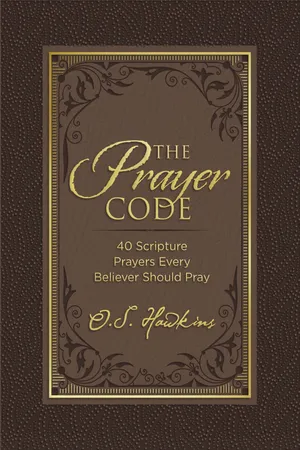
The Prayer Code
eBook - ePub

The Prayer Code

40 Scripture Prayers Every Believer Should Pray

  1. 224 pages
  2. English
  3. ePUB (mobile friendly)
  4. Available on iOS & Android
eBook - ePub

The Prayer Code

40 Scripture Prayers Every Believer Should Pray

About this book

Do you want a richer, more robust prayer life? Your prayers are powerful! Learn how to pray with confidence, faith, and an awareness of the Holy Spirit as you draw from world-changing prayers from Scripture in this inspiring guide to a transformed spiritual life. The Prayer Code is the latest addition to O. S. Hawkins's bestselling series that includes The Joshua Code and The Jesus Code.

David prayed for protection from his enemies. Jesus prayed for all believers. The early Church prayed for courage. The most powerful prayers of Scripture have one thing in common: they reflect the promises of God in His Word, promises that are available to you today, just as they were to people in the Bible.

In The Prayer Code, Hawkins explores biblical prayers to equip you to pray effectively for:

  • peace in times of change
  • courage to overcome your fears
  • healing for yourself and others

Each of the entries includes a prayer, life-guiding principles you can draw from that prayer, and a code word to help you apply those truths to your life. With its presentation page and ribbon marker, The Prayer Code makes a beautiful gift for:

  • high school and college graduations
  • Christmas
  • Father's Day and Mother's Day
  • birthdays
  • men and women looking for fresh energy for their prayer life

Whether you offer a prayer of confession, thanksgiving, praise, intercession, petition, or communion, you can be confident that you're praying as the Bible teaches. Transform your prayer life as you learn to pray with passion to a loving Father who longs for you to draw near.

Frequently asked questions

Yes, you can cancel anytime from the Subscription tab in your account settings on the Perlego website. Your subscription will stay active until the end of your current billing period. Learn how to cancel your subscription.
No, books cannot be downloaded as external files, such as PDFs, for use outside of Perlego. However, you can download books within the Perlego app for offline reading on mobile or tablet. Learn more here.
Perlego offers two plans: Essential and Complete
  • Essential is ideal for learners and professionals who enjoy exploring a wide range of subjects. Access the Essential Library with 800,000+ trusted titles and best-sellers across business, personal growth, and the humanities. Includes unlimited reading time and Standard Read Aloud voice.
  • Complete: Perfect for advanced learners and researchers needing full, unrestricted access. Unlock 1.4M+ books across hundreds of subjects, including academic and specialized titles. The Complete Plan also includes advanced features like Premium Read Aloud and Research Assistant.
Both plans are available with monthly, semester, or annual billing cycles.
We are an online textbook subscription service, where you can get access to an entire online library for less than the price of a single book per month. With over 1 million books across 1000+ topics, we’ve got you covered! Learn more here.
Look out for the read-aloud symbol on your next book to see if you can listen to it. The read-aloud tool reads text aloud for you, highlighting the text as it is being read. You can pause it, speed it up and slow it down. Learn more here.
Yes! You can use the Perlego app on both iOS or Android devices to read anytime, anywhere — even offline. Perfect for commutes or when you’re on the go.
Please note we cannot support devices running on iOS 13 and Android 7 or earlier. Learn more about using the app.
Yes, you can access The Prayer Code by O. S. Hawkins in PDF and/or ePUB format, as well as other popular books in Theology & Religion & Religion. We have over one million books available in our catalogue for you to explore.

Information

1

A PRAYER OF AFFECTION

“Our Father . . .”
—MATTHEW 6:9
How many times have those two words escaped your lips over the years of your own Christian experience? Hundreds? Thousands? They have become so familiar that we often rush through and skip over them in our quest to get to the more direct requests of this model prayer—“Give us . . . forgive us . . . deliver us.” But take a step back for just a moment and think on those words—“Our Father.” No matter who we might be, whether we have just begun the faith journey or have been walking this path for decades, we can all begin our prayer time with this foundation of true prayer—“Our Father.”
I remember the day when I made the marvelous discovery, as a new believer, that I did not have to enter into prayer as some beggar cowering down at the back door, begging for a handout. I am God’s own child and seated at His own table. This gives me confidence and even boldness to approach Him. Before we rush once again into the repetition of our Lord’s Prayer, let’s pause just a moment at these first two words.

AN UNSELFISH RECOGNITION

The foundation of true prayer is built on an unselfish recognition. He is our Father. In fact, a careful reading of this model prayer reveals the repeated use of these plural pronouns—our and us. So often we approach the Lord in prayer with a string of “I, I, I” or “me, me, me” or “my, my, my.” When we pray as Jesus taught us, there are no singular pronouns, only plural ones. He is not just “My” Father; He is “Our” Father. To my earthly family I am an only child, but in the family of God there is no such thing.
To my earthly family I am an only child, but in the family of God there is no such thing.
When we pray, “Our” Father, we are acknowledging that we are a part of a big family. Some are different in doctrine, race, culture, or social standing. But the family includes all believers. I have prayed this prayer in countries where believers were under intense persecution or where they were dominated by caste systems, in Africa in open-walled churches under tin roofs, with Arab believers in Muslim countries, in Cuba with those still oppressed by a failed communist regime, in Israel with Jewish believers, and with my Black and Hispanic brothers and sisters in America. Saints in prayer all appear as one. This is what Jesus prayed for us in His high intercessory prayer when He prayed, “. . . that they all may be one . . . that the world may believe that You sent Me” (John 17:21).
The next time you pray this prayer commonly known as the Lord’s Prayer, stop at this first word and remember all that is behind it. He is “Our” Father. When we say, “Our Father,” we are acknowledging that the true brotherhood of man is really in the family of God. This is the foundation of our praying, for true prayer is built on this unselfish recognition.

AN UNSHAKABLE RELATIONSHIP

When we say, “Our Father,” we take a step further to acknowledge that the foundation of true prayer is also based on an unshakable relationship. The only way we can refer to Him as “Father” is if we have been born into His family. Many have the erroneous idea that we are all God’s children. We are not. We are all God’s creations, but we are not all God’s children. The Bible is plain on this point. John said, “As many as received Him, to them He gave the right to become children of God” (John 1:12). Paul, inspired by the Holy Spirit wrote, “You are all sons of God through faith in Christ Jesus” (Galatians 3:26). It is plain. Only those who have put their faith in Christ alone and have been born again into His forever family can pray, “Our Father.”
As we read the Gospels, we discover that Jesus used the word Father dozens of times in prayer. There is only one occurrence in the New Testament when He prayed without the use of this word. It was on the cross. Three times Jesus prayed from that instrument of execution from which He hung. The first time, “Father, forgive them” (Luke 23:34). The final time, “Father, into Your hands I commit My spirit” (Luke 23:46). But in between those two prayers, when darkness enveloped the earth, when He was bearing our own sin in His own body, is the only time He refrained from using the word Father. He cried out, “My God, My God, why have You forsaken Me?” (Matthew 27:46). In the act of bearing the sins of the world, He was separated from the Father so that we might be enabled and empowered to pray based on an unshakable relationship—“Our Father.”
All true prayer is built on an unselfish recognition. He is our Father. And it is based on an unshakable relationship. He is our Father. These two words we have repeated for most of our lives form the very foundation of all our prayers. If we have come to Christ in faith, we are part of a large family and are God’s own children, born again by faith in Him. So the real question is this: Can you pray, “Our Father”?

CODE WORD: FAMILY

Today, when you talk to a family member, speak to your dad, or see a photo of him, let it be a reminder to you that you are a member of another family, a much larger one, the family of God. And remember, the true brotherhood of man is found in God’s forever family, where we are more closely related to one another through the blood of Christ than to our own blood relatives who do not know Him.

CODE VERSE

As many as received Him, to them He gave the right to become children of God, to those who believe in His name. (John 1:12)

2

THE MODEL PRAYER

“Our Father in heaven, hallowed be Your name. Your kingdom come. Your will be done on earth as it is in heaven. Give us this day our daily bread. And forgive us our debts, as we forgive our debtors. And do not lead us into temptation, but deliver us from the evil one. For Yours is the kingdom and the power and the glory forever. Amen”
—MATTHEW 6:9–13
For most of us, prayer does not come naturally, nor does it come effortlessly. It is a learned behavior. This is why the disciples requested our Lord to “teach” them to pray (Luke 11:1). In this most famous of all prayers, the Master Teacher does just that—He teaches us to pray. Even though this prayer is the most recited and repeated prayer of the Bible, Jesus never said, “Pray this prayer.” In fact, earlier in this same conversation He had admonished us to “not use vain repetitions” when we pray (Matthew 6:7) but to use this prayer as a model for our praying. Thus, Jesus gives us a model, a formula, around which to construct our prayers and present our petitions before Him. His desire is that we will pray with an eye to His glory, resulting in an answer for our own good.
God is not impressed with our longwinded prayers that are filled with lofty words and often holier-than-thou cadences in our inflective voices. He is basically saying, “Keep it simple. Pray like this from your heart.”

THE OBJECT OF THIS PRAYER IS FOR GOD’S GLORY

We glorify the Lord when we are sincere in our worship, sensitive in our witness, and submissive to His will. The model prayer is 100 percent petition, and the first petition is the request that God’s name be praised: “Hallowed be Your name.” This involves the element of sincere worship. The word hallowed means sanctified, to be set apart. The place to begin in prayer is with an acknowledgment that the name of the Lord is different from every other name. He is holy and must be approached with reverence and respect.
God is glorified when we are not simply sincere in our worship but when we are sensitive in our witness. The Teacher continues admonishing us to pray, “Your kingdom come.” At this point in the model prayer we are praying that the kingdom of grace might come to the hearts of those we know who need to know Jesus. But there is a larger dimension to this expression. When we request that Christ’s kingdom comes, we are also praying for the coming kingdom of glory, when the Lord Jesus Christ returns to this earth and sets up His earthly kingdom, reigning and ruling from the throne of David in Jerusalem during a millennium of perfect peace.
Glorifying God in prayer also involves our being submissive to His will. We are to pray, “Your will be done on earth as it is in heaven.” True prayer will always lead us to the place of elevating God’s will over our own will in the issues of life. What Jesus preached to us on the grassy green hillside in Galilee in this model prayer, He, Himself, practiced beneath the old olive trees of Gethsemane’s garden the night before He was crucified. Hear him as He prayed, “Not as I will, but as You will . . . Your will be done” (Matthew 26:39, 42). True prayer involves surrendering our own wills to His will for us.
True prayer will always lead us to the place of elevating God’s will over our own.

THE OUTCOME OF THIS PRAYER IS FOR OUR GOOD

Jesus is teaching us to ask Him for our provision—“Give us this day our daily bread.” We are to pray with a spirit that is dependent on Him to meet our daily needs. And note, it is “daily” bread for which we are to pray. Most of us are keenly aware that the Bible relates bread to the Word of God. We need this kind of bread “daily” in our own walk with Him. What a privilege to lay our basic needs before Him and trust Him for our provision.
We are also admonished to pray not just for our provisions but for our pardon—“Forgive us our debts, as we forgive our debtors.” True prayer will always employ this element of confession of sin in order that our sins may be forgiven. I wonder how many hundreds, perhaps thousands of times some believers have recited this prayer without ever thinking of what they are asking of the Lord. Do we truly want God to forgive us “as,” in the same way, that we forgive those who have wronged us? This makes this a dangerous prayer to pray. Some of us are prone to say of someone who may have wronged us, “I will forgive him or her, but I won’t have anything else to do with them.” Is that really the way you want God to forgive you? It is a powerful thing to pray, “Forgive us our debts, as we forgive our debtors.” Immediately after Jesus finishes this model prayer, the very next verse holds a powerful promise: “If you forgive men their trespasses, your heavenly Father will also forgive you” (Matthew 6:14).
Finally, Jesus teaches us to pray for protection—“Do not lead us into temptation, but deliver us from the evil one.” Temptation is something we all face each day, and there is a vast difference in the trials we may face and the temptations that may come our way. Temptation comes from the devil to cause the believer to stumble. Trials are allowed by the Lord to enable us to stand. God will make a “way of escape” for those of us who sincerely pray for deliverance (1 Corinthians 10:13).
Jesus concludes this teaching on prayer by challenging us to pray this compelling acknowledgment that closes with a cascading crescendo: “For Yours is the kingdom and the power and the glory forever. Amen.”

CODE WORD: MODEL

Today, as you go about your work and witness and see a model home or perhaps look at a set of architectu...

Table of contents

  1. Cover Page
  2. Title Page
  3. Copyright Page
  4. Contents
  5. Introduction
  6. 1. A Prayer of Affection
  7. 2. The Model Prayer
  8. 3. God-Honoring Prayer
  9. 4. The Trinity and Prayer
  10. 5. Prayer According to the Will of God
  11. 6. Our Prayer Partner
  12. 7. A Tale of Two Prayers
  13. 8. A Prayer for a New Beginning
  14. 9. True Confession
  15. 10. Prayer and Revival
  16. 11. Making the Ask
  17. 12. The Prayer of Jabez
  18. 13. The Prayer That Gets Results
  19. 14. Praying Through the Tabernacle
  20. 15. A Prayer for Service
  21. 16. Just a Call Away
  22. 17. A Prayer of Desperation
  23. 18. A Prayer of Rejoicing
  24. 19. Prayer and the Harvest
  25. 20. Listen to Him
  26. 21. The Pattern of Prayer
  27. 22. The Original Lord’s Prayer
  28. 23. Praying With Power
  29. 24. What Happens When People Pray?
  30. 25. A Prayer for Direction
  31. 26. God Is Listening
  32. 27. First Things First
  33. 28. Put On the Gospel Armor
  34. 29. Prayer Is the Battlefield of the Christian Life
  35. 30. Praying for the Sick
  36. 31. The Prayer That Avails Much
  37. 32. Prayer and Fasting
  38. 33. Praying for the Lost
  39. 34. Answered Prayer
  40. 35. A Prayer of Acknowledgment
  41. 36. Prayer and the Will of God
  42. 37. Watch and Pray
  43. 38. Prayers from the Cross
  44. 39. A Prayer of Affirmation
  45. 40. The Last Prayer of the Bible
  46. Epilogue
  47. Mission:Dignity
  48. About the Author