In the past fifty years, port cities around the world have experienced considerable changes to their morphologies and their identities. The increasing intensification of global networks and logistics, and the resulting pressure on human societies and earthly environments have been characteristic of the rise of a »planetary age«. This volume engages with contemporary artistic practices and critical poeticsthat trace an alternate construction of the imaginaries and aspirations of our present societies at the crossroads of sea and land – taking into account complex pasts and interconnected histories, transnational flux, as well as material and immaterial borders.
eBook - ePub
Maritime Poetics
From Coast to Hinterland
- English
- ePUB (mobile friendly)
- Available on iOS & Android
eBook - ePub
Maritime Poetics
From Coast to Hinterland
About this book
Information
Part 1: Work and leisure in the port city
Altona: Between land and sea
Vanessa Hirsch
Vanessa Hirsch is a curator at Altonaer Museum, one of the largest regional museums in Germany. The museum presents the cultural-historical development of the Elbe region around Altona, Schleswig Holstein and the coastal areas of the North and Baltic Seas. The collection contains graphics, paintings, textiles, toys and cultural-historical objects from the fields of arts and crafts, shipping, life, and work in the countryside and in the city. The institution was founded in 1863 as a regional museum for the then independent city of Altona. Today, Altona is one of the seven boroughs of Hamburg. In the following piece, Vanessa Hirsch describes her curatorial work at the institution. She begins by outlining key aspects of Altona’s history and its special relationship with the river and the regional hinterland, before moving on to discuss three recent exhibitions. All three exhibitions were multi-faceted projects, using works of art to gain insights into the historical past. Through these displays, Hirsch reflects on the agency of regional cultures in the global age and their capacity to nurture contemporary mythologies.
Altona was an independent city from 1664 to 1937, until it was merged with Hamburg. Today, Altona is one of Hamburg’s seven districts. In 1664, Altona was given a town charter by the Danish crown to encourage growth as a port city and a site for commerce and manufacture. Geographically, the city of Altona was extremely close to Hamburg. As a port city, Hamburg had been a centre of trade and commerce in Northern Europe since the middle ages. The idea in 1664 was to create a competitor to Hamburg in its direct vicinity. The Danish crown hoped to increase taxes by stimulating trade in Altona. In 1664, the Danish ruled the duchies of Schleswig and Holstein. Altona was part of the duchy of Holstein. Hamburg and the region south of the Elbe did not belong to the Danish sphere of influence.
In order to encourage people to trade in Altona, the town chapter allowed things that were forbidden not only in Hamburg but in most other European cities as well. The port was made Northern Europe’s first free port. Manufacturers of goods were not forced to join a guild, which made mass production, which was strictly forbidden in Hamburg, possible. Furthermore, and most importantly, freedom of faith was guaranteed. These unique conditions attracted immigration, especially by those who were not allowed to practice their faith in Hamburg: Jews, Calvinists, Catholics, Mennonites. Some, like the Sephardic Jews or Mennonites, were extremely well connected all over Europe and established prospering trading houses in Altona. During the last three centuries, however, Hamburg has always been the far more successful port city, relegating Altona to a mere borough. Nevertheless, Altona is very proud of its legacy as an open city that welcomes foreigners. Today, most of Altona’s inhabitants describe themselves as being open-minded, as being a little bit different.
The River Elbe connects Hamburg and Altona with the North Sea, and its riverbanks were used for the ports of Hamburg and Altona. For centuries, the Elbe was perceived as a gateway to faraway regions all over the world. Historically, the river was used to connect the cities with their hinterland. Agricultural goods like vegetables, fruit or corn from regions like Vierlande or Altes Land reached the towns’ markets by boat. In comparison, Altona’s ties with its hinterland were always much closer than Hamburg’s. The reasons are political: Hamburg has always been an independent city and the surrounding regions were subject to different rulers. Altona, by contrast, was part of the duchy of Holstein; from 1640 onwards, the Danish kings were dukes of Schleswig and Holstein. So, there was no political separation between the city and its hinterland: Altona was part of a region that also shared a cultural history.
Culturally, the duchies of Schleswig and Holstein are shaped by their closeness to the sea. The goods produced in the region were traded in Altona. In regional culture, the sea is understood as a promise. New and extremely fertile land can be gained by diking, agriculture can be exported as ports are close. On the other hand, the sea is a huge threat, as floods can destroy everything in a matter of hours. The sea brings wealth for seamen or fishermen; at the same time the profession is dangerous and ships can easily sink. Since the early nineteenth century, the sea has attracted tourists, still a source of wealth today. As for the maritime business, during the last decades, there has been a decline in Schleswig-Holstein. Smaller ports along the coasts, engaged in the import/export business, have closed their doors, and fishing has been reduced continually. In contrast, Hamburg’s port is doing quite well. Altona’s commercial port closed during the 1980s, only a cruise terminal and small marinas remain. 1
Altona’s history is not the same as Hamburg’s, which is why it is still worth telling. Altonaer Museum was founded in 1863 by local citizens and run privately until 1888. In 1901, a new regional museum was opened right in the prestigious centre of the town to educate the workers living in Altona about the cultural history of Schleswig-Holstein and the traditions of its pre-industrial society. We still maintain this mission, although we use a twenty-first-century perspective that deconstructs narratives about traditions and elitist views on society. In the following pages, I will describe how this influences my museum work. I will focus on three exhibitions that were mounted in the last decade. The first exhibition, titled In flux. A panoramatic view on the river Elbe, offered a multi-disciplinary view on Altona’s relationship with the river Elbe; Quiet peasants and sturdy fishermen? Northern Germany in photography analysed Altonaer Museum’s collection of historic photographs; Better Living in Altona? City Development in the 20th and 21st Century gave an overview of urban development in the district of Altona. These exhibitions have one aspect in common: contemporary art was an integral part in exhibitions that dealt with historical topics.
Exhibition In flux. A panoramatic view on the river Elbe, 2006
Altona’s history has always been closely tied to the river. In 1536, a fisherman from Hamburg was in search of a new business and opened a small inn on the Elbe riverbank, right at the border that separated Hamburg from the duchy of Pinneberg; according to one local legend, Altona’s name is an allusion to its location ‘all to nah’ or ‘all too close’, to Hamburg. A small pier was added and soon developed into a place for trade; it came to be known as the Altona Fischmarkt and has been the centre of Altona ever since. Over the years, the riverbank developed into a harbour. In 1664, Altona was given a town charter and its residents started taking up long-distance trade. The town prospered and grew, especially during the eighteenth century.
In 2006, the museum team decided to mount an exhibition about Altona. A short discussion revealed that the most important thing about Altona was its special relationship with the river. We therefore focused on the Elbe as our subject. We wanted to give a multidisciplinary, panorama-like view of the Elbe, yet focus exclusively on the part flowing through the district of Altona, as our institution is dedicated primarily to the history of Altona. The objective was to gain new insight into the history of the city by mixing disciplines, such as politics, economics, biology, as well as literature and the arts. The introductory section in the first room was called ‘On the river’.Here, our visitors were given background information on the ships that are such an integral part of the scenery: trading vessels, their cargo bringing the world into town. Which types of ships were used over the centuries, what was typical cargo, where did it come from and who sailed the ships? A second room focused on the themes eminent ‘Along the riverbanks’: tourism and recreation. Tourists and locals alike enjoy the views, people take strolls, use the beaches, some even swim. A third room was dedicated to the world ‘Under the river’, focusing on eels as these are typical for the river ecology near Hamburg. Biological background information was mixed with cultural history, including regional fishing techniques, local recipes for eel-soups, interviews with fishermen.2
We chose an interdisciplinary perspective, mixing art history, political history, economic history and cultural history with biology. The objects on display were diverse, too: paintings, prints, photographs, ship models, porcelain, textiles, children’s toys, taxidermy objects, as well as 100 litres of Elbe-water. To add another layer of meaning, we asked a group of students from the local art academy to contribute their perspective. Over the course of one year, they did their own research and developed artworks. In the end, we were able to show twenty works of art in a wide range of media: film, sound, installation works, paintings and drawings, and sculpture. For instance, a sound installation by Marte Kießling greeted the visitors by using tapes from the Ship Greeting Station Welcome Point at Wedel-Willkommhoeft, which is a tourist destination on the riverbank. Karsten Wiesel’s video work showed all the impressions of a person taking a boat ride from Altona’s fish market to Willkommhoeft. Silke Silkeborg, Willem Mueller and Yoonjoo Cho depicted the landscape close to the Elbe in paintings and drawings. Almut Gryptra’s work Exzellentes strong hand mammut uses worn working gloves found near the river to sculpt a dress onto her own body. All these student works were shown in various sections of the exhibition, their subject matter matched with the thematic sections in the exhibition. One installation work even went on public display outside of the museum. Paul Sochacki’s Loreley, a neon sculpture, was erected in a public park famous for offering the best views of the river, and of the Port of Hamburg.
Fig. 1: Paul Sochacki, Loreley, 2006 © Historische Museen Hamburg, Altonaer Museum

The work alludes to the myth of Loreley, as described in the famous poem by Heinrich Heine. A beautiful young woman sits high on a rock near the river Rhine, singing while combing her long blond hair. The skippers on the river get so fascinated by this sight that their ships founder on the nearby cliffs. Sochacki transferred the myth from one famous river to the other. His neon Loreley was meant to lure the seamen on the freighters passing by on their way to the Port of Hamburg. The artist’s choice of material refers to the neon signage at St. Pauli and its famous nightclubs, traditionally places where sailors can spend their money. In the exhibition, a sailor’s way of life and their traditions was one of our topics in the section ‘On the river’. For the museum, the public sculpture was a great way to integrate a part of our exhibition into the everyday life of the Elbe. The sculpture was part of the park for ten years. It had to be dismantled in 2016 when the council needed the location to present other works of art. In general, the students’ artworks worked very well. They commented on the historical topics with fresh eyes and an artistic perspective. To me, this was a perfect approach for our multi-disciplinary exhibition.3
Exhibition Quiet peasants and sturdy fishermen? Northern Germany in photography, 2015
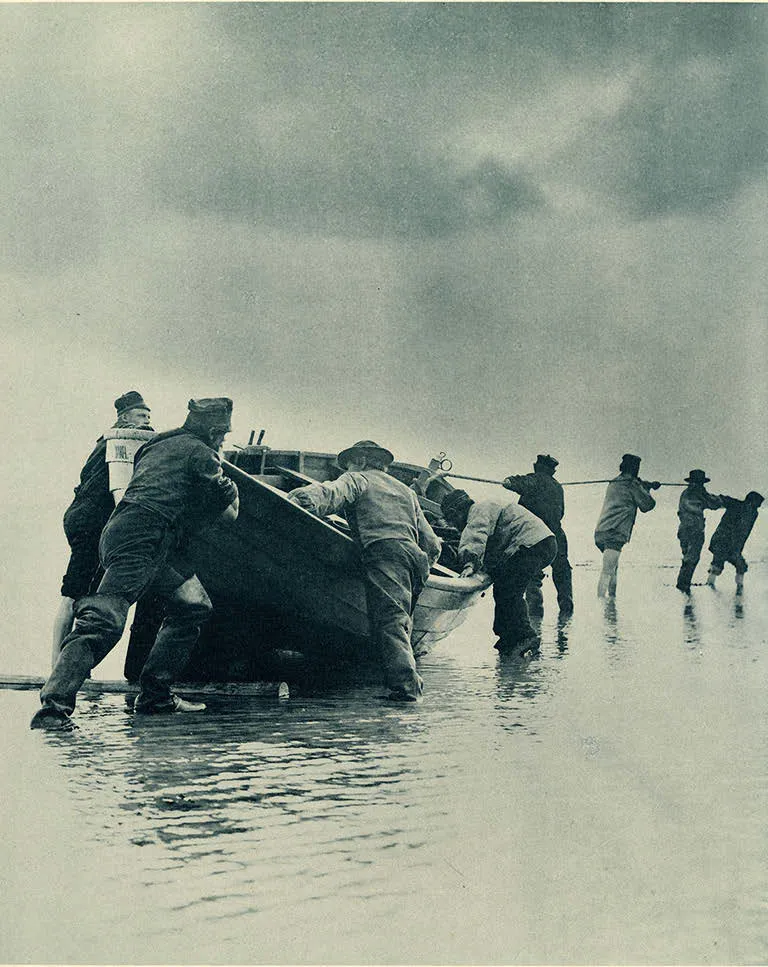
This exhibition aimed to offer an insight into the Altonaer Museum’s huge photographic collection. In order to document the regional culture of Northern Germany more than 100.000 photographs had been collected at Altonaer Museum, starting in 1901. Most of these pictures were taken between 1860 and 1950. They depict various local traditions, houses, ships, and tools used for typical crafts. We observe fishermen on their boats, farmers taking in the harvest, women spinning yarn, men and women wearing regional costumes.
To many viewers, these photographs seem to depict the most common stereotypes that come to mind when they hear the keyword ‘Northern Germany’. Among the museums’ collections, these photographs were not regarded as art. For internal classification, recording aspects such as where and when the picture was taken and the specifics of the local tradition it documented was deemed more important than noting the photographer’s name. In total, the collection was meant to be used as a visual encyclopedia of local culture. Yet, despite this seemingly prosaic use, a great part of the pictures was taken according to the standards of the Pictorialist movement in photography and therefore has a close connection to nineteenth-century painting. By exhibiting photographs and paintings together, we were able to prove that the source of the stereotypical image of Northern Germany as portrayed in the photographic collection of Altonaer museum is part of the aesthetics of nineteenth-century painting.
Fig. 2: Wilhelm Dreesen, At work, 1891 © Historische Museen Hamburg, Altonaer Museum
Yet can the same be true for today? Do the same stereotypes still influence our contemporary perception of the landscape and its inhabitants? Is there anything ‘typically local’ in the age of globalisation, where the same furnit...
Table of contents
- Cover
- Title Page
- Copyright Page
- Contents
- Foreword
- Introduction: maritime introspections
- Part 1: Work and leisure in the port city
- Part 2: Commerce
- Part 3: Metabolic pressure
- Part 4: Dreamscapes
Trusted by 375,005 students
Access to over 1.5 million titles for a fair monthly price.
Study more efficiently using our study tools.
Frequently asked questions
Yes, you can cancel anytime from the Subscription tab in your account settings on the Perlego website. Your subscription will stay active until the end of your current billing period. Learn how to cancel your subscription
No, books cannot be downloaded as external files, such as PDFs, for use outside of Perlego. However, you can download books within the Perlego app for offline reading on mobile or tablet. Learn how to download books offline
Perlego offers two plans: Essential and Complete
- Essential is ideal for learners and professionals who enjoy exploring a wide range of subjects. Access the Essential Library with 800,000+ trusted titles and best-sellers across business, personal growth, and the humanities. Includes unlimited reading time and Standard Read Aloud voice.
- Complete: Perfect for advanced learners and researchers needing full, unrestricted access. Unlock 1.5M+ books across hundreds of subjects, including academic and specialized titles. The Complete Plan also includes advanced features like Premium Read Aloud and Research Assistant.
We are an online textbook subscription service, where you can get access to an entire online library for less than the price of a single book per month. With over 1.5 million books across 990+ topics, we’ve got you covered! Learn about our mission
Look out for the read-aloud symbol on your next book to see if you can listen to it. The read-aloud tool reads text aloud for you, highlighting the text as it is being read. You can pause it, speed it up and slow it down. Learn more about Read Aloud
Yes! You can use the Perlego app on both iOS and Android devices to read anytime, anywhere — even offline. Perfect for commutes or when you’re on the go.
Please note we cannot support devices running on iOS 13 and Android 7 or earlier. Learn more about using the app
Please note we cannot support devices running on iOS 13 and Android 7 or earlier. Learn more about using the app
Yes, you can access Maritime Poetics by Gabriel N. Gee, Caroline Wiedmer, Gabriel N. Gee,Caroline Wiedmer in PDF and/or ePUB format, as well as other popular books in Social Sciences & Art General. We have over 1.5 million books available in our catalogue for you to explore.