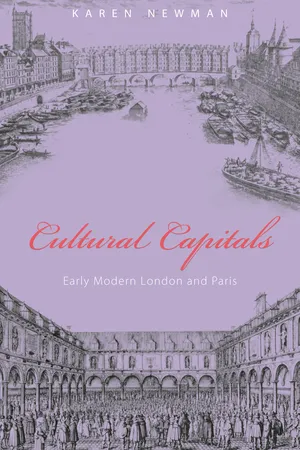
Social theories of modernity focus on the nineteenth century as the period when Western Europe was transformed by urbanization. Cities became thriving metropolitan centers as a result of economic, political, and social changes wrought by the industrial revolution. In Cultural Capitals, Karen Newman demonstrates that speculation and capital, the commodity, the crowd, traffic, and the street, often thought to be historically specific to nineteenth-century urban culture, were in fact already at work in early modern London and Paris.
Newman challenges the notion of a rupture between premodern and modern societies and shows how London and Paris became cultural capitals. Drawing upon poetry, plays, and prose by writers such as Shakespeare, Scudéry, Boileau, and Donne, as well as popular materials including pamphlets, ballads, and broadsides, she examines the impact of rapid urbanization on cultural production. Newman shows how changing demographics and technological development altered these two emerging urban centers in which new forms of cultural capital were produced and new modes of sociability and representation were articulated.
Cultural Capitals is a fascinating work of literary and cultural history that redefines our conception of when the modern city came to be and brings early modern London and Paris alive in all their splendor, squalor, and richness.
- 224 pages
- English
- ePUB (mobile friendly)
- Available on iOS & Android
eBook - ePub
About this book
Information
Publisher
Princeton University PressYear
2021Print ISBN
9780691141107
9780691127545
eBook ISBN
9781400832705
CHAPTER ONE
Early Modern London and Paris
On April 29, 1665, the architect and sculptor Bernini left Rome for Paris, where he spent several months at the invitation of Louis XIV.1 Summoned to complete the Palais du Louvre, Bernini was escorted throughout his stay by Paul Fréart, Seigneur de Chantelou, the younger son of a minor French nobleman. An admirer of Italian art and a speaker of the language who had known Bernini during a sojourn in Rome, Chantelou was appointed Bernini’s cicerone by the king and wrote an account of the artist’s visit to France, supposedly at the request of his elder brother, as this dedicatory note recounts:
Le désir que vous avez eu d’être instruit de tout ce qui regarde M. le Cavalier Bernin, que le roi a appelé de Rome en France pour le bâtiment du Louvre, a fait que j’ai taché de me souvenir de ce qui s’est passé aux premiers jours de son arrivée, que je ne pensais pas encore a` noter ces sortes de particularités, comme j’ai fait depuis. J’en ai donc dressé, suivant votre avis, une espéce de journal que vous recevrez avec cette lettre.
Knowing how much you wish to learn everything about the Cavalier Bernini, who was summoned by the King to France from Rome to design the new palace of the Louvre, I have tried to remember what happened during the first days of his visit, before I thought of noting down the events of his daily life. On your advice I have arranged it as a sort of journal, which I am sending with this letter.2
Chantelou’s text presents a double displacement. As its title indicates, it purports to be a journal of Bernini’s visit to Paris, but it is written not by Bernini himself but by his royally appointed guide and courier; next, Chantelou himself claims his account was dressé—advanced, set right, built, erected, made, fashioned—to please his elder brother’s desire to know. Yet the excess of detail in setting forth the circumstances of Bernini’s visit (“le roi a appelé de Rome . . .”) makes plain that the elder Chantelou’s announced desire is itself a pretext, a self-protective aristocratic disclaimer to mitigate the scandal of writing.3 The Journal, heretofore read primarily by art historians interested in Bernini and his bust of Louis XIV, in architectural style, in patronage and clientage systems, and in seventeenth-century aesthetic debates, also demonstrates the movement and fortunes of cultural capital across early modern Europe and provides a snapshot of the cultural life of a seventeenth-century urban elite.
Chantelou’s Journal in fact exemplifies what I will argue are three topoi of the urban. Two are urban spatial practices that I suggest are heuristically powerful for reading the literature and culture of seventeenth-century Paris and London: the prospect or survey and the promenade; the third is a cultural practice linked to urban exchange and sociability, collecting: the practice of acquiring, displaying, and visiting the great collections being amassed in Europe and particularly, in this case, London and Paris, in the course of the seventeenth century.
Some two months after the artist’s arrival in Paris, Chantelou describes a dinner he and Bernini attend in the suburb of Meudon, a village near Saint-Cloud. Meudon’s situation presented the visitor with a view of Paris and was a popular place of resort from which to survey the city. Chantelou recounts Bernini’s response at the view of Paris presented from Meudon: the artist complains that he could see only a mass of chimneys that made the Parisian skyline resemble a carding comb (“un amas de chéminées [et que cela paraissait comme un peigne a` carder]” [102]). He proceeds to compare Paris and its crowded urban prospect with Rome, whose monuments—Saint Peter’s, the Coliseum, the palaces of Saint Mark, Farnese, and the Colonna, the Campidoglio—present a magnificent aspect. Chantelou counters that Paris’s buildings and monuments, though as beautiful, are pressed one against the other and therefore obscured from view.4
This deceptively simple anecdote epitomizes the representational history of the city in the early modern period. Skylines, as architectural historians point out, are urban signatures that trace a distinctive urban identity.5 Urban landmarks symbolize the collective life of a city, its religious and governmental hierarchies, civic priorities, and technological progress.6 Until the early modern period, depictions of cities in the West were conventional, even formulaic, often based on the scriptural model of the heavenly Jerusalem. Early images of Jerusalem, for example, often depicted an out-of-scale Dome of the Rock, Florence was represented with a highlighted Santa Maria del Fiore, and medieval Parisian city scenes show Notre Dame looming extravagantly large. During the Renaissance, representations of cities were similarly contrived, but to conform instead to the increasingly secular expectations and military aspirations of a patron or prince or to the mercantile interests of travelers and merchants.7
As early as the Nuremberg Chronicle we find illustrations of cities, but in the early modern period the most famous collection of city images is Braun and Hogenberg’s monumental folio, Civitates orbis terrarum, published in five volumes between 1572 and 1618 and produced both for travelers and for those wishing to travel “at home” (figs. 1 and 2).8 It allowed its owner to view the various cities of Europe from several perspectives: the stereographic—from the ground or from not far above, but at some distance; the aerial—from above; and a combination of the two—maps with elevations. Such perspectives helped to produce a totalizing eye/I, a unitary subjectivity organized around a fictive knowledge based on scopic mastery that fosters what Michel de Certeau has called an “erotics of knowledge.”9Many visual and verbal early modern cityscapes represent their objects from the perspective of a “voyeur-god,” from impossible, bird’s-eye heights. The affective power and pleasure of such perspectives were already recognized in the seventeenth century. Here is Burton in The Anatomy of Melancholy: “A good prospect alone will ease melancholy. . . . What greater pleasure can there now be than to view those elaborate Maps of Ortelius, Mercator, Hondius, &c. To peruse those books of Cities put out by Braunus and Hogenbergius?”10 Though Burton initially claims that “a good prospect alone” will ease melancholy, he goes on to extend that power to the viewing and perusing of maps and urban topographies, that is, to reading. His “now” insists on the novelty of these newly developing technologies and extends the mastery of space they enable from prince and palace to the humanist in his library perusing maps and “books of Cities.”


On one hand, Bernini’s boast about the prospect of Rome and its skyline emphasizes its social and civic order by foregrounding its public buildings and institutions, its glorious Roman past, and its contemporary artistic achievement. On the other hand, his description of Paris’s mass of chimneys like a carding comb implies disorder, helter-skelter growth, and the city’s teeming urban populace and its daily work that are mostly missing from Chantelou’s account and ordinarily suppressed in the idealizing depictions of the conventional cityscape below the threshold at which visibility begins.11 Bernini’s comparison of Parisian roofs and chimneys to a carding comb also works to pastoralize Paris and undermine its status as a city and cultural center by linking it to the countryside and its homely occupations. Ironically, the very possibility of distinguishing Rome’s monuments and palaces marks its difference from Paris—in Bernini’s day, Rome was a small city, its palaces and monuments set off by fields and undeveloped green space.12
The entry ends with the two men’s return to Paris and Bernini’s demand that Chantelou and his brother find the artist “quelqu’un intelligent en lunettes,” someone skilled in the grinding of lenses. In a parable that continues the comparison of Paris and Rome begun earlier in the evening, Bernini explains that a certain Stefano in Rome had presented him with eyeglasses so well ground they enabled the artist “voir les objets justes et sans alterations, ce qui n’est pas nécessaire pour ceux qui ne demandent des lunettes que pour lire” (to see objects precisely and without distortion, which isn’t required by those who need glasses merely for reading [103]). In this fable on the artist’s eye, the new technology of lens grinding is appropriated on behalf of the artist’s privileged vision.“Lunettes bien taillés” enable him not merely to read, but to see, and what he sees are cities—a spacious, ordered Rome, a crowded, commonplace Paris. But, significantly, that privileged artist’s sight is mediated by the narrator Chantelou. Writing disallows presence and the privilege accorded the gaze of the eyewitness. We see not what Bernini’s eye/I sees but what Chantelou says he sees. In that displacement is recorded all the complexities of Bernini’s position as a foreigner and an artist of the baroque in a culture committed to an increasingly classicizing aesthetic. The seamless constitution of subjectivity around the gaze is disrupted. However exceptional the artist Bernini and his aristocratic handler, Chantelou, the displacements enacted in Chantelou’s memorial account of Bernini’s visit to Paris, putatively produced for his brother, stage the constitution of a metropolitan subjectivity that pretends to the presence of the gaze and yet is only an effect of writing. In that sense, this book is also concerned with the spatialization of the written word—with maps, prospects, engravings, graphs, paintings, books and pamphlets, epigraphs, typography—in short, with myriad forms of notation.13
Chantelou’s Journal also instances another significant urban spatial practice, the “promenade.” Traversing urban space—the streets and gardens, quais and squares, public buildings, fairs, markets, and exchanges of the city—was perhaps the chief pastime of the early modern city dweller regardless of social rank.14 Organizing urban space to allow for such movement was a significant obligation of the early modern monarch; some of those spaces were open only to the court, some to the elite, still others to honnêtes gens, and a few to a broader public.15 Pedestrian movement and, increasingly in the course of the seventeenth century, vehicular movement shaped urban space to form “systems whose existence in fact makes up the city.”16 The “promenade” is an elite spatial acting out of place that denoted moving to and fro, without a necessary goal or end point, and which begins to be used in the late sixteenth century. Within Chantelou’s text, the promenade is a space of enunciation witnessed by the myriad verbs of motion that record the comings and goings of the narrator as he squires his celebrated guest around the city and its environs: aller, promener, mener, arriver, revenir, retourner, repartir, ramener. Bernini and his French host pass to and fro, seeing and being seen, sometimes in the coach of the king, through urban spaces. They visit palace and cathedral, hotêl and chapel, riding academy and theater, and the grand urban gardens of Paris, often called “promenades,” acting out their status. In the course of their daily outings, promenades, and visits, Chantelou takes Bernini to see the collections of the Parisian elite—books, engravings, painting, sculpture, tapestry—and Bernini offers his judgments. There are allusions to the practice of extemporaneous poetic composition, to the technical and aesthetic aspects of theater, to clothing and music, to riding academies and gardens, in short, to the pastimes of an urban elite. Bernini and Chantelou skip over other spaces and practices outside the aristocratic loop, places to which the text alludes only in Bernini’s cavalier demand that numerous houses and shops obstructing his grand, never-initiated design for the Louvre be demolished.17
Walking the City
If the promenade was a chief pastime of the early modern urban elite, walking was that of the middling sort and the poor.18 The people of Paris who inhabited the houses and shops Bernini planned to demolish, though excluded from prospect and promenade, experienced the city through walking its streets. In his well-known essay “Walking the City,” Michel de Certeau contrasts the view from the top with the everyday practices of city dwellers “down below” who, in traversing the city on foot, produce their own itineraries and maps. They walk, de Certeau says, and thus escape the “imaginar...
Table of contents
- Cover Page
- Title Page
- Copyright Page
- Dedication
- Contents
- List of Figures
- Acknowledgements
- Introduction
- Chapter One: Early Modern London and Paris
- ChapterTwo Toward a Topographic Imaginary
- Chapter Three: Walking Capitals
- Chapter Four: “Filth, Stench, Noise”
- Chapter Five: Courtship and Consumption in Early Modern Paris
- Chapter Six: Armchair Travel
- Chapter Seven: Death, Name, and Number
- Chapter Eight: Sex in the City
- Epilogue: Paperwork
- Notes
- Index
Trusted by 375,005 students
Access to over 1.5 million titles for a fair monthly price.
Study more efficiently using our study tools.
Frequently asked questions
Yes, you can cancel anytime from the Subscription tab in your account settings on the Perlego website. Your subscription will stay active until the end of your current billing period. Learn how to cancel your subscription
No, books cannot be downloaded as external files, such as PDFs, for use outside of Perlego. However, you can download books within the Perlego app for offline reading on mobile or tablet. Learn how to download books offline
Perlego offers two plans: Essential and Complete
- Essential is ideal for learners and professionals who enjoy exploring a wide range of subjects. Access the Essential Library with 800,000+ trusted titles and best-sellers across business, personal growth, and the humanities. Includes unlimited reading time and Standard Read Aloud voice.
- Complete: Perfect for advanced learners and researchers needing full, unrestricted access. Unlock 1.5M+ books across hundreds of subjects, including academic and specialized titles. The Complete Plan also includes advanced features like Premium Read Aloud and Research Assistant.
We are an online textbook subscription service, where you can get access to an entire online library for less than the price of a single book per month. With over 1.5 million books across 990+ topics, we’ve got you covered! Learn about our mission
Look out for the read-aloud symbol on your next book to see if you can listen to it. The read-aloud tool reads text aloud for you, highlighting the text as it is being read. You can pause it, speed it up and slow it down. Learn more about Read Aloud
Yes! You can use the Perlego app on both iOS and Android devices to read anytime, anywhere — even offline. Perfect for commutes or when you’re on the go.
Please note we cannot support devices running on iOS 13 and Android 7 or earlier. Learn more about using the app
Please note we cannot support devices running on iOS 13 and Android 7 or earlier. Learn more about using the app
Yes, you can access Cultural Capitals by Karen Newman in PDF and/or ePUB format, as well as other popular books in Literature & European History. We have over 1.5 million books available in our catalogue for you to explore.