At the turn of the twentieth century, William James was America's most widely read philosopher. In addition to being one of the founders of pragmatism, however, he was also a leading psychologist and author of the seminal work, The Principles of Psychology (1890). While scholars argue that James withdrew from the study of psychology after 1890, Eugene Taylor demonstrates convincingly that James remained preeminently a psychologist until his death in 1910.
Taylor details James's contributions to experimental psychopathology, psychical research, and the psychology of religion. Moreover, Taylor's work shows that out of his scientific study of consciousness, James formulated a sophisticated metaphysics of radical empiricism. In light of historical developments in psychology, as well as the current philosophic implications of the neuroscience revolution related to the biology of consciousness, Taylor argues that both the subject matter of James's investigations and his metaphysics of radical empiricism are just as important for psychology today as James believed they were in his own time.
This book represents a major new contribution both to James scholarship and to the history of American psychology. Although philosophers have analyzed radical empiricism, this book is the first to trace the development of radical empiricism as a metaphysics addressed to psychologists. It is also the first to show James's involvement in depth-psychology and psychotherapeutics and to trace historical continuity between James's work on consciousness and subsequent developments in psychoanalysis, personality theory, and humanistic psychology.
- 232 pages
- English
- ePUB (mobile friendly)
- Available on iOS & Android
eBook - ePub
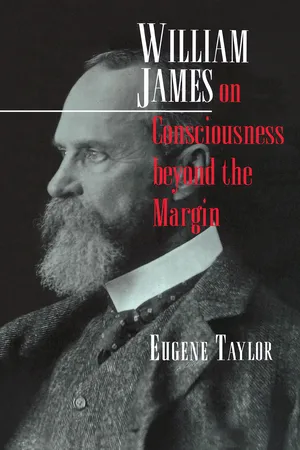
William James on Consciousness beyond the Margin
About this book
Information
Publisher
Princeton University PressYear
2021Print ISBN
9780691151144
9780691011363
eBook ISBN
9781400822195
Chapter One
AN OUTLINE OF THE PROBLEM
WILLIAM JAMES, whether loved or reviled, looms large in the history of American psychology. He was the first to wrest control of psychology from the abstract philosophers by adapting study of mental functioning to the methods of physiology. He was the first to take up the scientific study of consciousness within the context of the new evolutionary biology. He was the first to teach the new scientific psychology in the United States in 1875; the first to open a laboratory for student instruction that same year; the first to grant a Ph.D. in the new discipline, to G. Stanley Hall, in 1878; and the first American to write a world-famous textbook, The Principles of Psychology (1890), from the positivist point of view. Moreover, a list of his many beloved students reads like a Who’s Who of the discipline. As teacher, colleague, and friend, he touched the lives of James Rowland Angell, Gertrude Stein, Robert Yerkes, E. L. Thorndike, Walter Cannon, William Healy, Robert Woodworth, Boris Sidis, L. Eugene Emerson, Mary Calkins, E. B. Holt, and more.
But he fell out with the Social Darwinists when he championed the importance of the individual over the survival of the species. He scandalized the philosophers and the scientists with his theory that emotions do not follow cognitions, but rather are the complex of our immediate physiological perceptions. He offended the medical establishment by his eloquent and successful defense of the mental healers, and he appeared to abandon psychology altogether after 1890 when his experimentalist detractors said that professionally he had fled into philosophy and personally he had become lost in the occult.
The truth of the matter is, however, that, far from abandoning psychology, James was paying close attention to then recent advances in experimental psychopathology, a new field which historians have shown developed out of psychical research and the French experimental psychology of the subconscious, and in both lines James himself was a pioneer.1 Experimental evidence for the pathology of the emotions and for the reality of multiple subconscious states caused James to reevaluate the antimetaphysical position he had taken in The Principles. This led him to his metaphysics of radical empiricism and to a sophisticated critique of experimentalism in scientific psychology after 1890.2
Psychologists first heard of radical empiricism, although as yet unnamed, when James delivered his presidential address to the American Psychological Association in 1894. There Janies asserted that any legitimate scientific psychology must contend with the fact that no scientific system can ever be free of metaphysics. In James’s case this meant that laboratory investigation, which was defined by strict materialism and positivist epistemology, could not possibly establish itself as the only legitimate form of knowledge-getting in psychology simply by asserting that it was antimetaphysical. James’s analysis showed that positivistic reductionism was, rather, based on a metaphysics of physicalism. James was willing to concede that, by confining attention only to models of the external world, replicable effects were produced that approximated normal interaction between the organism and the environment. Such modeling, however, could not possibly apply to an understanding of the internal phenomenological life of the person, to beliefs, attitudes, values, or to the phenomena of changing states of consciousness. Experimentalism, radical materialism, or reductionistic positivism, as he came to call it, could never lead to an understanding of the whole person. Instead of ignoring the individuality of the subject by focusing exclusively on normative scientific data, he believed that the core of the discipline should be a scientific study of consciousness, by which he meant experience in all its forms and manifestations.
To James this meant, among other things, that psychologists should take an in-depth look at the phenomenology of the science-making process. It also meant that if positivism was itself based on an implied metaphysics, then other philosophical systems could also plausibly govern scientific psychology. James envisioned his metaphysics of radical empiricism as serving such a function, which he developed as an epistemology, in turn, to justify his pioneering work in abnormal psychology, psychical research, and the psychology of religion, particularly between 1890 and 1902.
But the experimentalists ignored him as a psychologist after the publication of his Principles in 1890. They criticized him in print for his support of the mental healers; they accused him of making a full flight into theology; and they absolutely denied any philosophical bias to their own definition of science. Eulogized in public for fathering the New American Psychology, but castigated in private by the laboratory types as irrelevant, when he died in 1910 it was nevertheless generally recognized by psychologists the world over that a major figure had passed from the scene.
But did James really abandon psychology after 1890? After all, this is the contention of almost all modern psychology textbooks that mention him in any detail; it is the prevailing opinion aired by the most noted historians of the discipline; and it was a view widely held by James’s own contemporaries who played a major role in the development of modern psychology as an experimental, laboratory-based enterprise.3
My answer to the question, on the other hand, shall be a resounding “no!” In fact, as I read the evidence, James abandoned only the reigning positivist epistemology of the era. His own scientific sensibilities had been fostered under the local Harvard influences of such men as Charles Peirce, the mathematical logician and interpreter of Kant who first introduced James to the German psychophysicists; and Chauncey Wright, who had been an avid follower of the works of Comte and Mill before turning to Darwin. James had then gone on to fight his own pitched battles against the scientific pretensions of Herbert Spencer and the Social Darwinists and the political motives of medical scientists trying to infuse all of culture with reductionism. All this prepared him for the positivism of Mach and Avenarius, and for the German experimental laboratory tradition that soon came to dominate the new scientific psychology by the end of the nineteenth century.
By the 1890s, the German ideal of science, with its emphasis on determinism, materialism, and reductionism, began to gain prominence in American universities. James thought that it had created a barren brass instrument psychology, too much artificial busywork in the laboratory, and a glut of measurements carried to three decimal places, which, in the end, the experimentalists themselves admitted had no meaning except to justify their new love affair with precision. Growing more and more devoid of concrete references to human experience, psychology, according to William James, was in danger of degenerating into mere experimentalism.
James preferred instead to redefine psychology anew in terms of an evolving person-centered discipline, in vital touch as much with philosophy and the humanities as with physics and the natural sciences. At the center of this new psychology, at first only glimpsed in numerous eleventh-hour footnotes and newly written passages in his Principles of Psychology, was a dynamic conception of personality and consciousness, which, for the first time in his thinking, gave formal recognition to the impact of personal metaphysics in the collective enterprise of psychology as a science. His new position acknowledged the reality of consciousness as an ultimate plurality of states; it shed significant light on then current scientific studies of personality disintegration; it admitted the iconography of the transcendent as a crucial determinant of personality transformation; and it provided James with an analytic tool powerful enough to critique the unexamined assumptions of radical materialism in experimental science.
To understand his change from positivism to radical emipiricism is to throw new light on a variety of problems James took up, from experimental psychopathology, psychical research, the social psychology of crowds, the psychology of painting, our understanding of creative genius, and the psychology of education, to the experience of transcendence in religious awakening. Indeed, his psychological investigations during this pivotal phase of his career, particularly between 1890 and 1902, I shall maintain, significantly informed the development of his technical philosophy, which in turn he used to justify the possibility of a scientific psychology centered on the person rather than the laboratory.
WHAT WE KNOW OF JAMES’S PSYCHOLOGY AFTER 1890
While it is true that James’s contributions to psychology after 1890 continue to be largely overlooked or misinterpreted, there is a handful of scholars who have considered James’s activities as a psychologist during this era. Dorothy Ross has alluded to this period in her review of G. Stanley Hall’s relation to James, but she gives greater stress to Hall’s point of view.4 Otto Marx reviewed the neurological and psychiatric journals during this time and concluded that James made no contribution to the literature.5 Archie Baum, as well as Gardner Murphy and Robert O. Ballou, have written in defense of James’s studies of psychic phenomena, but deal only with James’s published materials, and they cast their interpretation against the implicit backdrop of twentieth-century definitions of parapsychology and not the nineteenth-century context of psychical research.6 Grace Foster has given one of the most thorough analyses of James’s personal and professional involvement in psychotherapy during this period, while H. D. Spoerl has reviewed with much accurate detail James’s contribution to abnormal and social psychology.7 Both these authors made their ideas known only in brief articles read by limited audiences, and they did not fully draw out the implications of James’s psychology after 1890 for later developments, either in James’s thinking or in the field of psychology at large.8
Within the history of medicine, Henry Ellenberger, Nathan G. Hale, and John Burnham have mentioned James’s contribution to the rise of American psychotherapy in the late nineteenth century, but only as a prelude to the coming of Freud.9 While they have broached James’s influence on the so-called Boston School of Abnormal Psychology and pointed to his association with such lights as Morton Prince, Boris Sidis, James Jackson Putnam, and Josiah Royce, only when taken collectively does their work suggest that James played an important role in the development of a uniquely American psychology of the subconscious, now largely forgotten because it was later inundated by the flood of Freudian psychoanalysis and then politically torpedoed by the prophets of behaviorism. Norman Cameron has given a summary of James’s contribution to the American reception of psychoanalysis, seconded by Barbara Ross.10 Saul Rosenzweig in 1959 has suggested that Freud might even have been influenced by James’s stream of consciousness technique, particularly as it derived from the method of automatic speaking, writing, and drawing described by James John Garth Wilkinson, a translator of Swedenborg, pastoral psychiatrist to the James family, and older colleague of William James in the field of abnormal psychology.11
Despite this wealth of information, historians of psychology and psychiatry continue to suggest that James was more of a philosopher than a psychologist; that his efforts in the field of psychical research were somehow not scientifically legitimate; that his dabbling in the unconscious was merely a naive precursor to Freud; and that after The Principles of Psychology in 1890 James was not involved in anything that could be called psychology by his more experimentally oriented colleagues. Thus, a work such as The Varieties of Religious Experience (1902) represents to James’s most reductionistic scientific detractors a full flight into theology, even though James himself claimed that in examining religious consciousness he spoke from the standpoint of a psychologist. Clearly, to stretch a point to its limit, most experimental psychologists do not read James after 1890, if they read him at all, while theologians, ministers, and psychologists of religion tend to ignore him before Varieties of Religious Experience.
While James scholars generally have managed to avoid most of these problems, three tendencies are nevertheless clear: (1) James is often interpreted out of context according to an author’s own more modern and oftentimes less eclectic frame of reference. James’s name is then invoked as anticipating some exclusive future trend; hence, when writing about the Jamesean influence in psychology, we have James the pioneer psychoanalyst, James the pioneer behaviorist, or James the pioneer phenomenologist, all simultaneously claimed by adherents among the rival schools. (2) Most James scholars rely primarily on James’s published works, on only the most accessible letters, or on only a limited reading of the vast collection on deposit at the Houghton Library at Harvard. And (3), only in certain instances has Ralph Barton Perry’s initial interpretation of James and his psychology been questioned or revised. Despite Perry’s eminent status as a philosopher in his own right, and despite the circumstances that he was first a student and later friend and designated biographer—and that he deserved the Pulitzer Prize he won for his life of James—he was still highly selective about what he emphasized in James’s writings. Perry, ultimately a Western philosopher in the American academic tradition, tended to gloss over James’s activities in psychical research, his psychology of the subconscious, the Asian influences, and the impact of the New England Mind-Cure Movement on James’s thinking as a psychologist.12
Indeed, I shall maintain that even in his most positivistic phases, William James espoused a psychology which I would characterize as a person-centered science. True, he was a man of many moods and mirrors. He appeared to change his mind on an issue many times and indeed at one point said that he really didn’t mind contradicting himself. But there is sufficient evidence to suggest that the general orientation toward a person-centered science was present in his work when he first entered the field of psychology in the 1870s. He may have waxed hot and cold during different decades over it as a primary focus, yet it remained hovering in the background even in his most reductionistic pronouncements. Despite his antimetaphysical claims, his Principles is suffused with this person-centered orientation, and it comes out most cogently in the period between 1890 and 1902, when he became intensely involved in problems of experimental psychopathology, psychical research, and the psychology of religion. As I shall also attempt to indicate, the influence of James’s psychology during this period was extensive, not only in relation to the subsequent content areas and methodologies inherent in the numerous subdisciplines he covered, but also because his views on the implicit metaphysical assumptions even of the most rabid positivist epistemology continue to cast important light on the present state and future prospects of psychology.
This thesis I shall defend in five stages. First, I would like to establish that from its very inception, James’s psychology, while it focused on the scientific study of consciousness, remained person-centered. Second, while James self-consciously established a positivist epistemology in his Principles of Psychology, even there he injected important psychological material that had clear metaphysical implications for his later philosophical critique of science. Third, using archival manuscripts as well as his published works, I would like to ask, “Just what were James’s activities as a psychologist after 1890, and particularly before 1902?” and to answer by showing that his endeavors demonstrate the foundation upon which he believed a person-centered science could be built. Fourth, I would like to examine the opposition that developed in America to James’s program for psychology, chiefly among a coterie of Wundt’s American students who wished to displace James’s influence with the rhetoric and methods of the German experimental laboratory tradition. Fifth, I intend to enunciate the grounds upon which James repudiated the positivist epistemology of these German-trained students, claiming their agenda to be an ill-conceived basis for constructing a scientific psychology. In stating my conclusions, I would like to highlight what I understand to have been James’s final message to psychologists about some potential future trends in the discipline.
Chapter...
Table of contents
- Cover Page
- Title Page
- Copyright Page
- Dedication
- Contents
- Preface
- Acknowledgments
- Chapter One: An Outline of the Problem
- Chapter Two: Consciousness: The Focus of Experimental Psychology at Harvard before 1890
- Chapter Three: Consciousness and the Subconscious: The Conundrum of The Principles
- Chapter Four: The Reality of Multiple States: Abnormal Psychology and Psychical Research
- Chapter Five: Mystical Awakening: An Epistemology of the Ultimate
- Chapter Six: The Anti-Jamesean Movement
- Chapter Seven: James’s Rejoinder: A Critique of Experimentalism in Psychology
- Chapter Eight: James’s Final Statement to Psychologists
- Notes
- Annotated Bibliography
- Index
Trusted by 375,005 students
Access to over 1.5 million titles for a fair monthly price.
Study more efficiently using our study tools.
Frequently asked questions
Yes, you can cancel anytime from the Subscription tab in your account settings on the Perlego website. Your subscription will stay active until the end of your current billing period. Learn how to cancel your subscription
No, books cannot be downloaded as external files, such as PDFs, for use outside of Perlego. However, you can download books within the Perlego app for offline reading on mobile or tablet. Learn how to download books offline
Perlego offers two plans: Essential and Complete
- Essential is ideal for learners and professionals who enjoy exploring a wide range of subjects. Access the Essential Library with 800,000+ trusted titles and best-sellers across business, personal growth, and the humanities. Includes unlimited reading time and Standard Read Aloud voice.
- Complete: Perfect for advanced learners and researchers needing full, unrestricted access. Unlock 1.5M+ books across hundreds of subjects, including academic and specialized titles. The Complete Plan also includes advanced features like Premium Read Aloud and Research Assistant.
We are an online textbook subscription service, where you can get access to an entire online library for less than the price of a single book per month. With over 1.5 million books across 990+ topics, we’ve got you covered! Learn about our mission
Look out for the read-aloud symbol on your next book to see if you can listen to it. The read-aloud tool reads text aloud for you, highlighting the text as it is being read. You can pause it, speed it up and slow it down. Learn more about Read Aloud
Yes! You can use the Perlego app on both iOS and Android devices to read anytime, anywhere — even offline. Perfect for commutes or when you’re on the go.
Please note we cannot support devices running on iOS 13 and Android 7 or earlier. Learn more about using the app
Please note we cannot support devices running on iOS 13 and Android 7 or earlier. Learn more about using the app
Yes, you can access William James on Consciousness beyond the Margin by Eugene Taylor in PDF and/or ePUB format, as well as other popular books in Psychology & History & Theory in Psychology. We have over 1.5 million books available in our catalogue for you to explore.