The problem of trust in social relationships was central to the emergence of the modern form of civil society and much discussed by social and political philosophers of the early modern period. Over the past few years, in response to the profound changes associated with postmodernity, trust has returned to the attention of political scientists, sociologists, economists, and public policy analysts. In this sequel to his widely admired book, The Idea of Civil Society, Adam Seligman analyzes trust as a fundamental issue of our present social relationships. Setting his discussion in historical and intellectual context, Seligman asks whether trust--which many contemporary critics, from Robert Putnam through Francis Fukuyama, identify as essential in creating a cohesive society--can continue to serve this vital role.
Seligman traverses a wide range of examples, from the minutiae of everyday manners to central problems of political and economic life, showing throughout how civility and trust are being displaced in contemporary life by new "external' system constraints inimical to the development of trust. Disturbingly, Seligman shows that trust is losing its unifying power precisely because the individual, long assumed to be the ultimate repository of rights and values, is being reduced to a sum of group identities and an abstract matrix of rules. The irony for Seligman is that, in becoming postmodern, we seem to be moving backward to a premodern condition in which group sanctions rather than trust are the basis of group life.
- 240 pages
- English
- ePUB (mobile friendly)
- Available on iOS & Android
eBook - ePub
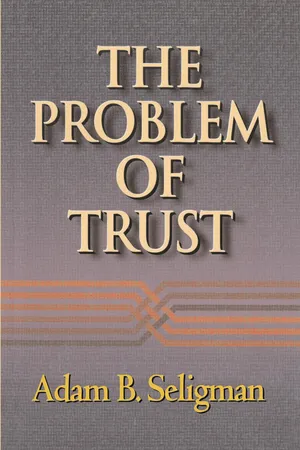
The Problem of Trust
About this book
Information
Publisher
Princeton University PressYear
2021Print ISBN
9780691050201
9780691012421
eBook ISBN
9781400822379
Topic
PhilosophySubtopic
Political PhilosophyPart One ______________
THE PROBLEM OF TRUST
One __________________________
Trust, Role Segmentation, and Modernity
Introducing a Modern Problem
The existence of trust is an essential component of all enduring social relationships. As Talleyrand is reported to have said: “You can do anything with bayonets except sit on them.”
Power, dominance, and coercion can, in this reading, be a temporary solution to the problem of social order and the organization of the division of labor therein, but they will not in themselves provide the basis for the maintenance of said order over time. Such aspects of social organization as the structuring of the major markets in society (of power, prestige, and wealth), the construction and definition of the Public Good (and the myriad public goods of which it is constructed), and the rules and regulations for the public distribution of private goods rest, in all societies—from the premodern to the most postmodern—on some interplay of coercion and consent, of market and community, of instrumental and affective commitments and so also of the reigning definitions, boundaries, and extent of trust in society.1
This insight has found its place as one of the fundamental concepts of sociology and sociological analysis. Indeed, from the nineteenth century and the theoretical insights of Emile Durkheim on the existence of a “precontractual” element in all social arrangements, the importance of trust to the existence of society has been recognized by many students of social life.
On the most general and abstract level it can be stated that the need for perduring, stable, and universally recognized structures of trust is rooted in the fundamental indeterminacy of social interaction. This indeterminacy, between social actors, between social actors and their goals, and between social actors and resources results in a basic unpredictability in social life notwithstanding the universality of human interdependence.2 Consequently, any long-range attempt at constructing a social order and continuity of social frameworks of interaction must be predicated on the development of stable relations of mutual trust between social actors. Clearly, however, different forms of organizing society (on the macrosociological level) will bring in their wake different forms of establishing trust in society.
In this context one of the major arenas where the study of trust—on the interpersonal as well as the institutional level—has been central, has been in the study of modernization.3 Here, studies in the 1950s and 1960s concentrated on the establishment of new bases of trust in society centering on new terms of solidarity, of citizenship, and what were, in fact, new parameters defining the boundaries of trust in modernizing social structures.
This focus on the changing nature of trust in modernizing societies is indeed not surprising given the extraordinary importance of a universal basis of trust in modern, democratic societies. The emphasis in modern societies on consensus, the ideology of pragmatism, problem-solving, and technocratic expertise, as well as conflict management (as opposed to ideological fission), are all founded on an image of society based on interconnected networks of trust—among citizens, families, voluntary organizations, religious denominations, civic associations, and the like.4 Similarly the very “legitimation” of modern societies is founded on the “trust” of authority and of governments as generalizations of trust on the primary, interpersonal level. In fact, the primary venues of socialization, whether they be the educational system or the mass media, are oriented to the continuing inculcation of this value and what is in fact an “ideology” of trust in society. Finally, and perhaps most importantly, the definitions of trust in Western industrialized and “modern” societies are rooted in the idea of the individual as final repository of rights and values. In these societies, it is the individual social actor, the citizen of the nation-state and not any collectively defined, primordial or corporate entity who is seen as at the foundation of the social order and around whom the terms of social trust are oriented.
The current concern with and revival of the idea of civil society, as essentially a clarion call to defining new terms of generalized trust in modern democratic societies, points to crises in those bases of trust that have defined the modern nation-state for the past two hundred years.5 Similarly, the continuing debates between communitarians and liberals over the terms of citizenship and the definition of the Public Good, as well as the seemingly irreparable chasm between normative and rational-choice theorists over their respective visions of the social order, all point to what seem to be fundamental problems (in theory as in practice) in the terms of generalized trust and the modes of its operation. Any solution to these problems must begin, however, with a clarification of terms, and the obvious place to begin is with an attempt to understand just what is meant by the term trust. This chapter is dedicated to an explication of that problem.
While there will be occasion to return again and again to the problematic connection between trust and modes of social organization, it may be wise, here at the outset, to note that an awareness of the problems of establishing generalized modes of social trust is as old as modernity itself. From the writings of Puffendorf and Grotius to those of John Locke, David Hume, and Immanuel Kant, the duty of “promise-keeping,” of honoring one’s declaration of will (decleratio, or signum voluntatis), becomes a central component of political theory.6 And, whereas for Grotius the obligation to fulfill promises was an element of natural law, for Kant the “perfect duty” of promise-keeping is what unites us in a moral community, is itself the woof and weave of those “bonds of mutual respect between members of a moral community.”7 Promise-keeping then is what allows the constitution of a moral community, in fact of society tout court. This attitude toward promise-keeping was as true for Locke as for Hume. And if for Locke “grants, promises and oaths are bonds that hold the Almighty,” for Hume they were but one of the three “artifices of society,” necessary for its constitution: no longer divine dictates, but nonetheless “a rule-dependent or convention-dependent road to commitments beyond family and friends to those whom we bear no ‘real kindness.’ ”8
What, however, is the early modern concern with promise-keeping if not a concern with establishing social bonds of trust in a society increasingly being defined by individual agents with interests and commitments of an increasingly personal nature? The breakup of local, territorial, and, crucially, primordial ties that accompanied Europe’s entry into the modern era engendered, as is well known, a new concern with redefining the nature of society.9 With the destruction of these bonds of primordial attachment to kith and kin, to territorial and local habitus, which had defined Western European societies until the Reformation, new forms of generalized trust had to be established. The early modern concern with promise-keeping must, I submit, be viewed in this light, as essentially an attempt to posit new bonds of generalized trust in societies where primordial attachments were no longer “good to think with” (to borrow a phrase from Claude Lévi-Strauss). The promise then is an act of will that invites trust among strangers, that is, among those who share no ties of affinity, kinship, or even shared belief. It is, as has been attested by many, “a speech act whereby one alters the moral situation” by incurring new obligations.10 The social ties predicated on these obligations and the moral force of one’s commitment to them thus serve (or at least were seen to serve by early modern political theorists) as forging a new model of (and as Clifford Geertz would remind us, “for” as well) the political community—one based on a shared belief in the very act of promise-keeping.
It may even be said that the attempt to found a political community on the basis of mutual promise-keeping was essentially an attempt to construct a new community of belief predicated not on blood, but on belief itself. It may not even be too exaggerated a claim to state that the maintenance of such a community—one predicated solely on mutual promise-keeping— and so also of trust defined in generalized (and hence always potentially universal) terms has been the enduring challenge of modern societies during the past two centuries. What is certain is its centrality to social thought and political theory throughout the whole of this period. The interest in establishing nonascriptive bases for trust has been a constant theme from John Locke’s concern with “trustworthiness, fidelity, the keeping of agreements and promises and respect for oaths” as a precondition for the existence of society, through the writings of the Scottish moralists on “natural sympathy,” Edmund Burke’s writings on the “little platoons” of society, and down to the later, nineteenth-century theorists of society such as Tönnies, Maine, and Durkheim. Indeed, Durkheim produced what was perhaps the boldest of solutions, in essence defining the problem away by positing the basis of modern solidarity (i.e., of a moral community of belief, and so of shared trust) as resting on our shared belief in the integrity of the individual conscience: “Since each of us incarnates something of humanity, each individual consciousness contains something divine and thus finds itself marked with a character which renders it sacred and inviolable to others. Therein lies all individualism; and that is what makes it a necessary doctrine.”11 Here the necessary (and modern) doctrine of (true) individualism (as opposed to its utilitarian or Spencerian variety) rests on the collective cognizance of the sacred individuality of each member. That this “solution” to the modern problem of trust was no solution (despite the heroic attempts of Talcott Parsons and others who attempted to systematize and generalize its implications) is by now more than clear.12
A political or intellectual history of these debates, while certainly called for, is not our concern here. Our purpose in the above discussion is simply to establish the centrality of the issue of trust to modern social and political thought and in so doing, point out how inexorably woven together are the problems of trust and the construction of modern social and political orders: how the problem of establishing trust—or more specifically generalized trust—defines as it does the specificity of modernity. Again, this is not to say that the problem of trust is not the problem of all social order; only that the breakdown of primordial and other ascriptive identities which has (to different degrees and at different times) accompanied the “great transformation” of modernity in the West has made of this an enduring and seemingly intractable problem and one that is again of major concern to students of social life.13
The Problem Explained
But what is trust and how are we to understand the specific forms of social relations predicated on its existence? More especially, how are we to distinguish it from such seemingly similar terms as faith and confidence— terms which are often used synonymously but which may well carry different valences and refer to arguably different types of social phenomena? A useful point of departure may then be to try and isolate the distinction between trust and confidence. True, most social scientists tend to conflate both terms in myriad studies of the degree of trust (or, as I would argue, confidence) in social and government institutions.14 However, we have only to recall the old German proverb Vertrauen ist gut, Sicherheit noch besser (trust is good, confidence better) to realize that social scientists notwithstanding, ordinary people have long distinguished between these two modes of interaction or rather the cognitive and emotional states that accompany such interaction.15 This distinction, by the way, is preserved in some of the more recent philosophical literature on trust that distinguishes between trust and reliance.16
Among sociologists, some recent work has touched on this distinction between trust and confidence in ways that are not fully adequate. Thus, for example, Lewis and Weigert’s statement that “trust begins where prediction ends” would seem to indicate a recognition of this distinction.17 For these researchers as for others, such as Rotter, however, trust—as distinct from confidence—is often reduced to an individual psychological state, a generalized expectation that alter will fulfill promises or obligations, and such expectation is tied to the experiences of early socialization.18 Similar reduction of the meaning of trust to an individual psychological (or emotional) state can be found in the work of Lars Hertzberg, T. Govier, Richard Holton, and even in the more rational account of Russell Hardin.19 Hardin, in fact, presents a rationalized account of trust as a learned capacity that serves on the individual level to permit the extension of confidence on the general level toward the institutions of society. Thus while he does distinguish trust from confidence and attempts a rational account of the former’s emergence, this account ends up being tied to the early socialization experiences of the individual (affluent middle-class white, as opposed to innercity black children, for example), which then go on to allow one rather than the other that necessary confidence in the system to take risks. In the end, for him too, trust is tied to some psychological orientation.
A more sociological attitude can be found in the writings of Anthony Giddens, who distinguishes between trust in people and trust in “abstract systems.” Trust in persons “is built upon mutuality of response and involvement: faith in the integrity of another is a prime source of feeling of integrity and authenticity of the self. Trust in abstract systems provides for the security of day-to-day reliability, but by its very nature cannot supply either the mutuality or intimacy which personal trust relations offer.”20 Giddens goes further and relates this distinction in types of trust to the old sociological chestnut of the difference between traditional and modern societies, between, in Ferdinand Tönnies’s terms, Gemeinschaft and Gesellschaft. Thus he notes:
In pre-modern settings basic trust is slotted into personalized trust relations in the community, kinship ties, and friendships. Although any of these social connections can involve emotional intimacy, this is not a condition of the maintaining of personal trust. Institutionalized personal ties and informal or informalized codes of sincerity and honor provide (potential, by no means always actual) frameworks of trust.21
This situation he contrasts with contemporary life where, “with the development of abstract systems, trust in impersonal principles, as well as in anonymous others, becomes indispensable to social existence.”22 Here then is what in essence amounts to a threefold classification: trust in persons, trust in institutionalized personal ties, and trust in abstract systems.
Aside from the confusion involved in using the same term—trust—to describe all three forms of social relations, there is a further and more critical problem with the above scheme. For Giddens does not really define analytically the difference between institutionalized personal ties and the abstract systems of contemporary life. Institutionalized personal ties are by their nature abstract, as any cursory inquiry into medieval lineages or tribal systems of kinship affinity will prove. And while we no doubt do exist in a world of abstract systems, we also exist in a world where the bonds of friendship tie us to special places and people as well as in a world regulated by more institutionalized personal ties.23 Moreover, and equally telling, abstract systems themselves (whether of money or, ...
Table of contents
- Cover Page
- Title Page
- Copyright Page
- Contents
- Acknowledgments
- Introduction
- Part One: The Problem of Trust
- Part Two: The Representation of Trust and the Private Sphere
- Notes
- Bibliography
- Index
Trusted by 375,005 students
Access to over 1.5 million titles for a fair monthly price.
Study more efficiently using our study tools.
Frequently asked questions
Yes, you can cancel anytime from the Subscription tab in your account settings on the Perlego website. Your subscription will stay active until the end of your current billing period. Learn how to cancel your subscription
No, books cannot be downloaded as external files, such as PDFs, for use outside of Perlego. However, you can download books within the Perlego app for offline reading on mobile or tablet. Learn how to download books offline
Perlego offers two plans: Essential and Complete
- Essential is ideal for learners and professionals who enjoy exploring a wide range of subjects. Access the Essential Library with 800,000+ trusted titles and best-sellers across business, personal growth, and the humanities. Includes unlimited reading time and Standard Read Aloud voice.
- Complete: Perfect for advanced learners and researchers needing full, unrestricted access. Unlock 1.5M+ books across hundreds of subjects, including academic and specialized titles. The Complete Plan also includes advanced features like Premium Read Aloud and Research Assistant.
We are an online textbook subscription service, where you can get access to an entire online library for less than the price of a single book per month. With over 1.5 million books across 990+ topics, we’ve got you covered! Learn about our mission
Look out for the read-aloud symbol on your next book to see if you can listen to it. The read-aloud tool reads text aloud for you, highlighting the text as it is being read. You can pause it, speed it up and slow it down. Learn more about Read Aloud
Yes! You can use the Perlego app on both iOS and Android devices to read anytime, anywhere — even offline. Perfect for commutes or when you’re on the go.
Please note we cannot support devices running on iOS 13 and Android 7 or earlier. Learn more about using the app
Please note we cannot support devices running on iOS 13 and Android 7 or earlier. Learn more about using the app
Yes, you can access The Problem of Trust by Adam B. Seligman in PDF and/or ePUB format, as well as other popular books in Philosophy & Political Philosophy. We have over 1.5 million books available in our catalogue for you to explore.