Robert's Rules of Writing, Second Edition
eBook - ePub

Robert's Rules of Writing, Second Edition

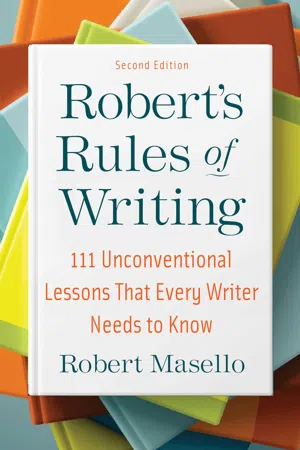
111 Unconventional Lessons That Every Writer Needs to Know

  1. 240 pages
  2. English
  3. ePUB (mobile friendly)
  4. Available on iOS & Android
eBook - ePub

Robert's Rules of Writing, Second Edition

111 Unconventional Lessons That Every Writer Needs to Know

About this book

Bestselling author Robert Masello guides working and aspiring writers alike with the hard-won advice, tricks of the trade, and indispensable encouragement that only a seasoned professional can provide. Although there's no shortage of books on writing and publishing, there's none quite like Robert's Rules of Writing: 111 Unconventional Lessons Every Writer Needs to Know. Drawing on his many years of experience as an award-winning journalist, TV writer, and the author of over twenty books published by mainstream houses and translated, to date, into nineteen languages, Robert Masello addresses all the issues that confront, and all the problems that beset, writers of all stripes.Whether you're working on a novel or a script, a memoir or a blog, an epic poem or a newspaper piece, you're going to have to find the best way to express yourself clearly, persuasively, and entertainingly. You'll have to find your own personal voice (much harder than it sounds) and use that unique voice to convey your story, your thoughts, and your opinions, to the many readers out there that you're eager to reach; with complete candor and welcome irreverence, Robert's Rules of Writing offers the inside knowledge that will help you do just that. As provocative as they are amusing, these rules are purposely designed to challenge the old axioms and get you thinking afresh about your work.In well over a hundred short but pithy takes, Masello guides you over hurdles, around obstacles, and through the seemingly insurmountable barriers to completion and ultimately publication—hooray!—of your writing. It's a lively, thought-provoking, and often downright funny addition to any veteran, or fledgling, writer's shelf.
Frequently asked questions

Yes, you can cancel anytime from the Subscription tab in your account settings on the Perlego website. Your subscription will stay active until the end of your current billing period. Learn how to cancel your subscription.
At the moment all of our mobile-responsive ePub books are available to download via the app. Most of our PDFs are also available to download and we're working on making the final remaining ones downloadable now. Learn more here.
Perlego offers two plans: Essential and Complete
  • Essential is ideal for learners and professionals who enjoy exploring a wide range of subjects. Access the Essential Library with 800,000+ trusted titles and best-sellers across business, personal growth, and the humanities. Includes unlimited reading time and Standard Read Aloud voice.
  • Complete: Perfect for advanced learners and researchers needing full, unrestricted access. Unlock 1.4M+ books across hundreds of subjects, including academic and specialized titles. The Complete Plan also includes advanced features like Premium Read Aloud and Research Assistant.
Both plans are available with monthly, semester, or annual billing cycles.
We are an online textbook subscription service, where you can get access to an entire online library for less than the price of a single book per month. With over 1 million books across 1000+ topics, we’ve got you covered! Learn more here.
Look out for the read-aloud symbol on your next book to see if you can listen to it. The read-aloud tool reads text aloud for you, highlighting the text as it is being read. You can pause it, speed it up and slow it down. Learn more here.
Yes! You can use the Perlego app on both iOS or Android devices to read anytime, anywhere — even offline. Perfect for commutes or when you’re on the go.
Please note we cannot support devices running on iOS 13 and Android 7 or earlier. Learn more about using the app.
Yes, you can access Robert's Rules of Writing, Second Edition by Robert Masello in PDF and/or ePUB format, as well as other popular books in Languages & Linguistics & Authorship. We have over one million books available in our catalogue for you to explore.
RULE 1.
BURN YOUR JOURNAL.
Just about every writing book I know says writing is a muscle that you have to regularly exercise and keep in use, and that if you don’t know what to write, you shouldn’t let that stop you. You should just start keeping a journal and writing down, at random, all your thoughts and ideas.
In my book—this one to be exact—that’s almost always an immense waste of time and paper. The only muscle you’ll be exercise by keeping a journal is your hand, and for that you’d be better off jumping rope.
If you feel like keeping a journal—something that neither you nor anyone else on earth will ever want to read—by all means be my guest.
But if you want to write something that may eventually see the light of day, that a magazine might buy, a publisher publish, or a producer produce, then you’ll have to knock off the journaling and do the grunt work that real writing requires.
Nine out of ten struggling writers get stuck right there. Instead of confronting all the very real problems that any book or article or story poses, they retreat to those blasted journals, on the theory that they’re loosening up their artistic tendons and free-associating their way to fresh ideas.
All they’re really doing is keeping the manufacturers of those fancy blank books, the ones that uselessly clutter up the shelves at your local bookstores, in business.
All too often, writing in a journal is just a stall, a waiting game, a way to tell yourself that you’re working when you’re not, that you’re doing something of value when you’re just using up paper, that you’re a writer when in fact you’re just going through the motions of one. Look at me! I had blank paper in front of me—and now it’s filled with words!
Anyone can do that. Anytime.
The hard part of writing isn’t scribbling words on a page. The hard part is scribbling words that mean something, that make sense, that build a narrative or lay out an argument, that construct a scene or articulate a position. It’s not about how many pages you can cover with ink in a day. In some cases, a good day’s work might be a couple of paragraphs. But if those two paragraphs are right, then they’re a lot more valuable than ten or twenty pages of idle burbling.
Writing takes deliberation and thought, craft and commitment.
If you’re serious about writing, burn the journal, and get to work.
RULE 2.
GET A PEN PAL.
But I don’t want you to think I’m too hard-hearted.
I know what it’s like to be stuck, to have the urgent desire to write, but nothing particular to say just now. That’s usually when those alluring journals come out.
But try this. Instead of writing the stream-of-consciousness twaddle that generally fills those blank pages, try this instead—write a letter, to a friend.
Writing has to have a purpose; it’s meant to communicate something, to someone, and if you’re not ready to write for the general public—many times we’re not—then try writing for a very specific audience—one that you know will be happy to hear from you. (People are so astonished to get letters these days, you might want to send a text in advance to warn them that one is on the way, lest they keel over in shock.) If you must, you could even make your letter an e-mail, but there’s something about the ephemerality of e-mails, or texts and tweets for that matter, that virtually cries out for sloppiness and imprecision. A good, old-fashioned letter, hand-scrawled or printed out on paper, will require you to think before you write, as well as permit you to edit and revise and amend.
All the things, in other words, that honest-to-God writing makes you do!
It’ll also put you in touch with a lot of important things. For one, your ideal audience. Much of the time, writers are stuck because we can’t figure out who we’re writing for, or because we’ve started imagining our audience as an indifferent, even hostile, crowd—a bunch of critics just waiting to take their shot at us. Writing to a friend will remind you that there are nice folks out there, folks you like and who like you back, who would be delighted to hear what you have to say.
Writing a letter can also remind you, in case you’d forgotten, what it is that you actually have to say. Look and see what flows from your flying fingertips, or your scribbling pen. Are you seeking comfort for a broken heart? Are you telling a funny story about the perfectly awful job interview you just went on? Are you ranting about the next-door neighbors who barbecue meats of unknown origin? Whatever it is, that’s what you’re thinking about, that’s what’s on your mind. And, if you wanted to, that’s what you could be writing about for others, too—the dismal job interview could work as a humor piece for a local paper, the cookout kings next door could become characters in a screenplay, the broken romance story might be right for the “Modern Love” column in the New York Times (though the odds of capturing that particular Holy Grail are, I’m told, astronomical. I have the rejection letters—oops, rejection emails—to prove it.)
But because you’re writing now with a purpose and a person in mind—instead of just sprawling all over a journal—you’re paying attention, the way you should, to everything from pace to clarity. You’re writing to interest and even, with any luck, entertain the friend who’s going to receive this letter in a few days. And secretly, you’re looking forward to the reaction your words are going to get.
However limited it may be, writing a letter is a form of publication. Next time you can go after a bigger—and paying—crowd.
RULE 3.
THROW OUT YOUR THESAURUS.
How many times, when you’re telling a story at a party, do you stop dead to search for a bigger, better, or more impressive word than the one you were just about to utter?
Unless you were determined to lose your audience, probably not very often.
So why would you do it when you’re writing?
The best writing is the writing that flows naturally, and without delay or hesitation, from the mind of the writer. It’s writing that appears to have come effortlessly (however much effort actually went into it behind the scenes). It’s writing that sounds like its author—you—and that uses your rhythm, your sensibility, and your vocabulary.
The minute you pick up a thesaurus, you’ve muddied the waters. Into the clear running stream of your prose, you’ve introduced an oil slick. Nothing sticks out in a piece of prose like the words you’ve plucked from those long lists of synonyms, each one more obscure than its predecessor.
Thesaurus words are words you would never use on your own; the fact that you had to resort to the thesaurus just to find them proves it. They aren’t words that come readily to your mind, or that rest comfortably in your working vocabulary. Suddenly, you start sounding pompous, or precious. It’s as if you’ve swapped your customary Hawaiian shirts and shorts for a three-piece suit and a watch fob. If you think people won’t notice the change, think again.
The voice you write in is the voice your reader hears, and, ideally, grows to trust. It’s the voice the reader becomes accustomed to, the one that makes a sort of pact between the two of you. When you stop writing with your own words, the words that you would or could summon up on your own, then you break that pact and you propel the reader out of your world and straight into Mr. Roget’s. It’s no different than if you were writing fiction and you put into a character’s mouth words that the character could never have conjured up on his own. If you wrote about a high fashion editor and had her barking like a short-order cook, or a stevedore sounding like a diplomat, you’d be shaking your reader’s belief not only in the character, but in the entire fictional world that the character inhabits.
Whatever it is you want to say in your work, find a way to say it not in words you’ve borrowed for this special occasion, like some rental tuxedo, but in words you already own, words that are already hanging in your closet. Those are the words that you’ll be most comfortable wearing and that your readers will recognize you in.
RULE 4.
ZIP THE LIP.
Ever notice how, when an interviewer asks an author about his next project, the author gets very evasive. “Oh, I’m just noodling with a couple of things right now,” or “Well, I hate to jinx anything by talking about it too soon.”
Take an important cue from this.
Professional writers know that the more you talk about something you’re planning to write, the less likely it is that you’ll ever write it.
A book is like a steam engine, and the more you talk about it, the more you lower the internal pressure that’s needed to make the thing run. All the energy that should be going back into the book is being squandered in talk and dissipated in the air.
If people do ask what you’re working on these days, it’s perfectly all right to say you’re taking a shot at a murder mystery, a biography, a memoir of your curious years as a button man for the mob, because if you try to dodge the question altogether, you’ll look snooty—“Oh, look at Mr. Fancy Pants here, thinks he’s too smart for the likes of us!”—or just plain rude.
But if you talk too much, you’ll get into trouble. Either you’ll start going on about the subject of your book until your friends are bored to tears—and trust me, they’re bored in three minutes—or, and this is even more dangerous, you’ll go on about it until you begin to get bored yourself. There’s nothing like hearing a story told over and over again to take the zest out of it, for you and everybody else.
In every book you write, there will be things you discover only along the way, points you suddenly want to make, themes that slowly emerge, stories that take surprising turns. But the place to discover these things is on the page, as you write, rather than at some cocktail party where the best you can do is jot something down on a napkin and hope, when you fish the darn thing out of your pocket the next morning, that it isn’t hopelessly smudged and illegible.
Carry the book you’re writing in your imagination, but keep your mouth closed. That way, nothing that belongs to the book will escape—no image will fade from overexposure, no dialogue will become rote, and no shocking twist will lose its full impact. Sealed in its original container—your head—your work will retain all of its freshness and flavor.
RULE 5.
CALL OUT THE THOUGHT POLICE.
If there’s one question successful writers get asked at virtually every public event they attend, it’s “Where do you get your ideas?”—as if they could tell you, “Oh yeah, there’s this great little shop on the corner of Lexington and 23rd. But go early, because the best ideas are gone by ten.”
Oh man, if only there were such a shop. The line would be around the block, and, frankly, I’d be camped out at the head of it.
No, the best place to get ideas—for articles, essays, books, stories, scripts—is much closer to home than that. It’s your own head, if only you’ll learn to pay proper attention to what’s going on in there.
Sure, you can sit down with a legal pad in your lap, shut your eyes, press your hands to your temples, and bid the ideas to come. But that probably works as well as guessing the right lottery numbers. With something as ephemeral as ideas, intense concentration can sometimes prove to be more of an impediment than a help.
Meanwhile, all day long, everyday, great notions are flowing right by you, but just under your radar. Where are they? What are they? They’re in the thoughts you’re thinking as you drive to work, or as you sit on the bus observing your fellow passengers. They’re crossing your mind while you have dinner with friends and somebody says something that makes you laugh. They’re in the tub with you, as you lie back with your head on the cold porcelain rim, and wonder what your colleague really meant by that weird remark at work.
All day long, like a radio that’s never turned off, your mind is broadcasting your interests, your obsessions, your worries, your fears, your deepest concerns, and these are the raw materials from which you will build your most effective work. They’re the things that please and plague you, trouble and tempt you, the things that get your sympathies engaged, your temper aroused, your sense of humor tickled. But because you’re doing something else at the time—because you’re not actually in the working mode—you’re not paying attention, and you’re not giving these thoughts their due.
In fact, half the time you’re trying to banish these thoughts—so what, for instance, if the third girlfriend in a row has just broken up with you for no reason you can discern? You tell yourself to forget about it, and think about something more constructive. Like your stock portfolio. But your thoughts, undoubtedly, keep returning to that sore point. What is it, you wonder, that women really want? Is it even remotely possible that you are doing something wrong? Should you not have suggested that she throw out everything in her closet and replace it all with those catalog items you’d so helpfully flagged with colorful Post-it notes? Was that … insensitive?
Here’s your material, here’s your mother lode. Here’s something you feel strongly about, even if your chief emotion is confusion. And this is where you will find your most successful stories and essays. When you sit at your computer, hell-bent on coming up with some important concept, you are asking for trouble; before you know it, you will be jotting down big themes like “man’s inhumanity to man,” or intractable problems like the proliferation of motorized scooters on our city sidewalks. That’s all fine if you’re on the editorial staff of some newspaper, but for the rest of us, that kind of material is dead on arrival. Killed by noble intentions.
Meanwhile, the stuff you scorn, the quotidian chaff that your mind keeps turning over and over, is where your fortune lies. Let the big themes emerge, if they will, from the everyday questions, the Sturm und Drang of your daily existence, from the...

Table of contents

  1. Front Cover
  2. Title Page
  3. Copyright Page
  4. Contents
  5. Preface
  6. Rule 1. Burn Your Journal.
  7. Rule 2. Get a Pen Pal.
  8. Rule 3. Throw Out Your Thesaurus.
  9. Rule 4. Zip the Lip.
  10. Rule 5. Call Out the Thought Police.
  11. Rule 6. Don’t Overinflate the Balloon.
  12. Rule 7. Skip the Starbucks.
  13. Rule 8. Take the Zoloft.
  14. Rule 9. Lose the Muse.
  15. Rule 10. Get Rolling.
  16. Rule 11. Let the Well Refill.
  17. Rule 12. Tell, Don’t Show.
  18. Rule 13. Play God.
  19. Rule 14. Stop Reading.
  20. Rule 15. Don’t Get Trendy.
  21. Rule 16. Write What You Read.
  22. Rule 17. Make ’Em Worry.
  23. Rule 18. Memo Yourself.
  24. Rule 19. Take Liberties.
  25. Rule 20. Know the Territory.
  26. Rule 21. Settle Down.
  27. Rule 22. Pick Your Poison.
  28. Rule 23. Shut Out the Noise.
  29. Rule 24. Map That Route.
  30. Rule 25. Wing It.
  31. Rule 26. Don’t Look Back.
  32. Rule 27. Let It Marinate.
  33. Rule 28. Overcome Your Separation Anxiety.
  34. Rule 29. Call “Action!”
  35. Rule 30. Pile It On.
  36. Rule 31. Reduce Clutter.
  37. Rule 32. Offer an Appetizer.
  38. Rule 33. Don’t Tense Up.
  39. Rule 34. Plant Now, Harvest Later.
  40. Rule 35. Say What?
  41. Rule 36. Show What You Know.
  42. Rule 37. Make ’Em Care.
  43. Rule 38. Flaw Your Hero.
  44. Rule 39. Perfect Your Villain.
  45. Rule 40. Skip the Truth.
  46. Rule 41. Strip Down to Your Briefs.
  47. Rule 42. Go Subliminal.
  48. Rule 43. Cook Up a Story.
  49. Rule 44. Let Them Lead the Way.
  50. Rule 45. Make an Entrance.
  51. Rule 46. Do Double Duty.
  52. Rule 47. Be a Tease.
  53. Rule 48. Keep the Faith.
  54. Rule 49. Fly Solo.
  55. Rule 50. Go for Broke.
  56. Rule 51. Lay Down the Law.
  57. Rule 52. Keep Your Promises.
  58. Rule 53. Sweat the Small Stuff.
  59. Rule 54. Hit Your Marks.
  60. Rule 55. Don’t Push Your Luck.
  61. Rule 56. Take a Walk around the Block.
  62. Rule 57. Lose Your Form.
  63. Rule 58. Set an Alarm Clock.
  64. Rule 59. Fall in Love.
  65. Rule 60. Get Rejected.
  66. Rule 61. Indulge the Fantasy.
  67. Rule 62. Keep Your Day Job.
  68. Rule 63. Pick a Personage.
  69. Rule 64. Ham It Up.
  70. Rule 65. Know No Shame.
  71. Rule 66. Pass the Scuttlebutt.
  72. Rule 67. Come to Your Senses.
  73. Rule 68. Turn Up the Heat.
  74. Rule 69. Go Inside.
  75. Rule 70. De-claim! De-claim!
  76. Rule 71. Take the Long Way.
  77. Rule 72. Show No Mercy.
  78. Rule 73. Doubt Everyone.
  79. Rule 74. Find Your Ideal.
  80. Rule 75. Kill the Passion.
  81. Rule 76. Grumble and Fuss.
  82. Rule 77. Engage the Enemy.
  83. Rule 78. Mix It Up.
  84. Rule 79. Graph It.
  85. Rule 80. Join Up.
  86. Rule 81. Stake Your Claim.
  87. Rule 82. Get in Style.
  88. Rule 83. Change Your Spots.
  89. Rule 84. Tone It Up.
  90. Rule 85. Make ’Em Laugh!
  91. Rule 86. Befriend Your Editor.
  92. Rule 87. Choose Your Words.
  93. Rule 88. Choose Their Words, Too.
  94. Rule 89. Beware of Easy Inspiration.
  95. Rule 90. Add a Dash of Metaphor.
  96. Rule 91. Rid Yourself of Writing Words.
  97. Rule 92. Convert Yourself.
  98. Rule 93. Punctuate That Thought.
  99. Rule 94. Build the Perfect Reader.
  100. Rule 95. Don’t Believe Everything You Read!
  101. Rule 96. Pass the Scalpel.
  102. Rule 97. Gather Ye Moonbeams!
  103. Rule 98. Lose Your Perspective.
  104. Rule 99. Take Up Whittling.
  105. Rule 100. Save Every Scrap.
  106. Rule 101. Engage in No False Advertising.
  107. Rule 102. Keep Your Prose Clean.
  108. Rule 103. Don a Disguise.
  109. Rule 104. Protect Your Inspiration.
  110. Rule 105. Magnetize Yourself.
  111. Rule 106. Spill Your Secrets.
  112. Rule 107. Hit the Snooze Alarm.
  113. Rule 108. Call It Quits.
  114. Rule 109. Grant Yourself a Title.
  115. Rule 110. Love Words.
  116. Rule 111. Break the Rules.
  117. About the Author