- 272 pages
- English
- ePUB (mobile friendly)
- Available on iOS & Android
eBook - ePub
Athenian Potters and Painters III
About this book
Athenian Potters and Painters III presents a rich mass of new material on Greek vases, including finds from excavations at the Kerameikos in Athens and Despotiko in the Cyclades. Some contributions focus on painters or workshops – Paseas, the Robinson Group, and the structure of the figured pottery industry in Athens; others on vase forms – plates, phialai, cups, and the change in shapes at the end of the sixth century BC. Context, trade, kalos inscriptions, reception, the fabrication of inscribed painters' names to create a fictitious biography, and the reconstruction of the contents of an Etruscan tomb are also explored. The iconography and iconology of various types of figured scenes on Attic pottery serve as the subject of a wide range of papers – chariots, dogs, baskets, heads, departures, an Amazonomachy, Menelaus and Helen, red-figure komasts, symposia, and scenes of pursuit. Among the special vases presented are a black spotlight stamnos and a column krater by the Suessula Painter. Athenian Potters and Painters III, the proceedings of an international conference held at the College of William and Mary in Virginia in 2012, will, like the previous two volumes, become a standard reference work in the study of Greek pottery.
Information
Subtopic
Greek Ancient HistoryIndex
History1 Fallen Vessels and Risen Spirits: Conveying the Presence of the Dead on White-ground Lekythoi
The Bosanquet Painter decorated two white-ground lekythoi with scenes that, at first glance, appear to be nearly identical. On both, a lekythos in the Metropolitan Museum of Art (Fig. 1)1 and another in the Antikenmuseum und Sammlung Ludwig in Basel (Fig. 2; Color Pl. 1A),2 a woman and a young, beardless man flank grave monuments. The grave stelai are wrapped with fillets, and vessels, wreaths, and fillets adorn the monuments’ steps. So the women are visiting the graves at some unspecified period after burial.3 They carry oinochoai in their left hands and hold out phialai in their right hands to make libations (probably of wine) in honor of the dead. The young men at the grave look intently at the women. In short, the New York and Basel lekythoi both display typical scenes of a visit to a grave. Such images became quite common around the middle of the fifth century, when lekythoi had a predominantly funerary function.4 Deposited with the dead or at their tombs, when decorated they bore imagery appropriate for the grave, with women often depicted bringing wreaths, fillets, and vessels (including lekythoi) to honor the dead. And yet one detail on the Basel lekythos is rather unusual within the corpus of white-ground lekythoi: among the grave offerings on the steps of the tomb, a lekythos lies fallen on its side. Is there any significance to this small sign? Is the Basel lekythos semantically any different from the New York lekythos?
A fallen vessel, often a lekythos, occurs on only ten white-ground lekythoi. Six are similar in composition to the Basel lekythos – a man and a woman flank a decorated grave with one or more fallen vessels on its steps – and are chronologically close.5 The Sabouroff Painter provides one image;6 the Bosanquet Painter depicts four in addition to Fig. 2;7 and the Thanatos Painter one.8 The three other examples differ. The Beldam Painter represents a fallen vessel at the bottom of the image’s field (i.e., not on the tomb steps) in one of the earliest scenes of a visit to the grave, where two women with baskets of offerings flank the tomb. 9 An artist near the Quadrate Painter depicts two women flanking a grave monument, a child on its steps touching the stele, and a hydria split in two tumbling off the steps.10 An unattributed lekythos in the Louvre focalizes the steps of the grave and reveals several fallen vessels, but no persons are at the grave.11 Fallen vessels on tomb steps also appear on a monumental red-figure loutrophoros in the manner of the Talos Painter,12 where a group visits a grave decorated with an equestrian monument, and on a red-figure pelike attributed to the Jena Painter, where Orestes leaves a lock of hair at the tomb of Agamemnon.13 The sign of the fallen vessel need not have the same significance in all these examples. In this essay I will first focus on the white-ground lekythoi with a composition similar to the Basel lekythos, for which sufficient comparanda exist for a productive, semiotic approach. I will then consider the red-figure vessels and the unusual lekythos in the Louvre.
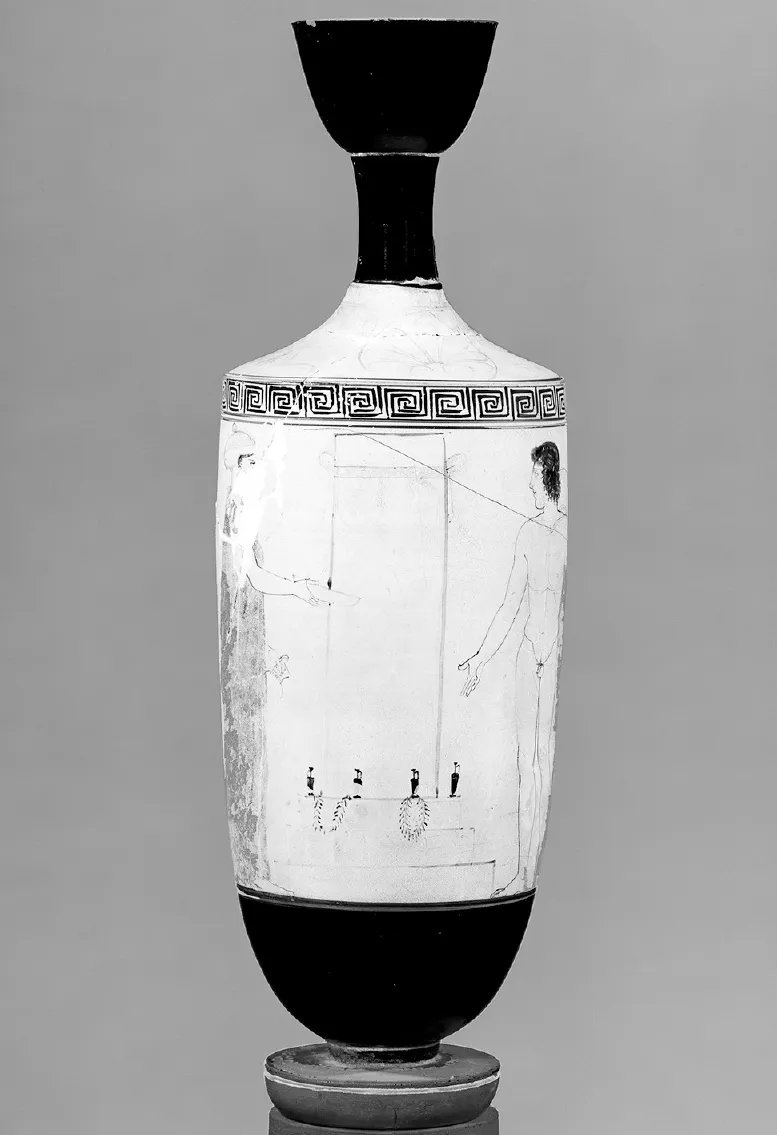
Fig. 1 Attic white-ground lekythos attributed to the Bosanquet Painter. New York, Metropolitan Museum of Art 23.160.39. Photo: © The Metropolitan Museum of Art. Image source: Art Resource, New York.
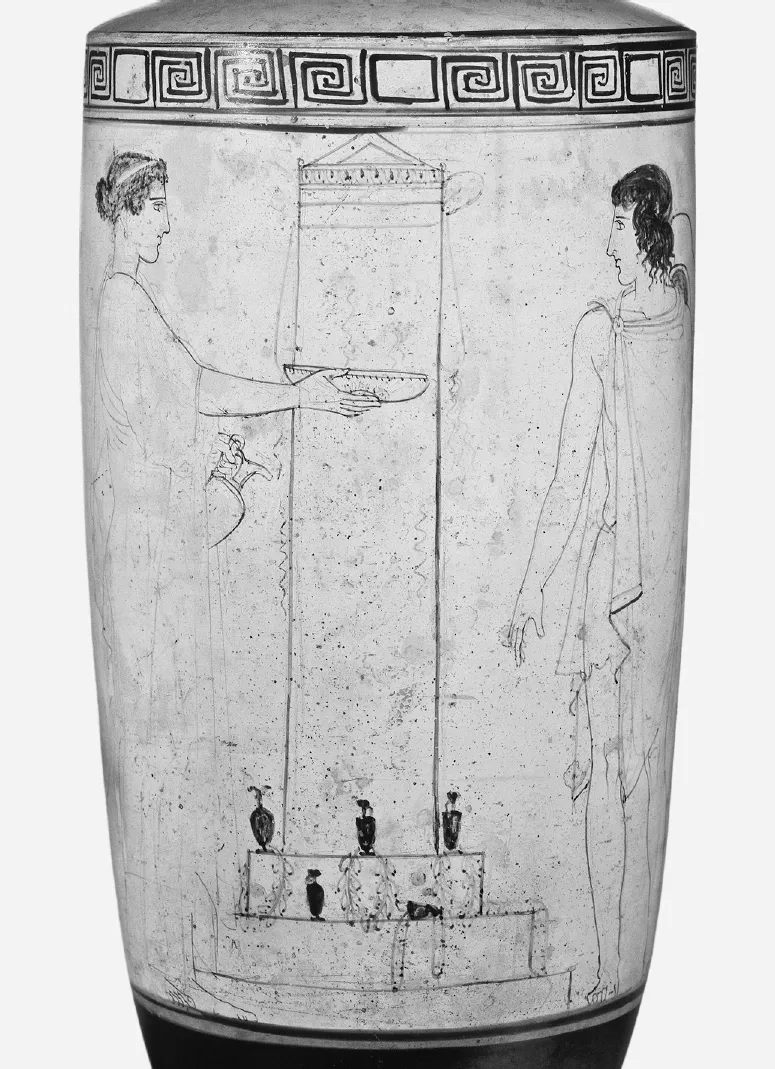
Fig. 2 Attic white-ground lekythos attributed to the Bosanquet Painter. Basel, Antikenmuseum und Sammlung Ludwig, Kä 402. Photo: Antikenmuseum und Sammlung Ludwig/A. Voegelin.
Fallen vessels in Attic vase-painting usually index motion and surprise. A fallen and sometimes broken hydria, for instance, accompanies many scenes of Achilles pursuing Troilus, representing the haste of Polyxena’s flight and perhaps also foreshadowing the youth’s death.14 Dropping a vase became a standard device to show women rushing from their pursuers,15 and non-ceramic fallen objects could perform similar narrative functions. Menelaos, for instance, may drop his sword as he runs toward Helen.16 The fallen weapon signals his change of intent while also conveying his swift motion. Armor and weapons can lie on battle grounds, indexing the movement of figures and the disarray of war.17 Centaurs and Lapiths topple vases to the ground in their strife as they battle indoors.18
The hydria depicted in the process of tumbling off the steps of the grave monument on the lekythos by an artist near the Quadrate Painter similarly indexes motion, although it is difficult to identify with confidence what caused the vessel to fall (Fig. 3).19 Some scholars have thought that the broken hydria on our lekythos stems from a ritual act,20 but since both women are depicted in the process of going to the tomb with offerings in their hands, this is an unlikely scenario. The images on other lekythoi demonstrate that hydriai could rest on the steps of the tomb or serve as grave markers,21 and so the child on the Quadrate Painter’s lekythos probably broke a hydria placed on the grave steps as he ran from the left up to the stele. The vessel tumbles to the right, and traces of the child’s right leg suggest that it was raised off the ground in a running motion. Although this fallen hydria seems to conform to the general function of fallen vessels in Attic vase-painting by indexing movement, the other fallen vessels do not fit the mold. The vessels are not in the process of falling, and the scenes in which they appear are quiet and nearly motionless.22 The lekythos near the Quadrate Painter only makes the other lekythoi in need of further explication.
Fallen vessels on lekythoi have not gone unnoticed, nor have they received any sustained discussion. Interpretations generally may be divided into two views, although usually they were not advanced to explain every example. The first, advocated by Ernst Buschor, Donna Kurtz, Christoph Clairmont, and Erika Kunze-Götte, sees the vessels as efforts to represent the actual appearance of the grave.23 They represent the detritus from rituals where vessels were broken at the tomb, or they simply fell over in the course of time. These images, the scholars contend (to varying degrees), reveal the artists’ interest in reality. A second view adopts a more semiotic approach. For Stefan Schmidt, at least some of the vessels serve to demonstrate the consequences of not tending the grave.24 John Oakley argues that they mark the passage of time.25 A third view, of course, might be that these fallen vessels are meaningless variations to repetitive, stock scenes of a visit to the grave.
Painted broken lekythoi by the Beldam Painter, in the manner of the Talos Painter (Fig. 9), and possibly by the Bosanquet Painter26 may stem from rituals, but the others are simply fallen rather than smashed. For instance, in the example by the Sabouroff Painter (Figs. 4–5) the lekythos clearly has fallen from the space between vessels two steps above.27 So the view that the lekythoi transcribe a ritual moment can only explain a few of the examples, if any. And although some tombs may indeed have resembled the paintings of graves with fallen vessels, the interpretation that these objects were details serving to increase a painting’s realism faces the difficulty that realism was not the primary concern of Classical painters of white lekythoi such as the Sabouroff, Bosanquet, and Thanatos Painters. They conflate home and grave, with items such as vessels and mirrors impossibly suspended in midair by the tomb.
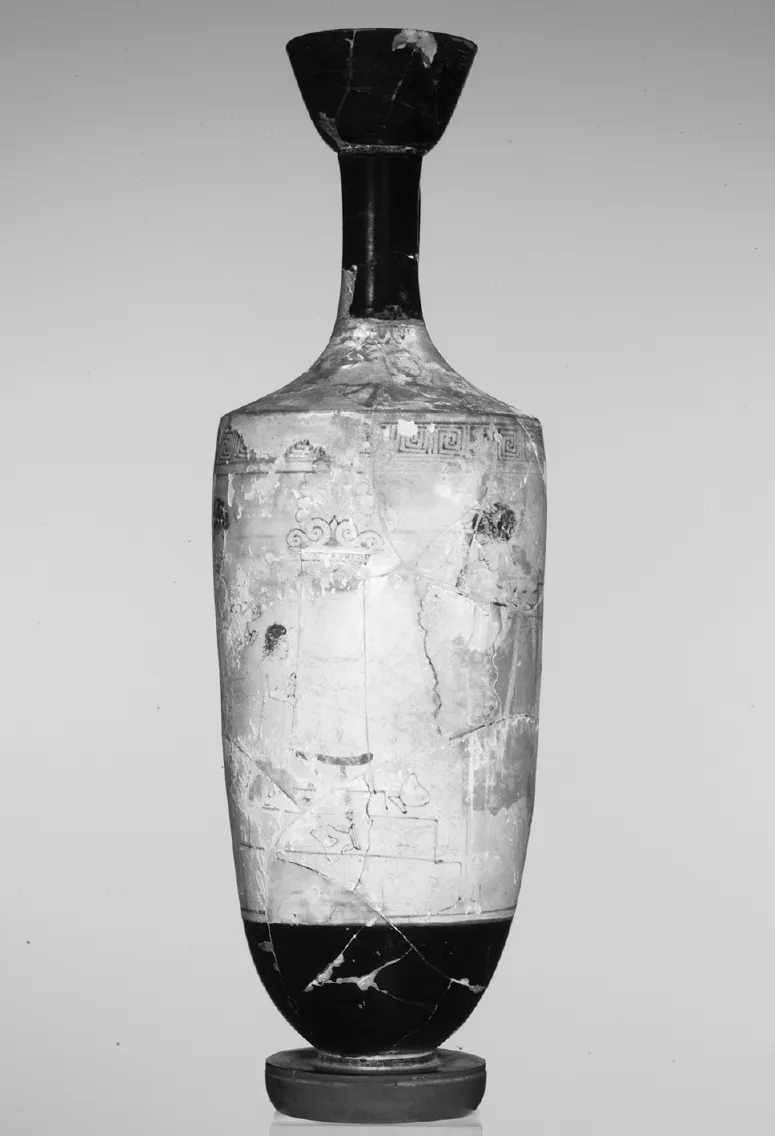
Fig. 3 Attic white-ground lekythos by an artist near the Quadrate Painter. Munich, Staatliche Antikensammlungen und Glyptothek, 2779. Photo: Renate Kühling.
Moreover, there is reasonable doubt whether or not the grave monuments in the paintings are real, for few stone monuments survive from Classical Athens until they start to be made again ca. 430. While it is possible that some of these painted monuments imitate wooden ones erected at Athens that do not survive in the archaeological record – or reflect gravestones erected outside of Athens – or, after ca. 430, actual Athenian gravestones – i...
Table of contents
- Cover
- Dedication
- Title Page
- Copyright
- Contents
- Foreword
- Chapter 1: Fallen Vessels and Risen Spirits: Conveying the Presence of the Dead on White-ground Lekythoi
- Chapter 2: Under the Tuscan Soil: Reuniting Attic Vases with an Etruscan Tomb
- Chapter 3: Regional Variation: Pelops and Chrysippos in Apulia
- Chapter 4: Baskets, Nets and Cages: Indicia of Spatial Illusionism in Athenian Vase-painting
- Chapter 5: Red-figured Cups in the Kerameikos
- Chapter 6: Smikros and Epilykos: Two Comic Inventions in Athenian Vase-painting
- Chapter 7: Facing West: Athenian Influence on Isolated Heads in Italian Red-figure Vase-painting
- Chapter 8: The Gigantomachy in Attic and Apulian Vase-Painting. A New Look at Similarities, Differences and Origins
- Chapter 9: Plates by Pasteas
- Chapter 10: Some Greek Vases in the Museum of Mediterranean Archaeology at Nir David (Gan Hashlosha) Israel
- Chapter 11: Trade of Athenian Figured Pottery and the Effects of Connectivity
- Chapter 12: Beautiful Men on Vases for the Dead
- Chapter 13: The View from Behind the Kline: Symposial Space and Beyond
- Chapter 14: Chariots in Black-figure Attic Vase-painting: Antecedents and Ramifications
- Chapter 15: “Whom are You Calling a Barbarian?”A Column Krater by the Suessula Painter
- Chapter 16: Good Dog, Bad Dog: A Cup by the Triptolemos Painter and Aspects of Canine Behavior on Athenian Vases
- Chapter 17: A Scorpion and a Smile: Two Vases in the Kemper Museum of Art in St. Louis
- Chapter 18: Demographics and Productivity in the Ancient Athenian Pottery Industry
- Chapter 19: An Amazonomachy Attributed to the Syleus Painter
- Chapter 20: Democratic Vessels? The Changing Shape of Athenian Vases in Late Archaic and Early Classical Times
- Chapter 21: A Kantharos in the Museum of Fine Arts, Boston and the Reception of Athenian Red-figure in Boeotia
- Chapter 22: Oikos and Hetairoi: Black-figure Departure Scenes Reconsidered
- Chapter 23: The Robinson Group of Panathenaic Amphorae
- Chapter 24: Guess Who’s Coming to Dinner? Red-figure Komasts and the Performance Culture of Athens
- Chapter 25: Menelaos and Helen in Attic Vase Painting
- Chapter 26: Attic Black-figure and Red-figure Fragments from the Sanctuary of Apollo at Mandra on Despotiko
- Chapter 27: The Attic Phiale in Context. The Late Archaic Red-figure and Coral-red Workshops
- Chapter Color Plates
Trusted by 375,005 students
Access to over 1.5 million titles for a fair monthly price.
Study more efficiently using our study tools.
Frequently asked questions
Yes, you can cancel anytime from the Subscription tab in your account settings on the Perlego website. Your subscription will stay active until the end of your current billing period. Learn how to cancel your subscription
No, books cannot be downloaded as external files, such as PDFs, for use outside of Perlego. However, you can download books within the Perlego app for offline reading on mobile or tablet. Learn how to download books offline
Perlego offers two plans: Essential and Complete
- Essential is ideal for learners and professionals who enjoy exploring a wide range of subjects. Access the Essential Library with 800,000+ trusted titles and best-sellers across business, personal growth, and the humanities. Includes unlimited reading time and Standard Read Aloud voice.
- Complete: Perfect for advanced learners and researchers needing full, unrestricted access. Unlock 1.5M+ books across hundreds of subjects, including academic and specialized titles. The Complete Plan also includes advanced features like Premium Read Aloud and Research Assistant.
We are an online textbook subscription service, where you can get access to an entire online library for less than the price of a single book per month. With over 1.5 million books across 990+ topics, we’ve got you covered! Learn about our mission
Look out for the read-aloud symbol on your next book to see if you can listen to it. The read-aloud tool reads text aloud for you, highlighting the text as it is being read. You can pause it, speed it up and slow it down. Learn more about Read Aloud
Yes! You can use the Perlego app on both iOS and Android devices to read anytime, anywhere — even offline. Perfect for commutes or when you’re on the go.
Please note we cannot support devices running on iOS 13 and Android 7 or earlier. Learn more about using the app
Please note we cannot support devices running on iOS 13 and Android 7 or earlier. Learn more about using the app
Yes, you can access Athenian Potters and Painters III by John Oakley in PDF and/or ePUB format, as well as other popular books in History & Greek Ancient History. We have over 1.5 million books available in our catalogue for you to explore.