- English
- ePUB (mobile friendly)
- Available on iOS & Android
eBook - ePub
About this book
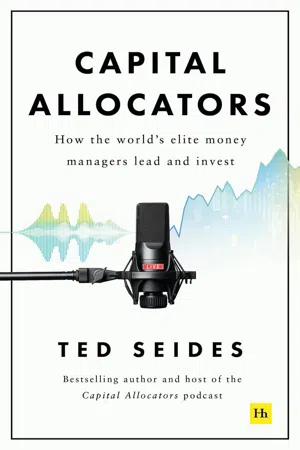
The chief investment officers (CIOs) at endowments, foundations, family offices, pension funds, and sovereign wealth funds are the leaders in the world of finance. They marshal trillions of dollars on behalf of their institutions and influence how capital flows throughout the world.
But these elite investors live outside of the public eye. Across the entire investment industry, few participants understand how these holders of the keys to the kingdom allocate their time and their capital.
What's more, there is no formal training for how to do their work.
So how do these influential leaders practice their craft? What skills do they require? What frameworks do they employ? How do they make investment decisions on everything from hiring managers to portfolio construction?
For the first time, CAPITAL ALLOCATORS lifts the lid on this opaque corner of the investment landscape.
Drawing on interviews from the first 150 episodes of the Capital Allocators podcast, Ted Seides presents the best of the knowledge, practical insights, and advice of the world's top professional investors.
These insights include:
- The best practices for interviewing, decision-making, negotiations, leadership, and management.
- Investment frameworks across governance, strategy, process, technological innovation, and uncertainty.
- The wisest and most impactful quotes from guests on the Capital Allocators podcast.
Learn from the likes of the CIOs at the endowments of Princeton and Notre Dame, family offices of Michael Bloomberg and George Soros, pension funds from the State of Florida, CalSTRS, and Canadian CDPQ, sovereign wealth funds of New Zealand and Australia, and many more.
CAPITAL ALLOCATORS is the essential new reference manual for current and aspiring CIOs, the money managers that work with them, and everyone allocating a pool of capital.
Information
Subtopic
Investments & SecuritiesIndex
BusinessPart 1: Toolkit
When I joined private equity firm Stonebridge Partners after business school, Bob Raziano was the lead operating partner at the firm. Bob had been one of the youngest partners at consulting firm Booz Allen and rose to the role of Chief Financial and Administrative Officer at CS First Boston before joining Stonebridge. I remember visiting a manufacturer of metallized paper with him and marvelling at his ability to systematically break down every aspect of the business during due diligence. I asked if he used a checklist. He responded that his apprenticeship in management consulting early in his career was like being handed a ruler to measure how to dissect companies.
Similarly, CIOs need a set of tools to break down the complex task of managing large pools of capital. Talented CIOs are skilled at both listening carefully and speaking in public, both learning and educating, both thinking independently and orchestrating a group, both managing a team and a governance board, and each of reading, writing and arithmetic. The best ones are the equivalent of Major League Baseball’s five-tool players.
Acquiring such a broad set of skills draws on many different disciplines. The interviews on the podcast with CIOs, investment managers, and thought leaders from outside of the investment industry collectively teach best practices around each of these skills.
These lessons are not found in the readings in the CFA program, CAIA curriculum, or other investment materials. Just as my first book, So You Want to Start a Hedge Fund, shares case studies about start-up hedge funds from the front lines, this section describes skill sets that are only encountered in practice. Importantly, these chapters do not present definitive research on the topics. They are a compilation of lessons gleaned from my experiences and those of guests on the show.
The toolkit in Part 1 explores the major disciplines required of CIOs:
- Interviewing
- Decision-making
- Negotiations
- Leadership
- Management
We’ll start with interviewing, a practice that allocators engage in just about every day.
Chapter 1: Interviewing
“I’ve learned that people will forget what you said, people will forget what you did, but people will never forget how you made them feel.”
– Maya Angelou
The core interaction in the investment process is a series of interviews. Across 20 years in the business, I conducted interviews with money managers two or three times a day, totaling thousands. In all that time, I only peripherally thought about the process of interviewing until I started the podcast.
The lessons I learned by studying professional interviewers and conducting podcasts over the last three years follow this process:
- Defining the purpose
- Preparing
- Setting the stage
- Listening actively
- Receiving feedback
- Additional interviewing tips
In the investment world, these lessons are applicable to manager interviews and reference checking.
Defining the purpose
Interviews are different from conversations. Conversations are casual discussions between people. They are back and forth interactions often balanced in airtime.
Interviews are conversations with a purpose. For the most part, interviewers ask the questions and interviewees answer. An allocator’s purpose in a manager interview is to gather information and evaluate the manager on both content and persona. CIOs seek to confirm or refute the validity of their hypothesis for investing in the manager. At the same time, each interview offers an opportunity to learn about social interactions and trustworthiness for a partnership that may last years or decades. These interviews require focus and attention in every aspect of the conversation.
That purpose sounds straightforward, but we’ve all experienced ineffective meetings in which the objective gets subjugated to an allocator peacocking by expressing their views to prove their intellectual worth. Tom Bushey found in his initial market meetings for Sunderland Capital that probably two-thirds of the people interviewing him told him why what he was doing was ludicrous and how they would do it instead.
A podcast interview is different. I discuss many of the same subjects I did when interviewing as an allocator, but evaluation is no longer my objective. I let CIOs and investment managers tell their stories, and I have no need to decide if I want to invest with them afterwards.
Other forms of interviewing carry a different purpose and call on different skills. Jon Wertheim has written and conducted interviews for Sports Illustrated and 60 Minutes for 25 years. His interviews have sought quotes for stories, entertainment for television, and facts for journalistic investigations. When filling a story with a quote, Jon wants just one nugget. A half-hour conversation can be horrible for 29 minutes, but if the subject gives a sound bite when wrapping up, he will have accomplished his mission. He may purposefully express boredom, excitement or provocation, all in the interest of getting one little gem.
His television interviews are the opposite. The medium requires a cadence and flow throughout that matters as much as the material. If the interviewer and subject interrupt each other, the television viewing will be poor and will usurp otherwise great content.
Investigative journalism is different again. Conducting research for a story requires in-depth probing and verbal interrogation techniques where substance matters more than style.
The style and techniques of interviewing across podcasts, stories, television, and investigations are all different from the evaluative interviews conducted by allocators. At the same time, the different disciplines share common techniques that are effective across the board and useful for allocators to improve their skills for evaluating managers.
Prepari...
Table of contents
- Contents
- Praise for Capital Allocators
- About the Author
- Acknowledgments
- About Capital Allocators
- How to Use This Book
- Introduction
- Active versus Passive
- Part 1: Toolkit
- Chapter 1: Interviewing
- Chapter 2: Decision-Making
- Chapter 3: Negotiations
- Chapter 4: Leadership
- Chapter 5: Management
- Part 2: Investment Frameworks
- Chapter 6: Governance
- Chapter 7: Investment Strategy
- Chapter 8: Investment Process
- Chapter 9: Technological Innovation
- Chapter 10: Case Study of Uncertainty
- Part 3: Nuggets of Wisdom
- Chapter 11: Investment Lessons
- Chapter 12: Life Lessons
- Chapter 13: The Top 10
- Appendices
- Appendix A: Initial Manager Meeting Outline
- Appendix B: To Learn More
- Appendix C: Directory of Guests on Capital Allocators
- Publishing details
Trusted by 375,005 students
Access to over 1.5 million titles for a fair monthly price.
Study more efficiently using our study tools.
Frequently asked questions
Yes, you can cancel anytime from the Subscription tab in your account settings on the Perlego website. Your subscription will stay active until the end of your current billing period. Learn how to cancel your subscription
No, books cannot be downloaded as external files, such as PDFs, for use outside of Perlego. However, you can download books within the Perlego app for offline reading on mobile or tablet. Learn how to download books offline
Perlego offers two plans: Essential and Complete
- Essential is ideal for learners and professionals who enjoy exploring a wide range of subjects. Access the Essential Library with 800,000+ trusted titles and best-sellers across business, personal growth, and the humanities. Includes unlimited reading time and Standard Read Aloud voice.
- Complete: Perfect for advanced learners and researchers needing full, unrestricted access. Unlock 1.5M+ books across hundreds of subjects, including academic and specialized titles. The Complete Plan also includes advanced features like Premium Read Aloud and Research Assistant.
We are an online textbook subscription service, where you can get access to an entire online library for less than the price of a single book per month. With over 1.5 million books across 990+ topics, we’ve got you covered! Learn about our mission
Look out for the read-aloud symbol on your next book to see if you can listen to it. The read-aloud tool reads text aloud for you, highlighting the text as it is being read. You can pause it, speed it up and slow it down. Learn more about Read Aloud
Yes! You can use the Perlego app on both iOS and Android devices to read anytime, anywhere — even offline. Perfect for commutes or when you’re on the go.
Please note we cannot support devices running on iOS 13 and Android 7 or earlier. Learn more about using the app
Please note we cannot support devices running on iOS 13 and Android 7 or earlier. Learn more about using the app
Yes, you can access Capital Allocators by Ted Seides in PDF and/or ePUB format, as well as other popular books in Business & Investments & Securities. We have over 1.5 million books available in our catalogue for you to explore.