Choreographies of African Identities traces interconnected interpretative frameworks around and about the National Ballet of Senegal. Using the metaphor of a dancing circle Castaldi's arguments cover the full spectrum of performance, from production to circulation and reception. Castaldi first situates the reader in a North American theater, focusing on the relationship between dancers and audiences as that between black performers and white spectators. She then examines the work of the National Ballet in relation to Léopold Sédar Senghor's Négritude ideology and cultural politics. Finally, the author addresses the circulation of dances in the streets, discotheques, and courtyards of Dakar, drawing attention to women dancers' occupation of the urban landscape.
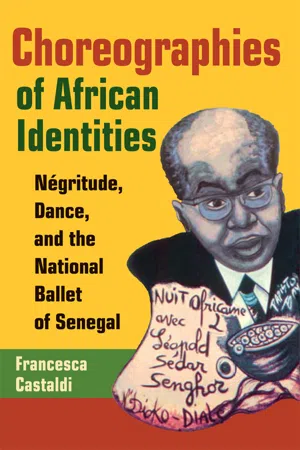
eBook - ePub
Choreographies of African Identities
Négritude, Dance, and the National Ballet of Senegal
- English
- ePUB (mobile friendly)
- Available on iOS & Android
eBook - ePub
Choreographies of African Identities
Négritude, Dance, and the National Ballet of Senegal
About this book
Information
Publisher
University of Illinois PressYear
2010Print ISBN
9780252072680
9780252030277
eBook ISBN
9780252090783
Subtopic
Music1
The National Ballet of Senegal at a Theater in California
Ethnic Dance in the Theater: The Audience, the Performers, and the Staging of Ethnographic Research
Irvine, California, March 1995. This is the land of highways, malls, and parking lots: Southern California, the “Inland Empire.” My car is my most precious asset in this empire, where the lack of adequate public transportation and a staunch belief in independence oblige us to drive everywhere, often alone. Those of us who can afford to own a car, that is. I am one of those lucky polluters, and I happily jump into the car to drive down to Irvine’s Barclay Theater, where the National Ballet of Senegal is performing. It is March 7, 1995.
I arrive at the theater early, and since I am not meeting anybody I walk into the building. I have bought a ticket in the orchestra for twenty-five dollars, and I proceed to my seat. Glossy program in hand, I enter a world where shapes and colors are softened by dim lights, where the sound of steps is muffled by a thick burgundy carpet, and where I must sit among a row of cushioned chairs, each covered by the same luxurious velvet fabric of the carpet and the heavy curtains of the stage. This is a site of high-cultural production and enjoyment; purpose and status are written into the architecture of the theater.
I choose to sit in the last row of the first floor, close to the light technician, so I will be able to see the whole audience and include it in my viewing of the performance. I take out notebook and pen and begin my ethnographic project on the National Ballet of Senegal.
I observe people fill the theater. Approximately eight hundred bodies come in short waves, a couple at a time, or two, three, or four couples, like mature bunches of grapes, the women and men plump and shiny with formal attire and perfume. There are only a few African Americans—or are they Africans?—most of them dressed in African clothes. The rest of the audience, like the group of six women sitting in front of me, are Euro-Americans in their forties or older, middle and upper-middle class.1 I write in my notebook: “The natives, dressed in their best traditional clothes, have gathered to watch the performance of the National Ballet of Senegal, a company renowned for its transnational tours and worldwide appeal.” I smile, sigh, and rewrite the previous sentence: “The worldly Southern Californian audience is coming to enjoy a performance by native African dancers and musicians.”
The physical separation between the white North American audience and the black African performers, engendered by the theater’s architecture, provokes the ethnographer to assign the term “native” to one or the other side of the proscenium stage. The term carries deep-rooted political implications. The weight of history in the production of anthropological knowledge has traditionally configured the flux of information and cultural exchange between white and black peoples as that between ethnically unmarked white citizens and ethnically marked black “natives.”2 The colonial roots of the ethnographic enterprise have for centuries configured North American intellectuals and a wider Euro-American amateur public as the audience for ethnographic tales in which African natives perform an alien and exotic way of life. I wonder whether this configuration of identities will be hinted at and reproduced by the spectacle on the stage.
My thoughts are interrupted by that unmistakable signal to forget the outside world and focus one’s attention on the stage: the lights are switched off. Comfortably seated in the darkness, I softly brush the edges of my notebook to remind myself that I am no ordinary spectator, but an ethnographer. The notebook, like a fétiche, gives me an empowered identity.
The velvet curtain opens to reveal a village scene. The roofs of two huts, to the left and right of the stage, emerge from behind a wooden fence. A raised platform stands at the center, and to the right a baobab tree marks a public meeting space.3 This is the way the audience is encouraged to imagine the village in Africa: the simple comfort of the huts, the majestic and legendary beauty of baobab trees, a warm summer night. The bucolic scene shocks the spectators with its contrast to the urban landscape of the outside world.
The scenography on stage is part of a larger choreography: the First World spectators leave a complex world behind to enter into the rarefied atmosphere of the theater and confront Africa, summarized by the village scene. For eighteen to thirty-two dollars, the spectators become consumers of world culture while the performers represent a local product—their identities tied to the confines of the African village. The purchasing power of spectators qualifies them as cosmopolitan consumers even if they have never traveled outside the United States. On the other side of the proscenium, members of the National Ballet of Senegal, experienced border crossers, are presented by the scenography as natives of an African village, appealing because uncontaminated performers of a local cultural product.
The confrontation between global consumers and authentic local producers lies at the core of the concept of “world dance,” which in some intellectual and artistic circles has replaced “ethnic dance” as a more politically correct terminology.4 Both terms refer to nonwestern dance forms; one emphasizes the identity of the producers, and the other the identity of the consumers. While the term “ethnic dance” ethnically marks nonwestern cultural producers, the term “world dance” focuses on westerners as the ethnically unmarked consumers of world cultures.
Seated at the theater, I recognize the association and conflation of the ethnic with the local and, by contrast, of the nonethnic, unmarked white with the global as a fundamental premise of ethnologic.5 Quickly, groping in the darkness, I write in my notebook, for later consideration: “The Ethnographic Mode of Representation on Stage: World Dance and Ethnic Others in Euro-American High Art Institutions.” I then refocus my gaze on the stage, anxious not to miss anything.
A man is standing on the central platform of the stage. He wears red pants, and a double string of beads crosses his bare chest. He appears small against the baobab tree in the back and a huge sky above him. He takes a step down the platform, and, with a slow, sustained motion, he opens his arms from his heart into an extended welcome to the audience. He speaks/sings in Mandinka. He points to a red silhouette of the African continent floating up with the stars in the blue sky, and we understand the words “Senegal, West Africa.” Women’s voices resonate in the background. The man moves out of the village’s square, and women enter carrying a big basket. They place it on the ground, salute each other, open the basket, and take out some scarves.
Throughout the performance the sky changes from blue to orange, yellow, green, and violet, as if to move us in time with the passing of days, from night to dawn to full day and sunset, and then along the passing of seasons or maybe the passing of years. In the sky Africa appears like a continent afloat in the vast universe—a vision or a mirage? This Africa transforms over the course of the performance. In the opening scene it appears as a homogeneous red mass that suggests a unified cultural and political territory. It then disappears from the sky only to reemerge at the end of the performance, marked by the dancers, appropriated by their feats, signed by their actions: Ballet National du Sénégal will be inscribed in white against the red territory of Africa.
Framing Spectatorship: The Publicity Notes
The distance between my seat and the performers is filled with expectations— thick, almost palpable, as I, with the other members of the audience, create a space of willful silence. Publicity announcements and program notes have fed our expectations, pulling us to the theater.6 Even for those of us who came to the show motivated by our own desires and fantasies, a colorful flyer is available at the entrance—a promise of the fulfillment to come, vouched for by accredited public critics. The flyer shows on one side the picture of some company members dancing on a beach, and, on the other side, it presents us with the following newspaper excerpts (no dates or authors provided):
[The national Ballet of Sengal] is blessed with an AMAZING ability to make spectators feel happy. Its entire works are meticulously choreographed. Yet, they are performed with such clear love of dance that the program is disarming. . . . This troupe of dancers, singers, and musicians quite literally inspires spectators to ignore decorum and join the FUN.
—New York Times
Since they embarked on their first tour 20 years ago, these ebullient dancers and musicians have dazzled thousands with their country’s most visible and EXPLOSIVE art. . . . [They have] presented the traditional movement and music of their country in the most direct and heartfelt fashion imaginable.
—Washington Post
Notes on the Publicity Notes
I will be helpless, disarmed, leaving behind any sense of propriety to join in the “FUN” of the dances. The theater publicity assures me that I will be watching serious art that is “meticulously choreographed,” and “yet” I will have great fun. The invitation to ignore decorum seems to suggest that I will be exonerated from the critical labor usually demanded from viewers of high art. It implies that I am exonerated from thinking and instead asked to respond sensually and emotionally to the performance. I am assured of immediate communication and understanding—heart to heart—and I am thus encouraged to avoid thinking about the complexities of intercultural communication and the cultural and social origins of aesthetic judgment. The newspaper reviews suggest that the language of dance is transnational (universal?)—it speaks to thousands across the nation and across several nations.
An older program for Pangols, given to me by the artistic director of the National Ballet on our first encounter, presents a somewhat different framing of the performance. Written for the 1992 performance of Pangols at the Jean Vilar Theater (a nineteenth-century theater in Saint-Quentin, France), it presents the dances as a specific mode of representation that can be compared to other representational modes for accuracy and expressive vitality: “This troupe is a crucible that has realized and continues to realize a collection of dances, eurhythms, beats, songs, and poems. And far from preserving them only in cold and knowledgeable books like ethnographers do, the National Ballet turns it into a lively album in which colors merge with alternating or undulatory movements, offering these sequences to the whole world” (emphasis added).
These program notes suggest that the National Ballet of Senegal takes ethnography into its own hands to produce a representation of Senegalese culture that follows and challenges the European ethnographic tradition. Choreography becomes the writing of history and indigenous traditions, and the dances thus produced are to be read by the public of “the whole world.”7 The narrative suggests that the choreographer of the Ballet, like an ethnographer, carefully constructs an ideal village, open to the gaze of foreigners who will enjoy the display of local life. This same articulation of choreography as a representational strategy is found in Sekou Touré’s celebratory description of the National Ballet of Guinea, one of the first national dance troupes to be created on the African continent:
The National Troupe is our roving Ambassador whose mission is to encourage understanding of Africa with a view of creating the most favorable conditions for healthy and fruitful cooperation between Africa and the rest of the world. . . . The troupe is a living image of African culture. The foreign audiences that have seen the lives of our people presented on stage have seen the veil of false exoticism that envelopes the continent torn asunder and have learned better to understand our men, women, and children who are struggling to live and to be free.8
Touré’s quote shares with the previous narratives the belief that the dances performed by African Ballets will be universally appealing and comprehensible by citizens all over the globe. Yet these narratives also differ, in so far as the American reviews define dance as pure entertainment, while the French program and Touré’s introduction entrust the Ballet’s performance with an educational component. The French program casts the performance as a definitive improvement over the work of ethnographers. Touré’s narrative gives even more power the spectacle on stage, asserting that it will provoke spectators into recognizing exotic representations of Africa and Africans as false.
I will evaluate whether the performance of the National Ballet of Senegal at the Barclay Theater indeed entertains and/or educates in these terms. Does the Euro-American observer, seated in the dark, invited to ignore decorum and quietly yet sensually consume the spectacle, shed his or her cultural heritage to magically share with the performers the traditions of Senegal? Does the power of the dancers overwhelm the spectators with its own semantic energy? Is Senegalese tradition an obvious, transparent category? Does the National Ballet of Senegal offer an autoethnographic representation of the national cultural patrimony that is able to compete and counter (Euro-American) ethnographers’ exoticizing and “cold knowledge”?
My reading of the performance will be informed by two sets of writing, the first representing the performers’ perspective, the second from the audience’s perspective. I have chosen written texts as dialogical voices rather than interviews with performers and audiences to establish a more equal exchange in ethnographic dialogue, matching my own criticism with that of other cultural critics.9 Thus, the first writerly interlocutor that I engage with is Léopold Sédar Senghor, who represents perhaps the most eloquent official interpretation of the National Ballet of Senegal. The second voice I have chosen is embodied by program notes and newspaper excerpts, which represent authoritative perspectives intended to inform and influence the audience’s interpretation of the performance and, more generally, of African cultures.
Take One: Analyzing the Performance with the Aid of Léopold Sédar Senghor (on Rhythm and Spirituality)
I lean back in my seat. The program tells me to relax. This is dance: fun, immediate entertainment. The lights go off. The whole audience is in front of me, barely visible, as the stage fills with dancers and musicians radiating colors and energy.
How can the spectators sit so still, not even waving their heads? The seats gently suggest passivity, immobilizing the spectator’s body in soft velvet cushions. Leaning my spinal axis against the support offered by the chair I find myself tilted backward, my feet slightly off the floor. I feel trapped in this position, unable to respond, driven into passivity by the backward tilt. I move forward, with my butt resting only on the tip of the chair to root my feet solidly on the floor, ready to spring into action. But I have nowhere to go.
A group of women has come out into the onstage village square. Singing and moving their arms in flowing waves, they take different group formations. Their dresses are bright red, green, brown, yellow, blue, and violet, each with an embroidery of a different color on the chest. As the women swing their arms, the ample cloth makes rippling shapes. The rhythm is texture and color, choral songs and sustained movements, nurturing like the caresses of a female wind. A flicker of the wrists; the feet mark the beat as the head and arms swing side to side.
What is rhythm? It is the architecture of the being, the internal dynamics that give it form, the system of waves that it emits toward Others, the pure expression of vital force. Rhythm is the vibratory shock, the force that, through the senses, strikes us to the root of our being and expresses itself in the most material, sensual ways: lines, surfaces, colors, volumes and architecture, sculpture and paintings, accents in poetry and music, movements in dance. But, in doing so, it orders all this concreteness toward the light of the spirit. Among the Negro-African, it is in the same measure that rhythm is embodied in sensuality that it illuminates the spirit. African dance abhors the physical contact of bodies. But look at the dancers. If their lower limbs are shaken by the most sensual tremor, their heads partake of the serene beauty of the masques, of the Dead. (Senghor 1956:60–61)10
Senghor’s definition of rhythm encompasses all the different dimensions of the performance: the music, the dance, the dresses and the visual organization of colors, the pace and structure of the choreography, the spatial dynamics on the stage, the spiritual content of the dances, and the ethos of audience participation. Polyrhythms establish “unity within diversity” (Senghor 1956:61) across different expressive media—visual, kinetic, sonic, and spiritual.
At the Barclay, the polyrthythmic interplay of visual, ...
Table of contents
- Cover
- Title
- Copyright
- Contents
- Acknowledgments
- Introduction: Positionality and the Choreography of Theory
- 1. The National Ballet of Senegal at a Theater in California
- 2. African Dance, Africanist Discourse, and Négritude
- 3. The National Ballet of Senegal at the National Theater in Dakar
- 4. Sabar Dances and a Women’s Public Sphere
- 5. Tales of Betrayal
- 6. The Circulation of Dances on and off the Stage
- 7. Urban Ballets and the Professionalization of Dance
- 8. Exploiting Terànga
- Conclusion: Négritude Reconsidered
- Notes
- References
- Index
Trusted by 375,005 students
Access to over 1.5 million titles for a fair monthly price.
Study more efficiently using our study tools.
Frequently asked questions
Yes, you can cancel anytime from the Subscription tab in your account settings on the Perlego website. Your subscription will stay active until the end of your current billing period. Learn how to cancel your subscription
No, books cannot be downloaded as external files, such as PDFs, for use outside of Perlego. However, you can download books within the Perlego app for offline reading on mobile or tablet. Learn how to download books offline
Perlego offers two plans: Essential and Complete
- Essential is ideal for learners and professionals who enjoy exploring a wide range of subjects. Access the Essential Library with 800,000+ trusted titles and best-sellers across business, personal growth, and the humanities. Includes unlimited reading time and Standard Read Aloud voice.
- Complete: Perfect for advanced learners and researchers needing full, unrestricted access. Unlock 1.5M+ books across hundreds of subjects, including academic and specialized titles. The Complete Plan also includes advanced features like Premium Read Aloud and Research Assistant.
We are an online textbook subscription service, where you can get access to an entire online library for less than the price of a single book per month. With over 1.5 million books across 990+ topics, we’ve got you covered! Learn about our mission
Look out for the read-aloud symbol on your next book to see if you can listen to it. The read-aloud tool reads text aloud for you, highlighting the text as it is being read. You can pause it, speed it up and slow it down. Learn more about Read Aloud
Yes! You can use the Perlego app on both iOS and Android devices to read anytime, anywhere — even offline. Perfect for commutes or when you’re on the go.
Please note we cannot support devices running on iOS 13 and Android 7 or earlier. Learn more about using the app
Please note we cannot support devices running on iOS 13 and Android 7 or earlier. Learn more about using the app
Yes, you can access Choreographies of African Identities by Francesca Castaldi in PDF and/or ePUB format, as well as other popular books in Media & Performing Arts & Music. We have over 1.5 million books available in our catalogue for you to explore.