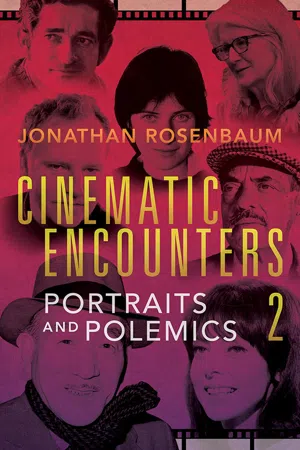
Rosenbaum takes on filmmakers like Chantal Akerman, Richard Linklater, Manoel De Oliveira, Mark Rappaport, Elaine May, and Béla Tarr. He also engages, implicitly and explicitly, with other writers, arguing with Pauline Kael—and Wikipedia—over Jacques Demy, with the Hollywood Reporter and Variety reviewers of Jarmusch's The Limits of Control, with David Thomson about James L. Brooks, and with many American and English film critics about misrepresented figures from Jerry Lewis to Yasujiro Ozu to Orson Welles. Throughout, Rosenbaum mines insights, pursues pet notions, and invites readers to join the fray.
- English
- ePUB (mobile friendly)
- Available on iOS & Android
eBook - ePub
About this book
Eschewing the idea of film reviewer-as-solitary-expert, Jonathan Rosenbaum continues to advance his belief that a critic's ideal role is to mediate and facilitate our public discussion of cinema. Portraits and Polemics presents debate as an important form of cinematic encounter whether one argues with filmmakers themselves, on behalf of their work, or with one's self.
Information
Publisher
University of Illinois PressYear
2019Print ISBN
9780252084386
9780252042553
eBook ISBN
9780252051395
Subtopic
Film & VideoCHAPTER 1
Chantal Akerman
As with Sylvia Plath, Chantal Akerman's critical stock seemed to shoot up as a direct consequence of her suicide, giving far too much ill-considered value, in my opinion, to both her bipolarity and her final film, No Home Movie (2015). By neglecting her fiction films, this essay, commissioned by Icarus Films for their DVD box set Chantal Akerman: Four Films in 2016, can't pretend to encompass the full range of her work—her status as a Belgian surrealist, for example, which links her to another filmmaker considered in this book, André Delvaux, is overlooked—but I hope it can provide a useful starting point. An even longer and more comprehensive survey of Akerman's work, though it only goes up to 2004, can be found at https://www.jonathanrosenbaum.net/2012/02/chantal-akerman-the-integrity-of-exile-and-the-everyday-tk/.
Place and Displacement: Akerman and Documentary
When you try to show reality in cinema, most of the time it's totally false. But when you show what's going on in people's minds, that's very cinematic.
—Chantal Akerman
If I had to describe the art of Chantal Akerman (1950–2015) in a single word, I think I'd opt for “composition.” This is a term that needs to be understood in its plastic as well as its musical meanings: a visual object that has to be framed in space, a musical object that has to be composed in time. And if we factor in the implied definitions offered above by Akerman regarding what's reality and what's cinematic, what's going on in people's minds and what's going on in front of a camera and microphone, then we have to acknowledge that what she chooses to compose represents a kind of uneasy truce between all four elements (or five elements, if we regard sound and image as separate). How much she and we privilege mind over matter and cinema over reality—or vice versa—has a lot of bearing on what's derived from the encounter.
The four Akerman documentaries included in this box set—D'est (From the East, 1993), Sud (South, 1999), De l'autre côté (From the Other Side, 2002), and Là-bas (Down There, 2006)—and the documentary about her included as an extra (Gustavo Beck and Leonardo Luiz Ferreira's 2010 Chantal Akerman, From Here) are all self-described in relation to place. Yet all five films are deeply involved with displacement, thanks to the uneasy truces between their elements that I've just alluded to. Chantal Akerman, From Here is further displaced from the four Akerman films by virtue of the fact that it may appear superficially to resemble her own films in its handling of space and time, although I would argue that in fact it does something that's actually antithetical to her methodology: a fixed camera position that seems uncomposed, at least in relation to Akerman's own monumentally forceful and weighted framings, and a use of real time that seems similarly haphazard and unfocused in contrast to the more structured uses of real time that she periodically employs. As Akerman herself points out in the interview proper, which gives Chantal Akerman, From Here its undeniable value and relevancy, the household rituals of Jeanne Dielman in her most famous fiction film, even if they seem to unfold in “real time,” are in fact “recomposed.” And even more relevant are her remarks in this interview about the viewer's perception of time passing, as opposed to the more commercial norm of time “flying by”—a subjective experience that is far removed from the notion of “real time” adopted by Beck and Ferreira. (“If I have a reputation for being difficult,” she once said, “it's because I love the everyday and want to present it. In general people go to the movies precisely to escape the everyday.”) This helps to explain why, in the same interview, she notes that documentaries gave her more freedom as an editor than her narrative features by virtue of allowing her more choices in how to combine disparate materials. Freed from the tyranny imposed by the necessity of following stories and characters, her best documentaries can arguably call on a fuller range of both her aesthetic resources and the imaginations of her viewers, which is implied by the title she gave to her 1995 installation related to From the East, Bordering on Fiction.
A brilliant French television producer once showed me a paper he wrote arguing that Akerman's greatest films were her documentaries, and he asked me for comments. My main comment was to ask about the 201-minute Jeanne Dielman, 23 Quai de Commerce, 1080 Bruxelles (1975), only to discover that he'd never seen it. But despite this major caveat—his overlooking of one of Akerman's greatest films, with an indelible depiction of housework and other forms of female entrapment, a subject that becomes no less worthy of epic proportions than those of From the East and From the Other Side—I think his overall point has some merit. It's especially valid once one acknowledges that like many of the other greatest filmmakers, Akerman worked in a zone in which nonfiction and fiction frequently intermingle and sometimes even trade places. The final sequence of From the Other Side is arguably more novelistic in the depth of its feeling and in its creation of a fictional temporality than anything in her no less distinctive adaptation of Marcel Proust, La captive (2000), while the final sequence in her only other (and no less free) adaptation of a novel, Joseph Conrad's Almayer's Folly (2011), ends with a striking use of extended real time that becomes in effect a documentary about its lead actor, Stanislaus Merhar. Furthermore, it is easy to conclude that Les années 80 (1983), her documentary about the making of her only musical, Golden Eighties (1986), is far more successful and expressive, even as a musical, than the finished work (largely because of Akerman's own contributions during the recording sessions)—a bittersweet tale of crossed romantic destinies that unfolds almost entirely inside a shopping mall.
Returning to Akerman's statement about what's cinematic, I think it's fair to say that From the East, South, From the Other Side, and Down There are only nominally and incidentally films about a journey from Berlin to Moscow, or the town of Jasper, Texas, or the border between the United States and Mexico, or a narrow patch in Tel Aviv mainly consisting of a room in Akerman's rented flat and its immediate environs. More basically, they're films about the states of Akerman's consciousness, her thoughts and feelings of displacement and alienation in relation to those places. Such displacements can be found throughout her work—perhaps most memorably in two films linking her sense of homelessness with the figure of her mother: News From Home (1976), occasioning what was perhaps her first major use of autobiographical and documentary materials (letters from her mother that are read by Chantal over shots of New York), and No Home Movie (2015), her final film (mostly conversations with her mother, shortly before her mother's death, during which she tries and fails to get her to open up about other family members—conversations that, as Janet Bergstrom has written, are “filled with the tension of Akerman's need to interrogate her mother about things that were taboo for her since childhood”).
Akerman's personal investments—or lack of same—in the places that she films have a great deal of relevance to her thoughts and feelings about them. Born in Brussels as the daughter of Polish Jews who were Holocaust survivors—including a mother, Natalia, whose own parents and other relatives perished in Auschwitz—and with one younger sister who eventually emigrated to Mexico (and who appears, along with Natalia and Chantal herself, in No Home Movie), she maintained throughout her career a refusal to participate in identity politics regarding her sexuality or her feminism outside the realm of her filmmaking, although her identity as a Jew remained crucial. Apart from her Judaism, she refused to accept tribal definitions and categories, although she was by no means apolitical or unaffiliated in her positions. Thus her voyage from Germany to Russia shortly after the fall of the Berlin Wall in From the East is directly inflected by the fates of other Eastern Europeans at that historical moment; her lack of a personal connection to the American South in South (apart from her horrified response to the brutal murder of a black man by several white men in Jasper, Texas) obliged her to forego much of her customary lyricism in that film and to function mostly as a journalist (not generally her forte); her own perceived status as a homeless alien who moved between Brussels and Paris (and, less often, New York) for most of her career informed her treatment of borders in From the Other Side, as, more specifically, did her various visits to her sister in Mexico; and her difficulty in engaging with Israel in Down There has to be seen in relation to her father's’ decision not to settle there after the war, choosing instead to move to Brussels, which she describes in some detail in her closing monologue.
In addition, our own personal responses to these films are necessarily and unfortunately affected by Chantal Akerman's suicide in Paris at the age of sixty-five, on October 5, 2015, after extended periods of hospitalization for her depression following her mother's death. As with the suicide of Sylvia Plath at the age of thirty in 1963, this is a suicide that retroactively informs our sense of the anguish and despair underlying much of her work, even to the extent of distorting it through overdetermination. Like the facile and mainly unhelpful slotting of her work into some brand of so-called lesbian or bisexual cinema, it oversimplifies far too much of the torment and anger as well as the exuberance and pleasure found in her work in diverse media.
■ ■ ■
The haunting masterpiece From the East documents without any commentary, dialogue, or subtitles Akerman's several-months-long trip from East Germany to Moscow, offering a formally rigorous inventory of what the former Soviet bloc looked and felt like at the time. Yet despite the overall narrative trajectory, Akerman's painterly penchant for finding Edward Hopper wherever she goes has never been more obvious. This travelogue seemingly offers vistas that any alert tourist could find, yet it delivers a series of images and sounds that are impossible to shake afterward, seeping into our consciousness as if by osmosis: the countless tracking shots of street life, the sense of people forever waiting, the rare occurrence of a plaintive offscreen cello over an otherwise densely (and sometimes deceptively) ambient soundtrack, an on-screen solo cello performance (by the previous cellist's teacher), static glimpses of roadside sites and domestic interiors, everyday activities inside other domestic interiors, the periphery of an outdoor rock concert, a heavy Moscow snowfall, and a crowded terminal where weary people and baggage are huddled together like so many dropped handkerchiefs. The only other film I know that imparts such a vivid sense of being somewhere is the Egyptian section of Straub-Huillet's 1982 Too Early, Too Late. Everyone goes to movies in search of events, but the extraordinary events in Akerman's sorrowful, intractable film are mainly the shots themselves.
Although it may not be precise in all of its particulars, the most telling account of what From the East does appears in the lengthy prospectus Akerman wrote before making the film, reprinted in the Walker Art Center catalogue for her multimedia installation two years later, Bordering on Fiction: Chantal Akerman's D'est. To quote only the opening paragraphs, before she broaches her personal investments in the material (including her parents’ Polish origins, her Belgian upbringing, and an earlier trip to the Soviet Union):
While there's still time, I would like to make a grand journey across Eastern Europe.
To Russia, Poland, Hungary, Czechoslovakia, the former East Germany, and back to Belgium.
I'd like to film there, in my own style of documentary bordering on fiction. I'd like to shoot everything. Everything that moves me.
Faces, streets, cars going by and buses, train stations and plains, rivers and oceans, streams and brooks, trees and forests. Field and factories and yet more faces. Food, interiors, doors, windows, meals being prepared. Women and men, young and old, people passing by or at rest, seated or standing, even lying down. Days and nights, wind and rain, snow and springtime.
And everything I see along the way that is slowly changing—faces and landscapes. All these countries in the throes of great change. Countries that have shared a common history since the war and are still deeply marked by this history, even in the very contours of the earth. Countries now embarking on different paths.
I would like to record the sounds of this land, to make you feel the passage from one language to another, the differences, the similarities.
A sound track only partially in sync, if at all. A river of diverse voices borne along by images. Voices that will tell stories both great and small, often very simple ones that we won't always need to understand but can grasp anyway, like music from a foreign land, only more familiar.
Why make this trip to Eastern Europe?
There are the obvious historical, social, and political reasons, reasons that underlie so many documentaries and news reports—and that rarely indulge a calm and attentive gaze. But although these are significant, they are not the only reasons. I will not attempt to show the disintegration of a system, nor the difficulties of entering into another one, because she who seeks shall find, find all too well, and end up clouding her vision with her own preconceptions.
This undoubtedly will happen anyway; it can't be helped. But it will happen indirectly.
We don't have access to Akerman's prospectus for Sud—whose title suggests that it was originally intended as a complementary offshoot of From the East—but reportedly her original intention was to create a more general portrait of the American South, inspired in part by her admiration for the work of William Faulkner. This plan was quickly overtaken by her response to a horrifying hate crime in Jasper, Texas that occurred a few days before her arrival in June 1998 and received international attention, in which a black man named James Byrd Jr. was beaten and tortured by three white supremacists, chained to the back of a truck, and dragged three miles to his death through a predominantly black neighborhood, severing both his head and his right arm in the process. This crime had many repercussions, including the arrests of the three men responsible (one of whom has since been executed) and the passage of hate crimes legislation, but Akerman's film, made shortly after the arrests, is clearly limited by having been made off the cuff, without much preparation.
The assumed audiences of both From the East and South are mainly if not exclusively Francophone, so that the “foreignness” of the settings won't register in the same way for Eastern Europeans or Russians who see the former, or for Americans (or more specifically, American southerners or East Texans) who see the latter. This is especially relevant in the case of South, which might be said to resemble Jean-Paul Sartre's 1946 play La Putain respectueuse, inspired by the Scottsboro case, in being consciously or unconsciously addressed to a non-American audience.
Speaking as a non-Texan southerner, I can identify two brief moments in South that evoke poetically (as opposed to literally) the small town in Alabama where I grew up: the sounds of insects heard at the beginning before any image appears, and a lovely, melancholy, slow-moving shot through Jasper's main street at dusk. But maybe this latter shot speaks to me directly because it's virtually the only shot in the film that shows white pedestrians. All the other neighborhoods seen in the film are peopled by blacks, and only three white people are shown and interviewed in interiors, all of them men, in contrast to the many black women and men encountered.
Given Akerman's feelings of solidarity and identification with Jasper's poor black population, this is understandable (as is her decision to omit her own questions and her presence throughout the film), but it makes her portrait of the community far from complete. Nineteen of the film's seventy minutes pass before we see a single white person, even though a white town official whom we see much later estimates that Jasper is two-thirds white (contrary to Wikipedia, which claims an almost even split between blacks and whites based on a 2010 census), and the only commentaries we encounter about this part of the community are a few personal anecdotes from black people, a brief description by a white man of the Aryan Nation and Christian Identity movements, and the aforementioned interview with a local official, who predictably tries to soft-pedal Jasper's racial strife by arguing that the town's problems are chiefly economic. The two longest sequences are a memorial for Byrd held in a black church (thirteen minutes) and the concluding shot, roughly half as long, filmed from the back of a car driving down the three miles of Huff Creek Road where Byrd's body was dragged. There's a disquieting clash between the beauty of the shot and the horror of what it signifies and asks us to imagine, but all Akerman can do with such a shot is bear mute witness to the crime.
In From the Other Side, we hear Akerman interviewing Mexicans in Spanish and Americans in English. This time it's far more evident that her interest in her subject goes well beyond sympathetic tourism. The final sequence here, shot from the front of a car traveling down a freeway at night, fe...
Table of contents
- Cover Page
- Title Page
- Copyright Page
- Dedication Page
- Contents
- Introduction. In Defense of Polemical Criticism
- Chapter 1. Chantal Akerman
- Chapter 2. James L. Brooks
- Chapter 3. Luis Buñuel
- Chapter 4. Pedro Costa
- Chapter 5. André Delvaux
- Chapter 6. Jacques Demy
- Chapter 7. Carl Dreyer
- Chapter 8. John Gianvito
- Chapter 9. Jim Jarmusch
- Chapter 10. Jia Zhangke
- Chapter 11. Jerry Lewis
- Chapter 12. Richard Linklater
- Chapter 13. Guy Maddin
- Chapter 14. Elaine May
- Chapter 15. Manoel de Oliveira
- Chapter 16. Ermanno Olmi
- Chapter 17. Yasujiro Ozu
- Chapter 18. Sally Potter
- Chapter 19. Mark Rappaport
- Chapter 20. Alain Resnais
- Chapter 21. Jacques Rivette
- Chapter 22. Béla Tarr
- Chapter 23. Tsai Ming-liang
- Chapter 24. Orson Welles
- Index
- About the Author
Trusted by 375,005 students
Access to over 1.5 million titles for a fair monthly price.
Study more efficiently using our study tools.
Frequently asked questions
Yes, you can cancel anytime from the Subscription tab in your account settings on the Perlego website. Your subscription will stay active until the end of your current billing period. Learn how to cancel your subscription
No, books cannot be downloaded as external files, such as PDFs, for use outside of Perlego. However, you can download books within the Perlego app for offline reading on mobile or tablet. Learn how to download books offline
Perlego offers two plans: Essential and Complete
- Essential is ideal for learners and professionals who enjoy exploring a wide range of subjects. Access the Essential Library with 800,000+ trusted titles and best-sellers across business, personal growth, and the humanities. Includes unlimited reading time and Standard Read Aloud voice.
- Complete: Perfect for advanced learners and researchers needing full, unrestricted access. Unlock 1.5M+ books across hundreds of subjects, including academic and specialized titles. The Complete Plan also includes advanced features like Premium Read Aloud and Research Assistant.
We are an online textbook subscription service, where you can get access to an entire online library for less than the price of a single book per month. With over 1.5 million books across 990+ topics, we’ve got you covered! Learn about our mission
Look out for the read-aloud symbol on your next book to see if you can listen to it. The read-aloud tool reads text aloud for you, highlighting the text as it is being read. You can pause it, speed it up and slow it down. Learn more about Read Aloud
Yes! You can use the Perlego app on both iOS and Android devices to read anytime, anywhere — even offline. Perfect for commutes or when you’re on the go.
Please note we cannot support devices running on iOS 13 and Android 7 or earlier. Learn more about using the app
Please note we cannot support devices running on iOS 13 and Android 7 or earlier. Learn more about using the app
Yes, you can access Cinematic Encounters 2 by Jonathan Rosenbaum in PDF and/or ePUB format, as well as other popular books in Media & Performing Arts & Film & Video. We have over 1.5 million books available in our catalogue for you to explore.