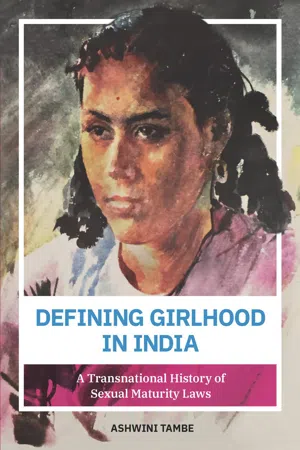
At what age do girls gain the maturity to make sexual choices? This question provokes especially vexed debates in India, where early marriage is a widespread practice. India has served as a focal problem site in NGO campaigns and intergovernmental conferences setting age standards for sexual maturity. Over the last century, the country shifted the legal age of marriage from twelve, among the lowest in the world, to eighteen, at the high end of the global spectrum. Ashwini Tambe illuminates the ideas that shaped such shifts: how the concept of adolescence as a sheltered phase led to delaying both marriage and legal adulthood; how the imperative of population control influenced laws on marriage age; and how imperial moral hierarchies between nations provoked defensive postures within India. Tambe takes a transnational feminist approach to legal history, showing how intergovernmental debates influenced Indian laws and how expert discourses in India changed UN terminology about girls. Ultimately, Tambe argues, the well-meaning focus on child marriage has been tethered less to the interests of girls themselves and more to parents' interests, achieving population control targets, and preserving national reputation.
- English
- ePUB (mobile friendly)
- Available on iOS & Android
eBook - ePub
About this book
Information
Publisher
University of Illinois PressYear
2019Print ISBN
9780252084560
9780252042720
eBook ISBN
9780252051586
Topic
Ciencias socialesSubtopic
Género y legislación1
Tropical Exceptions
Imperial Hierarchies, Climate, and Race
At what age do girls gain the maturity to make sexual choices? Until the twentieth century in many parts of the world, this question was answered using a physiological marker: the onset of menstruation. Menarche was treated as a threshhold marking the possibility of sexual activity both in religious norms and customary practice. The timing of coming-of-age ceremonies and customs, such as the quinceanera, ritushuddhi, and veiling, often coincided with this physiological change. In many instances, such rituals signaled sexual readiness and, as one attendant consequence, marriageability. While the level of choice that a girl could exercise in her sexual interactions certainly varied across contexts, puberty was generally assumed to mean a girl’s sexual maturation.
A different sense of sexual maturity, however, was in evidence in 1921 in Geneva at the first League of Nations Antitrafficking Convention, when representatives of the International Union for the Protection of Girls suggested that the legal age of consent to prostitution be set at 21 years.1 Only after reaching the age of formal majority, they said, did a girl have the requisite maturity to transact in sexual services. All countries around the world, they proposed, should share this same legal standard.2 This far-reaching proposal met with immediate resistance. The most forceful objections came from the representative of British India: Stephen Meredyth Edwardes, an Englishman and former police commisioner of Bombay, declared that all “tropical colonies” and “Eastern countries” be exempt from any such common age standard. His reasoning was strikingly physiological: he argued that setting 21 years as the age standard would be in conflict with “established physical facts, it being well known that the climatic conditions of India result in maturity being reached at an earlier age than in Europe.”3 Indian girls and girls in tropical colonies, he suggested, reached puberty before European girls did and hence did not merit such a high age of sexual consent.
Two understandings of sexual maturity were in conflict here: Edwardes’s rested on the notion of physical maturity, while antitrafficking advocates articulated a sense of mental maturity. Edwardes linked menarche with the capacity for engaging in sex, including transactional sex, while antitrafficking advocates presumed that such decisions were only possible after going through a longer period of mental maturation. These contrasting understandings of sexual maturity have been featured in other debates over legal age standards for prostitution, marriage, and statutory rape across multiple settings. This chapter focuses on the first sense of maturity—puberty—and explores why climate was presumed to affect it and how this notion shaped political debates.4 The next chapter focuses on how the second sense of a longer phase of mental maturation, with an extended adolescence ending in adulthood, emerged in the nascent field of psychology. In both contexts, I show how expert knowledges were complicit in affirming imperial narratives about hierarchies among parts of the world.
Even more striking than Edwardes’s focus on the physical marker of puberty is the meaning he assigned to early puberty: that it justified lower legal standards. Imperial ideologies deeply shaped this reasoning: the notion that menstruation and sexual maturation occurred earlier in warm climates was popular largely because it was consistent with the broader imperial narrative of the greater sexual proclivity of “tropical” people. Early sexual maturity was coded as a sign of fecundity, equated in prevailing ideologies with moral lassitude.5 Describing “tropical colonies and Eastern countries” as sites of early puberty affirmed a link between sexual precocity and civilizational inadequacy. In this context of an antitrafficking convention, the attendant assumption was that warm countries, purportedly prone to greater sexual license, would not enforce stringent state control of prostitution.
The resistance that Edwardes offered in the name of India was not unusual for official imperial discourse; as postcolonial theorists have argued, a common “rule of colonial difference” treated colonies as exceptions to liberalism’s universal norms.6 But it is not just colonial officials who asked to treat India as an exception: representatives of independent India at the United Nations in the 1950s also asked to exempt the country when a common age of marriage was discussed, as chapter 4 describes. Refusing interference in social practices, particularly those that affected women and children, was presented as an expression of national sovereignty.7 India, then, was held up as an exception to universal norms for both imperial and nationalist reasons.
Edwardes’s utter confidence that climate caused geographic differences in maturity was a sign of how entrenched theories from race science had become. Climatology, a version of race science explaining differences between people based on physical landscape and temperature, had, over the nineteenth century, advanced theories that the age of puberty varied according to climate. Such theories continued to circulate in the early twentieth century: classic obstetrics textbooks from the 1920s, 1930s, and 1940s in the English-speaking world contain detailed descriptions of geographic variations in the onset of menarche in girls. Race scientists, it appears, were deeply committed to the idea that regions of the world differed in this way, and they even sought to compute the average age of puberty along national territorial lines. In League of Nations conferences and even later in UN conferences, delegates made frequent and unreserved references to climate differences between countries as the reason for differences in their sexual mores. This common use of climate as a shorthand for describing race raises interesting questions: What explains the appeal of climate as a category for expressing difference? And what is the trajectory of climate as an explanatory device in the intellectual history of “race”?
Over the several League of Nations antitrafficking conventions held in the interwar period, conversations slowly tilted away from physiological reasoning toward a moral reasoning when framing differences between countries in sexual age standards. The League of Nations debates and proposals are a useful case when exploring the thorny legal question of how to compare sexual practices around the globe, because they demonstrate how geopolitics can shape the formulation of abstract universal principles. The league ostensibly inaugurated a modality of intergovernmental relations based not on the principle of the absolute power of the imperial powers but on greater acknowledgment of the sovereignty of nations—the very order we have inherited in the twentyfirst century. This new enterprise, premised on a liberal gesture toward the equivalence of nations, was, nonetheless, rife with attempts to establish implicit hierarchies among nations. Its proceedings also staged contests among competing imperialist nationalisms, apart from placing colonies in a subordinate role. In the 1920s and 1930s the minimum age for prostitution and marriage in various countries became a criterion for ascertaining their relative moral standing. In such a setting, climate emerged as a common way to index hierarchies in sexual practices. As the league’s infrastructure developed across the interwar years into a concerted biopolitical project, seeking to map the age of marriage, consent, and even puberty in the name of ameliorating moral health, this hierarchical vision deepened.
The first section of this chapter describes the efforts of the League of Nations to harmonize the age of sexual consent across countries and how some delegates used climate-based reasoning to resist a common age standard. The frequent mention of climate in these debates prompts my excavation, in the next section, of the genealogy of climate as a category in race science. In the last section of the chapter, I reflect on how, as the League of Nations began to implement antitrafficking projects, it grew more and more focused on altering social practices in the name of morality. The league became increasingly biopolitical in its reach in the late 1920s and 1930s, tracking sexual age standards and more across countries—and geographic differences remained salient. In sum, the chapter traces how, in a context where imperial countries vied for power over each other and influence over other parts of the world, the national age of consent for sex—understood through both physiological and social lenses—became a plank for indexing hierarchies among nations.
The League of Nations Antitrafficking Campaigns
Legal age standards for sexual maturity are challenging enough to devise at the state or national level, but they are especially contentious at the intergovernmental level. In the twentieth century, efforts at setting common standards have often been dogged by arrogance on the part of those proposing standards and by misgivings on the part of those most affected.8 The League of Nations case offers an example of an effort at universalizing age standards in a setting where tacit imperial hierarchies shaped relations among nations. In this context, I show both those who proposed and those who resisted universalizing efforts were complicit in advancing imperial ambitions.
The League of Nations Antitrafficking Conventions held in the 1920s were the first formal global intergovernmental context where a common sexual age standard was devised. Although earlier European conferences about white slavery (as European prostitution was called at the time) had specified a common age of consent, they did not bear the imprimatur of the league’s formal interstate agreements nor its professed geographic reach; these agreements had been promoted by a loose alliance of voluntary organizations and European government officials who had instituted a bureau run by voluntary organizations.9 The league took over the infrastructure of such agreements and gave it a universalist heft.
The institutional history of the League of Nations explains why it took up antitrafficking as a signature cause. The league was founded in the wake of World War I with the goal of preserving collective security, territorial integrity, and cooperation among nations of the world. It was prolific in setting up organizations that addressed important social questions of the time, such as refugee rehabilitation, labor rights, and public health, because such ventures in social terrains vastly enhanced the legitimacy of this new intergovernmental body. Its primary goal was to prevent a second world war, but through such organizations, it aimed to herald a new era of cooperation among nations.10
The purported aims of the league and its political structure were deeply at odds, though. While the league set out to offer a new model for international cooperation, it also was invested in preserving the power of imperial members. Its bipartite structure expressed the power of those victorious in the war: the permanent members of its executive body, the council, were the victorious Allied countries. As was common to many efforts at forming global institutions, “jockeying by competing colonial authorities” was a feature of its formation and functioning.11 Yet it also presented a stage for the entry of new international actors, and India was one such actor. India held the unique position of being admitted to the league even though it was a British colony, because of its important contributions of soldiers to Allied armies, helping to end World War I; Britain, however, selected its representatives.12 By the early 1930s the league’s membership had reached an unprecedented sixty-three countries, including representatives from Latin America and eastern Asia, such as China, Siam, and Japan, which gave the league’s ambitions and projects more heft. The story of its effort to coordinate a common age of consent illustrates the hazards of contexts in which coordination is attempted within deeply uneven power relations.
The first step the League of Nations took was to oversee the “supervision of the execution” of the 1904 and 1910 Suppression of White Slave Traffic protocols, as stated in article 23c of the Covenant of the League of Nations. It did so at the urging of several private organizations, particularly those of British origin, such as the Jewish Association for the Protection of Girls and Women, the feminist abolitionist Association for Moral and Social Hygiene, and the International Abolitionist Federation.13 The league set up the Committee on Traffic in Women and Children, which focused on policies for dealing with cross-border transportation for the purposes of prostitution, discouraging tolerated brothels, and coordinating laws pertaining to the age of consent for prostitution. Through the 1920s this committee met in a series of international conferences and called on member countries to respond to regular questionnaires, submit annual reports, send delegates to conferences, and, ultimately, pursue the legislative changes that would harmonize laws across countries.14
When the first League of Nations convention on trafficking met in six public sessions in Geneva in the summer of 1921, it was attended by delegates of thirty-four states and fourteen organizations. The conference featured a standoff between those who sought to abolish prostitution and those who sought to preserve its licensed forms. The former included representatives of the International Association for Social and Moral Hygiene and the Dutch delegate; and among the latter were France, Greece, Italy, Rumania, and Panama.15 The topic that galvanized the debate between these camps was a proposal to establish a common, and higher, age of consent for prostitution. Antitrafficking activists sought to raise the age of sexual consent for girls in an effort to establish an age below which entering prostitution would be illegal. Their goal was to prosecute as many traffickers as possible, and raising the age of consent allowed them to bring forward a larger number of cases.16 Their ultimate abolitionist vision was to eliminate the possibility of any kind of consent to prostitution; this was realized in 1932 when the League of Nations Traffic in Women and Children Committee voted to eliminate the age limit.17 In 1921 the Swiss voluntary organization International Union for the Protection of Girls made the formal recommendation to the league to raise the age standard to 21 years.18 The organization’s proposal implying that a woman below 21 was incapable of maturely consenting to prostitution gave rise to vexed debates among representatives about how age standards for sexual maturity...
Table of contents
- Cover
- Title
- Copyright
- Contents
- Acknowledgments
- Introduction
- 1 Tropical Exceptions: Imperial Hierarchies, Climate, and Race
- 2 Adolescence as a Traveling Concept
- 3 Legislating Nonmarital Sex in India, 1911–1929
- 4 Early Marriage as Slavery: UN Interventions, 1948–1965
- 5 Population Control and Marriage Age in India, 1960–1978
- 6 Investing in the Girl Child, 1989–2015
- 7 Curtailing Parents? Marriage and Consent Laws, 2004–2018
- Conclusion
- Notes
- Index
- Back Cover
Trusted by 375,005 students
Access to over 1.5 million titles for a fair monthly price.
Study more efficiently using our study tools.
Frequently asked questions
Yes, you can cancel anytime from the Subscription tab in your account settings on the Perlego website. Your subscription will stay active until the end of your current billing period. Learn how to cancel your subscription
No, books cannot be downloaded as external files, such as PDFs, for use outside of Perlego. However, you can download books within the Perlego app for offline reading on mobile or tablet. Learn how to download books offline
Perlego offers two plans: Essential and Complete
- Essential is ideal for learners and professionals who enjoy exploring a wide range of subjects. Access the Essential Library with 800,000+ trusted titles and best-sellers across business, personal growth, and the humanities. Includes unlimited reading time and Standard Read Aloud voice.
- Complete: Perfect for advanced learners and researchers needing full, unrestricted access. Unlock 1.5M+ books across hundreds of subjects, including academic and specialized titles. The Complete Plan also includes advanced features like Premium Read Aloud and Research Assistant.
We are an online textbook subscription service, where you can get access to an entire online library for less than the price of a single book per month. With over 1.5 million books across 990+ topics, we’ve got you covered! Learn about our mission
Look out for the read-aloud symbol on your next book to see if you can listen to it. The read-aloud tool reads text aloud for you, highlighting the text as it is being read. You can pause it, speed it up and slow it down. Learn more about Read Aloud
Yes! You can use the Perlego app on both iOS and Android devices to read anytime, anywhere — even offline. Perfect for commutes or when you’re on the go.
Please note we cannot support devices running on iOS 13 and Android 7 or earlier. Learn more about using the app
Please note we cannot support devices running on iOS 13 and Android 7 or earlier. Learn more about using the app
Yes, you can access Defining Girlhood in India by Ashwini Tambe in PDF and/or ePUB format, as well as other popular books in Ciencias sociales & Género y legislación. We have over 1.5 million books available in our catalogue for you to explore.