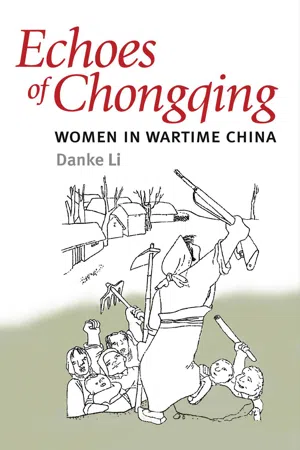
This collection of annotated oral histories records the personal stories of twenty Chinese women who lived in the wartime capital of Chongqing during China's War of Resistance against Japan during World War II. By presenting women's remembrances of the war, this study examines the interplay between oral history and traditional historical narrative, public discourse, and private memories. The women interviewed came from differing social, economic, and educational backgrounds and experienced the war in a variety of ways, some of them active in the communist resistance and others trying to support families or pursue educations in the face of wartime upheaval. Their stories demonstrate that the War of Resistance had two faces: one presented by official propaganda and characterized by an upbeat unified front against Japan, the other a record of invisible private stories and a sobering national experience of death and suffering. The accounts of how women coped, worked, and lived during the war years in the Chongqing region recast historical understanding of the roles played by ordinary people in wartime and give women a public voice and face that, until now, have been missing from scholarship on the war.
- English
- ePUB (mobile friendly)
- Available on iOS & Android
eBook - ePub
About this book
Information
Publisher
University of Illinois PressYear
2010Print ISBN
9780252076749
9780252034893
eBook ISBN
9780252091735
PART 1
The War and Gender's Social Roles
Prologue
Although Poshek Fu's 1997 study of occupied Shanghai, Joshua Fogel's 2000 study of Japanese-captured Nanjing, and Norman Smith's 2007 study of Japanese-controlled Manchukuo shed light on wartime life, especially intellectuals’ life in those places, we know very little about the social realities in the GMD-held wartime capital of Chongqing, especially how ordinary people made it through the war. Women's oral histories provide much information about the social realities in wartime Chongqing and a microcosmic view of how ordinary people survived the war.
The poor and well-to-do women's stories in this section reveal the social divide in wartime Chongqing society. While the war was inconvenient for well-to-do women's majiang games and dancing parties, it made ordinary Chongqing women's lives extremely disruptive and difficult. Ordinary women faced hardships ranging from daily bombardment by the Japanese to high inflation, lack of medical care, and severe shortages of food and other essential goods. Although during the war years numerous governmental and civil relief organizations were established, such as the Zhenji weiyuanhui [the Development and Relief Commission], an official relief bureau that was established in 1938, ordinary women benefited little from the services provided by them and were basically left alone to deal with the problems. Chongqing women initiated all kinds of day-to-day survival strategies to help themselves and their families stay alive. They took in whatever money they could and used marriage, kinship, regional associations, and classmate relationships as networks of survival. The interconnected relationships among all people, the native Chongqingnese and the xiajiang [downriver] people alike, revealed the essence and power of Chinese social networks in ordinary people's lives in times of national crisis when formal social order and power structures were disrupted by the war. Ordinary Chongqing women's survival stories provided vivid details about how the wartime society in GMD-held Chongqing operated through the interactions of a web of human connections that formed the social fabric in the region. Sometimes survival meant that women, especially the poor refugee women, had to take the worst options. Liu Qunying, a xiajiang woman who fled Wuhan with her mother and a young brother, was only seventeen. To survive the chaotic refugee life, she was forced to trade sex with a man outside of marriage for help and protection of her family. Her body became the family's survival device. Yet even under the worst circumstances, these women found ways to survive. Ordinary women were the unsung heroes who witnessed and endured much more of the war's detrimental harm than did many men and never received any recognition. To a large degree it was because of the unsung women's strong will of refusing to die, their resourcefulness, and their incredible skills in managing survival during the war that the nation was able to stay alive. Ordinary women were the bedrock of wartime China; their everyday lives embodied wartime Chinese anti-Japanese nationalistic spirit and reality.
Scholars in the West have argued that China's War of Resistance against Japan was an important period of modern state building, even though they have different opinions about the effectiveness of this process.1 For example, while Lloyd Eastman regards the Nationalists’ efforts as a total failure, Robert E. Bedeski believes that they were the “best possible under the circumstances.”2 The debate, however, does not tell us much about how the state-building process affected ordinary people's lives. Chongqing women's wartime stories shed light on the interactions between the Nationalist government, its state-building process, and local society in the region.
For example, although in 1939 the central and municipal governments established an air-raid emergency relief bureau to deal with Japan's intensive bombing of Chongqing and issued a comprehensive air-raid urgent relief plan to help people whose homes were damaged by the air raids, women's testimonies in this book reveal that ordinary people received little help from the government.3 The staggering housing problems that Li Shuhua and thousands of other poor families faced and the police abuses Wang Shufen frequently encountered during the war show that poor people benefited little from the state building. Though much scholarly attention in the West and China has been devoted to the study of wartime Chinese state building, not enough attention has been paid to the fact that many ordinary people were also significantly hurt and alienated by the wartime state in the GMD-held areas. Their alienation by the wartime state partly explains the lack of support from them for the Nationalists after the war during the final showdown between the CCP and the GMD.
Zhu Shuqin's story provides some concrete examples that during the war years the state had only limited control of the local society. Instead, underground societies, such as the Green and Red Gangs, had substantial influence. Although the local police could not stop thieves from stealing in her school, the admission of a daughter of one of the Green Gang chieftains pacified the campus.
For the Chongqing women whose stories are included in this book, gender identity was only part of their multiple identities and consciousnesses during the war. Gender clearly intersected with social class and other identities— family and educational background, political affiliation, personal awareness, and commitment to activism. These multiple identities and consciousnesses contributed to the variations in women's wartime experiences and to different degrees of awareness of representations of gender during the war in the Chongqing region.
For Chen Guojun, the wife of the king of dyestuffs in southwestern China, the war interrupted her college life and later created inconvenience for her majiang and dinner parties after her marriage. Overall, the war changed very little of her relatively comfortable material life, first as a rich and powerful person's daughter and then as a rich businessman's wife. Her personal identity and gender role were affected much less by the course of the war than by her social class and the power struggle between her and her stepmother. During the interview she constantly told me that she was aware of her gender identity at a fairly young age when she engaged in fighting with her stepmother. She believed that because she was a girl, not a boy, her stepmother dared to treat her badly, knowing that her father would care less about her than he would if the fighting involved a son. This realization and her family situation, rather than the war, played a large role in her struggle for personal identity and subjectivity. Although she gave in to the arranged marriage her parents imposed on her, she was a rebel by nature and actually manipulated the marriage to assert control over her own life. Her husband's money in addition to her father's social and political connections and influences made her a well-known woman with political influence during the war in Chongiqng. She was able to subdue her stepmother, contribute to the wartime efforts, and help underground Chinese Communists in a Nationalist-held city. She was able to assert her personal identity and patriotism.
In contrast, for the poor women at the bottom of Chongqing's wartime society, social class as manifested in extreme economic hardship was central in determining their wartime experiences. Ordinary Chinese women suffered most during the war years. Although their suffering was attributed more to their social class, wartime hardship did enhance their awareness of gender identities. Poor women, such as Li Shuhua and Wang Shufen, were poor to begin with and suffered before the war. Nevertheless, the war made their lives much more miserable. For these women, gender and social class built upon one another, creating a unique set of challenges that defined their war experiences. In terms of gender relationship, the interviewees in this section reveal that wartime hardship at least pushed many poor men and women to rely more on each other in order to survive. For example, Wang Shufen believed that because the war severely limited poor people's way of making a living and the great bombardment created extreme danger to their lives, her husband treated her so much better than before because they had to work very hard together and watch each other's backs to stay alive. To feed their families, poor women's survival strategies often took them out of their homes to the fields and garbage dumps to salvage edibles and reusables. Wartime hardships blurred the boundary of the “inner” and the “outer” spheres; scholars must rethink the meaning of domesticity.
In the case of female students, such as Zhu Shuqin and Luo Fuhui, the opportunity to receive progressive education, step out of the domestic domain, and work in the public sphere contributed to their awakening of gender and political consciousness. During the war years many Chinese schools and higher educational institutions moved to Chongqing and created greater and better opportunities for women's education for those who could afford it. Quality of education for women also improved as a result. The new schools that moved to Chongqing from coastal and more advanced areas, such as Shanghai and Beijing, were relatively more progressive and vigorous in their curriculum and pedagogy. Wartime Chongqing students thus had the opportunity to learn from highly qualified teachers who were famous scholars and former university professors as well as from some idealistic, enthusiastic, and progressive young teachers, both male and female. Young girls were deeply impressed and influenced by their teachers. Irma Highbaugh, an American scholar who resided in Sichuan, observed that during the war, “local rural teachers marry and continue to teach, bringing the new baby to school, where the children all help to tend it. Marriage and a profession are the standards set before the rural youth. Rural middle school girls are yearning for a career through which they can serve their country outside the home.”4 Seeing the female teachers’ independence, their roles in school in particular and in society at large, and their interactions with male colleagues made the young female students see for the first time a new kind of gender relationship and sexual division of labor. The war provided opportunities for them to assert their gender identity and prompted them to fight for personal and national liberation. Their active role in wartime mobilization demonstrated that women were part of wartime political discourse in the Chongqing region. To this group of women, the war facilitated the transformation of gender representations and had long-term beneficial influences on their personal lives.
As mentioned before, during the war years tens of thousands of people fled from the Japanese-captured north and central China to Chongqing. All interviewees in this book talked much about the relatively little-known cultural impact of the war displacement. The interviewees had vivid memories about the unprecedented wartime cultural fusion brought to the Chongqing region by the refugees. They were fascinated by the new styles of qipao [a mandarin collar dress], floral skirts, permed hair, and pantyhose introduced to Chongiqng by women from the lower Yangzi River. To the local women, the new products were symbols of modernity in material culture. Chongqing women's fascination about the xiajiang fashion and the wartime cultural fusion was noticed by Irma Highbaugh as well. She saw that when a large number of xiajiang people moved to Sichuan, many of them dressed differently and that “Shanghai styles of clothing and curled hair have moved into the rural sections to be secretly or openly admired and copied by the braver young matrons and bolder students.” And “in little rural towns educated women with bobbed hair and port-city dress styles go to market with baskets on their arms. … Diets change for these newly arrived families as they begin to eat locally grown vegetables new to them. In turn, diets change for the local people as the newcomers demonstrate new ways to prepare taro and sweet potatoes, for instance. People in the same yard exchange ideas on preparing foods: the Szechwanese housewife tells the down-river woman how to make pepper dishes, while the northern mother shares her newly made steamed biscuits with the children of the neighbours and explains how they are made.”5 Although in general during the war years there was a perceived social and cultural divide between the “modern” xiajiang people and the “backward” native Chongqing people,6 refugee migration also contributed to cultural fusion, which reconfigured local people's sense of space, blurred the gap of regional difference in culture, connected local and national together, and made the locality a national community. Not all refugee women belonged to or were perceived as the “modern” and “dominant” xiajiang people; nor were all xiajiang people treated by the native Chongqing people as hateful outsiders. The stories of three xiajiang women, Liu Qunying, Zhao Zhinan, and Cui Xiangyu, testify that social class and gender, more than the origins of geographic place, determined women's wartime experiences.
Refugee migration brought profound social changes, especially changes in people's attitude toward gender relations. Irma Highbaugh commented in 1942 that after the arrival in Sichuan of a large number of refugees from other parts of China, young men and women began to openly appear on streets together. “Girls who have traveled for weeks, and sometimes for months under circumstances that allowed for few reserves, see no need for down-cast eyes or hiding within the house when attractive young men come along. Parents who have realized that their daughters know how to take care of themselves have long since lost regard for conventions that are useless.” She also noticed that when local Sichuan youth went to school with the xiajiang youth, they copied what they saw from their xiajiang classmates. The war even changed young people's idea of the ideal mate. A man wanted a mate who could endure the hardship of the war, be able to march beside him like a soldier, carry the baby on the trek, and run for shelters from daily bombings.7
Chongqing women's wartime stories also tell us that the war fragmented not only many Chinese families but also the basic meaning of motherhood— being able to nurse and take care of infant children. The hardships of the war, constant Japanese bombardment, and severe shortages of material goods deprived young mothers like Cui Xiangyu of adequate food and water and made her unable to nurse her infant children. She could not find adequate medical care for her sick child and had to watch her young son die in her own arms in the midst of Japanese bombing. Her stories tell us that wartime motherhood was far different from the traditional image of domestically confined Chinese motherhood. Routinely running for air shelters with her children and going out to salvage edibles expanded a mother's sphere and blurred the boundary between domestic and public spaces.
While the war tore many Chinese families apart, the Zhongguo zhanshi ertong baoyuhui [Wartime Child Welfare Protection Association], ZZEB, functioned as families to over thirty thousand homeless refugee children and thousands of teachers and staff members from all over the country. The ZZEB was established in Wuhan on March 10, 1938, on the initiative of women activists with the support of men and women from all political camps. After the Japanese took over Wuhan in November 1938, the ZZEB national headquarters moved to Chongqing. Fifty-three homes were established; twentythree were located in Sichuan, with the majority of them in the Chongqing region.8 Leadership of the ZZEB was provided by women activists from all political camps. The women leaders and the female teachers and staff members of the organization were addressed by refugee children as “mothers.”
The mission of the ZZEB was best summarized by the manifesto of the Sichuan branch: “Since the September 18th incident, countless children in our country have been senselessly dying.9 Especially after the Lugou Bridge incident, the enemy began either killing a large number of our children or taking them away. The killed ones cannot come back and the captured ones are enslaved by the enemy. Both are the venomous schemes of the enemy aimed at terminating our national lifeline. Since the enemy is so desperately trying to destroy our children, we have to treasure them. If the enemy wants to kill them, we have to try our best to protect them; if the enemy wants to take them away, we have to rescue them. With this belief, we now formally launch the Zhanshi Ertong Baoyuhui.”10 During the eight years of war, the ZZEB was recognized as the most accomplished war effort pursued by women, and the ZZEB homes not only housed homeless refugee children but also trained them and imbued them with nationalism.
By assuming the responsibility for saving the children, women activists assumed the role of mother of the nation and the duty of national salvation. Initially the ZZEB was supported by men from all political camps because of the sexist assumption that it was women's duty to take care of children and that the reconnection of the ties between women and children would restore a gender-based division of labor and male-dominated social order that had been disrupted by the war. However, the sense of motherhood reinvented and pursued by ZZEB leaders and members was far beyond assuming a traditional natalist function for women. The refugee children's protection and education tested China's strength as a nation and symbolized its future. When women activists assumed the role of mother to the refugee children, they became the mothers of the Chinese nation. They turned privately and domestically defined motherhood into a public and patriotic role, which would determine the very survival of China as a nation and the Chinese as a race in the war and beyond.
Preserving the younger generation meant preserving the national lifeline. As Rong Cai points out, traditionally the preservation of China's national lifeline, zhong [the seeds, which traditionally refers to sperm], has always been associated with male authority and identity.11 Here, by assuming the duty of saving the children, women replaced men and claimed a rightful moral authority over the nation. Motherhood and the nurturing nature of womanhood became a public virtue and political discourse of wartime China. The ZZEB redefined not only motherhood but also the male-centered nation. More significantly, women themselves, not the men or the state, defined the role and negotiated feminist and national identities in wartime Chinese society and politics. The refugee children's homes established by the ZZEB represented the systematic development of China's modern child welfare system, which laid the foundation for the development of similar systems in the People's Republic of China and Taiwan.
One subject about which all interviewees had vivid memories and considered an important part of their...
Table of contents
- Cover
- Title
- Copyright
- Contents
- Acknowledgments
- Introduction: History, Women, and China’s War of Resistance against Japan
- Part I: The War and Gender’s Social Roles
- Part II: The War and Gender’s Economic Impact
- Part III: The War and Gender’s Political Impact
- Part IV: Women, Memory, and China’s War of Resistance against Japan
- Notes
- References
- Index
Trusted by 375,005 students
Access to over 1.5 million titles for a fair monthly price.
Study more efficiently using our study tools.
Frequently asked questions
Yes, you can cancel anytime from the Subscription tab in your account settings on the Perlego website. Your subscription will stay active until the end of your current billing period. Learn how to cancel your subscription
No, books cannot be downloaded as external files, such as PDFs, for use outside of Perlego. However, you can download books within the Perlego app for offline reading on mobile or tablet. Learn how to download books offline
Perlego offers two plans: Essential and Complete
- Essential is ideal for learners and professionals who enjoy exploring a wide range of subjects. Access the Essential Library with 800,000+ trusted titles and best-sellers across business, personal growth, and the humanities. Includes unlimited reading time and Standard Read Aloud voice.
- Complete: Perfect for advanced learners and researchers needing full, unrestricted access. Unlock 1.5M+ books across hundreds of subjects, including academic and specialized titles. The Complete Plan also includes advanced features like Premium Read Aloud and Research Assistant.
We are an online textbook subscription service, where you can get access to an entire online library for less than the price of a single book per month. With over 1.5 million books across 990+ topics, we’ve got you covered! Learn about our mission
Look out for the read-aloud symbol on your next book to see if you can listen to it. The read-aloud tool reads text aloud for you, highlighting the text as it is being read. You can pause it, speed it up and slow it down. Learn more about Read Aloud
Yes! You can use the Perlego app on both iOS and Android devices to read anytime, anywhere — even offline. Perfect for commutes or when you’re on the go.
Please note we cannot support devices running on iOS 13 and Android 7 or earlier. Learn more about using the app
Please note we cannot support devices running on iOS 13 and Android 7 or earlier. Learn more about using the app
Yes, you can access Echoes of Chongqing by Danke Li in PDF and/or ePUB format, as well as other popular books in History & Chinese History. We have over 1.5 million books available in our catalogue for you to explore.