Consider the usual view of film noir: endless rainy nights populated by down-at-the-heel boxers, writers, and private eyes stumbling toward inescapable doom while stalked by crooked cops and cheating wives in a neon-lit urban jungle.
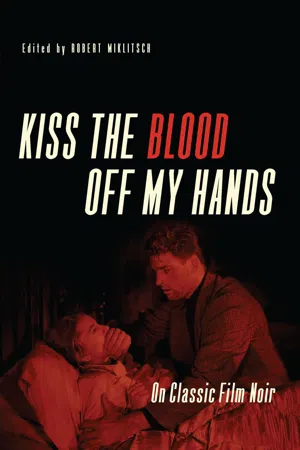
But a new generation of writers is pushing aside the fog of cigarette smoke surrounding classic noir scholarship. In Kiss the Blood Off My Hands: On Classic Film Noir, Robert Miklitsch curates a bold collection of essays that reassesses the genre's iconic style, history, and themes. Contributors analyze the oft-overlooked female detective and little-examined aspects of filmmaking like love songs and radio aesthetics, discuss the significance of the producer and women's pulp fiction, and investigate topics as disparate as Disney noir and the Fifties heist film, B-movie back projection and blacklisted British directors. At the same time the writers' collective reconsideration shows the impact of race and gender, history and sexuality, technology and transnationality on the genre.
As bracing as a stiff drink, Kiss the Blood Off My Hands writes the future of noir scholarship in lipstick and chalk lines for film fans and scholars alike.
Contributors: Krin Gabbard, Philippa Gates, Julie Grossman, Robert Miklitsch, Robert Murphy, Mark Osteen, Vivian Sobchack, Andrew Spicer, J. P. Telotte, and Neil Verma.
- English
- ePUB (mobile friendly)
- Available on iOS & Android
eBook - ePub
About this book
Information
Publisher
University of Illinois PressYear
2014Print ISBN
9780252080180
9780252038594
eBook ISBN
9780252096518
Subtopic
Social History1
Independence Unpunished
The Female Detective in Classic Film Noir
Film noir arose in concert with U.S. involvement in World War II. As the war came to a close, noir narratives were often centered on the problems facing returning servicemen, from unemployment to broken homes—problems often regarded as the result of increased female independence. During the war, women had supported the men fighting overseas and the war effort back at home by going to work; when the war was over and the men returned, however, women were encouraged to return back to the home. In the immediate postwar years, women were needed to nurture the physically and mentally wounded veterans—not to compete with them in the workplace—and this led to a bifurcation of roles for women in film noir. In reality, many women had left the home to take up employment and pursued sexual gratification in the absence of their husbands; in noir, these women were branded as evil and punished or restored to a subordinate place in the home.
As Sylvia Harvey explains, “The two most common types of women in film noir are the exciting, childless whores, or the boring, potentially childbearing sweethearts”—in other words, “the femme fatale” and what Janey Place refers to as “the woman as redeemer.”1 Julie Grossman argues that, in film criticism, “film noir has been understood in a feminist context in two central ways: first, as a body of texts that give rise to feminist critique; and second, as a celebration of unchecked female power.”2 Certainly, feminist film critics have tended to critique noir's representation of the “good girl” (the redeemer) as boring and unappealing and to celebrate that of the femme fatale as empowered—despite her vilification and punishment within noir narratives. In the world of the male-centered noir film, women represent oppositional choices for the male hero—safe versus tempting, good versus evil. For example, Robert Porfirio describes the femme fatale as “the worst of male sexual fantasies.”3 Mary Ann Doane suggests that she is a “symptom of male fears about feminism.”4 Janey Place proposes that the femme fatale is, for the noir hero, “the psychological expression of his own internal fears of sexuality, and his need to control and repress it.”5 Elizabeth Cowie confirms that the “‘femme fatale’ is simply a catchphrase for the danger of sexual difference and the demands and risks desire poses for the man.”6 Lastly, Tania Modleski argues that film noir “possesses the greatest sociological importance (in addition to its aesthetic importance) because it reveals male paranoid fears, developed during the war years, about the independence of women on the homefront.”7
Noir scholars have discussed at length the figure of the femme fatale as the epitome of dangerous femininity and the good girl as the noir hero's positive, but bland, choice. Many noir films, however, presented alternative roles for women—especially those films centered on a female protagonist. Although overshadowed by the critical focus on noir as a male genre, women have been the central driving force of many noir narratives, even some of the most memorable and critically praised ones, notably Michael Curtiz's Mildred Pierce (1945). More recently, attention has been paid to noir's gothic thrillers with female protagonists, including Alfred Hitchcock's Rebecca (1940) and George Cukor's Gaslight (1944), but noir's female investigative protagonists have been relatively underexamined. This is an oversight in noir scholarship, especially in light of the fact that the male investigative thriller is one of the most significant types of noir narrative—according to Frank Krutnik's classification—and those protagonists have been identified by critics as hard-boiled reactions to America's wartime and postwar social shifts.
The aim of Julie Grossman's work has been to expose “the misreadings of women in noir, first by the men whom they encounter within the films, and second by film viewers and critics who then perpetuate, and eventually institutionalize, these misreadings.”8 Similarly, the aim of this essay is to contribute to the growing body of scholarship dedicated to revising our erroneous assumptions about the role of women in the classic phase of film noir by examining one of the significant roles available to women: the detective. Women in classic noir are never detectives by profession, whether working for the police or as private investigators, but a number of them serve as amateur investigators (in the footsteps of Miss Marple and Nancy Drew), seeking out the truth about a crime most often to clear the name of a man they love. The sex of the female detective complicates the traditionally male noir detective narrative as the narrative is driven forward as much by the female protagonist's personal desires (as in the woman's film) as by her investigation (as in the detective film), and the heroine's independence as a detective and exploration of her sexuality pose undesirable challenges to the masculinity of her husband—just like the femme fatale. Unlike the femme fatale, however, the female detective is allowed to enjoy her foray into masculinity and conclude the film unpunished.
Investigating the Genre
Film noir, beginning in the early 1940s and concluding in the late 1950s, was initially a film style or film movement (rather than necessarily a genre) defined by themes, characters, and visual style that were darker than the typical classical Hollywood film. The label “film noir” was applied retrospectively by French critics (as opposed to a category identified by producers) to describe a group of Hollywood films that, at the time, were released as detective films, crime melodramas, or thrillers. With the return of noir in the 1970s with films like Roman Polanski's Chinatown (1974), noir style and narrative were solidified into what many critics regard as a genre. Consequently, I prefer the term “noir films” to “film noir,” referring to individual films with noir elements rather than a genre.
Krutnik argues that there are three types of protagonist in three types of noir film: the victim hero in “the male suspense thriller,” the criminal hero in “the criminal-adventure thriller,” and the detective hero in “the investigative thriller.”9 As Cowie confirms, Krutnik's argument assumes that noir is “a male preserve,” and, as Deborah Thomas suggests, film noir is regarded by most as a “male-centred” genre.10 Out of the frontier and onto America's twentieth-century city streets came the myths of rugged individualism and the American dream, both of which embodied the idea that if a man worked hard and lived a moral life then he would be successful. Servicemen returning from World War II, however, came back to a changed society and significant obstacles: unemployment, alienation, degradation, disablement, broken homes, and new gender roles. The expectation to conform—to embrace the role of the “grey flannel suit” (i.e., working for someone else rather than being one's own man)—contradicted the idea of being a rugged individual. Noir's hard-boiled private eye offered a fantasy of the rugged individual during the immediate postwar years: he worked for himself, by himself, and brought the villains to justice without having to work within the bureaucratic machinery of law enforcement. This identifiably American hero solved the mystery of the crime not through contemplative ratiocination, as would the British sleuth Sherlock Holmes, but through streets smarts, quick wit, and the ability to commit violence. The noir hero was not a secure, stable, and content man but jaded, troubled, and lonely. While the noir film introduced a mystery for the hero to solve, ultimately the mystery he investigated was that of his own masculinity and his place in postwar society. What then of the female investigator in noir films?
Richard Maltby defines the noir detective as “the man assigned the task of making sense of the web of coincidence, flashback, and unexplained circumstance that comprised the plot.” Maltby also notes that, importantly, the detective “was not always the central protagonist,” despite his role as investigator.11 Women in noir films are also sometimes assigned this same task, and they did not always complete the task alone. While detective fiction of the 1930s began to focus on the tough, hard-boiled, male heroes that would populate film noir a decade later, Hollywood—in the wake of the Depression—presented a range of female detectives that could be young or old, spinsters or lovers, feminine or masculine, hard-boiled or soft. Alongside the popular B-series male detectives, including Philo Vance, Perry Mason, and Charlie Chan, appeared the female amateur detective, including Torchy Blane, Nancy Drew, and Hildegarde Withers, who were all popular enough to sustain their own film series. Hollywood's female detectives defied their socially prescribed, “proper” roles by stepping out of the domestic sphere and taking on the presumed male pursuit of detecting. Because the Depression had made working women a reality, they were common Hollywood protagonists, and the female detective often rejects a proposal of marriage at the end of the film to continue with her career. With the United States joining World War II, gender roles—in Hollywood film and reality—experienced a repolarization, and the female investigator changed her mind. The wartime and postwar heroine sees the two “ambitions” of marriage and a career combined: the solution of the mystery will make the love interest available to the heroine to marry.12
While William Covey states that “[t]here were very few female investigators and no female detective in classic film noirs,” Krutnik acknowledges that two films—Boris Ingster's Stranger on the Third Floor (1940) and Robert Siodmak's Phantom Lady (1944)—foreground the investigations of female protagonists.13 Krutnik, though, is critical of the female detective, arguing that that her “detective activity” is “compromised by her femininity,” and he dismisses her agency because “the woman's placement in the conventional masculine role as detective is motivated by, and ultimately bound within, her love for the wrongly-convicted hero.”14 I disagree that such a motivation should negate the agency that such female detectives demonstrate, since several male detectives in noir films—most famously Dana Andrews in Otto Preminger's Laura (1944)—are also motivated to investigate out of love/desire. Indeed, Krutnik himself explains, “When, from 1944, the Hollywood studios began to produce ‘hard-boiled’ thrillers in a concerted manner, they tended either to introduce or to increase the prominence of a heterosexual love-story, a factor which in many cases shifted the emphasis from the story of a crime or investigation to a story of erotic obsession. The love story complicates the linear trajectory of the hero's quest.”15 I would argue that, in the case of the female investigator, there is not a shift in emphasis away from the investigation despite the foregrounding of a heterosexual romance, and that the linear trajectory of the heroine's quest is not necessarily complicated by it, especially in films such as Phantom Lady and Norman Foster's Woman on the Run (1950), in which the love interests are absent for the majority of the story. In response to Krutnik's assertions, Helen Hanson suggests that the romantic strand is as necessary to the female detective narrative as the crime strand: “The ‘woman's angle’ and her investigative quest, with the question of her male counterpart's innocence at its centre, allows her to ‘test’ her male counterpart before the film closes in marriage.”16
In her article on victims/redeemers and working girls, Sheri Chinen Biesen mentions that two of the latter are detectives.17 In his discussion of homefront detectives, Dennis Broe argues that the noir adaptations of three Cornell Woolrich stories centered on female detectives are part of a broader trend of narratives featuring “outside-the-law” detectives.18 Angela Martin identifies nine noir films with women in investigative roles, and Cowie five, but both discuss them only briefly as one of several types of central female protagonists in film noir.19 As William Park notes, “[S]uch films deserve a book of their own, which should do much to dispel the false notion that noir is confined to a boy's game.”20 Hanson offers an analysis of the female detective in four films but regards them as an extension of the female detective tradition established in the mystery-comedies of the 1930s—such as the Nancy Drew, Hildegarde Withers, and Torchy Blaine series—which I argue they are a deviation from.21
The noir films with an investigating heroine tend to fall into two distinct categories: the gothic melodrama in a rural setting in which the heroine investigates the mysterious past of the male love interest to determine if, or to ensure that, they can have a happy future together, including James V. Kern's The Second Woman (1950) and Vincente Minnelli's Undercurrent (1946); and the detective film in an urban setting in which the heroine investigates a crime that the male love interest has been accused of committing, including H. Bruce Humberstone's I Wake up Screaming (a.k.a. Hotspot, 1941) and Harold Clurman's Deadline at Dawn (1946). The former type often sees its heroine's investigation abandoned or short-circuited by a man and places the romance as the primary narrative focus; the latter typically provides the heroine a significant role as detective and places the investigation, rather than the romance, as the primary focus of the narrative. My research has uncovered at least twenty noir films with women in various roles as detectives: “minor,” possessing only some investigative agency in relation to a male detective, including Stranger on the Third Floor, Jacques Tourneur's The Leopard Man (1943), Henry Hathaway's The Dark Corner (1946), John Reinhardt's Open Secret (1948), and Harry Horner's Vicki (1953); “significant,” often assisting a male investigator, including I Wake up Screaming, Mark Robson's The Seventh Victim (1943), William Castle's When Strangers Marry (a.k.a. Betrayed, 1944), Sam Newfield's The Lady Confesses (1945), Deadline at Dawn, Undercurrent, Joseph M. Newman's Abandoned (1949), The Second Woman, and Vincent Sherman's Backfire (1950); and “major,” as the primary investigator, including Alfred Hitchcock's Shadow of a Doubt (1943), Phantom Lady, Roy William Neill's Black Angel (1946), Edward L. Cahn's Destination Murder (1950), Woman on the Run, and Roy Rowland's Witness to Murder (1954).22 Elsewhere I have discussed some of the last group of films as generic hybrids—part melodrama and part noir, or “melo-noir.”23 In this essay, however, I will explore how the female detective represents a third type of female role in the film noir—one that combines aspects of the femme fatale and the redeemer figure into a compelling, driven, sexualized, yet unpunished female fi...
Table of contents
- Cover Page
- Title Page
- Copyright Page
- Dedication Page
- Contents
- Acknowledgments
- Preface
- Introduction
- 1 - Independence Unpunished: The Female Detective in Classic Film Noir
- 2 - Women and Film Noir: Pulp Fiction and the Woman's Picture
- 3 - The Vanishing Love Song in Film Noir
- 4 - Radio, Film Noir, and the Aesthetics of Auditory Spectacle
- 5 - Disney Noir: “Just Drawn that Way”
- 6 - Detour: Driving in a Back Projection, or Forestalled by Film Noir
- 7 - Producing Noir: Wald, Scott, Hellinger
- 8 - Refuge England: Blacklisted American Directors and ’50s British Noir
- 9 - A Little Larceny: Labor, Leisure, and Loyalty in the ’50s Noir Heist Film
- 10 - Periodizing Classic Noir: From Stranger on the Third Floor to the “Thrillers of Tomorrow”
- Classic Noir on the Net
- Critical Literature on Film Noir
- Contributors
- Index
Trusted by 375,005 students
Access to over 1.5 million titles for a fair monthly price.
Study more efficiently using our study tools.
Frequently asked questions
Yes, you can cancel anytime from the Subscription tab in your account settings on the Perlego website. Your subscription will stay active until the end of your current billing period. Learn how to cancel your subscription
No, books cannot be downloaded as external files, such as PDFs, for use outside of Perlego. However, you can download books within the Perlego app for offline reading on mobile or tablet. Learn how to download books offline
Perlego offers two plans: Essential and Complete
- Essential is ideal for learners and professionals who enjoy exploring a wide range of subjects. Access the Essential Library with 800,000+ trusted titles and best-sellers across business, personal growth, and the humanities. Includes unlimited reading time and Standard Read Aloud voice.
- Complete: Perfect for advanced learners and researchers needing full, unrestricted access. Unlock 1.5M+ books across hundreds of subjects, including academic and specialized titles. The Complete Plan also includes advanced features like Premium Read Aloud and Research Assistant.
We are an online textbook subscription service, where you can get access to an entire online library for less than the price of a single book per month. With over 1.5 million books across 990+ topics, we’ve got you covered! Learn about our mission
Look out for the read-aloud symbol on your next book to see if you can listen to it. The read-aloud tool reads text aloud for you, highlighting the text as it is being read. You can pause it, speed it up and slow it down. Learn more about Read Aloud
Yes! You can use the Perlego app on both iOS and Android devices to read anytime, anywhere — even offline. Perfect for commutes or when you’re on the go.
Please note we cannot support devices running on iOS 13 and Android 7 or earlier. Learn more about using the app
Please note we cannot support devices running on iOS 13 and Android 7 or earlier. Learn more about using the app
Yes, you can access Kiss the Blood Off My Hands by Robert Miklitsch in PDF and/or ePUB format, as well as other popular books in Media & Performing Arts & Social History. We have over 1.5 million books available in our catalogue for you to explore.