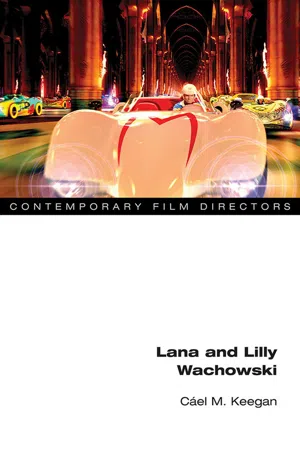
Cáel M. Keegan views the Wachowskis' films as an approach to trans* experience that maps a transgender journey and the promise we might learn "to sense beyond the limits of the given world." Keegan reveals how the filmmakers take up the relationship between identity and coding (be it computers or genes), inheritance and belonging, and how transgender becoming connects to a utopian vision of a post-racial order. Along the way, he theorizes a trans* aesthetic that explores the plasticity of cinema to create new social worlds, new temporalities, and new sensory inputs and outputs. Film comes to disrupt, rearrange, and evolve the cinematic exchange with the senses in the same manner that trans* disrupts, rearranges, and evolves discrete genders and sexes.
- English
- ePUB (mobile friendly)
- Available on iOS & Android
eBook - ePub
Lana and Lilly Wachowski
About this book
Lana and Lilly Wachowski have redefined the technically and topically possible while joyfully defying audience expectations. Visionary films like The Matrix trilogy and Cloud Atlas have made them the world's most influential transgender media producers, and their coming out retroactively put trans* aesthetics at the very center of popular American culture.
Information
Publisher
University of Illinois PressYear
2018Print ISBN
9780252083839
9780252042126
eBook ISBN
9780252050879
Subtopic
Film & VideoSensing Transgender
It is the day after the Orlando Pulse massacre, and Lana Wachowski is wearing black.
I am as well, but this is purely coincidence. Rushing with the jittery nerves of a young researcher to the Sense8 shoot in Gary, Indiana, that June morning, I had not given much thought to the news or to the color of my T-shirt. When Wachowski arrives to begin the day’s work, I see immediately that she has: her black shirt is emblazoned with a pink triangle accompanied by what I learn are the words “Who’s next?” in Cyrillic. When I inquire about the language, Karin Winslow Wachowski (Lana’s wife) explains to me that Lana and her sister, Lilly, wore these shirts during their press tour for Jupiter Ascending. Knowing they would be screening the film in Russia, the siblings and longtime codirectors used the shirts and matching armbands to protest the anti–gay propaganda law instated there in 2013. Today, in the wake of the forty-nine murders at Pulse,1 “Who’s next?” carries a renewed and terrible resonance. Quietly observing the crew’s unfolding preparations, the previous day’s news slowly catches my heels. I struggle to make sense of this scene in the face of such disaster for others.
As the sun begins to arc high, we throng into a ruined Gothic Revival church, its ceiling caved in by fire. From behind my dust mask and hardhat, I watch Wachowski work for hours with the cast, crew, and codirector James McTeigue in beating, early summer heat. More than anything, I am struck by the remarkably touching nature of her process: She touches everyone—blocking the cast members, physically guiding her Steadicam operator from behind while looking past his shoulder into the camera. She stands side by side with an actor for nearly an hour, asking for a short set of lines again and again until the necessary emotion pours out. She even touches me in a brief hug. I notice how by simply wearing the shirt, Wachowski has wordlessly brought the violence of the massacre into the shoot as an acknowledgment and a challenge: these are the stakes of being queer, trans, and of color in America; this is what we are imagining against. In response, the shoot feels full of a fierce sorrow, a desiring strain toward something else. The next day, as I drive back to Michigan, tears will unexpectedly roll down my face.
In a 2012 interview with the Village Voice, Lana Wachowski reflects: “Growing up, fantasy was the world as the world would never be, and science fiction was the world—filled with problems and ideas—as it could be. We were always drawn more to science fiction than to fantasy. … But for [Lilly and me], science fiction has always been an experimental genre.” At the very bottom of the same interview, she touches again on this utopian theme: “I believe inherent in any artist’s work is an optimistic truth. That the very creation of art is in itself an act of optimism” (Abrams). Across these statements, Wachowski expresses a faith in the subjunctive quality of art to lead us elsewhere:2 if by art we come to sense differently, we might then arrive at another world. This is the thesis and animating philosophy behind all of the Wachowskis’ cinema. It is also a conviction uniquely attuned with transgender experience. Transgender phenomenology is rooted in the desire to make perceivable a feeling of gender that others have not (yet) witnessed. In his enthralling exploration of transsexual selfnarration, Second Skins, Jay Prosser grounds transgender subjectivity in a felt imaginary that seeks “to recover what was not.” Sensing something others miss, the trans imaginary summons its own literalization, “its externalization, its substantiation, in material flesh” (84–86). We could say that “trans” describes an inherently subjunctive relation to what is considered real, to what can be commonly sensed. To survive, transgender people have had to craft imaginaries that sustain our desire to become, our belief that we might come into perception differently. The world, and me, as we could be.
Transgender studies grows out of this same desiring resistance to dictated form. In her foundational 1992 essay, “The Empire Strikes Back: A Posttranssexual Manifesto,” Sandy Stone called for a new transgender movement that would cast off the linear medical model imposed on transsexual identity, reconstituting trans not as a gender but rather as a genre “whose potential for productive disruption of structured sexualities and spectra of desire has yet to be explored” (231). An entire field concatenated in the quarter century following Stone’s call, shifting the focus of inquiry from transgender objects to “trans” as an analytic for “linking the questions of space and movement … to other critical crossings of categorical territories” (Stryker, Currah, and Moore 12).3 Today transgender studies describes trans* not as an identification, but as a force characterized by unpredictable flows across discrete forms, a “paratactic” that enacts the prepositional “with, through, of, in, and across” animating vitality itself (Hayward and Weinstein 196). Like science fiction, trans* is about how what could happen haunts the present, asking us to consider where elements in reality might lead if permitted to reach (Shaviro, No Speed Limit 2). The sticky fingers of the fronded asterisk (*) are the speculative lines of transgender’s felt imaginary, sensing outward with faith to realize new contacts. Trans* thus marks the “capacity to transform one reality into another” (Stryker, Foreword x)—how transgender phenomenology necessitates a ceaseless navigation between the tangible and intangible, perception and sense, the real and the imaginary.
Toward what might a trans* cinema reach? Cinema, of course, is a technology that orders our senses. As the phenomenological turn in film theory illustrates, cinema filters our pre-discursive affects so that they might become collectively, cognitively grasped.4 Much like gender, cinematic technology thoroughly permeates our idea of the real, such that we cannot access “the world” except through its language. Cinematic schemas arrange our shared expectations of what might happen at any moment—our common sense.5 We occupy a cinematic reality,6 cinematic bodies. Early on, transgender studies noted the similarities between transsexual and cinematic material processes. In an essay published in 2000, Susan Stryker writes:
The transsexual body … presents critical opportunities similar to those offered by the camera. Just as the camera offers a means for externalizing and examining a particular way of constructing time and space, the transsexual body—in the process of its transition from one sex to another—renders visible the culturally specific mechanisms of achieving gendered embodiment. It becomes paradigmatic of the gendering process, functioning, in Sandy Stone’s words, as “a meaning machine for the production of ideal type.” (“Transsexuality” 592)
As Stryker points out, medical transition is indeed similar to cinematic technique. As in editing or montage, surgical transition rearranges the flesh to tell a coherent story about gender. Yet the relation she notes between cinema and trans is a reciprocal one: Cinema is also “like” transgender phenomenology. Cinema, like trans* ideation, is a medium for expressing unrealized bodies. Both animate what is latent, distilling from the world forms that have been present all along, if imperceptibly. Both seem to reveal something new, even as they disclose only what idealities and objects preexist them. Cinema is, obviously, durational—the medium perhaps most capable of representing our sensorial life as it feels to happen. Like experience, cinema must move temporally forward. Its technicity is inherently speculative, opening a horizon in the text’s unfolding that is much like gender transition itself.7 The couldness of both cinema and trans* is a faith that other affects might come into perception. At the outset, we never know what will emerge. Inside the transitional space of cinema/cinematic space of transition, we become subjunctive—feeling in the dark toward what might happen, marking how we’ve become by touching back on our prior selves.
A popular trans* cinema would thus have speculative designs on cinematic reality. We could envision such a cinema as a desiring confrontation with what might be commonly perceived—a sensing at the far edges of preexisting cinematic forms, arising from within a trans* imaginary. Such a popular cinema would appear to not yet exist. Operating within the marginalized realm of independent queer/LGBT cinema, trans-authored films have rarely received widespread distribution, viewership, or critical attention. Or so we might presume. When Lana and Lilly Wachowski came out as transgender women, they retroactively altered the history of transgender cultural production, disclosing how trans-authored work is already located at the very center of our cultural imaginary.8 There is little theoretical context for such a revelation. Until recently, studies of transgender and cinema have largely been of transgender in cinema, the literature overdetermined by a focus on representation, casting, and performance.9 To make sense of the Wachowskis’ work as popular cinema produced by transgender creators requires alternative praxes, through which we might revisit objects to “tell new stories about things many of us thought we already knew” (Stryker, “(De)Subjugated” 13). Such “revisitations” (Keegan, “Revisitation”) are an inherent part of trans* meaning-making, crucial to how trans lives demand recognition in “new” genders and sexes that are not new—how trans people make ourselves perceivable in reverse. Lilly Wachowski invites such a return when she states, “There’s a critical eye being cast back on Lana’s and my work through the lens of our transness, and this is a cool thing, because it’s an excellent reminder that art is never static” (“Lilly Wachowski Shares”).
To read trans* in the Wachowskis’ cinema would therefore be to meet transgender as it is practiced,10 deploying the heuristics by which trans subjects bring what has only been sensed into shared recognition. Below I argue that the Wachowskis’ cinema establishes a common cinematic language for sensing beyond gender’s dictated forms, and therefore “the real,” that can be periodized to the turn of the twenty-first century. Mutually constitutive with the historical formation of transgender as a phenomenological form and a politics, their cinema can be understood as an aesthetic record of how mass cultural forms are interlaced with the “genealogy of trans cultural production” (Steinbock, “Towards” 401). I thus employ the asterisk in trans* to denote the potential of this convergence where cinema, theory, history, politics, and autoethnography collide to concatenate a trans* imaginary of the senses that has appeared, unnoticed, at the heart of our cinematic reality. Oriented by the same desiring tense that drives the Wachowskis’ cinematic vision, I seek to turn trans* studies toward the sensorial field as activated by film theory, leaping this limit to produce a cross-pollinating discussion of the directors as inventors of a popular trans* cinema. In what follows, I trace how their work has established trans* as a millennial and speculative mode for imagining against and beyond dominant representations of gender, race, space, and time, discussing how their films invent a trans* aesthetic that strains against the colonial foundations of modernity. The asterisk marks the subjunctive roving across and through vitality I follow in their cinema, leaping from affects toward new perceptions.
“Sensing transgender” is thus both call and response, a delayed yet faithful exchange (the response is belated) that relates how over their two decades of filmmaking, the Wachowskis have offered us a trans*cinematic engagement with the world. An aesthetic, a method, and an intervention, sensing transgender names how the Wachowskis’ cinema animates trans* as a sensing beyond the representational edges of popular media forms. Their work offers a sustained confrontation with the sensorial borders that demarcate cinematic reality, illustrating how involuntary forms of common sense fix the perceptible field (“perception” being a derivation of “to seize” or “take entirely”). The aesthetic I seek to describe therefore treats cinema as if it were gender itself—disrupting, rearranging, and evolving the cinematic sensorium in the same manner that trans* disrupts, rearranges, and evolves discrete genders and sexes. Sensing transgender does not search the Wachowskis’ cinema for transgender identity alone, but instead reads trans* in its moments of speculative expansion—where it confronts what makes sense. My transgender life and body cannot be extracted from such a process, from how the cinema I work upon here has helped me come to my (own) senses. To sense transgender is therefore not merely to sense for transgender, but to sense as transgender: a desiring feeling for what might otherwise go unrealized. Drawn from my own affective engagement with the Wachowskis’ cinema, my retrospective method here traces a mutually constitutive process by which I and the work have become trans* together, over time.11 Having learned how to arrive in reverse, I turn to my sensorial archive to recover what was not (yet) perceived.
Trans Opt: Received
Messages are sometimes received later.
There are those that come as an accretion of brushes with something impalpable over time. The message isn’t in any one then, but is a happening that has been happening all along. Say we revisit the same object repeatedly. Perhaps because we do not know how to pay attention to ourselves, we think, “Ah, this again”—forgetting all the while that in each encounter we are not the same. We cannot help these conditions, of course. Our affects live inside time. History, culture, and information are working upon us in ways we cannot tell. “Our senses are evolving” (Sense8). After many encounters, in what can seem like a flash of intuition, the object may appear differently. A sense that has been blocked from our own perception at last impinges (Massumi 30–32). We come to a new sense of the situation in which we are situated. These excavated sensations might subsequently aid us in finding a way we couldn’t find until then. We learn how to believe what we feel, receiving a message we could not at first seek. An option is received.
Such retrospective practices are as fundamental to film analysis as they are to trans* phenomenology. I am not going to claim that Bound (1996) and The Matrix (1999) made me transgender, as possible as that ever may have been. I am going to argue that somewhere between these films arriving, their invitation to sense...
Table of contents
- Cover
- Title
- Copyright
- Contents
- Acknowledgments
- Sensing Transgender
- Interview With Lana Wachowski
- Filmography
- Bibliography
- Index
Trusted by 375,005 students
Access to over 1.5 million titles for a fair monthly price.
Study more efficiently using our study tools.
Frequently asked questions
Yes, you can cancel anytime from the Subscription tab in your account settings on the Perlego website. Your subscription will stay active until the end of your current billing period. Learn how to cancel your subscription
No, books cannot be downloaded as external files, such as PDFs, for use outside of Perlego. However, you can download books within the Perlego app for offline reading on mobile or tablet. Learn how to download books offline
Perlego offers two plans: Essential and Complete
- Essential is ideal for learners and professionals who enjoy exploring a wide range of subjects. Access the Essential Library with 800,000+ trusted titles and best-sellers across business, personal growth, and the humanities. Includes unlimited reading time and Standard Read Aloud voice.
- Complete: Perfect for advanced learners and researchers needing full, unrestricted access. Unlock 1.5M+ books across hundreds of subjects, including academic and specialized titles. The Complete Plan also includes advanced features like Premium Read Aloud and Research Assistant.
We are an online textbook subscription service, where you can get access to an entire online library for less than the price of a single book per month. With over 1.5 million books across 990+ topics, we’ve got you covered! Learn about our mission
Look out for the read-aloud symbol on your next book to see if you can listen to it. The read-aloud tool reads text aloud for you, highlighting the text as it is being read. You can pause it, speed it up and slow it down. Learn more about Read Aloud
Yes! You can use the Perlego app on both iOS and Android devices to read anytime, anywhere — even offline. Perfect for commutes or when you’re on the go.
Please note we cannot support devices running on iOS 13 and Android 7 or earlier. Learn more about using the app
Please note we cannot support devices running on iOS 13 and Android 7 or earlier. Learn more about using the app
Yes, you can access Lana and Lilly Wachowski by Cael M. Keegan in PDF and/or ePUB format, as well as other popular books in Media & Performing Arts & Film & Video. We have over 1.5 million books available in our catalogue for you to explore.