- English
- ePUB (mobile friendly)
- Available on iOS & Android
eBook - ePub
About this book
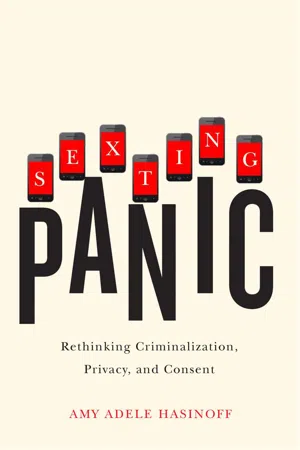
Sexting Panic illustrates how anxieties about technology and teen girls' sexuality distract from critical questions about how to adapt norms of privacy and consent for new media. Though mobile phones can be used to cause harm, Amy Adele Hasinoff notes that criminalization and abstinence policies meant to curb sexting often fail to account for the distinction between consensual sharing and the malicious distribution of a private image. Hasinoff challenges the idea that sexting inevitably victimizes young women. Instead, she encourages us to recognize young people's capacity for choice and recommends responses to sexting that are realistic and nuanced rather than based on misplaced fears about deviance, sexuality, and digital media.
Information
Publisher
University of Illinois PressYear
2015Print ISBN
9780252080623
9780252038983
eBook ISBN
9780252096969
PART I
Typical responses to sexting
CHAPTER 1
The criminalization consensus and the right to sext
Freedom of expression and access to information have been particularly idealized since the early internet. Yet the discussion of young people’s information rights regarding their access to or creation of sexual media is virtually nonexistent. That minors should be protected from seeing representations of sexuality is so deeply embedded in common sense that the harmful effects of these prohibitions are rarely discussed (Levine, 2002). Despite the restrictions, many youth access sexual content online (Wolak, Mitchell, & Finkelhor, 2007) and some break laws in order to create and share sexual images (Mitchell et al., 2012). This book argues that granting young people the right to consensually see, create, and distribute sexual media may be the most effective way to protect them from harm.
By examining and critiquing the consensus that teens should have no right to sext, in this chapter I argue for the decriminalization of consensual teen sexting. The first half of this chapter covers two cases at the beginning of the moral panic about sexting in 2009. In these two debates, shared assumptions on both sides illustrate that, in the mainstream discussion about teen sexuality and digital media, nearly everyone agrees that teenagers should not be sexting and should have no right to do so.
The second half of the chapter outlines arguments for why adolescents should have the legal right to sext. While this position may be unpopular, it could help address some of the problems with criminalization. Allowing teens to sext could accomplish three things: (1) shielding youth from discriminatory prosecutions for consensual behavior; (2) enabling youth to seek recourse against privacy violators without incriminating themselves; and (3) confirming that young people are entitled to free expression. Despite these compelling reasons, it is unlikely that arguments for adolescents’ right to sexual self-expression will be positively received in mainstream legal, media, and educational contexts. It may be more practical to think about regulating consensual sexting as a sex act (rather than a speech act), using the same age-span exemptions that exist in most statutory rape laws. This solution is imperfect, but it highlights the intimate relational context of consensual sexting and could also solve many of the problems with current sexting prohibitions.1
The consensus
A consensus is emerging in U.S. mass media that the criminal justice system should deal with sexting.2 For example, well-known internet law expert and online safety advocate Perry Aftab argues: “The laws are either too hot or too cold and we need to make sure we find one that is just right” (Marks, 2009). Many commentators condemn sexting and insist that the teens involved should be punished—indeed, the following chapters include quotations from a number of these people. However, in this chapter I analyze two cases in which people in national mainstream media outlets defend sexting teenagers. I chose these cases because they are unique in this respect. They allow for an analysis of the outer limits of the dominant discourse about sexting, since in both cases even teen sexters’ strongest supporters stop far short of supporting their right to sext.
The first case involves three teenage girls who, with the help of the Pennsylvania American Civil Liberties Union (ACLU), successfully prevented an overzealous prosecutor from punishing them for sexting. Because of existing child pornography laws, the ACLU has to defend the girls by dodging around the fundamental issue of youth rights to sexual self-expression.3 Instead, their strategy is to reiterate the common sense position that sexting is “foolish” and “wrong.” The second case is the development of new sexting legislation in Vermont, where legislators originally proposed to decriminalize some forms of sexting. After national pressure they passed a new misdemeanor law that criminalizes a broader range of sexting practices. As one of the first such laws, Vermont’s became a model for other states to follow. The consensus that teens should not have the right to sext is so broad that even though the lawmakers who originally advocated decriminalization were clear that their reform did not condone sexting, they still had to abandon their proposal.
In both the Pennsylvania case and the Vermont debate, both sides agree that teens should not have the right to sext. While the ACLU was compelled to avoid addressing the right to sext in order to make the best case for its clients, Vermont legislators could have theoretically taken any approach to argue for legal reform. Yet, the social limits on the discourse about teen sexuality and technology are such that Vermont legislators are also bound by unspoken, taken-for-granted restrictions on the range of ideas and political positions that mainstream news and politics considers to be part of a valid and reasonable debate. Hallin (1986) describes this as the “sphere of legitimate controversy.” As it turns out, the debate about what the criminal penalties for sexting should be (a misdemeanor or a felony) constitutes two sides of a “legitimate controversy.” The assertion that consensual sexting should not be a crime at all is absent in mainstream discourses and thus is located, in Hallin’s terms, in the “sphere of deviance.” In these two cases, in which teen sexters enjoy some of the most sympathetic support of any mainstream media coverage of sexting, the right to sext is still so unthinkable that it is excluded from the discussion entirely.
THE LIMITS OF SYMPATHY IN MILLER V. SKUMANICK
In early 2009, parents of nearly twenty students at a high school in Tunkhannock, Pennsylvania, received a letter from district attorney George Skumanick that opened with this statement: “[Your child] has been identified in a police investigation involving the possession and/or dissemination of child pornography” (Searcey, 2009b). Skumanick explained that school officials had found sexually explicit photos on some of the students’ cell phones, and those appearing in or possessing the photos could face child pornography charges unless they agreed to complete an education program and serve six months of probation, including random drug testing (Munley, 2009; Walczak, Burch, & Kreimer, 2009; Zetter, 2009).
Most of the students agreed to a version of this deal, while three students and their parents sought the help of the Pennsylvania American Civil Liberties Union (ACLU) to resist Skumanick’s demands. In March 2009, ACLU attorneys obtained a restraining order preventing the filing of child pornography charges.4 In a press release, the ACLU describes the images: “One [photograph] shows Marissa Miller and Grace Kelly from the waist up wearing white bras. The other depicts Nancy Doe (a pseudonym) . . . standing outside a shower with a bath towel wrapped around her body beneath her breasts” (2009). The ACLU argued that the photos did not meet the definition of child pornography and there was no evidence that the girls disseminated the photos.
The sympathy for sexting girls in this case is contingent on assertions that the photos were not intended to be sexual and on the notion that teenagers sext because they are innately irresponsible. For example, the lead ACLU attorney routinely refers to the girls as “careless,” “irrational,” and “foolish” in interviews with the press. These insults garner compassion and leniency, as the Miller case is one of the few in which mainstream media view girls who sext in a sympathetic light. The girls’ supporters, however, still cannot defend their right to freedom of expression. Instead, the ACLU won the case by arguing that forcing the girls to attend Skumanick’s education program would violate their parents’ right to control the upbringing of their children and the girls’ right to freedom from compelled speech (Miller v. Skumanick, 2009; Walczak, Rose, & Burch, 2010). While the ACLU’s rhetoric is overwhelmingly sympathetic to the girls, its exclusive focus on desexualization and innocence—that the girls took the photos for “fun” and were topless only because of the summer heat—precludes a larger discussion about teenagers’ right to freedom of expression.
The Miller case5 offers the opportunity to examine explanations for sexting in a specific, well-documented case. Both the ACLU and Skumanick agree that adolescents are not entitled to the same rights as adults.6 The only major disagreements between the two sides are whether to monitor, control, and guide adolescent sexuality through the legal system or through parental and school-based instruction, and whether the photos in question actually qualify as child pornography. The similar assumptions on both sides illustrate the limits on the discussion about teen expression and sexual rights in mainstream media and legal discourses about these issues.
DESEXUALIZING SEXTING The unprecedented victory for the girls in the Miller case is dependent on their ability to prove that the images they created were not intended to be “sexual.” In the press and in the courtroom, the girls’ supporters refer to hot weather, the context of a girls-only sleepover, and the types of bras the girls wore to desexualize their images and reclassify them as naive and innocent. Removing sexual agency from sexting may work to garner sympathy for some girls, but this rhetorical strategy ultimately reaffirms restrictions on girls’ rights and freedom.
Without a constitutional challenge to child pornography laws, which make no exception for self-produced images, the ACLU cannot effectively argue for the girls’ right to freedom of expression. Instead, the ACLU chooses the best strategy to win the case. ACLU attorneys dispute the prosecutor’s claim that the photos qualify as child pornography, arguing that since the photos of the teens were “harmless,” “fun,” and “not sexual,” they do not qualify as child pornography under even the vaguest part of Pennsylvania law. This law prohibits “nudity if such nudity is depicted for the purpose of sexual stimulation or gratification of any person who might view such depiction” (18 PS § 6312) and thus could potentially apply to a wide range of sexting images. Pennsylvania child pornography law is specific enough that photos of girls in bras would likely not qualify as “nudity,” though the photo of Nancy Doe’s breasts could. However, the ACLU reports that at the initial meeting with parents, Skumanick (2009) informed them that he “has the authority to prosecute girls photographed in underwear . . . or even in a bikini on the beach, because the photos are ‘provocative.’” Furthermore, as Skumanick says to the press, he could prosecute all the photos on the lesser and even vaguer charge of “open lewdness” (Zetter, 2009).
As such, the rhetoric that desexualizes the girls’ images is crucial. It is precisely the subjective determination of whether a photo is provocative or lewd that can distinguish a legal photo of a topless female minor from an illegal one. The ACLU thus must maintain that the images in question are not intended to express sexuality so they are less likely to qualify as child pornography. The ACLU attorneys defend the topless photo of one of the girls by arguing that it is “an innocent artistic image of a minor in a state of simple partial nudity, not a sexually provocative image intended to titillate” (Walczak et al., 2009, p. 29). This strategy is indeed successful, as the federal circuit courts handling this case agree that even the topless photo would likely not be found to qualify as child pornography at trial (Ambro, Chagares, & Stapleton, 2010; Munley, 2009). However, when the ACLU attorneys make these arguments, they also reaffirm that adolescents do not deserve the same right to freedom of expression as adults. The ACLU is not challenging the constitutionality of Pennsylvania’s child pornography statute, but instead argues that it has simply been misapplied to these girls’ “innocent” images (Walczak et al., 2009, p. 44).
Another way that sexting is desexualized in this case is through rhetoric that it is merely a popular teen fad. In his decision in the Miller case, the judge comments: “At issue in this case is the practice of ‘sexting,’ which has become popular among teenagers in recent years” (Munley, 2009, p. 1). He thus suggests that Skumanick may be overreacting to the latest teen trend, a relatively harmless activity. The judge’s comments imply that teens’ actions are neither serious nor intentionally criminal, since they are just following a fad established by their peers. Skumanick disagrees and explicitly refutes the judge’s and the ACLU’s argument that sexting is merely a “trend,” commenting on the case, “You can’t call committing a crime fun or a prank. If you do that, you can rob a bank because you think it’s fun” (Feyerick & Steffen, 2009). Since child pornography laws are so vague, asserting that sexting is “trendy,” “fun,” “innocent,” “artistic,” and “not intended to titillate” serves to desexualize sexting and help win the girls’ case.
A number of news stories that appear generally sympathetic to the teens in the Miller case stress specific details about the conditions of the photos’ production to convey the teens’ innocence. One narrative that appears a number of times is that the girls removed their shirts because of the summer heat, and another portrays the incident as “just girls having fun.” An Associated Press story that was also picked up by ABC News positions the photos as nonsexual:
One summer night in 2007, a pair of 13-year-old northeastern Pennsylvania girls decided to strip down to their skivvies to beat the heat. As Marissa Miller talked on the phone and Grace Kelly flashed a peace sign, a third girl took a candid shot of the teens in their white bras. It was harmless, innocent fun, the teens say. (Rubinkam, 2009)
A CNN story also draws on heteronormative assumptions about girls’ sleepover parties to de-eroticize this homosocial space, providing Marissa Miller’s argument that the photo was taken in “fun,” not to be sexual: “[Miller] was 12 when she and a friend snapped themselves wearing training bras. ‘I wasn’t trying to be sexual. . . . I was having fun with my friends at a sleepover, taking pictures, dancing to music’” (Feyerick & Steffen, 2009). An ACLU lawyer representing the girls repeats the same sentiment in a TV news interview, that it was innocent and that the exposed underwear was due only to hot weather (Galanos, 2009). These narratives present the girls wearing only bras as incidental and “fun” rather than as a planned intention to attract (male) sexual attention.
Describing the girls’ bras as “training bras” also positions them as prior to the onset of sexuality and as a strong piece of evidence that the photo was “fun” rather than sexual, as if the two were mutually exclusive. The AP story reports Marissa saying: “It was a first-ever bra that your parents buy you, an old grandma bra” (Rubinkam, 2009), and a Wall Street Journal story quotes her explaining, “It was like an old grandma bra. Nothing skimpy” (Searcey, 2009b). These comments draw on assumptions about the temporality of female sexuality, which is presumed to exist neither while parents still control the purchase of training bras nor after a certain age at which a woman would presumably become an asexual grandmother. The comments about the type of bra, the summer heat, and the sleepover deploy assumptions about female sexuality to argue that the teenage girls did not intend to provoke or sexually stimulate a hypothetical viewer of the photos. Such assumptions seem to work in securing the injunction from the federal judge as well as public sympathy. I make no claim here about the actual intent of the photos. The point is that arguing that they are nonsexual is the only option for the girls’ supporters.
One of the few arguments in support of the girls that can acknowledge sexuality does so by folding sexting into a normative framework of adolescent sexual development. An amicus brief for the case by the Juvenile Law Center references “the well-recognized adolescent need for sexual exploration” in combination with technology to explain why teens are sexting (Levick & Shah, 2009, p. 6). The Center argues that sexting is an innocent “expression of normal adolescent sexual exploration” rather than for the purpose of “sexual gratification,” which would be illegal (Levick & Shah, 2009, p. 20). These kinds of comments emerge from a legal and social context in which adolescents do not have the capacity or the right to pursue sexual pleasure. Instead, as chapter 2 discusses, they are thought to need adult intervention to ensure that they properly fulfill their developmental needs through limited sexual “exploration.” The underlying goal of such exploration is not sexual pleasure, but to fulfill the scientifically sanctioned aim of becoming a sexually healthy adult. While arguments like these can affirm some forms of adolescent sexuality, they still do not affirm teens’ sexual autonomy and privacy.
ABANDONING FREEDOM OF EXPRESSION The ACLU’s strategy of desexualizing sexting and clarifying that it does not condone it mobilizes both public and judicial sympathies. However, to do this the ACLU has to put itself in the strange position of seeking to protect some legal rights for teens while simultaneously reproducing the broader popular discourse that dictates that since teens are inherently inferior, irresponsible, and immature, they do not deserve the same rights as adults. The ACLU contends that forcing the girls to attend Skumanick’s educational program infringes on their freedom from compelled speech and on their parents’ freedom from excessive state intrusion in the upbringing of their children. Yet, the ACLU’s public statements also deploy some common sense arguments that position teens as unworthy of basic rights. The ACLU argues that sexting teens should not be prosecuted because they are too immature and foolish to be held acc...
Table of contents
- Cover
- Title
- Copyright
- Contents
- List of Illustrations
- Acknowledgments
- Introduction
- PART I. TYPICAL RESPONSES TO SEXTING
- PART II. ALTERNATIVE WAYS TO THINK ABOUT SEXTING
- APPENDIX 1. A brief history of the sexting panic
- APPENDIX 2. Discourse analysis: How to find common sense
- APPENDIX 3. Sexting tips and recommendations
- Notes
- Works Cited
- Index
Trusted by 375,005 students
Access to over 1.5 million titles for a fair monthly price.
Study more efficiently using our study tools.
Frequently asked questions
Yes, you can cancel anytime from the Subscription tab in your account settings on the Perlego website. Your subscription will stay active until the end of your current billing period. Learn how to cancel your subscription
No, books cannot be downloaded as external files, such as PDFs, for use outside of Perlego. However, you can download books within the Perlego app for offline reading on mobile or tablet. Learn how to download books offline
Perlego offers two plans: Essential and Complete
- Essential is ideal for learners and professionals who enjoy exploring a wide range of subjects. Access the Essential Library with 800,000+ trusted titles and best-sellers across business, personal growth, and the humanities. Includes unlimited reading time and Standard Read Aloud voice.
- Complete: Perfect for advanced learners and researchers needing full, unrestricted access. Unlock 1.5M+ books across hundreds of subjects, including academic and specialized titles. The Complete Plan also includes advanced features like Premium Read Aloud and Research Assistant.
We are an online textbook subscription service, where you can get access to an entire online library for less than the price of a single book per month. With over 1.5 million books across 990+ topics, we’ve got you covered! Learn about our mission
Look out for the read-aloud symbol on your next book to see if you can listen to it. The read-aloud tool reads text aloud for you, highlighting the text as it is being read. You can pause it, speed it up and slow it down. Learn more about Read Aloud
Yes! You can use the Perlego app on both iOS and Android devices to read anytime, anywhere — even offline. Perfect for commutes or when you’re on the go.
Please note we cannot support devices running on iOS 13 and Android 7 or earlier. Learn more about using the app
Please note we cannot support devices running on iOS 13 and Android 7 or earlier. Learn more about using the app
Yes, you can access Sexting Panic by Amy Adele Hasinoff in PDF and/or ePUB format, as well as other popular books in Social Sciences & Gender Studies. We have over 1.5 million books available in our catalogue for you to explore.