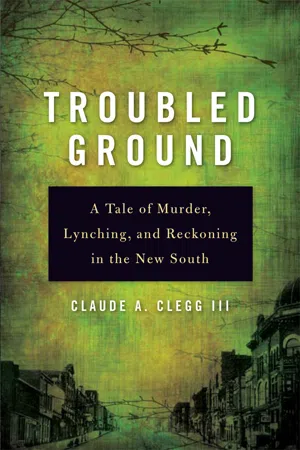
In Troubled Ground, Claude A. Clegg III revisits a violent episode in his hometown's history that made national headlines in the early twentieth century but disappeared from public consciousness over the decades. Moving swiftly between memory and history, between the personal and the political, Clegg offers insights into southern history, mob violence, and the formation of American race ideology while coming to terms on a personal level with the violence of the past. Three black men were killed in front of a crowd of thousands in Salisbury, North Carolina, in 1906, following the ax murder of a local white family for whom the men had worked. One of the lynchers was prosecuted for his role in the execution, the first conviction of its kind in North Carolina and one of the earliest in the country. Yet Clegg, an academic historian who grew up in Salisbury, had never heard of the case until 2002 and could not find anyone else familiar with the case. In this book, Clegg mines newspaper accounts and government records and links the victims of the 1906 case to a double-lynching in 1902, suggesting a complex history of lynching in the area while revealing the determination of the city to rid its history of a shameful and shocking chapter. The result is a multi-layered, deeply personal exploration of lynching and lynching prosecutions in the United States.
eBook - ePub
Troubled Ground
A Tale of Murder, Lynching, and Reckoning in the New South
- English
- ePUB (mobile friendly)
- Available on iOS & Android
eBook - ePub
Troubled Ground
A Tale of Murder, Lynching, and Reckoning in the New South
About this book
Trusted by 375,005 students
Access to over 1.5 million titles for a fair monthly price.
Study more efficiently using our study tools.
Information
Publisher
University of Illinois PressYear
2010Print ISBN
9780252077821
9780252035883
eBook ISBN
9780252090097
1 Bygones
After the shooting of Deputy Sheriff H. C. Owen on February 20, 1895, rumors of an imminent lynching swirled around the town of Cleveland in northwestern Rowan County, North Carolina. During an attempt to arrest Whit Ferrand for breaking into the still house of a Mr. Hutchinson, Owen was fatally wounded. Ferrand’s accomplices surrendered without incident when confronted by deputies. However, Ferrand was not so easily subdued. He successfully eluded the lawmen who initially came for him, going so far as to trek shoeless through the snow in order to obscure his trail. Pink Webb, a local man who had joined the pursuit, happened upon Ferrand in a field a few miles from Cleveland. He had time only to discharge a shotgun in Ferrand’s direction before being shot in the wrist and overtaken. The wanted man escaped capture once again, taking Webb’s weapons but sparing him further injury.
A short time later, Mac Hellard and another deputized civilian discovered Ferrand hiding in a tree in the vicinity. The hunted man exchanged gunfire with them before Deputy Owen appeared and demanded an end to the shooting. Ferrand reportedly agreed to cease his resistance if the officers would refrain from firing upon him further. It is unclear whether Owen approached the suspect in a threatening manner or as a coaxing gesture. Whatever the case, his advance was answered with a bullet to the chest, which almost instantly killed him. In his brief death throes, Owen stumbled forward, and Ferrand swung his gun at him as he collapsed. The remaining pursuers who had observed the slaying set upon Ferrand and wrestled him into submission.1
The events of this day posed a dilemma for Rowan County Sheriff James M. Monroe. News of a white lawman meeting his demise at the business end of a black man’s pistol predictably inflamed the Cleveland community. To many, the nonlethal shooting of Pink Webb alone warranted harsh and immediate retribution, and there could only be one penalty for a black man so brazen as to kill a white man, particularly one wearing a badge. In the wake of the shootings, area newspapers were quick to portray Ferrand as an utterly unsympathetic figure. The Salisbury Daily Herald described him as a “stalwart Samson-built man, coal black,” a vivid rendering that accentuated the suspect’s racial otherness and putative physical capacity for inflicting harm. The Charlotte Observer deemed Ferrand “a desperate character, and a noted criminal” and proceeded to chronicle a damning record of lawlessness. The paper asserted that he had previously served six years in a penitentiary for horse stealing and that there were rewards being offered in South Carolina for his arrest. It also mentioned that law enforcement officials from Salisbury and Statesville tried to apprehend him for an unnamed offense four years earlier, but were foiled when Ferrand seized a policeman’s pistol and made his escape. Following the shooting of Deputy Owen, Sheriff Monroe took seriously his responsibility to provide safekeeping for Ferrand until a trial, which meant keeping him out of the clutches of any lynch mob that might coalesce. The three accomplices who had allegedly collaborated with Ferrand, including a woman believed to be his wife, were brought to Salisbury and confined in the county jail on the evening of February 20. Monroe sensed correctly that their presence would likely not stir an assault on the town’s jail by infuriated citizens, but understood that to bring Ferrand there risked inviting mayhem and further bloodshed.2

Salisbury Town Square, ca. 1900 (courtesy of the Salisbury Post)
Rumors continued to circulate briskly. One told of Ferrand’s lynching on the night of February 20, while another placed him in the Lexington jail some fifteen miles away. After receiving the telegram that informed him of Owen’s death, Monroe sent five well-armed deputies to Cleveland. It was reasonable to assume that the suspects would be placed on a train at the Cleveland depot and conveyed to the county jail in Salisbury. At least this was the assumption that animated a crowd of vengeful locals who had assembled at the station to ostensibly intercept Ferrand. To their dismay, Monroe showed up at the depot alone, a ploy that bought Deputy Sheriff J. Hodge Krider enough time to discreetly transport Ferrand by buggy through the lonely back roads and obscure paths of Rowan County. At a place called Rock Cut, Krider handed the chained and bound prisoner over to Deputy Henry Monroe, the sheriff’s brother, who took him to a rendezvous point along Old Mocksville Road. Having outmaneuvered the disappointed mob at the Cleveland depot, Sheriff Monroe took custody of Ferrand and delivered him to the Lexington jail.3
Monroe’s deception had not so much saved Ferrand’s life as put off his execution until a time when he could be dispatched under better officiated and legally sanctioned circumstances. To his credit, the sheriff had spared Rowan County—and his office of public trust—the embarrassment of succumbing to the passions of the lynch mob, which Whit Ferrand himself could certainly appreciate at the time. However, very few would have labored under the illusion that this most tenacious resister of white legal authorities would not meet his end in a fashion directly correlated to the manner in which Deputy Owen had met his. Whether in the rough hands of the lynch mob or on the creaky planks of the local gallows, Ferrand’s existence was fatally scripted to conclude, legally or extralegally, shortly after the death of Deputy Owen and his subsequent capture. That such axioms governed race relations in Rowan County by the turn of the century is not surprising given the history of the area. Although it would have been of little consolation to Whit Ferrand once the May term of superior court sentenced him to hang for the murder of H. C. Owen, his dire situation as an African American man charged with killing a white person in central North Carolina was rooted firmly in the historical bedrock of an earlier time.
Thirty years prior to the deadly encounter between Ferrand and Owen, the county seat of Salisbury had been virtually prostrated by four years of war. As a supply depot for the secessionist Confederate States of America, its residents had witnessed the conversion of the local iron foundry into an arsenal, the establishment of hospitals for wounded soldiers, and the erection of a prison camp that would become notorious for its treatment of captured enemy combatants. Similar to other places in North Carolina, the war would suffuse Rowan County with an unprecedented degree of suffering, the magnitude of which became clearer to observers as the conflict came to a close in the spring of 1865. The value of Confederate currency had been in free-fall for months as the southern war effort collapsed. Shortages in food and other necessities triggered a riot of Salisbury women, who broke into local stores in 1863 to secure staples too costly to purchase and too essential to live without. Through the winter of 1864–65, Confederate military officials scrambled for slave labor to employ in a range of tasks, including work in artillery shops that would putatively provide owners with “a liberal price” for their leased bondmen and “ample food and the usual amount of clothing” for the enslaved workers themselves. When federal troops under Gen. George Stoneman marched into Salisbury on April 12, the town’s role as a crucial supply point for the Confederacy was starkly dramatized by the mass destruction of its assets by the conquerors. The list of items set to the torch was long and included 10,000 pounds of artillery, 75,000 uniforms, 20,000 pounds of leather, 10,000 bushels of corn, 80 barrels of turpentine, $100,000 in medical supplies, and $15,000,000 in Confederate money. For good measure, Stoneman’s troops razed a steam distillery, the arsenal, warehouses, railroad buildings, and other structures that may have been beneficial to the now defunct Confederate States of America, with particular attention paid to the utter annihilation of the prison camp.4

Rowan County, ca. 1900 (courtesy of John Hollingsworth)

The Confederate Prison at Salisbury, 1864 (courtesy of the North Carolina CoUection, UNC-Chapel Hill)
As with all such conflicts, the Civil War had been an ending and a beginning for Salisbury. Among the ashes of its cremated military supplies, ordinance depots, and dreams of southern independence lay the carcass of slavery that had been inextricably tied to the region’s social and economic development for well over a century. By the time of the secession crisis that had sparked the war in April 1861, the hereditary enthrallment of African Americans had become a fixture in American life. Every major economic enterprise of the southern states, from the rural cultivation of cotton, tobacco, and rice to an array of work in mines, docks, and assorted urban settings, was either substantially or solely placed into the hands or upon the backs of black slaves. On the eve of the Civil War, Salisbury’s enslaved people numbered 1,073 out of a total population of 2,420, which included 80 free African Americans. When Union soldiers set fire to the properties and belongings of their masters in 1865, many blacks in the town could probably discern that things were not the same as before and that a new order had emerged. However, the enslavement experience and lingering notions of racial difference would indelibly inscribe limits upon their postwar lives that would, in short order, be clear to all.5
While shaped by local labor needs and practices, the political and cultural milieu, and demographic patterns, slavery in Salisbury and Rowan County resembled iterations of the institution found elsewhere in North Carolina and the American South. Legally defined as chattel property, enslaved African Americans were largely subject to the whims of their masters in most circumstances, though legislators, law officers, and the vagaries of the economy could impinge upon the latitude of owners under certain conditions. Extant records disclose many instances of the buying, selling, and inheriting of slaves, which had profound and often tragic implications for black families, friendships, and communities.
These transactions sometimes involved prominent whites like Archibald Henderson, a lawyer and state legislator who accumulated wealth in slaves over time, including “three negro men” purchased in 1807, “a Negro fellow of the name Jim” acquired in 1809, and “a negro winch of the name of Natty” bought in 1811. Other instances of slave trafficking involved wills and probate proceedings that parceled black bondpeople between heirs or earmarked them for sale in order to liquidate debts. When the estate of William C. Love of Rowan County was settled in 1829, his seventy-three slaves, ranging from seventy-seven-year-old Hanah to two-month-old Mila, were divided “into four equal parts of as nearly equal value as practicable” and distributed among his inheritors. Similarly, following the deaths of Susan Craige and Horace H. Beard in the 1850s, the administrators of their estates exposed enslaved African Americans to public auction, along with household furniture, horses, cows, “and various other articles too tedious to mention.” On infrequent occasions, a master might furnish a path toward liberation for an enslaved person. For example, Michel Bacon willed his wife, Elizabeth, a number of bondpeople in 1791 and instructed that all be freed upon her death, with one in particular “educated in Duch [sic] learning until 21, then freed with £100.” More common, particularly by the mid-nineteenth century, were crude newspaper advertisements announcing “NEGROES WANTED” or “CASH FOR NEGROES,” which promised high prices and affirmed the existence of a market for an indiscriminate commerce in black lives and labor.6
If slavery and slave trading bred inhumanity and tragedy, these practices also provoked dissent. The boldest resistance took the shape of armed rebellions and conspiracies, such as the plans of Anthony, a Rowan County slave of Ephraim Hampton. Keenly observant of the War of 1812, Anthony allegedly informed fellow bondmen that he hoped to organize an uprising that would dispatch local whites, sparing only women who would become wives of the rebels. It is unknown whether these details, conveyed to white authorities by black informants, were completely accurate. Nonetheless, the reported plot was taken seriously enough to earn Anthony six weeks in jail and 150 strokes of the lash. Given the unfavorable odds of success of North American slave rebellions due to the minority status of African Americans and other factors, quotidian resistance to slavery was more frequently articulated through other acts aside from armed insurrection. These challenges could involve slaves intermarrying and/or cohabiting with free blacks, as Elija Volentine did with Nancy, a bondwoman of Sarah Smith, in 1842. There were actually numerous cases of this kind during the nineteenth century that resulted in the intervention of masters and court authorities who undoubtedly feared that such close associations with the county’s small population of free African Americans might make slaves even more desirous of their own liberty. Other acts that could be construed as resistance—or at least as unsettling presumed white mastery over black agency—included theft or the destruction of the property of whites, purposefully slow or shoddy work, feigning illness, and verbal insubordination. Similar to masters elsewhere, Rowan County slaveholders had to deal with the phenomenon of slaves running away, which deprived them of both the labor and security that black bondage was supposed to ideally provide.7
The frequency of slave flight from their owners can never be accurately quantified. The surviving records only document those instances that masters and others believed significant enough to chronicle in newspapers, diaries, letters, or court proceedings. In cases in which a slave’s absence was too frequent or temporary to be remarkable, too thorough to warrant the expense of pursuit, or too embarrassingly suggestive of an owner’s ill treatment or inability to manage his human property, fugitive activity was simply not recorded and thus eluded count. Still, the evidence that can be gleaned from newspapers, jail records, patrol regulations, and other sources indicates a salient and irrepressible pattern of slaves absconding from their owners, as well as persistent, if not always successful, efforts to close avenues of escape.
At any given time, the Rowan County jail might house runaways who were being detained until their masters retrieved them. In September 1818, Lydia and George found themselves in such confinement while their jailers determined how best to discharge them. Advertisements for runaways were among the most common newspaper items by mid century, sometimes receiving front-page coverage with extensive descriptions and hefty rewards offered. Over a span of less than two months in late 1855, local newspapers published ads for Henry, described as “about 5 feet high, 23 years old, dark black, and whiskers all over his face”; Simon, “about 40 years old, rather a mulatto or Indian colour; about five feet nine inches high, heavy built, and STUTTERS when talking and if excited can hardly talk at all”; and Dick, characterized as “rather of a COPPER color, about thirty five years of age, inclined to be bold-headed” and worth a reward of fifty dollars upon capture. Such notices and monetary incentives certainly led to the discovery of many runaways, as well as mistaken arrests of more than a few blacks, both enslaved and free.
To better police the mobility of slaves, the county instituted a patrol in 1825, which had the authority to inflict corporal punishment upon any slave suspected of being a fugitive “or travelling on the sabbath, or other unreasonable time, without a proper permit or pass.” Despite these regulations, the problem of slaves departing their masters’ premises without permission continued. In 1852, a group of whites met at the county courthouse to discuss the dilemma and issued a resolution calling for the strict enforcement of the Fugitive Slave Law of 1850, which gave federal sanction to the pursuit of runaways across state lines. Still, as late as March 1862, the Board of Commissioners of Salisbury struggled to stem the incessant leakage of fugitives from farms and plantations, even as they extended their surveillance to include the movements of free blacks.8
Although Confederate defeat allowed for the legal ...
Table of contents
- Cover
- Title
- Copyright
- Contents
- Acknowledgments
- Prologue: Searching for a Troubled Past
- 1. Bygones
- 2. Old Demons of the New South
- 3. The Reaping
- 4. Presumed Guilt
- 5. A Blot upon the State
- 6. A Reckoning
- Epilogue: New South, Old South
- Appendix
- Notes
- Bibliography
- Index
Frequently asked questions
Yes, you can cancel anytime from the Subscription tab in your account settings on the Perlego website. Your subscription will stay active until the end of your current billing period. Learn how to cancel your subscription
No, books cannot be downloaded as external files, such as PDFs, for use outside of Perlego. However, you can download books within the Perlego app for offline reading on mobile or tablet. Learn how to download books offline
Perlego offers two plans: Essential and Complete
- Essential is ideal for learners and professionals who enjoy exploring a wide range of subjects. Access the Essential Library with 800,000+ trusted titles and best-sellers across business, personal growth, and the humanities. Includes unlimited reading time and Standard Read Aloud voice.
- Complete: Perfect for advanced learners and researchers needing full, unrestricted access. Unlock 1.5M+ books across hundreds of subjects, including academic and specialized titles. The Complete Plan also includes advanced features like Premium Read Aloud and Research Assistant.
We are an online textbook subscription service, where you can get access to an entire online library for less than the price of a single book per month. With over 1.5 million books across 990+ topics, we’ve got you covered! Learn about our mission
Look out for the read-aloud symbol on your next book to see if you can listen to it. The read-aloud tool reads text aloud for you, highlighting the text as it is being read. You can pause it, speed it up and slow it down. Learn more about Read Aloud
Yes! You can use the Perlego app on both iOS and Android devices to read anytime, anywhere — even offline. Perfect for commutes or when you’re on the go.
Please note we cannot support devices running on iOS 13 and Android 7 or earlier. Learn more about using the app
Please note we cannot support devices running on iOS 13 and Android 7 or earlier. Learn more about using the app
Yes, you can access Troubled Ground by Claude A. Clegg,Claude A. Clegg, III in PDF and/or ePUB format, as well as other popular books in Social Sciences & North American History. We have over 1.5 million books available in our catalogue for you to explore.