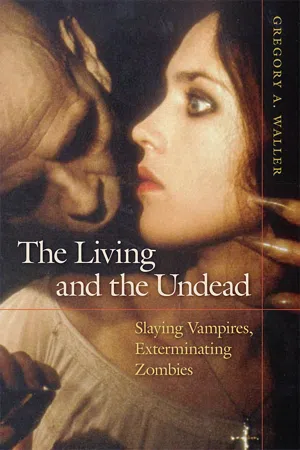
Examining a broad range of novels, stories, plays, films, and made-for-television movies, Waller focuses upon a series of interrelated texts: Bram Stoker's Dracula (1897); several film adaptations of Stoker's novel; F. W. Murnau's Nosferatu, A Symphony of Horror (1922); Richard Matheson's I Am Legend (1954); Stephen King's 'Salem's Lot (1975); Werner Herzog's Nosferatu the Vampyre (1979); and George Romero's Night of the Living Dead (1968) and Dawn of the Dead (1979). All of these works, Waller argues, speak to our understanding and fear of evil and chaos, of desire and egotism, of slavish dependence and masterful control. This paperback edition of The Living and the Undead features a new preface in which Waller positions his analysis in relation to the explosion of vampire and zombie films, fiction, and criticism in the past twenty-five years.
- English
- ePUB (mobile friendly)
- Available on iOS & Android
eBook - ePub
About this book
With a legacy stretching back into legend and folklore, the vampire in all its guises haunts the film and fiction of the twentieth century and remains the most enduring of all the monstrous threats that roam the landscapes of horror. In The Living and the Undead, Gregory A. Waller shows why this creature continues to fascinate us and why every generation reshapes the story of the violent confrontation between the living and the undead to fit new times.
Information
Subtopic
Performing ArtsPART ONE
The Moral Community and the King-Vampire
Professor Van Helsing: We, too, are not without strength. We have on our side power of combination—a power denied to the vampire kind.
Dracula (1897)
It is our purpose to study the sentiments and motives which draw people to each other, keep them together, and induce them to joint action.
Ferdinand Tönnies
Community and Society
CHAPTER 2
Into the Twentieth Century
WRITTEN AT NEARLY the beginning of our century, Bram Stoker’s Dracula (1897) is the single most influential of all stories of the living and the undead; indeed, it is among the most influential of all horror stories. Yet Stoker’s novel is not the first such story published in English—that distinction is generally accorded to John Polidori’s The Vampyre (1819). Dracula is not even the only Victorian vampire story to be adapted for the movies and to be often reprinted in the twentieth century, for there is Sheridan Le Fanu’s Carmilla (1871), which today remains much more than a long-forgotten curiosity piece. Nonetheless, Dracula provides the best and most appropriate introduction to the series of works I will discuss. Rather than being a footnote to or an imitation of Dracula, the story of the living and the undead as it develops in the twentieth century is an ongoing process of retelling and revisioning Stoker’s narrative and in various ways modifying, reaffirming, or challenging the assumptions that inform Dracula. Accordingly, we will enter the genre, so to speak, through Stoker’s novel, and Dracula will serve as a reference point throughout the discussion.
This chapter begins with a reading of Dracula and concludes by placing Stoker’s novel in the context of The Vampyre and Carmilla, of several vampire stories published between 1890 and 1925, of Stoker’s other horror stories, and of the “myth of the father of the primal horde” that Freud explores in his studies of culture and group psychology. Comparing Dracula with these works and reading these stories in light of Stoker’s novel help both to define the specific features of the confrontation between the living and the undead in Dracula and to suggest this genre’s “inventory of options” as twentieth-century stories like F. W. Murnau’s Nosferatu (1922), Hamilton Deane and John L. Balderston’s Dracula: The Vampire Play (1927), and Tod Browning’s Dracula (1931) begin to appear.
In Stoker’s hands the story of the living and the undead becomes the story of how, in the face of the enormous threat posed by the vampire, the living form a new community and together carry out the ritualized violence necessary to rid the world of the undead. In the course of discussing Dracula, I will set Stoker’s image of the community against Ferdinand Tönnies’s classic distinction between Gemeinshaft and Gesellschaft, and compare the assumptions about violence in Dracula with Freud’s speculations concerning collective violence and Hannah Arendt’s remarks about creative violence. Let us begin, however, at the beginning of Stoker’s narrative with Jonathan Harker’s journey to Transylvania, an episode that could be said to parallel the reader’s entrance into this novel and this entire genre—for, during this opening journey, the sightseer becomes a confused and frightened witness to horror and the innocent traveler a potential victim. Jonathan’s adventures in Count Dracula’s homeland are a particularly effective example of what Walter M. Clements calls the “Polyphemous type” of horror formula, which involves “an encounter with an alien being or state in an exotic locale and an escape—at least physically—from the alien force.”1 Presented in Jonathan’s own first-person account, the type of formula Clements identifies becomes for Stoker a means of emphasizing the visitor’s realization—resembling both an awakening and a lapsing into nightmare—that monsters exist and that evil has an almost irresistible appeal.
At the same time Jonathan’s journey to Transylvania, a business trip that draws this middle-class, commonsensical solicitor into the “imaginative whirlpool” that is the “East” (D, 12), demonstrates the vulnerability of the isolated modern man who is immersed in the primitive. Initially, Jonathan is an open-eyed if somewhat condescending tourist, filling his journal with facts and personal observations about the scenic beauty of nature and the quaint local color of paprika-spiced food and picturesque peasants. Armed with factual knowledge of the area gleaned from the books and maps of the British Museum, enlightened by the tenets of lukewarm Anglicanism, well-versed in law and real estate, Jonathan is a late Victorian with modest expectations who has no trouble in perceiving and actively pursuing his “duty.” His own “queer dreams” (D, 12) and the many cryptic warnings of superstitious local inhabitants go unheeded, for “there was business to be done” and nothing must be allowed “to interfere with it” (D, 15).
The redefinition of duty and the transformation of this innocuous excursion into a spiritual quest that will lead through temptation and suffering to redemption begin when Jonathan becomes not merely a tourist, but truly a stranger in a strange land. (As Count Dracula so fully realizes, “A stranger in a strange land, he is no one” [D, 30].) After leaving the company of terrified peasants and entering the coach that will transport him over the Borgo Pass to Dracula’s castle, Jonathan becomes increasingly passive and isolated, trapped alone inside the coach by the forbidding darkness and the roving wolves outside. Carried on a circuitous route into the night that destroys his sense of both spatial direction and chronological time, Jonathan enters a world in which “reality” and the most “awful nightmare” inextricably merge to create a “paralysis of fear” (D, 22–23). Ironically, for Jonathan the castle and its English-speaking host herald a return to the normality of business and social intercourse (even though the British Museum maps do not note the “exact locality” of Castle Dracula [D, 12]). Thus this naive young man enters the vampire’s domain “freely” of his “own will” (D, 25) and is easily led to adopt the Count’s “night-existence” (D, 34). However, once Jonathan begins to glimpse the threat that Dracula poses, “safety and the assurance of safety” disappear, and the man of real estate begins to doubt even his own sanity (D, 44).
As is the case in so many horror stories, both false, opiatic security and well-intentioned, if imprudent, exploration render the potential victim even more vulnerable. After Jonathan realizes the impossibility of communicating with his fiancée, Mina, and the rest of the outside world, the castle becomes a labyrinthine prison that, when explored, leads past innumerable closed doors to a room where, “in old times, possibly some fair lady sat to pen … her ill-spent love-letter” (D, 44). Alone in the ancient “fair lady’s” room, far removed from all traces of the business and morality of late nineteenth-century England, Jonathan encounters the three brides of Dracula, who embody that which he most desires and most fears. “In an agony of delightful anticipation,” he passively waits with eyes closed for the “voluptuous” brides to satisfy his “wicked, burning desire” as he feels the “hard dents of two sharp teeth” upon his exposed neck (D, 46, 47). Only by the grace of Dracula is Jonathan’s physical desire left unfulfilled and thus his soul—for the time being—saved.
Isolated and left to his own devices and dreams, Jonathan does in a sense become “no one,” for all the fragile foundations of his public identity begin to disintegrate in Castle Dracula, where he is without the “protection of the law” (D, 53). “Action!” is what saves Jonathan (D, 55); even though he fails in his courageous attempt to destroy the monster, Jonathan manages to escape from the castle after the Count departs. However, survival—at this point in the novel—is not the same as victory. Jonathan alone is no match for the vampire. The eager solicitor and expectant fiancé is merely a pawn who unwittingly fulfills his part in Dracula’s ambitious strategy.2
Jonathan’s journey to Transylvania (chapters 1 – 4 of the novel) serves as the necessary prelude to the other journeys that figure prominently in Dracula—the Count’s invasion of England, the trek to Lucy Westenra’s tomb, and the final holy crusade that moves eastward to rid the world of the undead.3 Similarly, this opening section of the novel introduces several interrelated motifs that form the ideological structure of Stoker’s narrative: the dangerous, hypnotizing appeal of physical beauty; the saving quality of action; the disorienting departure from modern civilization; and the troubling convergence of nightmare and wish-fulfillment. Yet perhaps most important is the overwhelming impression of Jonathan’s “dread loneliness” (D, 44), for comparable images of isolation and vulnerability are found throughout Dracula: the ship captain binding himself to the wheel of the Demeter after his crew has all died, Renfield alone in his madman’s cell, Lucy Westenra sleepwalking in a moonlit graveyard with “not a sign of any living thing about” (D, 101), Mina Harker forced to suck blood from the breast of the vampire while her husband sleeps beside her.
Thus the organization of the novel as a collection of letters, memoranda, journals, and diary entries is appropriate, even though Stoker is not very successful in capturing the subtleties of dialect and accent. For as the first-person narration shifts from character to character, revealing ironic misperceptions and cross-purposed actions, the limitations of each individual perspective are exposed.4 Unlike the protagonists and victims of much twentieth-century horror, the narrators in Dracula are not guilt-ridden, apathetically faithless, or “evil” in any traditional sense; yet, because they are isolated individuals each telling and living his or her own story, the modern civilized world they inhabit is particularly susceptible to the vampire’s assault. As Jonathan’s journey begins to suggest, the foreign threat that stretches out of the past to invade the present can only be countered by a community, a group of human beings who can, in Mina’s words, “all work together” (D, 301).5
One type of group in Dracula is the Russian crew of the Demeter, the ship that unknowingly transports the vampire to England. Organized into a strict hierarchy, these men appear to be competent and experienced. Yet, as the crew becomes increasingly aware of a strange presence aboard the ship, a “panic of superstitious fear” spreads (D, 92), and in its wake come the potential for mutinous violence and then “madness” and suicide. One by one the group disintegrates, until finally only the Captain is left alive, terrified, but determined to “baffle” the “fiend” by tying himself to the wheel and praying to “God and the Blessed Virgin and the saints” (D, 95). Regardless of his courageous allegiance to his duty, however, the Captain fails, and his failure is a reminder that the isolated individual cannot halt the progress of the vampire. More important, the Captain’s faith—much deeper than anything Jonathan demonstrates in Transylvania—assures neither protection nor salvation: “only God can guide us in the fog, which seems to move with us,” he writes, “and God seems to have deserted us” (D, 94). The failure of the Demetefs crew suggests that a highly organized, all-male group cannot combat Dracula, even when this group is itself from the East and when its pious leader senses the magnitude of the evil he confronts and is willing to sacrifice himself in the name of duty.6
No more effective than the crew of the Demeter is an even more basic social unit, the family. From Mina’s first letter to Lucy, courtship and marriage figure prominently in Dracula (not least in the actions of the vampire and his brides), but until the final page of the novel there are virtually no extended families in Stoker’s vision of middle- and upper-class England. Both the American Quincey Morris and Dr. John Seward, who runs the asylum where Renfield is kept, have no parents—no blood relatives at all, in fact, though both are young men (Seward, for all of his professional responsibility, is only twenty-nine years old). And the closest person Mina and Jonathan have to a parent is Jonathan’s employer and benefactor. Although the Harkers are left materially secure when this kindly old man dies, leaving his home and business to Jonathan, Mina admits that “it really seems as though we had lost a father” (D, 164). Arthur Holmwood’s father also dies of natural causes during the novel, but not before his long illness forces Arthur, who remains true to his filial “duty” (D, 124), to leave the side of his fiancée, Lucy Westenra, rendering her more vulnerable to Dracula’s nocturnal visits. Lucy receives even less aid from her mother than from her fiancé, for Mrs. Westenra’s weak heart and overall physical fragility force the others to keep Lucy’s situation a secret from her. So when Mrs. Westenra, with the best of intentions, opens a window and removes a garland of garlic flowers from Lucy’s neck, she allows the vampire free access to her daughter. The ultimate irony, however—and the scene which summarizes the status of the traditional family in the novel—occurs when a wolf under Dracula’s control appears at Lucy’s window. Terrified, Mrs. Westenra again inadvertently tears the garlic flowers from Lucy’s neck and then falls dead upon her daughter’s reclining body: “dear mother’s poor body, which seemed to grow cold already … weighed me down” (D, 151).
Lucy is isolated and imprisoned in the bedroom of her family home, the most familiar and yet in Dracula the most easily invaded domain. Terrified and helpless, she appeals to God to “shield me from harm this night!” (D, 152), but her prayer seems to go unanswered. Literally burdened by her mother’s corpse, Lucy suffers the attack that ultimately transforms her into a vampire. Her fate is even more disturbing than Jonathan’s because she has not journeyed to the mysterious East. Except for her sleepwalking excursions, Lucy remains at home—protected, loved, watched over. Still she is repeatedly drained of blood and then finally captured by Dracula, an apparently unstoppable predator who appears almost always in nonhuman form during this section of the novel (chapters 5–16), mocking by his success the well-intentioned, hopelessly inadequate plans and precautions of the living.
Into the vacuum left by dead or dying parents steps Dr. Abraham Van Helsing, a surrogate father who redeems Lucy, unites the orphaned children, and is thus himself rescued from a “barren and lonely” life (D, 191). (Stoker assumes without question that a strong paternal figure is not just important, but essential; left to their own devices, the young people will not live long enough to gain maturity.) Jonathan is only a lawyer and Seward only a scientist, but Van Helsing is a Renaissance man in an age of specialization, and his credentials are indeed impressive. By occupation, he is a lawyer, “a philosopher and a metaphysician, and one of the most advanced scientists of his day” (D, 121). Along with his age and gender, what qualifies him to be a paternal figure and guide, however, is his temperament. With an “absolutely open mind” (D, 121), Van Helsing can acknowledge and respect the “mysteries in life” that lie beyond the understanding of science (D, 197), mysteries that include both God and Dracula. Being aware of these mysteries, the Professor also realizes what Jonathan and Lucy so painfully come to understand, that “to be alone is to be full of fears and alarms” (D, 165). To an “iron nerve” and “indomitable resolution” that are like those of the Captain of the Demeter, Van Helsing also adds the “kindliest and truest heart” (D, 121) and the abiding faith of a benevolent Christian patriarch. Significantly, Van Helsing, like Dracula, is a foreigner. Both the height of wisdom and the depth of evil are alien to the placid superficialities of modern England, and thus the stage is set for a melodramatic one-to-one confrontation between two worthy opponents with the future of British civilization at stake.
Yet this confrontation never occurs. Even with all of Van Helsing’s secular and spiritual qualifications, he alone cannot destroy the “King-Vampire” (D, 374).7 And this fact is essential, because Dracula is, perhaps above all, the story of the formation and growth of a community, a story that proves that the foremost source of strength the living possess is, as Van Helsing realizes, the “power of combination” (D, 244). In this emphasis on community, Dracula differs substantially from Mary Shelley’s Frankenstein, nineteenth-century ghos...
Table of contents
- Cover
- Title Page
- Dedication
- Copyright
- Contents
- Preface
- Acknowledgments
- Introduction
- Part One: The Moral Community and the King-Vampire
- Part Two: Dracula Retold
- Part Three: The Sacrifice of the Pure-Hearted Seer
- Part Four: Legions of the Undead
- Conclusion
- Appendix: Précis of Dracula: The Vampire Play
- Index
Trusted by 375,005 students
Access to over 1.5 million titles for a fair monthly price.
Study more efficiently using our study tools.
Frequently asked questions
Yes, you can cancel anytime from the Subscription tab in your account settings on the Perlego website. Your subscription will stay active until the end of your current billing period. Learn how to cancel your subscription
No, books cannot be downloaded as external files, such as PDFs, for use outside of Perlego. However, you can download books within the Perlego app for offline reading on mobile or tablet. Learn how to download books offline
Perlego offers two plans: Essential and Complete
- Essential is ideal for learners and professionals who enjoy exploring a wide range of subjects. Access the Essential Library with 800,000+ trusted titles and best-sellers across business, personal growth, and the humanities. Includes unlimited reading time and Standard Read Aloud voice.
- Complete: Perfect for advanced learners and researchers needing full, unrestricted access. Unlock 1.5M+ books across hundreds of subjects, including academic and specialized titles. The Complete Plan also includes advanced features like Premium Read Aloud and Research Assistant.
We are an online textbook subscription service, where you can get access to an entire online library for less than the price of a single book per month. With over 1.5 million books across 990+ topics, we’ve got you covered! Learn about our mission
Look out for the read-aloud symbol on your next book to see if you can listen to it. The read-aloud tool reads text aloud for you, highlighting the text as it is being read. You can pause it, speed it up and slow it down. Learn more about Read Aloud
Yes! You can use the Perlego app on both iOS and Android devices to read anytime, anywhere — even offline. Perfect for commutes or when you’re on the go.
Please note we cannot support devices running on iOS 13 and Android 7 or earlier. Learn more about using the app
Please note we cannot support devices running on iOS 13 and Android 7 or earlier. Learn more about using the app
Yes, you can access The Living and the Undead by Gregory A. Waller in PDF and/or ePUB format, as well as other popular books in Media & Performing Arts & Performing Arts. We have over 1.5 million books available in our catalogue for you to explore.