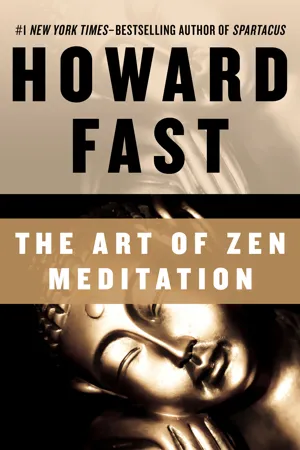
Bestselling author Howard Fast's straightforward introduction to Zen meditation
Howard Fast began to formally practice Zen meditation after turning away from communism in 1956.
The Art of Zen Meditation, originally published by the antiwar political collective Peace Press in 1977, is the fruit of Fast's study: a brief and instructive history of Zen Buddhism and its tenets, written with a simplicity that is emblematic of the philosophy itself. Fast's study of Zen also inspired his popular Masao Masuto mystery series about a Zen Buddhist detective in Beverly Hills, which he published under the pseudonym E. V. Cunningham.
The Art of Zen Meditation is illustrated with twenty-three beautiful photographs.
This ebook features an illustrated biography of Howard Fast including rare photos from the author's estate.
- 44 pages
- English
- ePUB (mobile friendly)
- Available on iOS & Android
eBook - ePub
The Art of Zen Meditation
About this book
Information
Topic
PhilosophySubtopic
Eastern Philosophy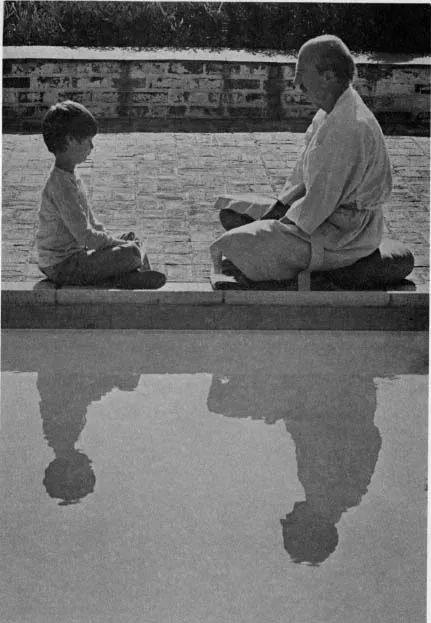
This small book is intended as an introduction to the art of Zen meditation. Since Zen masters are fond of stating that Zen is the most direct and obvious thing in the world, a simple manual for the art of Zen is neither extraordinary nor presumptuous; but it must be presented with the additional reminder that while Zen meditation is very simple, very direct, very ordinary, it is also very difficult and very frustrating. There is no ladder of ascension; there are no points; there is no score; and as for the rewards, they are not to be spoken of, or calculated, or even expected, and if one demands to know what they are, a proper Zen answer would be a simple shrug of the shoulders.
Nevertheless, for those who undertake the process of Zen meditation and stay with it, the process becomes the most important and central fact in their lives. And if Zen meditation promises nothing, it very often achieves more than all the rest of living can grant a person. And while this is intended as an instruction in doing the process of meditation, I feel that a few words about Zen, as I understand it, are not inappropriate.
About five hundred years before our era, there lived in the north of India, a royal prince whose name was Siddhartha Guatama. Conscious of the suffering of people who lived beyond the walls of his palace, he gave up his sheltered, comfortable life and set out to find a way of being that would help mankind. He became a hermit, a wanderer, a part of the seething mass of mankind that he so loved and pitied. Meditation was known and practiced in India, and Guatama chose the way of meditation as a key to the problem of man’s suffering.
For years, he meditated under a Bodhi tree, and during those years people came from all over India to listen to the discipline and the code of life he taught. Through his meditation, he came to a kind of ultimate knowing, or enlightenment, as the Buddhists call it, or Satori, as the Japanese Zen masters describe it.
He preached a doctrine of an everlasting universe of absolute being, of man as part of that absolute – but man held captive by illusion and suffering. The way out of the suffering was defined in eight simple strictures: right belief, right resolve, right living, right effort in the direction of what is good, right speech, right conduct, right contemplation and right ecstasy. Meditation was a path to self-knowledge, and self-knowledge a way to all the rest. He spoke of a thing called Karma, the indestructable moral kernal of any being, and of a thing called nirvana, an enlightenment that came of many generations of good Karma.
It is a gentle religion, woven out of compassion and love for all living things. It speaks of no God as we know God, but embraces an absolute that always was and always will be.

And Guatama, the man who preached this way of life, came to be known to his followers and then to all the world as the Buddha, the enlightened one. He was never a God-figure, never any more than a man but never less than a man, and among Zen Buddhists, the belief is held that this same Buddha nature, this same possibility for enlightenment or satori exists in all people.
About a thousand years after Buddha’s time, an Indian monk whose name was Bodhidharma made his way to China to preach Buddhism. His name (which may have been given to him) consists of two Sanscrit words, Bodhi, which means enlightenment, and Dharma, which means truthful.

The Chinese both embraced and modified Buddhism. They added to a way of life, a strict discipline of meditation in search of self-knowledge, along with the conviction that enlightenment could come as an accretion of inner knowledge, a sort of breaking through to satori. This way of Buddhism was called Ch’an, which in Japan – to which Chinese monks brought it – was transliterated as Zen. The word ch’an simply means to sit.
Zen Buddhism divided itself into two schools. The Rinzai school developed the koan method of Zen, wherein the master gives the student a riddle whose solution transcends reason. The Soto school of Zen, introduced into Japan by the great Zen master, Dogen, allows for a way other than the Koan method and puts forward the practice of meditation somewhat as described in the following pages.
It must be emphasized, however, that Zen is never exclusive. It is the content of Zen meditation that matters, not the style, not the trappings. Most assuredly Zen is a religion, but it is a religion without scripture, without doctrine or dogma and without si...
Table of contents
- Cover Page
- Title Page
- The Art of Zen Meditation
- A Biography of Howard Fast
- Copyright Page
Trusted by 375,005 students
Access to over 1.5 million titles for a fair monthly price.
Study more efficiently using our study tools.
Frequently asked questions
Yes, you can cancel anytime from the Subscription tab in your account settings on the Perlego website. Your subscription will stay active until the end of your current billing period. Learn how to cancel your subscription
No, books cannot be downloaded as external files, such as PDFs, for use outside of Perlego. However, you can download books within the Perlego app for offline reading on mobile or tablet. Learn how to download books offline
Perlego offers two plans: Essential and Complete
- Essential is ideal for learners and professionals who enjoy exploring a wide range of subjects. Access the Essential Library with 800,000+ trusted titles and best-sellers across business, personal growth, and the humanities. Includes unlimited reading time and Standard Read Aloud voice.
- Complete: Perfect for advanced learners and researchers needing full, unrestricted access. Unlock 1.5M+ books across hundreds of subjects, including academic and specialized titles. The Complete Plan also includes advanced features like Premium Read Aloud and Research Assistant.
We are an online textbook subscription service, where you can get access to an entire online library for less than the price of a single book per month. With over 1.5 million books across 990+ topics, we’ve got you covered! Learn about our mission
Look out for the read-aloud symbol on your next book to see if you can listen to it. The read-aloud tool reads text aloud for you, highlighting the text as it is being read. You can pause it, speed it up and slow it down. Learn more about Read Aloud
Yes! You can use the Perlego app on both iOS and Android devices to read anytime, anywhere — even offline. Perfect for commutes or when you’re on the go.
Please note we cannot support devices running on iOS 13 and Android 7 or earlier. Learn more about using the app
Please note we cannot support devices running on iOS 13 and Android 7 or earlier. Learn more about using the app
Yes, you can access The Art of Zen Meditation by Howard Fast in PDF and/or ePUB format, as well as other popular books in Philosophy & Eastern Philosophy. We have over 1.5 million books available in our catalogue for you to explore.