When a reporter pretends to be Jewish, he experiences anti-Semitism firsthand in the
New York Times bestseller and basis for the Academy Award–winning film.
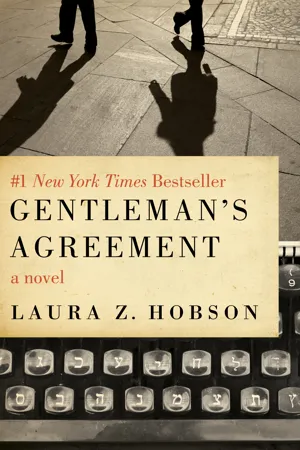
Journalist Philip Green has just moved to New York City from California when the Third Reich falls. To mark this moment in history, his editor at
Smith's Weekly Magazine assigns Phil a series of articles on anti-Semitism in America. In order to experience anti-Semitism firsthand, Phil, a Christian, decides to pose as a Jew. What he discovers about the rampant bigotry in America will change him forever.
- 278 pages
- English
- ePUB (mobile friendly)
- Available on iOS & Android
eBook - ePub
Gentleman's Agreement
About this book
Information
Subtopic
Literature GeneralIndex
LiteratureCHAPTER ONE
ABRUPT AS ANGER, depression plunged through him. It was one hell of an assignment.
“You’ll find some angle,” John Minify said.
“It’ll need an angle all right.” He squinted his eyes and looked off past Minify’s shoulder as if he were taking the measure of some palpable thing there.
“Take your time on it.” Minify spoke without urgency. “I think you might turn out a great job.”
Philip Green nodded, not in agreement with the comfortable words, but in affirmation of his own estimate of the job ahead. It would be flabby, lifeless, unless he found some special approach to it. Instinct, experience, past failures as well as past successes, all helped him now in his quick appraisal.
“If you want,” Minify went on, “we’ll borrow the clips on it from some newspaper morgue. There’d be plenty of names of agencies and committees to start on.”
“Committees.” The certainty of future boredom, of wasted listening, laced his depression with resentment. Minify surely could have found a more manageable subject for his first job as a staff writer. “The clips would help,” he said. “Thanks.” He half closed his eyes, drew his lower lip in taut over his teeth as if he were shaving his chin, and sat thinking. “I’ll start researching it, anyway. There must be plenty of dope around.”
“I wouldn’t force this series on you,” Minify said. “Knock it around awhile and we’ll talk again.”
“O.K.” Phil stood up, without finality. He was in his middle thirties, tall, too thin, with an intelligent, decent face. Eyes and hair were dark; he had begun to go gray. There was a quiet about him, an absence of aggression, yet there was no diffidence in his voice or manner.
“You certainly didn’t hand me a pushover for a starter,” he said at last. It was matter-of-fact, bare of complaint or chiding. It would take more than a disappointing assignment to topple his admiration for Minify or lessen his confidence in him as an editor. “Would anybody read five articles about antisemitism?” He saw Minify nod. “Three million readers?”
Minify didn’t answer. He leaned forward toward his desk, propped his chin on the knuckles of his closed hand. Then he swiveled the hand about so that the thumb stood up vertically across the corner of his mouth. He seemed all at once absorbed in another idea. His thumb tapped lightly against his lips, in a one-two-three, one-two-three rhythm. Phil smiled. Minify was considering three million readers out there somewhere across all the towns and cities of the land.
“No,” Minify said at last. “You couldn’t print anything in God’s world all three million would read. But some of them will.”
“Sure. And will it do any good?”
Minify tipped his head back so he could look directly at Phil. “Did your Okie pieces or your mine pieces ‘do any good’?”
Phil smiled. “That’s nailing me. Fathead question.”
“It didn’t take that Roper survey to tell me it’s getting worse. You feel it. It gets you either mad or uneasy. I mean me.”
“Or baffled.”
“So you can bet it’s hitting plenty of people that same way. If you find some strong way to write it, it’ll get read.”
“If.”
Minify offered his half-empty pack of cigarettes as if he counted on a refusal, the way you used to during the cigarette shortage. He lit one himself and then sat examining his lighter. He snapped the flame on and off several times, watching it flare up and snuff out. He gave it a last decisive click and stood up.
“Getting to know people here?”
“Not so many. I’m always slow about that. It’s fine, though. My kid likes it, and my mother. She always wanted to live in New York.”
“Have you any relatives here? Or are they all in California, too?”
Phil shook his head to both questions. Minify’s concern on this personal level pleased him. “One of my sisters is out there, and the other lives in Detroit. Grosse Pointe, rather.”
“I’ve been meaning to introduce you,” Minify began vaguely. Then his manner lost its air of improvising. “How about tonight at my place? We’re having some people over. Couple of girls and people.”
“Thanks. I’d like to.”
The editor told him where, and they shook hands with a touch of formality, as if each suddenly remembered he didn’t know the other well. With an inexplicable embarrassment, Phil took up his coat and hat and left quickly. He went down the long corridor, past open-doored offices in which people were talking or laughing. The shyness of the outsider came over him. Though the line “By Schuyler Green” was known to every one of them, he himself was a stranger. Working at home was the setup he’d asked for, but it would be wise, now that he was on the staff, to come in every day until he got to know some of these editors and writers. At once the idea disturbed him. On an assignment, he was never shy about meeting and interviewing people, but to make new social contacts was another thing. His mind ran from this self-recognition, with a hurried promise to do something about the office soon.
In the reception room, he stopped to put on his overcoat. The receptionist gave him a neat, exact smile, a precise replica of the one she had bestowed each of the other three times he had come in or gone out through the double glass doors that announced Smith’s Weekly Magazine. The scene was a replica of the other times, too; in the dark-red armchairs the usual assortment of people waited the signal to go in to their appointments. Could any of these unknowns be some writer whose name and work were perfectly familiar? The notion made him look around once more. With the exception of best-selling authors and syndicated columnists, whose faces looked out of endless book advertisements, reviews, and columns, there was an anonymity about most writers. Perhaps some of these waiting people in the reception room knew his name and work and would yet look blankly at his stranger’s face. In his anonymity, he smiled comfortably, and went out to the elevators.
In the street, he turned toward Fifth Avenue. In the two weeks since he’d become a resident of New York, he had passed the stage where he had to watch two successive street signs to see whether he was headed uptown or down. At the corner of Fifty-seventh and Fifth, he turned south and began to walk rapidly in the thin December sunlight. Soon he was striding along as if he were hurrying to a specific place at a specific time. Actually he was walking only so that he could think more rapidly about the new assignment. Already the search for the “angle” completely occupied him. He might take one Jewish family in some particularly antisemitic section and trace its life in the past few years. No, a long string of articles on that would bore readers to death. His mind pushed the notion aside, darted in new directions, hunting possibilities, exploring, rejecting. Again he was depressed. For days he’d be in for the old familiar sequence—hope as an idea flared bright, then unease and self-mistrust as closer examination snuffed it out. Like Minify’s lighter.
It was the rhythm of all living, apparently, and for most people. Happiness, and then pain. Perhaps then happiness again, but now, with it, the awareness of its own mortality. He had made an honest enough search for happiness—in the last year or two, at any rate. All he had found was transience.
The sting of cold air in his throat told him he had sighed deeply. “Cut the philosophy,” he told himself testily. He walked on now, thinking of nothing, merely watching, seeing, noting. At Thirty-fifth Street, he turned left, to the remodeled brownstone house just east of Park where he lived. In the vestibule he took out his keys, tapped the bell, and let himself in without waiting. Above, a door opened. His mother’s voice said, “That you, Tom?” and he said, “No, it’s me.” He went up the carpeted steps slowly, suddenly thinking about his mother. Her voice sounded older than her sixty-eight years; all the chivying details of transcontinental moving had been hard on her.
“How was it, Phil?” she greeted him.
“O.K. I’ve got the hell of a stiff assignment.”
She sat down, waiting. He wandered about the wide, tall-ceilinged room in which their own furniture and books looked so different from the way they had in the house in California. When the extra bookshelves were built in and the rest of his books taken out of the stacked cartons, it would be a pleasant room; he would like working in it. This and his mother’s room in the rear of the whole-floor apartment were the only good things about it; the kitchen and bathroom had air-suction outlets instead of windows, and the two “hall bedrooms” which were for him and Tom were smaller than their bathroom out in California.
Yet when Minify had told him that he could sublease the apartment from an editor who had been newly assigned to the London office, Minify had said, “Better grab it, whatever it is. The Coast isn’t the only place with a desperate housing shortage.” He had grabbed it and considered himself lucky.
Actually, the very oddness of living in a rectangular shelf of space rather than in a house set to the earth among bushes and trees had so far stimulated rather than dampened his spirits. He had sought basic change in the patterns of his life. This apartment was physical proof that he had found it, or, at any rate, one facet of it.
He remembered that his mother was waiting for him to go on. “Minify wants me to write a series,” he said, “five, six articles, on antisemitism in America.”
“That’s good.” She underlined the “good” with approval.
“If I could find some way to make it good.”
“I mean, most big magazines—it’s nice Mr. Minify wants to do it. You can do such a fine thing on it.”
“Minify’s a strange guy. I liked him even better today than the first time.” He lit a cigarette. “He’s all hopped up about the job I could do, just like you.”
“And you’re not?”
He frowned. “It’s a toughie.”
“You’ll do a wonderful series, dear.” She sounded placid. He remembered Minify’s comfortable words and was all at once irritated with both of them. It was so easy to say, “This is a great theme and you’ll write a great series.”
“Christ, I will if I can get some idea.” His voice flung exasperation at her. “But not just if I spin out the same old drool of statistics and protest.” He walked over to the window, looked down on the street. Without turning around, he added a moment later, “Sorry.”
“That’s all right. How about some coffee?” She started toward the small kitchen.
“Fine. Damn assignment’s got me in a sweat already.”
A hundred times he vowed never to talk to her in that quick sharpness, yet a moment would come when it sprang out as if he had no power to halt it in his throat. Once he had apologized, too earnestly, and she had said, “It’s all right. It’s because you’re not happy enough.” At his silence, she had added, “Being lonely makes people snap. Tension, I suppose.”
Now he waited a moment and then followed her to the kitchen. “Where’s Tom?” he asked conversationally. “It’s nearly four.”
“Across the street at Jimmy Kelly’s.” She looked at him and smiled. “He makes new friends so easily, Phil.”
“Yeah.” Suddenly he felt obscure pride in himself. Tommy, at eight, without a mother since infancy, was relaxed, outgiving, never “the problem child.” Somehow, then, he, Phil, had done a sound job of concealing the unevenness of his own moods all these seven years.
“I told him not to be too long,” Mrs. Green added. “Belle’s in town.”
“Again?” His sister had flown in from Detroit to help them get settled the day they’d arrived in the East.
“Just for today—Christmas shopping.”
“Aren’t Detroit stores good enough for her? That Belle. She’s the golden sheep in this family for fair.”
“Now, Phil.”
“O.K.” Suddenly he grinned. “She is a little hard to take at times, and you know it.”
“So are you, dear, but it’s worth it.”
“Sure, sure. I’d hate to think I’d stodgied up as much as she has in the last few years, though.” Mrs. Green made no comment. When the coffee was ready, Phil took his cup, said, “Think I’ll start jotting down some notes,” and went back to the living room. “I’ll quit when she gets here,” he added.
But when the downstairs bell rang half an hour later, he left his desk and went to his room. It was too small to serve as a study, taking only a tall chest, one big reading chair, and a narrow bed. He puttered about, dissatisfied, with what he did not know. He drew out a bureau drawer, closed it, and drew out another, as if he were searching for something. At his desk, he had ordered himself to think about the assignment, but like a fractious child, his mind had refused to comply. This was another sign, he thought dismally, that his flash appraisal in Minify’s office had been correct. There was in him no itch to get at it, the way there was when instinct told him he had a “natural” by the tail. As he had said, it was going to be the hell of an assignment and the bitch of a job to bring the stuff alive.
There was a knock at the door. “Hi, Belle,” he called, and she opened the door.
“Mamma says you’re working.” She made it a gentle accusation. “Come out a minute and tell me about the new job.”
When he told her, she said, “I should think he’d have assigned it to a Jewish writer.”
“Why? I’m not blind, am I?”
Belle went on as if he hadn’t spoken. “Anyway, I just wonder. You can’t scold people into changing.”
“Who said anything about scolding?” Phil asked, and Mrs. Green said, “Now, Belle, you don’t mean that. It’s not like you.”
Belle began to elaborate her point, but Phil scarcely listened. There was a flat certainty about her statements which irritated him. He had noticed it on her other trip and decided she had changed a good deal during the war years. The difficulties of travel had kept her away from the Coast; for five years they had not seen her. Apparently she regarded New York as a neighboring town of Grosse Pointe.
He sat, dispirited and silent, looking at her and wondering how he could get off by himself again. Belle was handsome, slender, expensively dressed. He looked at her attentively, as if she were someone he would have to describe accurately on paper. There were two horizontal lines grooved in her neck, like necklaces tight to the skin; he had never noticed detail of that sort before. She talked with loud animation as one does in a large room with many voices to combat; her hands moved restlessly in gesture. Now she was describing the large new house she and Dick wanted to buy.
“Did you close the sale on the old place?” Mrs. Green asked.
“Not yet. That cheap Pat Curran keeps trying to Jew us down.” She shook her head despairingly, and Phil thought her distress vulgar and ridiculous when millions of people couldn’t find a two-room flat. He saw his mother frown at her. He glanced at his watch, offered excuses about a pressing appointment, and left them.
Outside, the city was already dim with the early twilight and sharp with the clean smell of cold, but he still relished New York’s positive weather and walked into it as if into sanctuary. He wished it were his sister Mary in California instead of Belle who lived near enough for frequent visits. Belle was seven years older than he, and Mary only four; maybe that accounted for the greater closeness there’d always been between him and Mary. No, it was more than that. Mary lived in a sprawly house near the university and was lazy and easy about things; Belle had a terrific place, smart to the last ash tray. He’d been only sixteen when Belle had married Dick King. Nineteen years ago, Dick had been a college-boy draftsman, and for a long time the Kings had led an ordinary modest life like the rest of the family. Then Dick had designed the new wheel-transmission gadget that did the trick better than the one his company had been using; almost at once he’d become one of the high-priced big shots in the automotive world. That was ten years ago, and as if she’d been tensed and ready to spring, should the chance ever be offered her, Belle instantly changed into one of the “smart set” out there. “Perhaps a long transition period would have made her less of a jackass about being rich,” Phil had once remarked to Mary. Now he thought, Oh, well, and forgot her.
He’d been walking along Lexington Avenue. At Forty-second, he stopped and folded his head back on his neck as far as it would go, looking up at the Chrysler Tower. He wondered whether an atomic bomb could really vaporize it out of existence. He knew he looked like any t...
Table of contents
- Cover
- Title Page
- Dedication
- Contents
- Chapter One
- Chapter Two
- Chapter Three
- Chapter Four
- Chapter Five
- Chapter Six
- Chapter Seven
- Chapter Eight
- Chapter Nine
- Chapter Ten
- Chapter Eleven
- Chapter Twelve
- Chapter Thirteen
- Chapter Fourteen
- Chapter Fifteen
- Copyright
Trusted by 375,005 students
Access to over 1.5 million titles for a fair monthly price.
Study more efficiently using our study tools.
Frequently asked questions
Yes, you can cancel anytime from the Subscription tab in your account settings on the Perlego website. Your subscription will stay active until the end of your current billing period. Learn how to cancel your subscription
No, books cannot be downloaded as external files, such as PDFs, for use outside of Perlego. However, you can download books within the Perlego app for offline reading on mobile or tablet. Learn how to download books offline
Perlego offers two plans: Essential and Complete
- Essential is ideal for learners and professionals who enjoy exploring a wide range of subjects. Access the Essential Library with 800,000+ trusted titles and best-sellers across business, personal growth, and the humanities. Includes unlimited reading time and Standard Read Aloud voice.
- Complete: Perfect for advanced learners and researchers needing full, unrestricted access. Unlock 1.5M+ books across hundreds of subjects, including academic and specialized titles. The Complete Plan also includes advanced features like Premium Read Aloud and Research Assistant.
We are an online textbook subscription service, where you can get access to an entire online library for less than the price of a single book per month. With over 1.5 million books across 990+ topics, we’ve got you covered! Learn about our mission
Look out for the read-aloud symbol on your next book to see if you can listen to it. The read-aloud tool reads text aloud for you, highlighting the text as it is being read. You can pause it, speed it up and slow it down. Learn more about Read Aloud
Yes! You can use the Perlego app on both iOS and Android devices to read anytime, anywhere — even offline. Perfect for commutes or when you’re on the go.
Please note we cannot support devices running on iOS 13 and Android 7 or earlier. Learn more about using the app
Please note we cannot support devices running on iOS 13 and Android 7 or earlier. Learn more about using the app
Yes, you can access Gentleman's Agreement by Laura Z. Hobson in PDF and/or ePUB format, as well as other popular books in Literature & Literature General. We have over 1.5 million books available in our catalogue for you to explore.