eBook - ePub
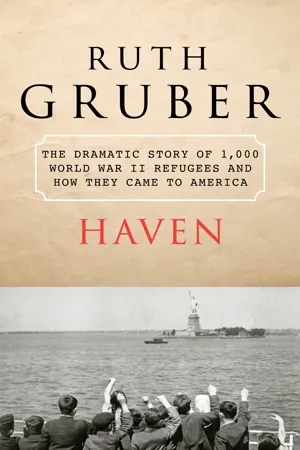
Haven
The Dramatic Story of 1,000 World War II Refugees and How They Came to America
- 326 pages
- English
- ePUB (mobile friendly)
- Available on iOS & Android
eBook - ePub
About this book
Award-winning journalist Ruth Gruber's powerful account of a top-secret mission to rescue one thousand European refugees in the midst of World War II
In 1943, nearly one thousand European Jewish refugees from eighteen different countries were chosen by President Franklin Delano Roosevelt's administration to receive asylum in the United States. All they had to do was get there.
Ruth Gruber, with the support of Secretary of the Interior Harold Ickes, volunteered to escort them on their secret route across the Atlantic from a port in Italy to a "safe haven" camp in Oswego, New York. The dangerous endeavor carried the threat of Nazi capture with each passing day.
While on the ship, Gruber recorded the refugees' emotional stories and recounts them here in vivid detail, along with the aftermath of their arrival in the US, which involved a fight for their right to stay after the war ended.
The result is a poignant and engrossing true story of suffering under Nazi persecution and incredible courage in the face of overwhelming circumstances.
Information
Subtopic
Holocaust HistoryIndex
HistoryPART ONE
THE STRUGGLE
IN WASHINGTON
IN WASHINGTON
ONE
THE WORDS LEAPED at me from The Washington Post.
“I have decided,” President Franklin Delano Roosevelt announced, “that approximately 1,000 refugees should be immediately brought from Italy to this country.”
One thousand refugees.
Europe was burning. It was June 1944, the middle of the war.
For years, refugees knocking on the doors of American consulates abroad had been told, “You cannot enter America. The quotas are filled.” And while the quotas remained untouchable, like tablets of stone, millions died.
Suddenly, one thousand refugees were to be brought in outside the quotas, by order of the President himself. Until now I had felt helpless, frustrated, enraged. Noble speeches were made each day about saving refugees before they were swept into the fire, but the deeds belied the words. Our doors had been slammed shut. Now suddenly there was hope.
At my breakfast table, air-conditioned against Washington’s summer heat, I continued to devour the article. The thousand refugees, I read, would be selected by the War Refugee Board, transported to America by the Army, and housed in a “temporary haven,” a former army camp called Fort Ontario, in Oswego, New York. The camp would be administered by the War Relocation Authority of the Department of the Interior. Only a few months before, the President had placed WRA, soon to be disbanded, under Harold L. Ickes, the secretary of the interior. I was Ickes’s special assistant, his field representative for Alaska.
Ickes would know what lay behind this sudden humanitarian gesture.
At E Street I jumped out of a cab and looked up at the handsome gray stone Interior building with its great bronze doors and modern columns. Interior—the vast grab-bag department of Indians, wildlife, Alaska, Puerto Rico, Hawaii, the Philippines—would now be in charge of Europe’s refugees too.
In my office, I telephoned Ickes’s appointments secretary and arranged a meeting for 11:55 A.M.
Ickes sat behind a huge desk littered with papers. His head was lowered as I began the long walk across the huge blue-carpeted office. He was writing with the thick scratchy pen I had seen him use countless times.
“Sit down,” he said briefly, and continued to write.
I sat in the armchair at the side of his desk. Behind him was a long table carefully stacked with books, newspapers, magazines. The Nation and The New Republic, to which he frequently contributed, were on top.
He finished his writing and buzzed for his secretary, who took the papers and disappeared.
Now he turned his full attention to me. “Yes?” he asked quizzically. “I understand it’s urgent.”
“It’s about the thousand refugees that President Roosevelt is inviting to America.”
He nodded. “The President sent me a copy of his cablegram to Robert Murphy in Algiers announcing it.”
“Mr. Secretary,” I said, “it’s what we’ve been fighting for all these years. To open doors. Save lives. Circumvent the holy quotas. What’s behind it? How did it happen?”
He leaned back in his chair. His eyes looked weary. “It came up in a Cabinet meeting with the President. It seems that Yugoslavian refugees and others are finding their way into Italy at the rate of about eighteen hundred a week. It’s a problem for the military in Italy.”
Was it Army pressure, then? The Allied armies were just now pushing up the boot of Italy. The papers were filled with the bloody battles of Anzio and Cassino. We had lost thousands of troops in the hills of southern Italy. I could see refugees fleeing into Italy on the heels of the Army. Clogging roads. Needing to be housed and fed.
“Someone at the meeting,” Ickes went on, “I don’t remember who, proposed that refugees be brought to this country. The President was still in favor of finding havens for them in Europe, Sicily, or parts of North Africa like Libya. I suggested, if any were brought to this country, that instead of coming to the mainland they be sent to the Virgin Islands. There’s plenty of room on the island of St. Croix, where the weather is mild, like southern Italy. Instead, they’re putting these people in New York State, near the snow belt around Lake Ontario.”
“But surely it’s not only because of the Army that we’re taking them in? It has to be more. It has to be humanitarian.”
“Of course it’s humanitarian.” His eyes blazed through his gold-rimmed glasses. “And it’s about time, too. We’ve been trying for years to open the door to refugees. Look what happened to the Alaskan Development Bill we prepared here in the department.”
I nodded. In November 1940, a year before Pearl Harbor, a bill was introduced to bring ten thousand settlers to Alaska: half of them were to be Americans; the other half would be European refugees who would promise to stay in Alaska for five years. Then they would be allowed to enter the United States under the existing quotas.
The bill was to do two things at once: help open Alaska for settlers and provide a haven for refugees. But the opposition was so great, from Alaskans as well as from isolationists who wanted no refugees at all, that it died in committee.
“I’m sure there’ll be opposition again,” Ickes said, “the restrictionists on one side and the damn fools on the other who’ll scream that one thousand isn’t enough. They don’t realize, with all the opposition to immigration in general and Jews in particular, that you can’t take in more than a thousand at a time.”
I thought of the millions of Jews waiting to be rescued. There were frightening rumors that several million had already been murdered in Germany, Poland, and other countries Hitler had overrun, though most of us still did not know how. But there were millions more—in Hungary, Romania, Italy. Maybe we could rescue them, snatch them from Hitler’s jaws.
Of all the Cabinet members, Ickes, who told me he had never met a Jew until he was sixteen, was the most passionate in denouncing the Nazi atrocities against Jews and the angriest that the doors of America were sealed.
“Mr. Secretary.” I heard the urgency in my voice. “These people coming here—they must be frightened, bewildered, coming to a strange land. Somebody has to be with them. Somebody has to take their hand.”
“You’re suggesting…?” His eyes began to sparkle; the weariness was gone. “Of course. It’s a great idea. I’m going to send you. You’re the one to go over and bring them back.”
Ickes was a man of instant decisions. He called his operator. “Get Dillon Myer on the phone.”
Myer was the head of the War Relocation Authority; his agency would administer the camp.
“Myer,” I heard him say, “I want to send someone over to Italy to bring back those refugees…. What? You’ve already selected someone?…A man? You send your man, I’m sending her…. That’s right. It’s a woman. A young woman…. What’s that?” His jowls trembled with anger.
I felt my stomach knot.
“What has being young got to do with this job? Being young didn’t stop her from getting a Ph.D. in literature when she was twenty, the youngest in the world. And she took it in Germany—as an exchange student from America. I know her capabilities. She’s been working for me now”—he turned to me—“how long is it?”
“Three years.” I could hardly hear my own voice.
“Three years. With all kinds of jobs. And this one is right for her. Those refugees are from the Balkans and Central Europe. They probably speak mostly German. She speaks German and Yiddish. There’ll be a lot of women and children. She’ll know how to reach them; she’ll understand them. You better come in at two-thirty today; I want to talk to you about her.”
Midafternoon, I was summoned to Ickes’s office. “Myer has just left,” he said. “I told him I couldn’t think of a better person to send.”
I sat upright in the chair.
“I told him it’s a unique job and you’ve got unique qualifications. You can communicate with the refugees. With your background, they’ll trust you.”
I waited for him to go on.
“What’s more, I assured Myer that you could be of great help to us by writing and speaking about the refugees when you get back. I told him how you are always asked to lecture on Alaska. Also, your press contacts are important. I made certain he knew that the Herald Tribune sent you to the Soviet Arctic. I told him I have full confidence in you, that you understand these people, and you can write.”
He was still not telling me Myer’s decision.
“It’s not settled, then?” I asked.
Myer, I knew, was an old-school government official who had come up through the ranks of the Agriculture Department. Instinctively, I sensed he would be dubious about sending a woman to do this job.
“Myer says there are problems,” Ickes went on. “Interior is not in overall charge of this project. The War Refugee Board is.”
The War Refugee Board had been created by the President five months ago—to save war refugees.
“Myer will have to check with WRB to get approval for you. I told him to see you first before he checks with them. He’ll see you at eleven tomorrow morning. I have to tell you, he’s hesitant about you.”
“He’s never met me.”
“I have the feeling he thinks you’re a big buxom social worker.”
I was neither big nor buxom nor a social worker.
“It’s these bureaucrats,” Ickes said. “They get in a niche and then they’re afraid to do anything unusual, anything that takes courage and imagination. Come back tomorrow after you’ve seen him.”
That night I replayed the scenes in Ickes’s office in my head. I walked to my desk and read again the President’s message to Congress. It was dated June 12, 1944.
This nation is appalled by the systematic persecution of helpless minority groups by the Nazis. To us, the unprovoked murder of innocent people simply because of race, religion, or political creed is the blackest of all possible crimes…. The fury of their insane desire to wipe out the Jewish race in Europe continues undiminished. This is but one example. Many Christian groups are also being murdered.
I leaned my head on my desk. There had been so many false starts to save them, so many conferences, so many hopes dashed. In July 1938 the United States had convened the Evian Conference in France on the shores of Lake Geneva. Thirty-two nations had sent representatives, most of whom stood up, one by one, to explain why they could not accept refugees. All that came out of Evian was a new committee, the Intergovernmental Committee on Refugees, which did little more to save refugees than the League of Nations had done before.
Meanwhile the two world leaders we loved, Roosevelt and Winston Churchill, made eloquent speeches about refugees even as they barred them. England closed the doors of Palestine, and the United States closed the doors of America. To be sure, individuals were brought into our country. Albert Einstein had been helped to escape; Thomas Mann had been invited as an honored guest. But now at last Roosevelt was inviting not famous men but a whole group of “common” people.
After World War I, America had pulled back between its two oceans, isolationist, largely antiforeign. The idea of taking in large numbers of refugees—especially Jews—was unpopular. The specter of anti-Semitism was in our country, to be evoked by any overt gesture. So FDR, along with many others, was careful not to show too much sympathy for beleaguered Jewish refugees. Besides, the time-honored distaste for Jews—if not outright hatred—was still a hallmark of the upper echelons of some government agencies, particularly the Department of State. I knew it firsthand working in Washington. Ickes was a different breed of high officialdom; there were not many like him.
That was why I was so excited, why Roosevelt’s decision to bring in even one thousand seemed to me such a triumph. One thousand, out of the millions being slaughtered and more millions without homes or refuge. It could be the beginning of a mass rescue movement. And for at least a thousand people, it would mean life, not death.
At eleven the next morning, I entered the seedy and steaming-hot Barr Building on Seventeenth Street and rode the elevator to the executive offices of the War Relocation Authority. Unlike the cool marble halls and broad corridors of Interior, the narrow halls and small offices seemed out of another era. I waited in the small room.
“Mr. Myer is free now.” His secretary pointed toward the door.
My instincts were right. There was no warmth in his greeting. A tall man with steel-rimmed glasses and steel-gray hair, he stared down at me as I entered. He looked like the engineers I had seen on construction projects in Alaska, hard-driving men who seemed closer to machines and mortar than to people.
“So,” he said coldly. “You’re even younger than I thought.”
I said nothing.
“I can’t understand why, for such an important, unprecedented mission, Ickes should want to send a young woman. Do you realize what this job means? You’ll be going over in the middle of war. You can be shot down. That’s all we need, to have a young woman from our department shot down by a Nazi plane.”
I wanted to tell him that I had been in the Aleutians when they were invaded, that I was a fatalist, that I would die when my number was up. Instead, I said, “It’s a danger I’m prepared to face.”
“Do you realize you’ll be dealing with a thousand people—with men as well as women and children? Don’t you see that after what they have gone through, they would have more respect for a man? They would pay much more attention to a man than they would to a woman.”
In a co...
Table of contents
- Cover Page
- Title Page
- Table of Contents
- Introduction
- Part One: The Struggle in Washington
- Part Two: The Voyage of The Henry Gibbins
- Part Three: The Oswego Adventure
- Part Four: After They Crossed the Rainbow Bridge
- Appendix
- Index
- Copyright Page
Trusted by 375,005 students
Access to over 1.5 million titles for a fair monthly price.
Study more efficiently using our study tools.
Frequently asked questions
Yes, you can cancel anytime from the Subscription tab in your account settings on the Perlego website. Your subscription will stay active until the end of your current billing period. Learn how to cancel your subscription
No, books cannot be downloaded as external files, such as PDFs, for use outside of Perlego. However, you can download books within the Perlego app for offline reading on mobile or tablet. Learn how to download books offline
Perlego offers two plans: Essential and Complete
- Essential is ideal for learners and professionals who enjoy exploring a wide range of subjects. Access the Essential Library with 800,000+ trusted titles and best-sellers across business, personal growth, and the humanities. Includes unlimited reading time and Standard Read Aloud voice.
- Complete: Perfect for advanced learners and researchers needing full, unrestricted access. Unlock 1.5M+ books across hundreds of subjects, including academic and specialized titles. The Complete Plan also includes advanced features like Premium Read Aloud and Research Assistant.
We are an online textbook subscription service, where you can get access to an entire online library for less than the price of a single book per month. With over 1.5 million books across 990+ topics, we’ve got you covered! Learn about our mission
Look out for the read-aloud symbol on your next book to see if you can listen to it. The read-aloud tool reads text aloud for you, highlighting the text as it is being read. You can pause it, speed it up and slow it down. Learn more about Read Aloud
Yes! You can use the Perlego app on both iOS and Android devices to read anytime, anywhere — even offline. Perfect for commutes or when you’re on the go.
Please note we cannot support devices running on iOS 13 and Android 7 or earlier. Learn more about using the app
Please note we cannot support devices running on iOS 13 and Android 7 or earlier. Learn more about using the app
Yes, you can access Haven by Ruth Gruber in PDF and/or ePUB format, as well as other popular books in History & Holocaust History. We have over 1.5 million books available in our catalogue for you to explore.