A collection of poetry by Kahlil Gibran, Eastern literature's most prolific thinker and the author of
The Prophet, one of the most renowned books of the last century.
Kahlil Gibran's reflections on the wistful beauty, lofty majesty, and abiding peace of Eastern wisdom revolutionized Arab literature. This collection of dramatic poems uses the dialogue between age and youth as a platform to discuss deep subjects such as freedom, death, and the eternal soul. From "Of Life and Sorrow" to "Of Science and Knowledge," Gibran's vision transcends boundaries of religion and culture, finding beauty and wisdom in the universal struggles of everyday life.
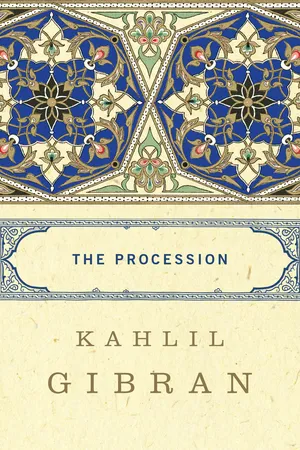
- 104 pages
- English
- ePUB (mobile friendly)
- Available on iOS & Android
eBook - ePub
The Procession
About this book
Information
Index
LiteratureWITH its shores caressed by the warm, indigo blue waters of the Mediterranean Sea, its lofty peaks turbaned with perpetual snow, the hoary and sacred Lebanon basks meditatively under the sunny, rarified skies of Mother Syria.
Nations were born on its western slopes; others were nursed and sheltered by it in the Orontes valley, and civilizations sprouted and matured in the not distant Plains of Shinar, under its watchful and benevolent eye. Although it lacked comparative fertility, the dwellers of its slopes were compensated by a plentiful supply of hardy cedar, planted there by the hand of God.
Its inhabitants built boats, sailed seas, and furnished their only available wealth to Egypt in the south and to the valley of the Euphrates on the east. The caskets of the Pharaohs within the sarcophagi, the beams of the Temples, the doors and furnishings, all required this precious wood. Their seamanship made the Phoenicians the world’s foremost traders and civilizers. Their greatest gifts, however, were not cedar, weaves, purple dyes, glass or metal castings (nor even their alphabet and sculptures which they bore to the then untutored Greeks and Romans), but rather the moral and spiritual revelations which their poets, seers, and prophets gave to the world.
For was it not in Lebanon that Tammuz was born? Did he not roam these very hills? Did he not descend to the depth of its valleys to cut and fashion his own reed and ascend again to scale its highest crags to play and sing? Beautiful of face, free of limb, and bold of spirit, he ranged the hillside, rode the wings of its tempests, communed with its stars and was lulled to sleep by the rustling of the leaves of its forests. Here the gentle zephyrs awakened him to plunge again into its crystalline rivers, quaff its water, and race its gazelles and antelopes, with Ishtar (Venus) in pursuit of this God of Beauty and Youth.
For many centuries the maidens of the Lebanon gathered on a certain spring day, adorned themselves in their finest raiment, bedecked themselves with flowers and ornaments, and roamed the hills for hyacinth, lilies, narcissi, and all the flowers with which the gods have especially carpeted the Lebanon. These they brought in armfuls to the River of Tammuz where, forming themselves into clusters and groups, they sang, danced, and bemoaned his death. They sprinkled their flower offerings on the rippling waters and the little virgins brought their small bronze statuettes of Tammuz to throw in the deep pools, hoping that a Tammuz-like bridegroom might come to seek them on some future spring day.
Tammuz, like everyone born on the slopes of these mountains, loved his native land, and could never resist its charm in springtime. Even after he was taken away by the Greeks, like many of the Syrian gods, and given the name of Adonis, he always deserted Mt. Olympus in springtime and returned to course over his native hills. Many a lovelorn maiden, who kept a vigil between the false and the true dawn, had a glimpse of the handsome Adonis fleeting over a promontory, running into the forest, or diving into the river. Even in our day, watchful shepherds have seen him in the environs of the Sacred Cedars, and many are those who believe that he will be reborn among them.
Wadi-Quadisha (The Holy or Sacred Valley) is the name by which this valley has been reverently called for unknown centuries. No other word could have described the feeling of the beholder than Wadi-Quadisha. The river course today, named Abu-Ali, which empties its waters into the infinite blue near Tripoli, leads towards its source in a steadily mounting grade. After following its upward zigzagging and tortuous course through the foothills and middle mountains, the traveler is suddenly ushered into a hushed and mystic canyon which expands into a basin-like valley, basking in peace and solitude, guarded on either side by immense, sheer and gigantic ledges of limestone and buttressed at the upper end against the snow-clad mountain.
In the distance, along the rim of the valley, are clusters of stone houses, clinging to the mountainside and forming the few scattered villages of Wadi-Quadisha. This Sacred Valley differs from other parts of the Lebanon because of its abundant water and its verdant and numerous groves of trees. Walnut and oak, zeizaphon, (Ziziphus Spina Christi), poplar and willow trees dot the landscape; graceful and airy pines interspace it here and there, and its terraced slopes are planted with mulberry, fig, fruit trees, and extensive vineyards.
It was to this spot in the early days of Christianity, when the strife of the sects was intense and bitter, that the monk-priest, Mar-Maroon (St. Maroon) came. It was here that his followers increased, and it was here that the Sons of Lebanon, conforming to his teachings, adopted for their ritual, still in use today, the Aramaic language which was spoken by Jesus. Although this church is affiliated with the Roman Catholic Church, its priests marry and raise families, and its liturgy and ecclesiastical chant—one of the most musical of all—is still followed in the langua...
Table of contents
- Cover Page
- Title Page
- Dedication
- Contents
- The Life of Gibran Khalil Gibran
- The Procession of Gibran
- The Illusory World
- Of Goodness and Station
- Of Life and Sorrow
- Of Religion
- Of Justice
- Of Will and Right
- Of Science and Knowledge
- Of Freedom
- Of Happiness and Hope
- Of Gentleness
- Of Love
- Of Soul and Fertility
- Of Death and Immortality
- The Summing of the Youth
- The Capitulation of the Sage
- Copyright Page
Trusted by 375,005 students
Access to over 1.5 million titles for a fair monthly price.
Study more efficiently using our study tools.
Frequently asked questions
Yes, you can cancel anytime from the Subscription tab in your account settings on the Perlego website. Your subscription will stay active until the end of your current billing period. Learn how to cancel your subscription
No, books cannot be downloaded as external files, such as PDFs, for use outside of Perlego. However, you can download books within the Perlego app for offline reading on mobile or tablet. Learn how to download books offline
Perlego offers two plans: Essential and Complete
- Essential is ideal for learners and professionals who enjoy exploring a wide range of subjects. Access the Essential Library with 800,000+ trusted titles and best-sellers across business, personal growth, and the humanities. Includes unlimited reading time and Standard Read Aloud voice.
- Complete: Perfect for advanced learners and researchers needing full, unrestricted access. Unlock 1.5M+ books across hundreds of subjects, including academic and specialized titles. The Complete Plan also includes advanced features like Premium Read Aloud and Research Assistant.
We are an online textbook subscription service, where you can get access to an entire online library for less than the price of a single book per month. With over 1.5 million books across 990+ topics, we’ve got you covered! Learn about our mission
Look out for the read-aloud symbol on your next book to see if you can listen to it. The read-aloud tool reads text aloud for you, highlighting the text as it is being read. You can pause it, speed it up and slow it down. Learn more about Read Aloud
Yes! You can use the Perlego app on both iOS and Android devices to read anytime, anywhere — even offline. Perfect for commutes or when you’re on the go.
Please note we cannot support devices running on iOS 13 and Android 7 or earlier. Learn more about using the app
Please note we cannot support devices running on iOS 13 and Android 7 or earlier. Learn more about using the app
Yes, you can access The Procession by Kahlil Gibran, George Kheirallah in PDF and/or ePUB format, as well as other popular books in Literature & Middle Eastern Literary Collections. We have over 1.5 million books available in our catalogue for you to explore.