A collection of eyewitness accounts of the Normandy landings that "gives you the [feeling] that you are there during the frenzied first hours of the invasion" (
Kepler's Military History Book Reviews).
Many professional historians have recorded the actions of D-Day but here is an account of the airborne actions as described by the actual men themselves, in eyewitness detail.
Participants range from division command personnel to regimental, battalion, company, and battery commanders, to chaplains, surgeons, enlisted medics, platoon sergeants, squad leaders and the rough, tough troopers who adapted quickly to fighting in mixed, unfamiliar groups after a badly scattered drop. And yet they managed to gain the objectives set for them in the hedgerow country of Normandy.
This book is primary source material. It is a "must read" for anyone interested in the Normandy landings, the 101st Airborne Division, and World War II in general. Hearing the soldiers speak is an entirely different experience from reading about the action in a narrative history.
- 384 pages
- English
- ePUB (mobile friendly)
- Available on iOS & Android
eBook - ePub
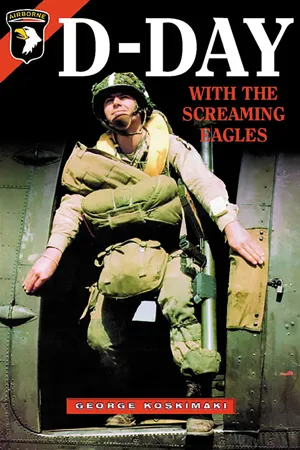
D-Day with the Screaming Eagles
About this book
Information
Subtopic
Military & Maritime HistoryIndex
HistoryCHAPTER 1
THE MARSHALING AREA
The training period had come to an end for the Screaming Eagles. The rumor mills had been busy for weeks grinding out the endless chain of reports concerning the imminence of departure for the marshaling areas. The experiences were not new for the men in that all units had participated in several dress rehearsals culminating with Exercise Eagle during the period of May 11-14. The sky troopers had emplaned from the same airfields to which they were now being sent. During the last week of May, orders were received restricting the men to their unit areas. They packed their personal belongings, were assigned parachutes, refitted with some new equipment, and packed their equipment bundles.
Lieutenant Richard Winters served as executive officer of his unit on D-Day. He wrote:1 “Leaving Aldbourne was a tough job. A fellow couldn’t say a thing to anybody due to security. The English knew we were pushing off. When I went to say good-by, as if I was off for another maneuver, it got me to see them cry and take it as they did.”
Technician 5th Grade Bill Finn, a D-Day communications wire-man said, “When we were leaving the company area for the marshaling area, most of the people living in the homes surrounding Donnington Castle were out in the street to wave good-bye to us and wish us luck. They probably didn’t know the day we would leave England but they sure knew we wouldn’t be back for some time.”
An intelligence soldier, PFC Richard M. Ladd wrote, “Regimental Headquarters Company of the 502nd Parachute Infantry Regiment was loaded aboard British buses May 30, 1944, at Chilton-Foliat, Berkshire, England, and driven perhaps 15 miles to Greenham Common Airdrome, where we were quartered until the evening of June 5 in a tent city. The. area was enclosed with barbed wire and termed a marshaling area. No one, other than a few high ranking officers, was ever allowed to leave this area until the evening of June 5, when we boarded C-47’s for France.”
Corroborating that statement, Sergeant Louis Truax said, “Our marshaling area was near Exeter, England, and was surrounded by barbed wire and guarded by army troops not of our division. They had machine guns at the corners of the area and we were forbidden to talk to the guards.”
Captain Charles O. Van Gorder was a member of the 3rd Auxiliary Surgical Group and had volunteered for the assignment to go in on D-Day with the 101st Airborne Division. His group had previously participated in the campaigns in North Africa, Sicily, and Italy prior to arriving in England. The detached service with the 101st Division was in the form of an experiment to find out if it would be any advantage to take a surgical team in where the casualties were, rather than to take the casualties back to where the evacuation hospitals were located.
The eight men who volunteered for this mission called themselves the 1st Airborne Surgical Team and they were attached to the 326th Airborne Medical Company. Van Gorder provided his recollections of the marshaling area with these comments: “Several days before D-Day, we were sent with part of the 101st Airborne Division to Aldermaston Air Field for staging and briefing. These were very trying days to remain crowded in a large hangar, going out in only small groups at intervals for chow. Latrines were in or somewhere under the roof of the hangars. Keeping us in the hangar and going out in small groups was to frustrate any enemy aerial reconnaissance.”
An enlisted man who was in the same area was PFC George S. Schulist, who was a jeep driver for his platoon leader. His memories of the same staging area include these items: “When we went to eat at the mess hall, we were always taken in groups, such as Battery A or Battery B. When we left the hangar, we had to pass the fence gates. Plainclothesmen were waiting on the other side of the gate to escort us to the mess hall. They were there so we could not talk to anyone outside of our groups at the marshaling area.”
The primary reason for placing the men in solitude much like imprisoned men was the briefing for the invasion. With firsthand knowledge of the D-Day targets and objectives, the men were kept isolated to prevent any leaks to the enemy. Some of the men who prepared the briefing aids have good descriptions of these preparations.
PFC Richard M. Ladd of the 502nd intelligence group described, “Regimental S-2 Section was one of the few groups that actually had duties to perform while in the marshaling area. This consisted of building crude tables with wooden sides. Sand was then shoveled into these boxes from some trucks that were driven in. From these crude beginnings, we began our sand tables which were located in each battalion area. On these were developed models from soap and other suitable materials to simulate houses, churches, etc., with paints and some coloring to simulate the general reliefs of the area in Normandy in which we were to jump. Each table was a bit different, in that, it contained different roads and hamlets peculiar to each battalion’s S-2 Section. We constructed these sand tables as accurately as we could from the latest aerial serial photographs supplied to us by the Air Force, to coordinate and orient them with wonderfully accurate British defense maps, as well as all the latest information supplied to us by various intelligence agencies, including the latest up-to-date ‘poop’ from the French underground Maquis.”
Ladd added, “After these tables were prepared and the various companies were broken down into platoons, the leaders and sergeants would be briefed in front of the tables as to their objectives, the terrain, directions of the roads, and a general familiarization of their target areas. Each unit would retire to tents and company streets to study maps that had been disseminated to them, and proceed to discuss, argue, and speculate the assigned squads and personnel for specific jobs to be accomplished. Then various trips were made back to the sand tables for restudy by the officers and noncoms.”
A former member of the regimental demolitions section, Corporal Vinnie Utz, had been transferred to the intelligence section of the 506th Regiment for the Normandy operation. He recalled, “The S-2 Section made the sand tables for the invasion and we assisted the officers in going over the objectives, company by company. I was put into a complete German uniform by Colonel Robert Sink and told to visit all the line company tents so they could get a good idea of what a Kraut looked like.”
An assistant operations officer for the 377th Parachute Field Artillery Battalion, Captain William E. Brubaker, stated, “I recall my part (and the entire S-3 Section) in preparing for the mission. We had plotted the location for the three firing batteries and spent several days in planning targets and computing the firing data for each target. The balance of our time was spent in briefing the rest of the battalion from sand tables and maps. I remember receiving very fine aerial pictures on a daily basis showing our main targets and objectives, and how delighted I was when we discovered that the Air Force had practically eliminated one of the coastal batteries we were to take.”
Recollections of the detailed map reading provides some interesting information. Engineer Lieutenant Harold Young said, “Every officer had maps at a scale of 1:10,000 plus oblique air photos of our landing and target positions. Every G.I. had a map at 1:300,000 of the whole general area. We had our men memorize a section of the map so they could get back if they landed in the wrong place. It was said that every private in a parachute unit knew as much as a colonel in a regular infantry outfit.”
After the intelligence personnel had briefed the regimental and battalion staff officers and their men, the briefings continued down through the company commander, the platoon leader, the squad leader, and down to the last private—or almost, as we shall see later.
The commanding officer of the 501st Regiment’s Charley Company, Captain Robert H. Phillips, described the painstaking preparation: “Several days were devoted by the unit commanders, of which I was one, studying our assignments and formulating detailed plans for carrying them out. Each individual member was then thoroughly briefed on the detailed plans of his particular unit. Only general information was given as to the missions of the division.
“My company’s mission was to seize and secure the road junction south of St. Come-du-Mont, a small village, thus securing a flank of the drop zone (DZ). This position also overlooked the main highway bridge north of Carentan, and later gained the name of ‘Dead Man’s Corner.’”
A platoon leader with Able Company of the same regiment, Lieutenant Sumpter Blackmon, recalled, “The intensive sand table briefing we received and gave to our sergeants and to the other men lasted for about a week. The mission for my platoon was to take and hold the La Barquette Locks on the Douve River about a mile north of Carentan. The remainder of the 1st Battalion was to blow the bridges over the river to the northwest of Carentan.”
Minute details were not forgotten. Sergeant Pat Lindsay, mortar man with the same company, said, “I remember the sand table work in which each man knew definitely which job he was to do, even down to the direction in which the fox holes would be dug.”
Part of the briefing included familiarizing the men with the enemy uniforms. Private Robert “Lightnin” Hayes had this recollection to add: “I remember the day we were assembled in a tent for the first time and an officer told us where we were going to jump. He then paused to watch our reactions. There was a sand table near by with a facsimile of the terrain on which we were going to drop. There were two dummies standing near the sand table. One was wearing a German Air Force uniform while the other was dressed in the black uniform of the Armored Corps. I tried on the black beret to see how it would fit me. I didn’t realize that a few days later I would meet a German face-to-face wearing one of those caps.”
Reconnaissance photography had been so detailed that individual enemy soldiers appeared in recent pictures taken of the objectives. An airborne engineer, PFC John G. Kutz, whose assignment was to be the preparation for destruction of two wooden bridges northeast of Carentan, was briefed with aerial photos of the bridges. He said, “On one photograph you could see a German guard standing against one of the bridges. It seemed he was trying to hide from the low flying plane.” Kutz felt he had already met the enemy!
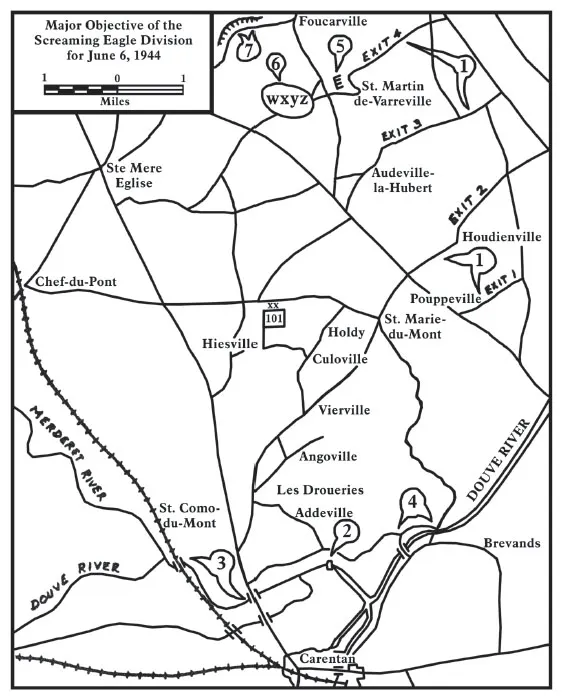
Map 1
No. 1—Capture of the four causeways leading down to Utah Beach (shown as Exits 1-4). No. 2—Capture and hold the locks at La Barquette. No. 3—Destroy the Douve River bridges northwest of Carentan. No. 4—Seize, hold, and establish bridgeheads at wooden bridges northwest of Carentan. No. 5—Silence the coastal battery at St. Martin-de-Varreville. No. 6—Capture artillery barracks complex at WXYZ (Mesieres). No. 7—Protect the northern flank of Utah Beach invasion area.
Two of the men called to mind that they had not received briefings with the rest. Captain Raymond S. “Chappie” Hall, Protestant Chaplain of the 502nd Regiment, said, “I never had time for the briefings and didn’t even know the password when it was given nor was I issued a metal clicker.”
A communications soldier with the 2nd Battalion of the 501st Regiment, T/5 Harry T. Mole, Jr., walked around the tented area and watched the men of Dog, Easy, and Fox Companies getting their equipment ready. He made this observation: “I watched them as they repeatedly cleaned their rifles over and over again. I watched these men as they sat on boxes and had their hair cut off Indian fashion. I didn’t have mine cut. I watched men in circles intently listening to an officer describe their objectives. Their eyes followed every line scratched in the dirt by a stick attached to the officer who was explaining their mission. The invasion was becoming real now. Training could possibly be called over. This was the time they had trained for. Me? Nobody briefed me. I wandered around the area watching the others learn their objectives. How envious I was of the line company men. They knew what it was all about. They belonged.
“My machine gun platoon and our 81mm Mortar Platoon of Headquarters Company belonged. They were assigned to various line companies and were being briefed by them. Each man in my communications platoon had an assignment except me. I was technically a battalion code clerk, a Technician 5th Grade, a rather unimportant role in an invasion of this magnitude. They also gave me an SCR-536, press-to-talk radio probably because they had one left over. As a code clerk, I had a machine to code and decode messages coming to and going from battalion headquarters. Cloak and dagger, eh! One thing was wrong—they never told me what the code was!”
Almost all of the men mentioned honing their trench knives, jump knives, bayonets, and special hunting knives to razor sharp edges. They took their weapons apart time and time again to assure perfect function.
Meals made a big impression. Most felt they had never eaten so well in the army. Others remembered the last two big evening meals. Most were happy not to draw KP details at this time. The sumptuous meal given to a convict in death row before his last walk was on the minds of several men. Captain William J. Waldmann, a surgeon, reflected, “The meals were so good we felt we were receiving our last meal before the execution.”
Technician 5th Grade Gordon E. King felt the best meal was served the day of the postponement. He said, “We had our ‘condemned person’s’ fancy meal one night early on the night of June 4th.”
One battalion commander was concerned about the effect pork chops would have on nervous stomachs. “Pork chops were on the menu for the last evening and they were turned down by our battalion commander,” remembered Sergeant Donald Castona. “Colonel Julian Ewell said they wouldn’t sit well on ‘queasy’ stomachs.”
Corporal Virgil Danforth of the same company lamented, “They fed us well except for our last meal, which they took away just as we sat down to eat. We had been eating lots of fat pork and butter which was supposed to improve our eyes and they were afraid we would get air sick if we ate it just before our jump.”
Being cooped up in a barbed wire enclosure for more than a week might have posed a problem had it not been for the usual pastimes found in army camps, such as boxing, wrestling, volleyball, and the ever present cards and dice.
At least one key officer missed out on the invasion because of an injury brought about in horseplay. Staff Sergeant Carwood Lipton recalled, “Lieutenant Schmitz, one of the platoon leaders, hurt his neck while wrestling with one of the other officers in the marshaling area and had to stay back and miss the invasion.”
Haircutting pranks developed in several areas. Captain Fred C. Culpepper, an artillery officer, recalled the loss of a prized facial possession. “Just prior to loading out for the first time (which was postponed at the last minute) my officers caught me and removed my mustache with a dull razor. I had said that I would not shave the mustache until we were in France.”
Two men who had been members of the same unit on D-Day related a combination boxing and hair-cutting incident that was amusing. Corporal Virgil Danforth related, “We played volleyball and boxed to pass the time. I had started to let my hair grow long enough to comb, but Lieutenant Marks and the rest of my platoon ganged me and ran the clippers through the center of my head making one wide part.”
Sergeant John Urbank mentioned, “We gave each ot...
Table of contents
- Cover Page
- Title Page
- Contents
- List of Maps
- Dedication
- Author
- Foreword
- Introduction
- 1. The Marshaling Area
- 2. The Pathfinders Lead the Way
- 3. The Flight Across
- 4. Bill Lee — Geronimo — Let’s Go!
- 5. Out of the Night Sky
- 6. Into the Midst of the Enemy
- 7. Early Encounters
- 8. Assembly
- 9. Johnson’s Regiment — the 501st
- 10. So Few Led By So Many
- 11. The Five–O–Deuce
- 12. The Scattered Artillerymen
- 13. The 506th Regiment
- 14. Hold Those Bridges!
- 15. The Glider Lifts
- 16. Angels of Mercy
- 17. At Day’s End
- 18. The French Were Waiting
- Notes
- Contributors
- Acknowledgments
- Bibliography
- Copyright Page
Trusted by 375,005 students
Access to over 1.5 million titles for a fair monthly price.
Study more efficiently using our study tools.
Frequently asked questions
Yes, you can cancel anytime from the Subscription tab in your account settings on the Perlego website. Your subscription will stay active until the end of your current billing period. Learn how to cancel your subscription
No, books cannot be downloaded as external files, such as PDFs, for use outside of Perlego. However, you can download books within the Perlego app for offline reading on mobile or tablet. Learn how to download books offline
Perlego offers two plans: Essential and Complete
- Essential is ideal for learners and professionals who enjoy exploring a wide range of subjects. Access the Essential Library with 800,000+ trusted titles and best-sellers across business, personal growth, and the humanities. Includes unlimited reading time and Standard Read Aloud voice.
- Complete: Perfect for advanced learners and researchers needing full, unrestricted access. Unlock 1.5M+ books across hundreds of subjects, including academic and specialized titles. The Complete Plan also includes advanced features like Premium Read Aloud and Research Assistant.
We are an online textbook subscription service, where you can get access to an entire online library for less than the price of a single book per month. With over 1.5 million books across 990+ topics, we’ve got you covered! Learn about our mission
Look out for the read-aloud symbol on your next book to see if you can listen to it. The read-aloud tool reads text aloud for you, highlighting the text as it is being read. You can pause it, speed it up and slow it down. Learn more about Read Aloud
Yes! You can use the Perlego app on both iOS and Android devices to read anytime, anywhere — even offline. Perfect for commutes or when you’re on the go.
Please note we cannot support devices running on iOS 13 and Android 7 or earlier. Learn more about using the app
Please note we cannot support devices running on iOS 13 and Android 7 or earlier. Learn more about using the app
Yes, you can access D-Day with the Screaming Eagles by George Koskimaki in PDF and/or ePUB format, as well as other popular books in History & Military & Maritime History. We have over 1.5 million books available in our catalogue for you to explore.