"A more-than-welcome return to a classic idea of the novel . . . A wonder to read" (
Los Angeles Times Book Review).
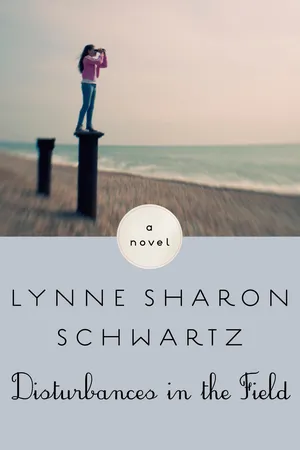
The field is all around us. It's our needs and our wants. This is what George tells Lydia. A disturbance, however, is something that keeps us from grasping and attaining the things we need. Usually, we can adapt to these disturbances and move forward. But, what happens if a disturbance becomes too great to move past? In this entrancing tale of loss and understanding, acclaimed author Lynne Sharon Schwartz plots the course of a woman's life, through the cycles of love, loss, and acceptance.
Lydia's early life is marked by calm constants: a house in Cape Cod, a philosophy group in college. These remain her touchstones as she becomes a busy wife, mother, and music teacher. But when her family's world is suddenly shattered, she struggles to regain her equilibrium. Will she be able to find her way in such a radically altered field?
- 371 pages
- English
- ePUB (mobile friendly)
- Available on iOS & Android
eBook - ePub
About this book
Information
Subtopic
Literature GeneralIndex
LiteraturePART I — FAMILIES AND BEGINNINGS
Even in early youth, when the mind is so eager for the new and untried, while it is still a stranger to faltering and fear, we yet like to think that there are certain unalterable realities, somewhere at the bottom of things. These anchors may be ideas; but more often they are merely pictures, vivid memories, which in some unaccountable and very personal way give us courage.
WILLA CATHER, Obscure Destinies
The Brown House
HAPPY FAMILIES ARE NOT all alike. I have belonged to three, now all families of the past, families no longer in existence, and they had little in common except for my membership.
The family my parents made was secure and practical and loving and staid. It sent my sister Evelyn and me off looking for excitement, in our diverging ways. During the steamy hot summers in Hartford we were restive. Late at night in bed we whispered about the exotic and cool places we wished we lived in: Norway, Alaska, the South Pole. And each morning as we watched my father set off uniformed and dapper in a business suit to peruse numbers and charts, we longed for our three weeks at the beach. We always had a good time at those rented houses, the same sort of good time every year, so that the summers run together in my mind, making one continuous summer, like a Platonic Idea from which any single beach vacation can draw its individual identity.
Except for the one summer, so idyllic that it stands apart with all the sensual detail of reality and none of the annoying abstraction of Plato. I don’t know why it was so perfect: some magic in the brown house itself, where we stayed, maybe, or some special concatenation of weather and internal chemistries. No rain. No toads in the garden. There must have been toads, but I have forgotten them. I did sometimes wake up at night terrified of the dark, but that was such a familiar panic, already a grudgingly admitted part of me, that it didn’t count.
Our life at the brown house moved in a cycle of order and harmony, a hypnotic rhythm which worked its way so deep in me that years later, it is still hard to accept that order is an anomaly, not to be expected any more. Hard to accept that the close harmony I shared in with my sister, she high on the dunes and I grappling below in the surf, will not come again. My sister is in Switzerland now, high in the mountains, as I might have foreseen. She was always a bit otherworldly, like Vivian. Evelyn too would have been capable of losing both her primary subway token and her spare in the snow, from holes in different pockets. Like Vivian too, she was overpoweringly sweet-natured, weaving a spell of entrancement wherever she went, and yet unabashedly selfish: younger daughters both, they looked out for themselves first and thought that only natural. Their refusals were final, while Althea or I can be coaxed into almost any favor. Evelyn spent her junior year of college abroad, met a Swiss businessman fifteen years older and married him, just like that, not to return except for rare visits. I felt deserted.
But that summer. The night before we left I watched my father undress when he came home from work. My father was a man who could not be rushed. And because his every move was slow and deliberate, the simplest gestures would assume a weight and texture of high significance. First, from the pockets of his navy blue suit he took out keys, wallet, handkerchief, loose change, several folded envelopes, a package of Chiclets, pens, pencils, cigars, matches, a little packet of business cards. It was like the tiny-car act in the circus, but in slow motion. He took off the suit and placed it carefully on a hanger. “Stay right there,” he addressed it, then me: “I won’t have to be wearing that for three weeks.” In his shorts and undershirt, he leaned toward the mirror and began clipping his mustache in neat, jovial little snips. I went to examine the suit, hanging on a doorknob. “What do you need all these pockets for?” “Pockets?” He came over, and with a hand resting on my shoulder he revealed the secret lore of men’s pockets. Upper left hand: the handkerchief folded in a triangle. Upper right hand: pens, pencils, cigars. Those inner breast pockets, layer upon layer of grownup business—cards, letters, mysterious slips of paper with numbers and names. Back pants pocket: wallet (“But don’t you sit on it?”), crumpled handkerchief (for use, not show). Front pants pocket for loose change and keys, rattling against the leg. And a strange little square pocket up near the belt loops. “Watch pocket.” “Watch what?” “For a watch, silly Lydia.” He rumpled my hair. “Dresses don’t have all those pockets,” I said. My future looked bleak and sparse. “No, but you ladies have your pocketbooks. They hold even more.” Pocketbooks were an appendage. Pockets were part of the suit, inseparable. Well, if I couldn’t have a suit I would have a man, at least, and I would know what wondrous things were in each of his pockets.
The next morning we set off for the Cape, unwrapping our pastrami sandwiches when we were barely out of Hartford. Hours later, nearing our goal, we were tired and full of trepidations, even Evelyn, wise for her six years, because my parents had taken the house sight unseen and paid in advance. We were relieved as soon as we saw it. More than relieved. Enchanted.
A rangy, gray-haired man called Mr. Wilson had built the brown house and rented it out for part of every summer. I regarded him as a kind of God or prime mover, to have been able to create such a paradise. Squarish, solid, and warm-looking, it might have sprung up as part of the natural landscape, an inevitable design against woods and sky, figure and ground merging. I also marveled that something so large as a house could have been built by one man. But Mr. Wilson had managed it all—walls and floors and windows, long brown beams on the ceilings, front and back porches with stairs of dark red-brown wood. Once when we met him in the drugstore I couldn’t resist asking again if he had really built it by himself.
“Well, like I told you before, I had some help with the kitchen and bathroom pipes, and with the electrical wiring. But otherwise, sure, I did it myself.” So nonchalant about his miracles.
The bedrooms in the brown house were downstairs and the kitchen and living room upstairs. When our mother told us to come up for breakfast or go down to bed, Evelyn and I laughed. Was it possible Mr. Wilson had made a mistake, or had he reversed the floors on purpose, for some deep reason beyond our imagining?
Evelyn and I slept in two small beds with a nighttable in between and two low chests of drawers opposite, where we piled our daily gleanings of seashells. The door was diagonally across from my bed: Evelyn liked it shut and I liked it open. Each night I yielded, and then after I was sure she was asleep I got up and opened it. The floor was tiled, a rare infelicity on Mr. Wilson’s part, for it was cold setting our feet down first thing in the morning. My mother mentioned buying a couple of scatter rugs in the five-and-ten-cent store a few towns away, but she never got around to it. A high window overlooked the woods; peering out at night I saw the dark tops of trees, like a comforter placed against the house. Over the right-hand corner of my bed was a tiny wall lamp, which meant I could read at night while Evelyn slept. I felt it had been provided especially for me, as if Mr. Wilson had anticipated my presence and understood my habits. There were those times when I woke in the middle of the night seized by panic—it was so densely black in the room. The worst thing about darkness in a new place is how it annihilates distances and proportions. I felt blind. I couldn’t orient myself in the space, couldn’t tell how near or far the walls were. The room might have been a cell or a cavern. But I remembered to reach up and switch on the lamp, and immediately all was well. This panic and its relief I also felt had been anticipated by Mr. Wilson, with the lamp.
Flowers were arrayed outside the brown house, with seashells around them in orderly protective rings. It was no easy task to grow flowers in that dry terrain, but somehow, miraculously, Mr. Wilson’s thrived in big clusters of red and gold and purple and pink, their faces turned up to the sun. There was one enormous sunflower, almost as tall as my sister, with which she held private converse every evening at dusk. I longed to know what they said to each other but had too much pride to ask. If I lingered nearby she would lower her voice to a whisper and soon stop altogether. I was pained by her secrecy but pretended not to care. Perhaps this was a small toad in my idyllic garden, but far greater than the pain was my admiration for Evelyn’s ability to keep her inmost thoughts to herself. I was a talker; my thoughts never seemed quite real till they were aired and acknowledged by someone else. Much later, when I took Vivian to the Children’s Zoo in Central Park and watched her face to face with the Shetland ponies, just about her height, I wondered what was being exchanged, and thought of Evelyn.
Mr. Wilson asked that we water the flowers generously, and so every evening we did, watering ourselves as well, with a long green hose. He told us to pick the vegetables as soon as they were ripe or else woodchucks would get them. Every morning before breakfast, while my father slept past his insurance company hours, we went out to the vegetable garden in our nightgowns, our mother carrying a long sharp knife. It was odd to see my mother wielding that glinty instrument outside of a kitchen. I knew a fairy tale in which the wicked mother takes her children out to the garden and lops off their heads in a trice. Of course I was aware that my mother, gentle and placid, could not possibly do such a thing. Nevertheless I behaved very well when she had the knife in her hand.
We were city people, ignorant of vegetable gardens, but Mr. Wilson had shown my mother how to cut the zucchini from their stems without hurting them. How fastidious a God, his care extending even to the lowliest of his creatures. My sister and I, his minions, helped twist and cut them off in the special way. We were not fortunate with the tomatoes; woodchucks mauled them every night. When we reached the stringbean patch my mother, a lover of raw vegetables, would say, “There really aren’t enough of them to bother cooking. We might as well eat them now.”
They were crisp and tart, the first juice on our tongues. They were born in the soil and grew up slowly in the sun, she told us as we munched; that was why they tasted so good. She said this so wistfully, I wondered if she was making comparisons. I knew how we were born. It sounded far better to be born in the soil and grow up in the sun. Once she personified the stringbeans that way, locating them in a natural cycle, it struck me that our chewing must be their death, and I had a queasy feeling. But I suppressed it and bit in as eagerly as before.
Down a hilly narrow path through the woods in back of the house was a clearing, and in it was something that looked like a seesaw, except it spun horizontally, describing a circle parallel to the earth. Evelyn and I loved to ride it, but our parents insisted it was dangerous—if we stood in the wrong place it could saw us in half—and we must not go down there alone. They took us, and stood out of range as the plank spun like a planet with us, shrieking for joy, aboard.
Each day at around eleven we set off for the beach. Evelyn would wave and call from the back window of the car, “Good-bye, brown house. See you later.” I found that infantile, yet I envied her freedom to say it. Usually we went to the ocean, which my parents and I loved; occasionally to the bay, for Evelyn’s sake.
Endlessly, late at night in bed, in soft whispers, my sister and I discussed the rival qualities of ocean side and bay side. She liked the gentle, warm water of the bay since she was not yet much of a swimmer; I liked water that was rough and cold. The bay beach was covered with stones and shells that stung the soles of our feet, while the ocean floor was velvety. Plus the ocean side had those huge sand dunes she loved to climb, I reminded her. Yes, she said, the dunes were very important. But the bay side had that prickly grass to hide in. And at the bay we could walk far out before the water reached our chests. We could dig for hermit crabs on big muddy islands. But at the ocean those fierce waves attacked the moment we set foot in the water. She shuddered under the covers. There was also the question of sand. I pointed out that the sand at the bay was dark and coarse; it stuck to our palms and wasn’t good for building. At the ocean side the grains were fine and soft and packed well. We could play ball at either side, but it was often so windy at the ocean that the ball blew away and we had to chase it down the beach. Evelyn was inordinately afraid of losing things; she was afraid of wind because it blew things away. We once lost a kite at the ocean and she cried, until a stranger appeared from far off carrying it back to us. She ran to the stranger with outstretched arms. It was beautiful, like the enactment of a myth. Lost and found.
I didn’t like the wind either—the only imperfection of the ocean side—but not because it blew balls away. It was a disturbance that spoiled the stillness and harmony of the scene. The dependable rhythm of the waves was all the motion I wanted. Once in a while, for an instant, the wind did stop. A strange lull of absence fell on the air, and for that instant the tableau was fixed, levitated out of time. But only for an instant.
At the beach, my father would open the trunk of the car and announce, “Everyone has to carry something.” We were not a family who traveled light: blanket, pails and shovels and balls, plastic bear, towels, kites, rubber rafts, umbrella, sweatshirts, Band-Aids, suntan lotion, books, picnic basket. But the bearing of our burden was orderly too, each according to his abilities.
To get to the beach we had to climb down an enormous dune, which I believed must be the highest dune in the world. It would still seem high to me, high enough, not being a mountain person, but Evelyn has since found much higher places. We stood at the top for a moment to contemplate the world below. Three wide stripes were all the world: blue sky, black ocean, white sand. On the stripe of white sand, little figures like dolls moved about. Evelyn and I glanced at each other and smiled: soon we would be four more dolls on the stripe of white.
We raced headlong down the dune, dropping things along the way and climbing back up to collect them. Our parents more sedately took a path that arched sideways down the hill. When I asked how the path first got there, my father said it was made by the feet of people, all summer long, climbing down the dune. And each summer the path was in a slightly different place. During the fall and winter, when the beach is virtually deserted, he explained, the wind blows the sand around and resettles it over the old path, and sometimes snow covers it up. In spring, when the snow is gone, the path is gone too. Then summer again; people who love the ocean return, and a new path is made by their feet. “Do you understand?” he said. “Everything in nature goes in cycles.”
That wind, always. I nodded, and ran off down the beach.
“If you ever get lost on the beach,” my father told us, “look for the yellow and white umbrella with the blue rubber slipper on it.” The corner of one canvas triangle had come off its metal spoke, and my father would hang his slipper on the bare tip so it wouldn’t poke out any eyes. A number of times we did get lost. There were many yellow and white umbrellas; from a distance it was hard to see the blue slipper. I had to hold Evelyn’s hand and pull her along as she whimpered, assuring her we would spot it any minute. I liked the role of older sister. Two or three times I pretended we were lost, just for the chance to soothe her with that exquisite, knife-edged condescension.
Evelyn was a dune climber. Once she had cooled off perfunctorily in the waves, she would run back across the wide beach and start up the dunes. The slope was steep....
Table of contents
- Cover Page
- Title Page
- Contents
- Epigraph
- Prologue: The Field, 1980
- Part I: Families and Beginnings
- Part II: The End
- Epilogue: The Middle of the Way
- Copyright
Trusted by 375,005 students
Access to over 1.5 million titles for a fair monthly price.
Study more efficiently using our study tools.
Frequently asked questions
Yes, you can cancel anytime from the Subscription tab in your account settings on the Perlego website. Your subscription will stay active until the end of your current billing period. Learn how to cancel your subscription
No, books cannot be downloaded as external files, such as PDFs, for use outside of Perlego. However, you can download books within the Perlego app for offline reading on mobile or tablet. Learn how to download books offline
Perlego offers two plans: Essential and Complete
- Essential is ideal for learners and professionals who enjoy exploring a wide range of subjects. Access the Essential Library with 800,000+ trusted titles and best-sellers across business, personal growth, and the humanities. Includes unlimited reading time and Standard Read Aloud voice.
- Complete: Perfect for advanced learners and researchers needing full, unrestricted access. Unlock 1.5M+ books across hundreds of subjects, including academic and specialized titles. The Complete Plan also includes advanced features like Premium Read Aloud and Research Assistant.
We are an online textbook subscription service, where you can get access to an entire online library for less than the price of a single book per month. With over 1.5 million books across 990+ topics, we’ve got you covered! Learn about our mission
Look out for the read-aloud symbol on your next book to see if you can listen to it. The read-aloud tool reads text aloud for you, highlighting the text as it is being read. You can pause it, speed it up and slow it down. Learn more about Read Aloud
Yes! You can use the Perlego app on both iOS and Android devices to read anytime, anywhere — even offline. Perfect for commutes or when you’re on the go.
Please note we cannot support devices running on iOS 13 and Android 7 or earlier. Learn more about using the app
Please note we cannot support devices running on iOS 13 and Android 7 or earlier. Learn more about using the app
Yes, you can access Disturbances in the Field by Lynne Sharon Schwartz in PDF and/or ePUB format, as well as other popular books in Literature & Literature General. We have over 1.5 million books available in our catalogue for you to explore.