- 160 pages
- English
- ePUB (mobile friendly)
- Available on iOS & Android
eBook - ePub
About this book
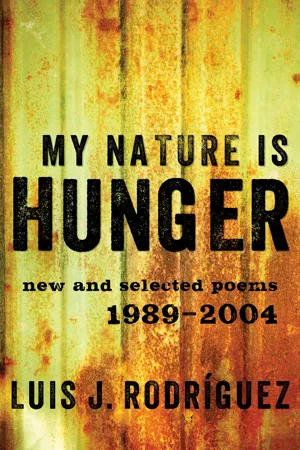
The collected poems of one of America's foremost balladeers of urban struggle and immigrant dreams
Over his three-decade career as a poet, novelist, and memoirist, Luis J. Rodríguez has earned acclaim for his remarkable ear for the voices of the city. My Nature Is Hunger represents the best of his lyrical work during his most prolific period as a poet, a time when he carefully documented the rarely heard voices of immigrants and the poor living on society's margins. For Rodríguez's subjects, the city is all-consuming, devouring lives, hopes, and the dreams of its citizens even as it flourishes with possibility. "Out of my severed body / the world has bloomed," and out of Rodríguez's stirring vision, so has beauty.
This ebook features an illustrated biography of Luis J. Rodríguez including rare images from the author's personal collection.
Information
Subtopic
PoetryIndex
Literaturefrom Trochemoche – 1998
Meeting the Animal in Washington Square Park
The acrobats were out in Washington Square Park,
flaying arms and colors—the jokers and break
dancers, the singers and mimes. I pulled out
of a reading at New York City College
and watched a crowd gather around a young man
jumping over 10 garbage cans from a skateboard.
Then out of the side of my eye I saw someone
who didn’t seem to belong here, like I didn’t
belong. He was a big man, six feet and more,
with tattoos on his arms, back, stomach and neck.
On his abdomen were the words in huge old English
lettering: Hazard. I knew this guy, I knew that place.
I looked closer. It had to be him. And it was—Animal!
From East L.A. World heavyweight contender.
The only Chicano from L.A. ever ranked
in the top ten of the division. The one who
went toe-to-toe with Leon Spinks and even
made Muhammad Ali look the other way.
Animal! I yelled. “Who the fuck are you?” he asked,
a quart of beer in his grasp, eyes squinting.
My name’s Louie—from East L.A. He brightened. “East L.A.!
Here in Washington Square Park? Man, we everywhere!”
Then the proverbial “what part of East L.A.?” came next.
But I gave him a shock. From La Geraghty, I said.
That’s the mortal enemy of the Big Hazard
gang. “I should kill you,” Animal replied.
Hey, if we were in L.A., I suppose you would
—but we in New York City, man.
“I should kill you anyway.”
Instead he thrust out his hand with the beer and offered
me a drink. We talked—about what had happened since he stopped
boxing. About the time I saw him at the Cleland House
arena looking over some up-and-coming fighters.
How he had been to prison and later ended up homeless
in New York City, with a couple of kids somewhere.
And there he was, with a mortal enemy from East L.A.,
talking away. I told him how I was now a poet,
doing a reading at City College, and he didn’t wince
or looked surprised. Seemed natural. Sure. A poet
from East L.A. That’s the way it should be. Poet
and boxer. Drinking beer. Among the homeless,
the tourists and acrobats. Mortal enemies.
When I told him I had to leave, he said “go then,”
but soon shook my hand, East LA. style, and walked off.
“Maybe, someday, you’ll do a poem about me, eh?”
Sure, Animal, that sounds great.
Someday, I’ll do a poem about you.
Victory, Victoria, My Beautiful Whisper
For Andrea Victoria
You are the daughter who is sleep’s beauty.
You are the woman who birthed my face.
You are a cloud creeping across the shadows,
drenching sorrows into heart-sea’s terrain.
Victory, Victoria, my beautiful whisper,
how as a baby you laughed into my neck
when I cried at your leaving
after your mother and I broke up;
how at age three you woke me up from stupid
so I would stop peeing into your toy box
in a stupor of resentment and beer;
and how later, at age five, when I moved in
with another woman who had a daughter about your age,
you asked: “How come she gets to live with Daddy?”
Muñeca, these words cannot traverse the stone
path of our distance; they cannot take back the thorns
of falling roses that greet your awakenings.
These words are from places too wild for hearts to gallop,
too cruel for illusions, too dead for your eternal
gathering of flowers. But here they are, weary offerings
from your appointed father, your anointed man-guide;
make of them your heart’s bed.
Catacombs
The concave view over desert groves
is maligned, dense with sacrifices
not to be believed.
A native face peers backward to time
and woman, gathering memory like
flowers on healing cactus.
Your eye is froth & formation, it is
rain of protocol you can’t relinquish
as water is wasted on sacred sand.
Across the turquoise rug, hexagon shapes.
I discover you, the howl of eternal mornings
while beckoning the blue from this sky,
while gesturing an infant from sleeping tree.
Sip the maguey juice from these mountains,
shear chaos from the catacombs:
forget and ferment the pain.
On the back of your hand, circles of flame.
to the police officer who refused to sit in the same room as my son because he’s a “gang banger”
For Ramiro
How dare you!
How dare you pull this mantle from your soiled
sleeve and think it worthy enough to cover my boy.
How dare you judge when you also wallow in this mud.
Society has turned over its power to you,
relinquishing its rule, turned it over
to the man in the mask, whose face never changes,
always distorts, who does not live where I live,
but commands the corners, who does not have to await
the nightmares, the street chants, the bullets,
the early-morning calls, but looks over at us
and demeans, calls us animals, not worthy
of his presence, and I have to say: How dare you!
My son deserves to live as all young people.
He deserves a future and a job. He deserves
contemplation. I can’t turn away as you.
Yet you govern us? Hear my son’s talk.
Hear his plea within his pronouncement,
his cry between the breach of his hard words.
My son speaks in two voices, one of a boy,
the other of a man. One is breaking through,
the other just hangs. Listen, you who can turn away,
who can make such a choice—you who have sons
of your own, but do not hear them!
My son has a face too dark, features too foreign,
a tongue too tangled, yet he reveals, he truths,
he sings your demented rage, but he sings.
You have nothing to rage because it is outside of you.
He is inside of me. His horror is mine. I see what
he sees. And if my son dreams, if he plays, if he smirks
in the mist of moon-glow, there I will be, smiling
through the blackened, cluttered and snarling pathway
toward your wilted heart.
A Tale of Los Lobos
One summer, to watch Los Lobos play,
I drove several hundred miles
from Chicago to Charleston,
West Virginia with three
Chicano buddies: Geronimo,
Mitch and Dario.
We got there in time to catch
a great concert. Afterwards,
we went backstage and talked
to the band members.
We told the band we’d see them
later at the honky tonk club
where they were expected to perform.
But they had to leave right away
and couldn’t make it.
We arrived at the club, sans Lobos,
and the place was packed.
I didn’t think there’d be a seat,
but soon someone directed us to a table
where three pitchers of beer stood
at attention on the varnished table top.
Great service, I thought. We sat down,
poured beers into frosty glasses,
and took in the down-home blues
emanating from the small, smoke-filled stage.
Before we finished the pitchers,
three more were brought over
(although nobody had asked for our money).
So we drank away, enjoying ourselves,
the only Mexicans in the place.
What gives? I asked. Geronimo, Mitch and Dario
shrugged their shoulders.
Soon many eyes turned our way.
Something’s up, I whispered,
look at the way everybody’s looking at us.
Sure enough, the band stopped and someone
at the mike asked us to come up to the stage.
“¡Que cabula!” Mitch exclaimed, “they think
we’re Los Lobos!”
Damn, man, I said, we don’t even look like them!
Geronimo stood up, said he was sorry
but we weren’t Los Lobos, and sat down.
Everything stopped. Incredulous stares
surrounded us. After an embarrassing
silence, the house band began
a slow number, than upped the tempo,
finally rocking the place
with harmonica-laden fervor.
Hijo de su, they believe us, I said.
“I don’t know,” Dario replied,
“I think they think we’re lying.”
One dude approached us:
“I know you’re Los Lobos;
you just don’t want to play, right?”
No, for reals, we ain’t them, I responded.
He winked and kept on walking.
When I went to the restroom,
a woman by the phone stopped me:
“I liked the way you played guitar
at the gig earlier.”
That wasn’t me, I explained.
“What I want to know,” the girl then asked,
“is how you got rid of the goatee so fast.”
I took my piss and rushed back to my seat.
Rumors that we were Los Lobos abounded.
Some shouted for us to get off it and perform.
“If we did,” Geronimo quipped, “Los Lobos
would never play this town again.”
I then noticed a bevy of West Virginia beauties,
local groupies, who followed the out-of-town
bands that landed here. They wouldn’t leave
even after we gave them expressions that said:
you’re nice, but we ain’t them!
One girl who sat directly behind me
had on a prom dress! She kept
ordering gin-and-tonics, waiting for a signal
from one of us, I presumed, for her
to join us at the table. We decided not to go
this route. Mitch figured we might have to scram
if people here concluded we had
insulted their fair city, club and women.
All our denials seemed pointless,
resulting in more knowing winks
as if they were all in on our little joke.
The pitchers kept coming,
the house band coaxed us up
once or twice,
and the groupies held on
like real troupers.
Finally, people began to depart.
The band packed up its instruments
and most of the girls had split.
Then just before our last beer,
a loud thump exploded behind me.
I turned. The girl in the party dress
had fallen over in her chair,
drunker than shit! We helped her back
on the stool. My partners and I
promptly left the club
as quietly as we could
on the night Los Lobos didn’t play
in Charleston, West Virginia.
Woman on the First Street Bridge
Traffic crawled for miles in front of me
and a similar number of miles behind.
Sandwiched between a truck-bed piled
with oil-soaked auto parts and a crumpled sedan,
I felt like melting beneath the peppered sun
as I inhaled the fetid fumes, scratched
my steaming eyeballs and crept toward
the concrete bridge facing the jagged s...
Table of contents
- Cover
- Title Page
- Dedication
- Contents
- Publisher’s Note
- from Poems Across the Pavement - 1989
- from The Concrete River - 1991
- from Trochemoche - 1998
- New Poems
- Acknowledgments
- A Biography of Luis J. Rodríguez
- Copyright
Trusted by 375,005 students
Access to over 1.5 million titles for a fair monthly price.
Study more efficiently using our study tools.
Frequently asked questions
Yes, you can cancel anytime from the Subscription tab in your account settings on the Perlego website. Your subscription will stay active until the end of your current billing period. Learn how to cancel your subscription
No, books cannot be downloaded as external files, such as PDFs, for use outside of Perlego. However, you can download books within the Perlego app for offline reading on mobile or tablet. Learn how to download books offline
Perlego offers two plans: Essential and Complete
- Essential is ideal for learners and professionals who enjoy exploring a wide range of subjects. Access the Essential Library with 800,000+ trusted titles and best-sellers across business, personal growth, and the humanities. Includes unlimited reading time and Standard Read Aloud voice.
- Complete: Perfect for advanced learners and researchers needing full, unrestricted access. Unlock 1.5M+ books across hundreds of subjects, including academic and specialized titles. The Complete Plan also includes advanced features like Premium Read Aloud and Research Assistant.
We are an online textbook subscription service, where you can get access to an entire online library for less than the price of a single book per month. With over 1.5 million books across 990+ topics, we’ve got you covered! Learn about our mission
Look out for the read-aloud symbol on your next book to see if you can listen to it. The read-aloud tool reads text aloud for you, highlighting the text as it is being read. You can pause it, speed it up and slow it down. Learn more about Read Aloud
Yes! You can use the Perlego app on both iOS and Android devices to read anytime, anywhere — even offline. Perfect for commutes or when you’re on the go.
Please note we cannot support devices running on iOS 13 and Android 7 or earlier. Learn more about using the app
Please note we cannot support devices running on iOS 13 and Android 7 or earlier. Learn more about using the app
Yes, you can access My Nature Is Hunger by Luis J. Rodríguez in PDF and/or ePUB format, as well as other popular books in Literature & Poetry. We have over 1.5 million books available in our catalogue for you to explore.