Renowned scholar George Steiner explores the power and presence of the unseen in art. "It takes someone of [his] stature to tackle this theme head-on" (
The New York Times).
There is a philosophical school of thought that believes the presence of God in art, literature, and music—in creativity in general—is a vacant metaphor, an eroded figure of speech, a ghost in humanity's common parlance. George Steiner posits the opposite—that any coherent understanding of language and art, any capacity to communicate meaning and feeling, is premised on God. In doing so, he argues against the kind of criticism that obscures, instead of elucidates, meaning. From the power of language to vital philosophical tenets,
Real Presences examines the role of meaning and of the spiritual in art throughout history and across cultures.
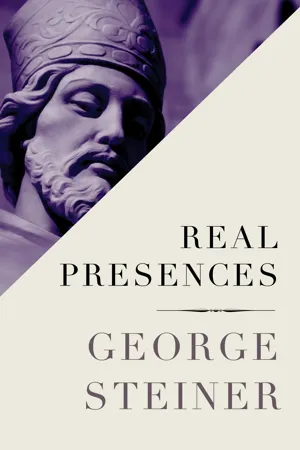
- 236 pages
- English
- ePUB (mobile friendly)
- Available on iOS & Android
eBook - ePub
Real Presences
About this book
Information
Topic
PhilosophySubtopic
Aesthetics in PhilosophyIII PRESENCES

1
There is language, there is art, because there is ‘the other’. We do address ourselves in constant soliloquy. But the medium of that soliloquy is that of public speech — foreshortened, perhaps made private and cryptic through covert reference and association, but grounded, nevertheless, and to the uncertain verge of consciousness, in an inherited, historically and socially determined vocabulary and grammar. Autistic inventions, solipsistic artefacts, are conceivable. The notion of a poet writing verse in a private tongue or of destroying what he has written, of a painter refusing to show any canvas to an eye other than his own, of a composer ‘performing’ his score in mute, purely inward audition, is conceivable. It figures in Gothic tales of isolation. And we do have record of masters who have hidden or laid waste their productions (Gogol burns the second half of Dead Souls). But they have done so precisely under pressure of the other’s intrusion. It is because the claims of the other’s presence reach so deeply into the final precincts of aloneness that a creator may, in circumstances of extremity, seek to guard for himself or for willed oblivion what are ineluctably, acts of communication and trials of encounter.
Why there should be the other and our relations to that otherness, be they theological, moral, social, erotic, be they those of intimate participation or irreconcilable difference, is a mystery both harsh and consoling. Goethe’s question, “How can I be when there is another?”, Nietzsche’s, “How can I exist if God does?”, stand unanswered. The desire for absolute singularity cannot be ruled out. But neither can the dread of solitude. The rapture of Narcissus is, tautologically, that of suicide. And Narcissus has no need of art. In him, utterance, fantastication, the making of an image, come home, fatally, to the closed self. On the edge of that perfect adequacy of selfhood, Descartes, in his third Meditation, calls upon the imperative likelihood of God in order to escape from the finality of aloneness.
It is out of the fact of confrontation, of affront in the literal sense of the term, that we communicate in words, that we externalize shapes and colours, that we emit organized sounds in the forms of music. “Mute inglorious Miltons” are distinctly possible in the concrete sense in which personal and social circumstances can muffle or even obliterate texts, paintings, compositions, in which ill fortune or abnegation can keep worthwhile work buried. But generally considered, there is no muteness in the poet. Whatever its stature, the poem speaks; it speaks out; it speaks to. The meaning, the existential modes of art, music and literature are functional within the experience of our meeting with the other. All aesthetics, all critical and hermeneutic discourse, is an attempt to clarify the paradox and opaqueness of that meeting as well as its felicities. The ideal of complete echo, of translucent reception is, exactly, that of the messianic. For in the messianic dispensation, every semantic motion and marker would become perfectly intelligible truth; it would have the life-naming, life-giving authority of great art when it reaches the one for whom it is uniquely intended — and here, ‘uniquely does not mean ‘solely’.
The unbounded diversities of formal articulation and stylistic construct correspond to the unbounded diversities of the modes of our meeting with the other. It is a commonplace of ethnography that early, ‘primitive’ art forms were meant to tempt towards domesticity, towards familiarity, the animal presences in the great dark of the outside world. Cave paintings are talismanic and propitiatory rites performed to make of the encounter with the teeming strangeness and menace of organic presences a source of mutual recognition and of benefit. The marvels of penetrative mimesis on the bison-walls at Lascaux are solicitations: they would draw the opaque and brute force of the ‘thereness’ of the non-human into the luminous ambush of representation and understanding. All representations, even the most abstract, infer a rendezvous with intelligibility or, at the least, with a strangeness attenuated, qualified by observance and willed form. Apprehension (the meeting with the other) signifies both fear and perception. The continuum between both, the modulation from one to the other, lie at the source of poetry and the arts.
But if much of poetry, music and the arts aims to ‘enchant’ — and we must never strip that word of its aura of magical summons — much also, and of the most compelling, aims to make strangeness in certain respects stranger. It would instruct us of the inviolate enigma of the otherness in things and in animate presences. Serious painting, music, literature or sculpture make palpable to us, as do no other means of communication, the unassuaged, unhoused instability and estrangement of our condition. We are, at key instants, strangers to ourselves, errant at the gates of our own psyche. We knock blindly at the doors of turbulence, of creativity, of inhibition within the terra incognita of our own selves. What is more unsettling: we can be, in ways almost unendurable to reason, strangers to those whom we would know best, by whom we would be best known and unmasked.
Beyond the strength of any other act of witness, literature and the arts tell of the obstinacies of the impenetrable, of the absolutely alien which we come up against in the labyrinth of intimacy. They tell of the Minotaur at the heart of love, of kinship, of uttermost confiding. It is the poet, the composer, the painter, it is the religious thinker and metaphysician when they give to their findings the persuasion of form, who instruct us that we are monads haunted by communion. They tell us of the irreducible weight of otherness, of enclosedness, in the texture and phenomenality of the material world. Only art can go some way towards making accessible, towards waking into some measure of communicability, the sheer inhuman otherness of matter — it haunted Kant — the retractions out of reach of rock and wood, of metal and of fibre (let the metal of a Brancusi figure sing to your hand). It is poetics, in the full sense, which inform us of the visitor’s visa in place and in time which defines our status as transients in a house of being whose foundations, whose future history, whose rationale — if any — lie wholly outside our will and comprehension. It is the capacity of the arts, in a definition which must, I believe, be allowed to include the living forms of the speculative (what tenable vision of poetics will exclude Plato, Pascal, Nietzsche?), to make us, if not at home, at least alertly, answerably peregrine in the unhousedness of our human circumstance. Without the arts, form would remain unmet and strangeness without speech in the silence of the stone.
Hence the immemorial logic of the relations between music, poetry and art on the one hand and the affront of death on the other. In death the intractable constancy of the other, of that on which we have no purchase, is given its most evident concentration. It is the facticity of death, a facticity wholly resistant to reason, to metaphor, to revelatory representation, which makes us ‘guest-workers’, frontaliers, in the boarding-houses of life. Where it engages, uncompromisingly, the issues of our condition, poetics seeks to elucidate the incommunicado of our meetings with death (in their terminal structure, narrations are rehearsals for death). However inspired, no poem, no painting, no musical piece — though music comes closest — can make us at home with death, let alone “weep it from its purpose”. But it is within the compass of the arts that the metaphor of resurrection is given the edge of felt conjecture. The central conceit of the artist that the work shall outlast his own death, the existential truth that great literature, painting, architecture, music have survived their creators, are not accidental or self-regarding. It is the lucid intensity of its meeting with death that generates in aesthetic forms that statement of vitality, of life-presence, which distinguishes serious thought and feeling from the trivial and the opportunistic.
At a dread cost of personal means, at a risk more unforgiving of failure than any other — the saint, the martyr know their elected destination — the artist, the poet, the thinker as shaper, seek out the encounter with otherness where such otherness is, in its blank essence, most inhuman. Why should death concede times of chosen meeting when we are, in fact, all on the same road towards it? Why should it grant the largesse of three roads meeting between Thebes and Delphi? Yet poetry and art compel it to do so. And they exercise, they give endurable form to that coercion still, as neither politics nor the sciences can.
A reflection on or (as German grammar allows) ‘a thinking of meetings, of encounters as instrumentalities of communication, comports a morality. An analysis of enunciation and of signification — the signal to the other — entails an ethics. It is this entailment which may provide the first step out of the house of mirrors which is that of modernist theory and practice.
The relations of ethics to poetics have, since Plato’s critique of the mendacities in Homer, been a source of fertile vexation. It is the merit of the Enlightenment, of Kant principally, to have sought to remove the domain of the aesthetic from that of systematic cognition on the one hand and from that of practical morality on the other. The Kantian postulate of the ‘disinterestedness’ of artistic and literary invention would distance the truth, the beauty, the liberties taken by the imaginary from the surveillance of moralistic criteria. This enfranchisement justly underlines the autonomous quality of the poetic act. It reminds us that the authenticity, the truth of motive in literature, in music, in the arts are indivisible from the executive form of the work, and that the verity of a poem or a painting is that of the specific internality and integrity of its shaping. The Kantian proposal of an extra-territoriality for the life of the arts is made both poignant and peremptory in Keats’s identification of truth with beauty and of beauty with truth. In so far as this equation and the Kantian concept of the special freedom of the poetic, of the disinterestedness of the fictive, help us to see more clearly the authority and singularity of the aesthetic experience, they are of eminent value. At the same time, however, any thesis that would, either theoretically or practically, put literature and the arts beyond good and evil is spurious.
The archaic torso in Rilke’s famous poem says to us: “change your life”. So do any poem, novel, play, painting, musical composition worth meeting. The voice of intelligible form, of the needs of direct address from which such form springs, asks: ‘What do you feel, what do you think of the possibilities of life, of the alternative shapes of being which are implicit in your experience of me, in our encounter?’ The indiscretion of serious art and literature and music is total. It queries the last privacies of our existence. This interrogation, like the winding of the sudden horn at the dark tower in Browning’s emblematic text of the seeking out of being by art, is no abstract dialectic. It purposes change. Early Greek thought identified the Muses with the arts and wonder of persuasion. As the act of the poet is met — and it is the full tenor and rites of this meeting which I would explore — as it enters the precincts, spatial and temporal, mental and physical, of our being, it brings with it a radical calling towards change. The waking, the enrichment, the complication, the darkening, the unsettling of sensibility and understanding which follow on our experience of art are incipient with action. Form is the root of performance. In a wholly fundamental, pragmatic sense, the poem, the statue, the sonata are not so much read, viewed or heard as they are lived. The encounter with the aesthetic is, together with certain modes of religious and of metaphysical experience, the most ‘ingressive’, transformative summons available to human experiencing. Again, the shorthand image is that of an Annunciation, of “a terrible beauty” or gravity breaking into the small house of our cautionary being. If we have heard rightly the wing-beat and provocation of that visit, the house is no longer habitable in quite the same way as it was before. A mastering intrusion has shifted the light (that is very precisely, non-mystically, the shift made visible in Fra Angelico’s Annunciation).
Such shifts are organically enfolded within categories of good and evil, of humane and inhumane conduct, of creative and destructive enactment. Any mature representation of imagined form, any mature endeavour to communicate such representation to another human being, is a moral act — where ‘moral’ can, unquestionably, include the articulation of sadism, of nihilism, of the bringing of unreason and despair. ‘Art for art’ is a tactical slogan, a necessary rebellion against philistine didacticism and political control. But pressed to its logical consequences, it is pure narcissism. The ‘purest’ work of art, the most abstemious from conceivable empirical instruction or appliance, is, by virtue of that very purity and abstention, a sharply political gesture, a value-statement of the most evident ethical import. We cannot touch on the experiencing of art in our personal and communal lives without touching, simultaneously, on moral issues of the most compelling and perplexing order. Are the resources of production, display and reception expended on the arts in a given political structure and economy justifiable (Tolstoy came to believe that they were not)? Do the identifications with fictions, the inner, tidal motions of pathos and libido which the novel, the film, the painting, the symphony unleash within us somehow immunize us against the humbler, less formed, but actual claims of suffering and of need in our surroundings? Does the cry in the tragic play muffle, even blot out, the cry in the street? (I confess to finding this an obsessive, almost maddening question.) Coleridge thought so: “Poetry excites us to artificial feelings — makes us callous to real ones.” What, if any, are the artist’ s responsibilities towards those whom his poems ‘sent out to be shot’ (Yeats) or, one must add, to shoot (Auden’s celebration of “the necessary murder”)? Are there any defensible limitations to the material, to the fantasies which literature, drama, painting or film can publish (can we conceive of serious art persuading our imaginings towards the torture or sexual abuse of children, a question made inescapable by certain moments in Dostoevsky)?
It is just because the persuasions to action in the aesthetic — most immediately if enigmatically in music — are so forceful, it is just because the fascinations and uprootings which images exercise on our conscious and subconscious motivations and springs of conduct are so far-reaching, that the question of constraint, of censorship, is, from Plato’s Republic to the present, a far more challenging one than liberal instinct would allow. Or to put it another way: does an artist bear any responsibility whatever for the misuse, abuse, barbarization of his inventions? Lukács held Wagner to be implicated, to the end of time, in the uses to which Nazism put his music. Not one note in Mozart, he argued, could be so used. To which, when I reported this dictum to Roger Sessions, that most philosophically acute of modern composers replied by playing the opening bars of the aria of the Queen of the Night in The Magic Flute.
No serious writer, composer, painter has ever doubted, even in moments of strategic aestheticism, that his work bears on good and evil, on the enhancement or diminution of the sum of humanity in man and the city. To imagine originally, to shape into significant expression, is to test in depth those potentialities of understanding and of conduct (“thrones, dominions, powers” as the rhetoric and architecture of the baroque have it) which are the life-substance of the ethical. A message is being sent; to a purpose. The style, the explicit figurations of that message may be perverse, they may intend the subjugation, even the ruin of the recipient. They may claim for themselves, as in Sade, as in the black paintings of Goya, as in the death-dance of Artaud, the sombre licence of the suicidal. But their pertinence to questions and consequences of an ethical order is the more palpable. Only trash, only kitsch and artefacts, texts, music which are produced solely for monetary or propagandistic ends do, indeed, transcend (transgress) morality. Theirs is the pornography of insignificance.
But the problem I want to clarify now is a more particular one, and often unobserved. It is not so much that of the morality or amorality of the work of meaning and of art. It is that of the ethics of its reception. What are the moral categories relevant to our meetings with the poem, with the painting or the musical construct? In what respect are certain moral motions of sensibility essential to the communicative act and to our apprehension of it? In Lorenzo Lotto’s Annunciation, one of the most unsettling, haunting versions we have of this inexhaustible theme, the Lady turns her back on the rushing radiance of the Messenger. That, too, is possible.
2
Oriental manuals of decorum, etiquette books of the European Renaissance and Enlightenment dwell on welcome. They detail the nuances of idiom and of gesture which define varying degrees and intensities of reception. They tell us how different social classes, genders, generations may meet appropriately. From such ceremonies of reciprocal perception, an axis of meaning extends into metaphysics and theology. It passes through models of translation in the fullest sense of that decisive but always problematic act. Translation comprises complex exercises of salutation, of reticence, of commerce between cultures, between tongues and modes of saying. A master translator can be defined as a perfect host. So far as it analyses the conditions of awareness and of intelligibility between the ego and the other, between the one and the many, so far as its means are those of question and response, of proposition and examination, philosophy systematizes intuitions, impulses of both encounter and valediction. There is much to be parted from at the interruption or close of the philosophic act of discourse and the study of such parting is crucial to Epicurean doctrine, to Hegel’s Phenomenology, to Wittgenstein’s Tractatus. A number of modern thinkers, Buber and Lévinas most notably, argue a theory of meaning based on literal envisaging, this is to say of the vision we have of the face, of the expressive ‘thereness’ of the other human person. The ‘open impenetrability’ of that visage, its alien yet confirmatory mirroring of our own, enact the intellectual and ethical challenge of the relations of man to man and of man to that which Lévinas terms ‘infinity’ (the potentialities of relationship are always inexhaustible).
Great poetry is animate with the rites of recognition. Odysseus proceeds from one recognition to the next in a voyage towards the self that is Ithaca. Dante recognizes the timbre of Brunetto Latini’s voice out of the ghost-smoke. Titania is “ill-met by moonlight”. In turn, religious thought and practice metaphorize, make narrative images of, the rendezvous of the human psyche with absolute otherness, with the strangeness of evil or the deeper strangeness of grace. Salutations are to be deciphered: in Jacob’s wrestling match and contest of nominations through the night, in the presence after presentness which is met on the road to Emmaus.
These intuitions and ceremonials of encounter, in social usage, in linguistic exchange, in philosophic and religious dialogue, are incisively pertinent to our reception of literature, of music and of the arts. They bear closely on our recognitions, on our entente (our hearing) of what the poem, the painting, the sonata would with us. We are the ‘other ones’ whom the living significations of the aesthetic seek out. It is on our capacities for welcome or refusal, for response or imperception, that their own necessities of echo and of presence largely depend. To think about why there should be painting or poetry or music at all — an order of matter and of being in which there would be none is perfectly conceivable — is to think about the kinds of entrance which we allow them or which they exact into the narrows of our individual existence.
Against the equation between text and commentary, making of aesthetic creation nothing but a ‘pre-text’, I want to test the instrumental force of the concept of courtesy. The root-strength ...
Table of contents
- Cover Page
- Title Page
- Dedication
- CONTENTS
- I A SECONDARY CITY
- II THE BROKEN CONTRACT
- III PRESENCES
- INDEX
- About the Author
- Copyright Page
Trusted by 375,005 students
Access to over 1.5 million titles for a fair monthly price.
Study more efficiently using our study tools.
Frequently asked questions
Yes, you can cancel anytime from the Subscription tab in your account settings on the Perlego website. Your subscription will stay active until the end of your current billing period. Learn how to cancel your subscription
No, books cannot be downloaded as external files, such as PDFs, for use outside of Perlego. However, you can download books within the Perlego app for offline reading on mobile or tablet. Learn how to download books offline
Perlego offers two plans: Essential and Complete
- Essential is ideal for learners and professionals who enjoy exploring a wide range of subjects. Access the Essential Library with 800,000+ trusted titles and best-sellers across business, personal growth, and the humanities. Includes unlimited reading time and Standard Read Aloud voice.
- Complete: Perfect for advanced learners and researchers needing full, unrestricted access. Unlock 1.5M+ books across hundreds of subjects, including academic and specialized titles. The Complete Plan also includes advanced features like Premium Read Aloud and Research Assistant.
We are an online textbook subscription service, where you can get access to an entire online library for less than the price of a single book per month. With over 1.5 million books across 990+ topics, we’ve got you covered! Learn about our mission
Look out for the read-aloud symbol on your next book to see if you can listen to it. The read-aloud tool reads text aloud for you, highlighting the text as it is being read. You can pause it, speed it up and slow it down. Learn more about Read Aloud
Yes! You can use the Perlego app on both iOS and Android devices to read anytime, anywhere — even offline. Perfect for commutes or when you’re on the go.
Please note we cannot support devices running on iOS 13 and Android 7 or earlier. Learn more about using the app
Please note we cannot support devices running on iOS 13 and Android 7 or earlier. Learn more about using the app
Yes, you can access Real Presences by George Steiner in PDF and/or ePUB format, as well as other popular books in Philosophy & Aesthetics in Philosophy. We have over 1.5 million books available in our catalogue for you to explore.