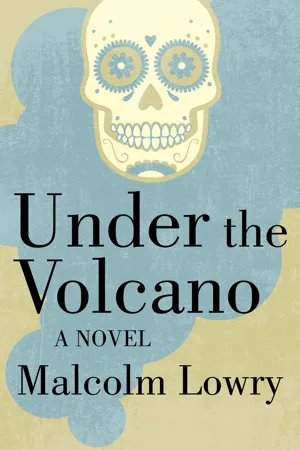
"Lowry's masterpiece" about a fateful Day of the Dead in a small Mexican town and one man's struggle against the forces threatening to destroy him (
Los Angeles Times).
In what the
New York Times calls "one of the towering novels of [the twentieth] century," former British consul Geoffrey Firmin lives alone with his demons in the shadow of two active volcanoes in South Central Mexico. Gripped by alcoholism, Geoffrey makes one last effort to salvage his crumbling life on the day that his ex-wife, Yvonne, arrives in town.
It's the Day of the Dead, 1938. The couple wants to revive their marriage and undo the wrongs of their past, but they soon realize that they've stumbled into the wrong place and time, where not only Geoffrey and Yvonne, but the world itself is on the edge of Armageddon.
Hailed by the Modern Library as one of the one hundred best English novels of the twentieth century,
Under the Volcano stands as an iconic and richly drawn example of the modern novel at its most lyrical.
- 416 pages
- English
- ePUB (mobile friendly)
- Available on iOS & Android
eBook - ePub
About this book
Information
Topic
LittératureSubtopic
Classiques1
TWO MOUNTAIN CHAINS TRAVERSE the republic roughly from north to south, forming between them a number of valleys and plateaus. Overlooking one of these valleys, which is dominated by two volcanoes, lies, six thousand feet above sea level, the town of Quauhnahuac. It is situated well south of the Tropic of Cancer, to be exact on the nineteenth parallel, in about the same latitude as the Revillagigedo Islands to the west in the Pacific, or very much further west, the southernmost tip of Hawaii—and as the port of Tzucox to the east on the Atlantic seaboard of Yucatán near the border of British Honduras, or very much further east, the town of Juggernaut, in India, on the Bay of Bengal.
The walls of the town, which is built on a hill, are high, the streets and lanes tortuous and broken, the roads winding. A fine American-style highway leads in from the north but is lost in its narrow streets and comes out a goat track. Quauhnahuac possesses eighteen churches and fifty-seven cantinas. It also boasts a golf course and no less than four hundred swimming pools, public and private, filled with the water that ceaselessly pours down from the mountains, and many splendid hotels.
The Hotel Casino de la Selva stands on a slightly higher hill just outside the town, near the railway station. It is built far back from the main highway and surrounded by gardens and terraces which command a spacious view in every direction. Palatial, a certain air of desolate splendour pervades it. For it is no longer a Casino. You may not even dice for drinks in the bar. The ghosts of ruined gamblers haunt it. No one ever seems to swim in the magnificent Olympic pool. The springboards stand empty and mournful. Its jai-alai courts are grass-grown and deserted. Two tennis courts only are kept up in the season.
Towards sunset on the Day of the Dead in November, 1939, two men in white flannels sat on the main terrace of the Casino drinking anís. They had been playing tennis, followed by billiards, and their racquets, rainproofed, screwed in their presses—the doctor’s triangular, the other’s quadrangular—lay on the parapet before them. As the processions winding from the cemetery down the hillside behind the hotel came closer the plangent sounds of their chanting were borne to the two men; they turned to watch the mourners, a little later to be visible only as the melancholy lights of their candles, circling among the distant, trussed cornstalks. Dr. Arturo Díaz Vigil pushed the bottle of Anís del Mono over to M. Jacques Laruelle, who now was leaning forward intently.
Slightly to the right and below them, below the gigantic red evening, whose reflection bled away in the deserted swimming pools scattered everywhere like so many mirages, lay the peace and sweetness of the town. It seemed peaceful enough from where they were sitting. Only if one listened intently, as M. Laruelle was doing now, could one distinguish a remote confused sound—distinct yet somehow inseparable from the minute murmuring, the tintinnabulation of the mourners—as of singing, rising and falling, and a steady trampling—the bangs and cries of the fiesta that had been going on all day.
M. Laruelle poured himself another anís. He was drinking anís because it reminded him of absinthe. A deep flush had suffused his face, and his hand trembled slightly over the bottle, from whose label a florid demon brandished a pitchfork at him.
“—I meant to persuade him to go away and get dealcoholisé,” Dr. Vigil was saying. He stumbled over the word in French and continued in English. “But I was so sick myself that day after the ball that I suffer, physical, really. That is very bad, for we doctors must comport ourselves like apostles. You remember, we played tennis that day too. Well, after I looked the Consul in his garden I sended a boy down to see if he would come for a few minutes and knock my door, I would appreciate it to him, if not, please write me a note, if drinking have not killed him already.”
M. Laruelle smiled.
“But they have gone,” the other went on, “and yes, I think to ask you too that day if you had looked him at his house.”
“He was at my house when you telephoned, Arturo.”
“Oh, I know, but we got so horrible drunkness that night before, so perfectamente borracho, that it seems to me, the Consul is as sick as I am.” Dr. Vigil shook his head. “Sickness is not only in body, but in that part used to be call: soul. Poor your friend, he spend his money on earth in such continuous tragedies.”
M. Laruelle finished his drink. He rose and went to the parapet; resting his hands one on each tennis racquet, he gazed down and around him: the abandoned jai-alai courts, their bastions covered with grass, the dead tennis courts, the fountain, quite near in the centre of the hotel avenue, where a cactus farmer had reined up his horse to drink. Two young Americans, a boy and a girl, had started a belated game of ping-pong on the verandah of the annex below. What had happened just a year ago to-day seemed already to belong in a different age. One would have thought the horrors of the present would have swallowed it up like a drop of water. It was not so. Though tragedy was in the process of becoming unreal and meaningless it seemed one was still permitted to remember the days when an individual life held some value and was not a mere misprint in a communiqué. He lit a cigarette. Far to his left, in the northeast, beyond the valley and the terraced foothills of the Sierra Madre Oriental, the two volcanoes, Popocatepetl and Ixtaccihuatl, rose clear and magnificent into the sunset. Nearer, perhaps ten miles distant, and on a lower level than the main valley, he made out the village of Tomalín, nestling behind the jungle, from which rose a thin blue scarf of illegal smoke, someone burning wood for carbon. Before him, on the other side of the American highway, spread fields and groves, through which meandered a river, and the Alcapancingo road. The watchtower of a prison rose over a wood between the river and the road which lost itself further on where the purple hills of a Doré Paradise sloped away into the distance. Over in the town the lights of Quauhnahuac’s one cinema, built on an incline and standing out sharply, suddenly came on, flickered off, came on again. “No se puede vivir sin amar,” M. Laruelle said …“As that estúpido inscribed on my house.”
“Come, amigo, throw away your mind,” Dr. Vigil said behind him.
“—But hombre, Yvonne came back! That’s what I shall never understand. She came back to the man!” M. Laruelle returned to the table where he poured himself and drank a glass of Tehuacan mineral water. He said:
“Salud y pesetas.”
“Y tiempo para gastarlas,” his friend returned thoughtfully.
M. Laruelle watched the doctor leaning back in the steamer chair, yawning, the handsome, impossibly handsome, dark, imperturbable Mexican face, the kind deep brown eyes, innocent too, like the eyes of those wistful beautiful Oaxaqueñan children one saw in Tehuantepec (that ideal spot where the women did the work while the men bathed in the river all day), the slender small hands and delicate wrists, upon the back of which it was almost a shock to see the sprinkling of coarse black hair. “I threw away my mind long ago, Arturo,” he said in English, withdrawing his cigarette from his mouth with refined nervous fingers on which he was aware he wore too many rings. “What I find more—” M. Laruelle noted the cigarette was out and gave himself another anís.
“Con permiso.” Dr. Vigil conjured a flaring lighter out of his pocket so swiftly it seemed it must have been already ignited there, that he had drawn a flame out of himself, the gesture and the igniting one movement; he held the light for M. Laruelle. “Did you never go to the church for the bereaved here,” he asked suddenly, “where is the Virgin for those who have nobody with?”
M. Laruelle shook his head.
“Nobody go there. Only those who have nobody them with,” the doctor said, slowly. He pocketed the lighter and looked at his watch, turning his wrist upwards with a neat flick. “Allons-nous-en,” he added, “vámonos,” and laughed yawningly with a series of nods that seemed to carry his body forward until his head was resting between his hands. Then he rose and joined M. Laruelle at the parapet, drawing deep breaths. “Ah, but this is the hour I love, with the sun coming down, when all the man began to sing and all the dogs to shark—”
M. Laruelle laughed. While they had been talking the sky had grown wild and stormy to the south; the mourners had left the slope of the hill. Sleepy vultures, high overhead, deployed downwind. “About eight-thirty then, I might go to the cine for an hour.”
“Bueno. I will see you this night then, in the place where you know. Remember, I still do not believe you are leaving tomorrow.” He held out his hand which M. Laruelle grasped firmly, loving him. “Try and come to-night, if not, please understand I am always interested in your health.”
“Hasta la vista.”
“Hasta la vista.”
—Alone, standing beside the highway down which he had driven four years before on the last mile of that long, insane, beautiful journey from Los Angeles, M. Laruelle also found it hard to believe he was really going. Then the thought of tomorrow seemed well-nigh overwhelming. He had paused, undecided which way to walk home, as the little overloaded bus, Tomalín: Zócalo, jounced past him downhill toward the barranca before climbing into Quauhnahuac. He was loth to take that same direction to-night. He crossed the street, making for the station. Although he would not be travelling by train the sense of departure, of its imminence, came heavily about him again as, childishly avoiding the locked points, he picked his path over the narrow-gauge lines. Light from the setting sun glanced off the oiltanks on the grass embankment beyond. The platform slept. The tracks were vacant, the signals up. There was little to suggest any train ever arrived at this station, let alone left it:
QUAUHNAHUAC
Yet a little less than a year ago the place had been the scene of a parting he would never forget. He had not liked the Consul’s half-brother at their first encounter when he’d come with Yvonne and the Consul himself to M. Laruelle’s house in the Calle Nicaragua, any more, he felt now, than Hugh had liked him. Hugh’s odd appearance—though such was the overwhelming effect of meeting Yvonne again, he did not obtain even the impression of oddity so strongly that he was able later in Parián immediately to recognize him—had merely seemed to caricature the Consul’s amiable half-bitter description of him. So this was the child M. Laruelle vaguely remembered hearing about years before! In half an hour he’d dismissed him as an irresponsible bore, a professional indoor Marxman, vain and self-conscious really, but affecting a romantic extroverted air. While Hugh, who for various reasons had certainly not been “prepared” by the Consul to meet M. Laruelle, doubtless saw him as an even more precious type of bore, the elderly aesthete, a confirmedly promiscuous bachelor, with a rather unctuous possessive manner toward women. But three sleepless nights later an eternity had been lived through: grief and bewilderment at an unassimilable catastrophe had drawn them together. In the hours which followed his response to Hugh’s telephone call from Parián M. Laruelle learned much about Hugh: his hopes, his fears, his self-deceptions, his despairs. When Hugh left, it was as if he had lost a son.
Careless of his tennis clothes, M. Laruelle climbed the embankment. Yet he was right, he told himself, as reaching the top he paused for breath, right, after the Consul had been “discovered” (though meantime the grotesquely pathetic situation had developed where there was not, on probably the first occasion when one had been so urgently needed, a British Consul in Quauhnahuac to appeal to), right in insisting Hugh should waive all conventional scruples and take every advantage of the curious reluctance of the “police” to hold him—their anxiety, it all but appeared, to be rid of him just when it seemed highly logical they should detain him as a witness, at least in one aspect of what now at a distance one could almost refer to as the “case”—and at the earliest possible moment join that ship providentially awaiting him at Vera Cruz. M. Laruelle looked back at the station; Hugh left a gap. In a sense he had decamped with the last of his illusions. For Hugh, at twenty-nine, still dreamed, even then, of changing the world (there was no other way of saying this) through his actions—just as Laruelle, at forty-two, had still then not quite given up hope of changing it through the great films he proposed somehow to make. But to-day these dreams seemed absurd and presumptuous. After all he had made great films as great films went in the past. And so far as he knew they had not changed the world in the slightest.—However he had acquired a certain identity with Hugh. Like Hugh he was going to Vera Cruz; and like Hugh too, he did not know if his ship would ever reach port …
M. Laruelle’s way led through half-cultivated fields bordered by narrow grass paths, trodden by cactus farmers coming home from work. It was thus far a favourite walk, though not taken since before the rains. The leaves of cacti attracted with their freshness; green trees shot by evening sunlight might have been weeping willows tossing in the gusty wind which had sprung up; a lake of yellow sunlight appeared in the distance below pretty hills like loaves. But there was something baleful now about the evening. Black clouds plunged up to the south. The sun poured molten glass on the fields. The volcanoes seemed terrifying in the wild sunset. M. Laruelle walked swiftly, in the good heavy tennis shoes he should have already packed, swinging his tennis racquet. A sense of fear had possessed him again, a sense of being, after all these years, and on his last day here, still a stranger. Four years, almost five, and he still felt like a wanderer on another planet. Not that that made it any the less hard to be leaving, even though he would soon, God willing, see Paris again. Ah well! He had few emotions about the war, save that it was bad. One side or the other would win. And in either case life would be hard. Though if the Allies lost it would be harder. And in either case one’s own battle would go on.
How continually, how startlingly, the landscape changed! Now the fields were full of stones: there was a row of dead trees. An abandoned plough, silhouetted against the sky, raised its arms to heaven in mute supplication; another planet, he reflected again, a strange planet where, if you looked a little further, beyond the Tres Marías, you would find every sort of landscape at once, the Cotswolds, Windermere, New Hampshire, the meadows of the Eure-et-Loire, even the grey dunes of Cheshire, even the Sahara, a planet upon which, in the twinkling of an eye, you could change climates, and, if you cared to think so, in the crossing of a highway, three civilisations; but beautiful, there was no denying its beauty, fatal or cleansing as it happened to be, the beauty of the Earthly Paradise itself.
Yet in the Earthly Paradise, what had he done? He had made few friends. He had acquired a Mexican mistress with whom he quarrelled, and numerous beautiful Mayan idols he would be unable to take out of the country, and he had—
M. Laruelle wondered if it was going to rain: it sometimes, though rarely, did at this time of year, as last year for instance, it rained when it should not. And those were storm clouds in the south. He imagined he could smell the rain, and it ran in his head he would enjoy nothing better than to get wet, soaked through to the skin, to walk on and on through this wild country in his clinging white flannels getting wetter and wetter and wetter. He watched the clouds: dark swift horses surging up the sky. A black storm breaking out of its season! That was what love was like, he thought; love which came too late. Only no sane calm succeeded it, as when the evening fragrance or slow sunlight and warmth returned to the surprised land! M. Laruelle hastened his steps still further. And let such love strike you dumb, blind, mad, dead—your fate would not be altered by your simile. Tonnerre de dieu … It slaked no thirst to say what love was like which came too late.
The town was almost directly to his right now and above him, for M. Laruelle had been walking gradually downhill since leaving the Casino de la Selva. From the field he was crossing he could see, over the trees on the slope of the hill, and beyond the dark castled shape of Cortez Palace, the slowly revolving Ferris wheel, already lit up, in the square of Quauhnahuac; he thought he could distinguish the sound of human laughter rising from its bright gondolas and, again, that faint intoxication of voices singing, diminishing, dying in the wind, inaudible finally. A despondent American tune, the St. Louis Blues, or some such, was borne across the fields to him, at times a soft windblown surge of music from which skimmed a spray of gabbling, that seemed not so much to break against as to be thumping the walls and towers of the outskirts; then with a moan it would be sucked back into the distance. He found himself in the lane that led away through the brewery to the Tomalín road. He came to the Alcapancingo road. A car was passing and as he waited, face averted, for the dust to subside, he recalled that time motoring with Yvonne and the Consul along the Mexican lake-bed, itself once the crater of a huge volcano, and saw again the horizon softened by dust, the buses whizzing past through the whirling dust, the shuddering boys standing on the backs of the lorries holding on for grim death, their faces bandaged against the dust (and there was a magnificence about this, he always felt, some symbolism for the future, for which such truly great preparation had been made by a heroic people, since all over Mexico one could see those thundering lorries with those young builders in them, standing erect, their trousers flapping hard, legs planted wide, firm) and in the sunlight, on the round hill, the lone section of dust advancing, the dust-darkened hills by the lake like islands in driving rain. The Consul, whose old house M. Laruelle now made out on the slope beyond the barranca, had seemed happy enough too then, wandering around Cholula with its three hundred and six churches and its two barber shops, the “Toilet” and the “Harem,” and climbing the ruined pyramid later, which he had proudly insisted was the original Tower of Babel. How admirably he had concealed what must have been the babel of his thoughts!
Two ragged Indians were approaching M. Laruelle through the dust; they were arguing, but with the profound concentration of university professors wandering in summer twilight through the Sorbonne. Their voices, the gestures of their refined grimy hands, were unbelievably courtly, delicate. Their carriage suggested the majesty of Aztec princes, their faces obscure sculpturings on Yucatecan ruins:
“—perfectamente borracho—”
“—completamente fantástico—”
“Sí, hombre, la vida impersonal—”
“Claro, hombre—”
“Positivamente!”
“Buenas noches.”
“Buenas noches.”
They passed into the dusk. The Ferris wheel sank from sight: the sounds of the fair, the music, instead of coming closer, had temporarily ceased. M. Laruelle looked into the west; a knight of old, with tennis racquet for shield and pocket torch for scrip, he dreamed a moment of battles the soul survived to wander there. He had intended turning down another lane to the right, that led past the model farm where the Casino de la Selva grazed its horses, directly into his street, the Calle Nicaragua. But on a sudden impulse he turned left along the road running by the prison. He felt an obscure desire on his last night to bid farewell to the ruin of Maximilian’s Palace.
To the south an immense archangel, black as thunder, beat up from the Pacific. And yet, after all, the storm contained its own secret calm … His passion for Yvonne (whether or not she’d ever been much good as an actress was beside the point, he’d told her the truth when he said she would have been more than good in any film he made) had brought back to his heart, in a way he could not have explained, the first time that alone, walking over the meadows from Saint Près, the sleepy French village of backwaters and locks and grey disused watermills where he was lodging, he had seen, rising slowly and wonderfully and with boundless beauty above the stubble fields blowing with wildflowers, slowly rising into the sunlight, as centuries before the pilgrims straying over those same fields had watched them rise, the twin spires of Chartres Cathedral. His love had brought a peace, for all too short a while, that was strangely like the enchantment, the spell, of Chartres itself, long ago, whose every sidestreet he had come to love and café where he could gaze at the Cathedral eternally sailing against the clouds, the spell not even the fact he was scandalously in debt there could break. M. Laruelle walked on swiftly toward the Palace. Nor had any remorse for the Consul’s plight broken that other spell fifteen years later here in Quauhnahuac! For that matter, M. Laruelle reflected, what had reunited the Consul and himself for a time, even after Yvonne left, was not, on either side, remorse. It was perhaps, partly, more the desire for that illusory comfort, about as satisfying as biting on an aching tooth, to be derived from the mutual unspoken pretense that Yvonne was still here.
—Ah, but all these things might have seemed a good enough reason for putting the whole earth between themselves and Quauhnahuac! Yet neither had done so. And now M. Laruelle could feel their burden pressing upon him from outside, as if somehow it had been transferred to these purple mountains all around him, so mysterious, with their secr...
Table of contents
- Cover
- Title Page
- Dedication
- Contents
- Chapter 1
- Chapter 2
- Chapter 3
- Chapter 4
- Chapter 5
- Chapter 6
- Chapter 7
- Chapter 8
- Chapter 9
- Chapter 10
- Chapter 11
- Chapter 12
- A Biography of Malcolm Lowry
- Copyright
Trusted by 375,005 students
Access to over 1.5 million titles for a fair monthly price.
Study more efficiently using our study tools.
Frequently asked questions
Yes, you can cancel anytime from the Subscription tab in your account settings on the Perlego website. Your subscription will stay active until the end of your current billing period. Learn how to cancel your subscription
No, books cannot be downloaded as external files, such as PDFs, for use outside of Perlego. However, you can download books within the Perlego app for offline reading on mobile or tablet. Learn how to download books offline
Perlego offers two plans: Essential and Complete
- Essential is ideal for learners and professionals who enjoy exploring a wide range of subjects. Access the Essential Library with 800,000+ trusted titles and best-sellers across business, personal growth, and the humanities. Includes unlimited reading time and Standard Read Aloud voice.
- Complete: Perfect for advanced learners and researchers needing full, unrestricted access. Unlock 1.5M+ books across hundreds of subjects, including academic and specialized titles. The Complete Plan also includes advanced features like Premium Read Aloud and Research Assistant.
We are an online textbook subscription service, where you can get access to an entire online library for less than the price of a single book per month. With over 1.5 million books across 990+ topics, we’ve got you covered! Learn about our mission
Look out for the read-aloud symbol on your next book to see if you can listen to it. The read-aloud tool reads text aloud for you, highlighting the text as it is being read. You can pause it, speed it up and slow it down. Learn more about Read Aloud
Yes! You can use the Perlego app on both iOS and Android devices to read anytime, anywhere — even offline. Perfect for commutes or when you’re on the go.
Please note we cannot support devices running on iOS 13 and Android 7 or earlier. Learn more about using the app
Please note we cannot support devices running on iOS 13 and Android 7 or earlier. Learn more about using the app
Yes, you can access Under the Volcano by Malcolm Lowry in PDF and/or ePUB format, as well as other popular books in Littérature & Classiques. We have over 1.5 million books available in our catalogue for you to explore.