The #1
New York Times–bestselling author of
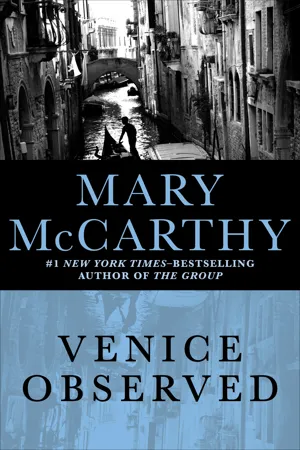
The Group takes readers on a captivating journey to one of the world's most celebrated cities.
Mary McCarthy brings her novelist's unerring eye to a book that blends art, politics, religion, music, and history to create a living portrait of "the world's loveliest city."
Like a painter capturing the city's essence on canvas, McCarthy uses words to create stunning visuals that bring both the old and new Venice to enchanting life. From her apartment overlooking the garden of a palazzo, McCarthy takes us into the museums and monasteries of this city of canals and gondolas, Machiavelli and Tintoretto. And she reveals some little-known facts: Venetians love pets, but prefer cats to dogs; during World War II, the Allies captured the city with a fleet of gondolas; and without Napoleon, Venice wouldn't be what it is today.
From the ancient roots of
The
Merchant of Venice's pound of flesh to the quotidian details of daily life, it's all here—the magnificent frescoes, the sublime music of Mozart, the virgins, and the saints. At once a comprehensive travelogue and a powerful piece of reportage,
Venice Observed is a testimony of McCarthy's love affair with the City of Canals.
This ebook features superb color reproductions of the works of Giorgione, Veronese, Titian, Canaletto, Guardo, Bellini, and Tiepolo, and an illustrated biography of Mary McCarthy including rare images from the author's estate.
- 158 pages
- English
- ePUB (mobile friendly)
- Available on iOS & Android
eBook - ePub
Venice Observed
About this book
Information
Subtopic
Italian HistoryIndex
History1
Venice Preserved
‘Venice at 8 to 9; went to Danielli’s [sic]. Saw St Mark’s, the Piazza, the Grand Canal and some churches: fine day—very picturesque—general effect fine—individual things not.’ Herbert Spencer in his diary, 1880.
‘Il disoit l’avoir trouvée autre qu’il ne l’avoit imaginée, et un peu moins admirable ... La police, la situation, l’arsenal, la place de S. Marc, et la presse des peuples étrangiers lui semblarent les choses plus remerquables.’ Michel de Montaigne in his Journal du Voyage en Italie, 1580–81.
THE RATIONALIST MIND HAS always had its doubts about Venice. The watery city receives a dry inspection, as though it were a myth for the credulous—poets and honeymooners. Montaigne, his servant recorded, ‘n’y trouva pas cete fameuse beauté qu’on attribue aus dames de Venise, et si vid les plus nobles de celles qui en font traffique.’ That famous beauty—the Frenchman sceptically sought it among the vaunted courtesans, who numbered 11,654 at the time of his visit. He had supper with the pearl of them all, no. 204 in the Catalogue of the Chief and Most Honoured Courtesans of Venice. ‘Le lundi à souper, 6 de novembre, la Signora Veronica Franco, janti fame venitiane, envoia vers lui pour lui presenter un petit livre de Lettres qu’elle a composé.’ It was evidently a literary evening. This Aspasia, at thirty-four, was retired from her profession and kept a salon frequented by poets and painters; she composed sonnets and letters and terza rima verses and had it in mind to write an epic poem. Henry III had visited her and brought back a report of her to France, together with two of her sonnets. But Montaigne was more impressed by the police and the high cost of living. ‘Les vivres y sont chers come à Paris’
That famous beauty—three hundred years later, the British philosopher, a bachelor, cocked a dubious eye at it in the touted palazzi. Everywhere he detected a ‘striving’ for the picturesque. He was particularly unimpressed by the leading examples: the little, leaning Palazzo Dario, in the Lombard style, with insets of porphyry and verd-antique, the Corner Spinelli, by Mauro Coducci, with its remarkable balconies, and the Ca’ Rezzonico, the baroque grey-columned prodigy begun by Longhena, in which the poet Browning was shortly to die. The Doge’s Palace exasperated Spencer to the point where he felt it necessary to hint bluntly at some general principles of architecture: ‘Dumpy arches of the lower tier of the Ducal Palace and the dumpy windows in the wall above ... the meaningless diaper pattern covering this wall, which suggests something woven rather than built; and the long row of projections and spikes surmounting the coping, which remind one of nothing so much as the vertebral spines of a fish.’ So much for the Doge’s Palace. ‘And what about St Mark’s? Well, I admit that it is a fine sample of barbaric architecture.’
Among Venice’s spells is one of peculiar potency: the power to awaken the philistine dozing in the sceptic’s breast. People of this kind—dry, prose people of superior intelligence—object to feeling what they are supposed to feel, in the presence of marvels. They wish to feel something else. The extreme of this position is to feel nothing. Such a case was Stendhal’s; Venice left him cold. He was there only a short time and departed with barely a comment to pursue an intrigue in Padua. Another lover of Italy, D. H. Lawrence (on one side of his nature, a debunker, a plain home-truth teller like Ruskin before him), put down his first reaction in a poem: ‘Abhorrent green, slippery city, Whose Doges were old and had ancient eyes ...’ And Gibbon ‘was afforded some hours of astonishment and some days of disgust by the spectacle of Venice.’
This grossly advertised wonder, this gold idol with clay feet, this trompe-l’oeil, this painted deception, this cliché—what intelligent iconoclast could fail to experience a destructive impulse in her presence? Ruskin, who was her overdue Jeremiah, and who came in the end to detest nearly everything in Venice, spent half his days trying to expose her frauds—climbing ladders in dusty churches to prove (what he had long suspected) that the Venetian Renaissance was a false front, a cynical trick, that the sleeping Doge Vendramin, for example, in marble effigy, atop his tomb in SS. Giovanni and Paolo was only a carven profile turned to the public: the other side, the side turned away from the public, being a vacancy, a featureless slab. Napoleon, Stendhal’s hero, went the whole way in brutal forthrightness, when he announced to the Venetian envoys, sent to treat diplomatically, his intention of shattering the image: ‘I have 80,000 men and twenty gunboats; io non voglio più Inquisitori, non voglio più Senato; sarò un Attila per lo stato Veneto.’
Io non voglio—a rude form of the verb, to wish. The phrase rings out, brazen, prophesying pillage: the sack of St Mark’s treasury, the rape of pictures for the Louvre, the agate-eyed, winged lion wrenched from his column on the quay to be carted off to the Invalides, the bronze horses of Nero hauled down from St Mark’s balcony to wait in front of the Tuileries until they could grace an arch of triumph on the Place du Carrousel.
The lion, damaged, came back. The horses came back. Their rape and return form simply another anecdote in the repertory of the guides of Venice, who drone it out in French, English and German, each to his flock of tourists herded in the Piazza between the three standards, where, on the eve of Napoleon’s appearance, the Tree of Liberty stood and a woman friend of Byron’s, the Countess Querini-Benzoni, la biondina in gondoleta, danced round it, dressed only in an Athenian tunic.
Napoleon’s prophecy came true, though not altogether in the sense he meant. He did become another Attila for Venice, that is, a figure in its touristic legend, another discountenanced invader, like the Genoese at Chioggia, like Pepin, whose army was engulfed in the lagoons and perished, according to tradition, as the Egyptians did in the Red Sea. Attila opened the story; refugees, fleeing from him on the mainland, sought safety on the fishing islets and began to build their improbable city, houses of wattles and twigs set on piles driven into the mud, ‘like sea-birds’ nests,’ wrote Cassiodorus, secretary of Theodoric, ‘half on sea and half on land and spread like the Cyclades over the surface of the waters.’ Napoleon closed the story, as he closed in the Piazza San Marco with the Fabbrica Nuova at the end, giving them—both square and narrative—their final, necessary form.
Without Napoleon, Venice would not be complete. Without Napoleon, the last Doge, Lodovico Manin (looking very much like a despondent housemaid in his portrait in the Museo Correr), could not have handed the ducal corno, tearfully, to a servant, saying, ‘I won’t be needing this any more.’ A pithy statement, in the matter-of-fact tradition of the noble Romans, from whom the Venetians claimed descent. And on the plebeian level, thanks to Napoleon, a gondolier had the last laugh. Examining Napoleon’s proclamation, which showed the armorial lion holding the Book, in which the old inscription, Pax tibi, Marce, Evangelista meus, was replaced by ‘The Rights of Men and Citizens,’ the gondolier is supposed to have commented, ‘At last he’s turned the page.’
But from Napoleon’s point of view, surely, that was just the trouble with Venice—the increment of childish history, of twice-told tales. The ducal bonnet, the Inquisitors, the Bocca del Leone, into which anonymous denunciations were slipped, the Doge’s golden umbrella, the Bucintoro, the Marriage of the Adriatic, the Ring, the Bridge of Sighs, Casanova, the Leads, Shylock, the Rialto, Titian, Tintoretto, les dames de Venise, the capture of the Body of St Mark, Lepanto, the pigeons, the pirates, the Taking of Constantinople, with the blind Doge Dandolo at ninety-five leading the attack, Marco Polo, the Queen of Cyprus, and (still yet to come!) Byron on the Lido on horseback, Byron swimming the Grand Canal, ‘Julian and Maddalo,’ Byron in the Armenian convent, Wagner in the Piazza listening to Tannhäuser played by the Austrian band; Wagner in the Palazzo Vendramin, Browning, D’Annunzio, Duse, and finally, last and first, the gondola, the eternal gondola, with its steel prow and its witty gondolier—to a ‘new man,’ a leveller, what insufferable tedium, what a stagnant canal-stench must have emanated from all this. ‘Non voglio più.’ When he announced that he would be an Attila, Napoleon’s irritation cannot have been purely political; it must have been an impatience, not so much with an obsolete, reactionary form of government, not so much even with the past (he was awed by the Sphinx and the Pyramids), as with an eternal present, with a city that had become a series of souvenirs and ‘views.’
Henry James, a lover of Venice, was familiar with the sensation. ‘The Venice of today is a vast museum where the little wicket that admits you is perpetually turning and creaking, and you march through the institution with a herd of fellow-gazers. There is nothing left to discover or describe, and originality of attitude is utterly impossible.’ After two weeks, he said, you began to feel as restless as though you were on shipboard, the Piazza figuring ‘as an enormous saloon and the Riva degli Schiavoni as a promenade deck.’
No stones are so trite as those of Venice, that is, precisely, so well worn. It has been part museum, part amusement park, living off the entrance fees of tourists, ever since the early eighteenth century, when its former sources of revenue ran dry. The carnival that lasted half a year was not just a spontaneous expression of Venetian license; it was a calculated tourist attraction. Francesco Guardi’s early ‘views’ were the postcards of that period. In the Venetian preserve, a thick bitter-sweet marmalade, tourism itself became a spicy ingredient, suited to the foreign taste; legends of dead tourists now are boiled up daily by gondoliers and guides. Byron’s desk, Gautier’s palace, Ruskin’s boarding house, the room where Browning died, Barbara Hutton’s plate-glass window—these memorabilia replace the Bucintoro or Paolo Sarpi’s statue as objects of interest. The Venetian crafts have become sideshows—glass-blowing, bead-stringing, lace-making; you watch the product made, like pink spun sugar at a circus, and bring a sample home, as a souvenir. Venetian manufactures today lay no claim to beauty or elegance, only to being ‘Venetian.’
And there is no use pretending that the tourist Venice is not the real Venice, which is possible with other cities—Rome or Florence or Naples. The tourist Venice is Venice: the gondolas, the sunsets, the changing light, Florian’s, Quadri’s, Torcello, Harry’s Bar, Murano, Burano, the pigeons, the glass beads, the vaporetto. Venice is a folding picture-post-card of itself. And though it is true (as is sometimes said, sententiously) that nearly two hundred thousand people live their ordinary working lives in Venice, they too exist in it as tourists or guides. Nearly every Venetian is an art-appreciator, a connoisseur of Venice, ready to talk of Tintoretto or to show you, at his own suggestion, the spiral staircase (said to challenge the void), to demonstrate the Venetian dialect or identify the sound of the Marangona, the bell of the Campanile, when it rings out at midnight.
A count shows the Tiepolo on the ceiling of his wife’s bedroom; a dentist shows his sitting-room, which was formerly a ridotto. Everything has been catalogued, with a pride that is more in the knowledge than in the thing itself. ‘A fake,’ genially says a gentleman, pointing to his Tintoretto. ‘Réjane’s,’ says a house-owner, pointing to the broken-down bed in the apartment she wants to let. The vanity of displaying knowledge can outweigh commercial motives or the vanity of ownership. ‘Eighteenth century?’ you say hopefully to an antique-dealer, as you look at a set of china. ‘No, nineteenth,’ he answers with firmness, losing the sale. In my apartment, I wish everything to be Venetian, but ‘No,’ says the landlady, as I ask about a cabinet: ‘Florentine.’ We stare at a big enthroned Madonna in the bedroom—very bad. She would like me to think it a Bellini and she measures the possibility against the art knowledge she estimates me to possess. ‘School of Giovanni Bellini,’ she announces, nonchalantly, extricating herself from the dilemma.
A Venetian nobleman has made a study of plants peculiar to Venice and shows slides on a projector. He has a library of thirty thousand volumes, mainly devoted to Venetian history. In the public libraries, in the wintertime the same set of loungers pores over Venetian archives or illustrated books on Venetian art; they move from the Correr library, when it closes, to the heatless Marciana, where they sit huddled in their overcoats, and finally to the Querini-Stampaglia, which stays open until late at night.
The Venetians catalogue everything, including themselves. ‘These grapes are brown,’ I complain to the young vegetable-dealer in Santa Maria Formosa. ‘What is wrong with that? I am brown,’ he replies. ‘I am the housemaid of the painter Vedova,’ says a maid, answering the telephone. ‘I am a Jew,’ begins a cross-eyed stranger who is next in line in a bakeshop. ‘Would you care to see the synagogue?’
Almost any Venetian, even a child, will abandon whatever he is doing in order to show you something. They do not merely give directions; they lead, or in some cases follow, to make sure you are still on the right way. Their great fear is that you will miss an artistic or ‘typical’ sight. A sacristan, who has already been tipped, will not let you leave until you have seen the last Palma Giovane. The ‘pope’ of the Chiesa dei Greci calls up to his housekeeper to throw his black hat out the window and settles it firmly on his broad brow so that he can lead us personally to the Archaeological Museum in the Piazza San Marco; he is afraid that, if he does not see to it, we shall miss the Greek statuary there.
This is Venetian courtesy. Foreigners who have lived here a long time dismiss it with the observation: ‘They have nothing else to do.’ But idleness here is alert, on the qui vive for the opportunity of sightseeing; nothing delights a born Venetian so much as a free gondola ride. When the funeral gondola, a great black-and-gold ornate hearse, draws up beside a fondamenta, it is an occasion for aesthetic pleasure. My neighbourhood was especially favoured in this way, because across the campo was the Old Men’s Home. Everyone has noticed the Venetian taste in shop-displays, which extends down to the poorest bargeman, who cuts his watermelons in half and shows them, pale pink, with green rims against the green side-canal, in which a pink palace with oleanders is reflected. Che hello, che magnifico, che luce, che colore!—they are all professori delle Belle Arti. And throughout the Veneto, in the old Venetian possessions, this internal tourism, this expertise, is rife. In Bassano, at the Civic Museum, I took the Mayor for the local art-critic until he interrupted his discourse on the jewel-tones (‘like Murano glass’) in the Bassani pastorals to look at his watch and cry out: ‘My citizens are calling me.’ Nearby, in a Palladian villa, a Venetian lady suspired, ‘Ah, bellissima,’ on being shown a hearthstool in the shape of a life-size stuffed leather pig. Harry’s Bar has a drink called a Tiziano, made of grapefruit juice and champagne and coloured pink with grenadine or bitters. ‘You ought to have a Tintoretto,’ someone remonstrated, and the proprietor regretted that he had not yet invented that drink, but he had a Bellini and a Giorgione.
When the Venetians stroll out in the evening, they do not avoid the Piazza San Marco, where the tourists are, as the Romans do with Doney’s on the Via Veneto. The Venetians go to look at the tourists, and the tourists look back at them. It is all for the ear and eye, this city, but primarily for the eye. Built on water, it is an endless succession of reflections and echoes, a mirroring. Contrary to popular belief, there are no back canals where a tourist will not meet himself, with a camera, in the person of the other tourist crossing the little bridge. And no word can be spoken in this city that is not an echo of something said before. ‘Mais c’est aussi cher que Paris!’ exclaims a Frenchman in a restaurant, unaware that he repeats Montaigne. The complaint against foreigners, voiced by a foreigner, chimes querulously through the ages, in unison with the medieval monk who found St Mark’s Square filled with ‘Turks, Libyans, Parthians, and other monsters of the sea.’ Today it is the Germans we complain of, and no doubt they complain of the Americans, in the same words.
Nothing can be said here (including this statement) that has not been said before. One often hears the Piazza described as an open-air drawing room; the observation goes back to Napoleon, who called it ‘the best drawing-room in Europe.’ A friend likens the ornamental coping of St Mark’s to sea foam, but Ruskin thought of this first: ‘... at last, as if in ecstasy, the crests of the arches break into a marbly foam, and toss themselves far into the blue sky in flashes and wreaths of sculptured spray ...’ Another friend observes that the gondolas are like hearses; I was struck by the novelty of the fancy until I found it, two days later, in Shelley: ‘that funereal bark.’ Now I find it everywhere. A young man, boarding the vaporetto, sighs that ‘Venice is so urban,’ a remark which at least sounds original and doubtless did when Proust spoke of the ‘always urban impression’ made by Venice in the midst of the sea. And the worst of it is that nearly all these clichés are true. It is true, for example, that St Mark’s at night looks like a painted stage flat; this is a fact which everybody notices and which everybody thinks he has discovered for himself. I blush to remember the sound of my own voice, clear in its own conceit, enunciating this proposition in the Piazza, nine years ago.
‘I envy you, writing about Venice,’ says the newcomer. ‘I pity you,’ says the old hand. One thing is certain. Sophistication, that modern kind of sophistication that begs to differ, to be paradoxical, to invert, is not a possible attitude in Venice. In time, this becomes the beauty of the place. One gives up the struggle and submits to a classic experience. One accepts the fact that what one is about to feel or say has not only been said before by Goethe or Musset but is on the tip of the tongue of the tourist from Iowa who is alighting in the Piazzetta with his wife in her furpiece and jewelled pin. Those Others, the existential enemy, are here identical with oneself. After a time in Venice, one comes to look with pity on the efforts of the newcomer to disassociate himself from the crowd. He has found a ‘little’ church—has he?—quite off the beaten track, a real gem, with inlaid coloured marbles on a soft dove grey, like a jewel box. He means Santa Maria dei Miracoli. As you name it, his face falls. It is so well known, then? Or has he the notion of counting the lions that look down from the window ledges of the palazzi? They remind him of cats. Has anybody ever noticed how many cats there are in Venice or compared them to the lions? On my table two books lie open with chapters on the Cats of Venice. My face had fallen too when I came upon them in the house of an old bookseller, for I too had dared think that I had hold of an original perception.
The cat = the lion. Venice is a kind of pun on itself, which is another way of saying that it is a mirror held up to its own shimmering image—the central conceit on which it has evolved. The Grand Canal is in the shape of a fish (or an eel, if you wish to be more literal); on the Piazzetta, St Theodore rides the crocodile (or the fish, if you prefer). Dolphins and scallop shells carry out the theme in decoration. It becomes frozen in the state ceremonial; the Doge weds the Adriatic in a mock, i.e., a punning, marriage. The lion enters the state myth in the company of the Evangelist and begets litter on litter of lions—all allusions, half jesting, half literary, to the original one: the great War Lion of the Arsenal gate whose Book (‘Peace be with you’) is ominously closed, the graduated lions from Greece below him, in front of the Arsenal, like the three bears in the story, the King of Beasts with uplifted tail in trompe-l’œil on the Scuola di San Marco, the red, roaring lions on the left of St Mark’s who play hobbyhorse for children every day, the lion of Chioggia, which Venetians say is only a cat, the doggy lion of the Porta della Carta being honoured by the Doge Foscari ... From St Mark’s Square, they spread out, in varying shapes and sizes, whiskered or clean-shaven, through Venice and her ancient territories, as far as Nauplia in the Peloponnesus. But St Mark’s lion is winged, i.e., a monster, and this produces a whole crop of monsters, basilisks and dragons, with their attendant saints and slayers, all dear to Venetian artists. St Jerome, thanks to his tame lion, becomes a favourite saint of the Venetians.
The twinning continues. The great pink church of the Frari is echoed on the other side of the city by the great pink church of the Dominicans, the other preaching order. And in St Mark’s shelter, near the Pietra del Bando, four small identical brothers, called the Moors, in porphyry embrace two and two, like orphans. The famous Venetian trompe-l’œil, marble stimulating brocade or flat simulating round, is itself a sort of twinning or unending duplication, as with a repeating decimal.
Venice is a game (see how many lions you can count; E. V. Lucas found 75 on the Porta della Carta alone), a fantasy, a fable, a city of Methuselahs, in which mortality has almost been vanquished. Titian, according to the old writers, was carried off by the plague in his hundredth year. How many Venetian painters can you count who, like him, passed three score and ten before they were gathe...
Table of contents
- Cover
- Title Page
- Contents
- 1. Venice Preserved
- 2. The Loot
- 3. A Pound of Flesh
- 4. The Monk
- 5. The Sands of Time
- 6. The Return of the Native
- 7. Col Tempo
- 8. Finale
- A Biography of Mary McCarthy
- Copyright
Trusted by 375,005 students
Access to over 1.5 million titles for a fair monthly price.
Study more efficiently using our study tools.
Frequently asked questions
Yes, you can cancel anytime from the Subscription tab in your account settings on the Perlego website. Your subscription will stay active until the end of your current billing period. Learn how to cancel your subscription
No, books cannot be downloaded as external files, such as PDFs, for use outside of Perlego. However, you can download books within the Perlego app for offline reading on mobile or tablet. Learn how to download books offline
Perlego offers two plans: Essential and Complete
- Essential is ideal for learners and professionals who enjoy exploring a wide range of subjects. Access the Essential Library with 800,000+ trusted titles and best-sellers across business, personal growth, and the humanities. Includes unlimited reading time and Standard Read Aloud voice.
- Complete: Perfect for advanced learners and researchers needing full, unrestricted access. Unlock 1.5M+ books across hundreds of subjects, including academic and specialized titles. The Complete Plan also includes advanced features like Premium Read Aloud and Research Assistant.
We are an online textbook subscription service, where you can get access to an entire online library for less than the price of a single book per month. With over 1.5 million books across 990+ topics, we’ve got you covered! Learn about our mission
Look out for the read-aloud symbol on your next book to see if you can listen to it. The read-aloud tool reads text aloud for you, highlighting the text as it is being read. You can pause it, speed it up and slow it down. Learn more about Read Aloud
Yes! You can use the Perlego app on both iOS and Android devices to read anytime, anywhere — even offline. Perfect for commutes or when you’re on the go.
Please note we cannot support devices running on iOS 13 and Android 7 or earlier. Learn more about using the app
Please note we cannot support devices running on iOS 13 and Android 7 or earlier. Learn more about using the app
Yes, you can access Venice Observed by Mary McCarthy in PDF and/or ePUB format, as well as other popular books in History & Italian History. We have over 1.5 million books available in our catalogue for you to explore.