"[An] intimate account of a Forward Air Controller working with the Special Forces on their secret operations in South Vietnam and Laos . . . Don't miss it!" (John Prados, author of
Storm Over Leyte).
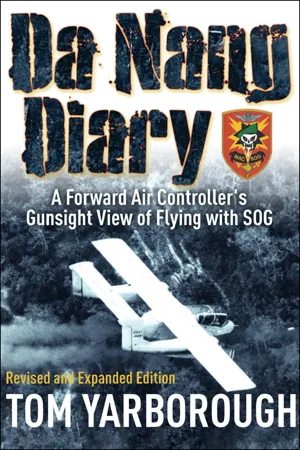
Originally published in 1991, this classic work has now been revised and updated with additional photos. It is the story of how, in Vietnam, an elite group of Air Force pilots fought a secret air war in Cessna 0-2 and OV-10 Bronco prop planes—flying as low as they could get. The eyes and ears of the fast-moving jets who rained death and destruction down on enemy positions, the forward air controller made an art form out of an air strike—knowing the targets, knowing where friendly troops were, and reacting with split-second, life-and-death decisions as a battle unfolded.
The expertise of the low, slow FACs, as well as the hazard attendant to their role, made for a unique bird's-eye perspective on how the entire war in Vietnam unfolded. For Tom Yarborough, who logged 1,500 hours of combat flying time, the risk was constant, intense, and electrifying. A member of the super-secret "Prairie Fire" unit, Yarborough became one of the most frequently shot-up pilots flying out of Da Nang—engaging in a series of dangerous secret missions in Laos. In this work, the reader flies in the cockpit alongside Yarborough in his adrenaline-pumping chronicle of heroism, danger, and wartime brotherhood. From the rescuing of downed pilots to taking out enemy positions, to the most harrowing extended missions directly overhead of the NVA, here is the dedication, courage and skill of the fliers who took the war into the enemy's backyard.
- 352 pages
- English
- ePUB (mobile friendly)
- Available on iOS & Android
eBook - ePub
About this book
Information
Subtopic
Military BiographiesIndex
HistoryCHAPTER 1
INDOCTRINATION OF A ROOKIE
- 4 April 1970: Waiting to catch the flight at Travis AFB that will take me to the war. One of the pilots in our group heard that an O-2 was shot down near Quang Ngai. The Jake FAC, Lt John Duffy, was KIA. So it starts.
- 21 April 1970: Just got the word. A Marine OV-10 at Da Nang got zapped by a 37mm and went down. Maj Gene Wheeler was KIA. His back-seater, Capt Chuck Hatch, managed to eject and was rescued.
- 22 April 1970: They keep coming. An O-2 jock flying out of Bien Hoa crashed on landing. No details, but the pilot survived.
- 29 April 1970: Two Issue FACs from Cu Chi bought it. Their OV-10 took a barrage of small arms fire and crashed. Neither Capt Wendell Brown nor Lt Jose Ortiz got out.
A gloved hand reached out and gently shook my right shoulder. Opening my eyes, I found myself staring into the boyish face of a young Air Force staff sergeant. “Sir,” he said, his left hand cupped against my right ear to block out the sound of the jet engines, “the aircraft commander says we’re getting ready to start our descent into Cam Ranh Bay. The jump seat’s all yours if you want it.”
“Thanks,” I answered groggily. “Tell your boss I’ll be right up as soon as I grab a cup of coffee.” The young load master smiled and shuffled off in his Nomex flight suit, trailing a long black cord connected to his headset and boom microphone, the other end attached somewhere inside the large C-141 jet transport aircraft.
On that April 19th morning, I stood up, stretched, and took a look around the interior that had been our home for the three hours since the predawn takeoff from Clark Air Base in the Philippines. Fifty or so military men sprawled sleepily in the rear-facing airliner seats. Behind the seats, toward the rear of the aircraft, three large pallets of cargo filled the remaining available space. An intricate weave of canvas webbing held the contents of each pallet neatly in position. There seemed to be boxes and crates of every size and description, all of it priority cargo headed for the war effort in South Vietnam. The fifty of us on board constituted the priority human cargo.
Standing there watching the other men sleep, I stole one last glance at the third pallet. Although partially obscured by the other pallets, there was no mistaking the distinctive shapes stacked three high—satin finished aluminum military caskets. I wanted to shift my gaze but couldn’t. The metal boxes held my eyes captive, and with no one watching me I stared at them shamelessly. The caskets represented an abstract concept I wasn’t prepared to confront, much less deal with. I was going to Vietnam as duty and honor demanded, to fulfill a military rite of passage and my trial by fire. But buying space in one of those caskets just couldn’t be my destiny; I could feel it with a fervor as passionate and intense as anything I had ever encountered. Then, with only the slightest hesitation, I snapped out of the momentary trance, turning away from the scene as easily as I might have switched channels on a television set.
As a young Air Force pilot anxious to get into combat before the war ended, I wasn’t at all sure where reality and my destiny would cross. The next few days would clarify where I would fit in. And fitting in was indeed quite problematic for those of us about to go into battle. At the macro level, the war had already ripped American society apart, and that same war had become far more about the United States than about Vietnam. While many of my civilian friends and contemporaries protested the war as immoral if not illegal, from my extremely limited geopolitical viewpoint I saw the fight as a vital component of America’s Cold War foreign policy of containment. From that perspective, the loss of South Vietnam to monolithic communism would threaten the security of the United States and the Western world—the beginning of the “Domino Theory.” Like many, I knew nothing about nascent nationalism or “wars of national liberation,” but I still vividly recalled President John F. Kennedy’s call to arms: “Let every nation know,” he said in his inaugural address, “whether it wishes us well or ill, that we shall pay any price, bear any burden, meet any hardship, support any friend, oppose any foe to assure the survival and the success of liberty.” To me, it still seemed like a noble cause.
Yet armed with ample historical precedent, our leaders had turned a blind eye to the French debacle in Indochina fifteen years earlier. And from all indications we Americans also turned a deaf ear to the warnings of French military intellectuals who eagerly pointed toward the disasters to come if we fought a conventional war using mainstream forces against Ho Chi Minh and his fanatic followers, seasoned foes bent on fighting a protracted guerrilla war and willing to absorb enormous casualties to achieve their goals. Prophetically, as in the case of General Henri Navarre and his French Far East Expeditionary Force, the war in 1954 Indochina had become very unpopular with French citizenry when the indecisiveness of the Fourth Republic signaled that France was both politically and militarily unable to extract itself from the conflict. As for the United States, we initially sought to remain neutral, viewing the conflict as chiefly a “decolonization war” between France and the Viet Minh. Nevertheless, the French experience in their war was significant if for no other reason than it demonstrated the ominous reality that a Western colonial power could indeed be defeated by a third-world, indigenous revolutionary force, or that God forbid, a super power could be cowed by a peasant army. And while France may have glimpsed a foreshadowing of our fate, none of it filtered down to the working level—to my level. As a young pilot I glossed over the rather murky national security policy issues and facts; my job was to fly and to fight. In the meantime, one fact was perfectly clear: in April 1970 there was a lot of war raging all across Vietnam. In spite of President Richard Nixon’s policy of “Vietnamization,” meant to transfer the fight back over to the South Vietnamese, there were still 429,000 U.S. combat troops in South Vietnam. As a forward air controller about to be stationed right in the middle of the war, I felt certain I would see my share of the fighting.
A jumble of additional thoughts ricocheted around in my psyche as the flight toward Vietnam droned on. The trip aboard the C-141 cargo jet was the final leg of a journey that started on a chartered Trans International Airlines DC-8 at Travis Air Force Base, California, carrying all of us to Clark Air Base, about forty miles north of Manila. And for good reason I kept thinking about Jungle Survival School in the Philippines—referred to by aircrews as “Snake School.” The instructors there dramatically informed us, “Ninety-seven percent of the snakes in Vietnam are deadly poisonous, and the other three percent will eat you.” Talk about being isolated in a parallel universe. We had been trekking through the jungle and were completely unaware of the drama surrounding the Apollo 13 moon mission. It was an event that had the whole planet holding its collective breath, and we missed it! Could that be a foreshadowing of the isolation that came with a combat tour in Vietnam?
I also caught myself reflecting on our final afternoon at Clark Air Base. Several of us were sitting on the officers’ club patio drinking beer and watching a bevy of Air Force nurses splash around in the swimming pool when suddenly the lamp posts began shaking, the stone patio started undulating, and some folks shouted, “Earthquake!” It only lasted a few seconds, but it got me to thinking: the world of Southeast Asia we were being plunged into was so strange and exotic, so different from anything I had ever encountered. How was it possible for the Air Force to train us for the upcoming year-long immersion? More importantly, had they done a good job?
Walking toward the flight deck, my ears popped as the cabin altitude surged, probably because the pilot had reduced power to start the en route descent into our destination. As I climbed into the jump seat between and just behind the two pilot seats, the flight engineer handed me a headset. When I was wired for sound, the pilot pointed to the TACAN gauge and announced, “We’re 180 miles out of Cam Ranh, descending through flight level three-one-zero. We should be on the deck in about thirty minutes. This your first time in-country?” Without waiting for a reply, the aircraft commander continued, “Somebody on the crew told me you’re gonna be a FAC. Sporty job. Let me be the first to welcome you to the war.”
With that the pilot turned back to the controls and began hand flying the big silver Starlifter toward the approach and landing at Cam Ranh Bay, one of the key aerial/naval supply ports in Southeast Asia. As we approached to within a few miles of the runway, the high-pitched whine of the hydraulic pumps told me the copilot must have activated the landing gear and flap levers. Slowing to 140 knots, the pilot picked up a two-and-a-half degree visual glide slope and deftly planted us on the centerline of the big runway, a little over three hours after our “oh-dark-thirty” departure from Clark Air Base.
There were no jet ways at Cam Ranh. I found myself being herded down a set of troop stairs at the front door of the big C-141. The first sensation to hit me was the blast furnace heat and dripping humidity, an assault on the senses that left me clutching the rail for fear of fainting. Inside, the shabby terminal proved to be only slightly less warm. There was no air conditioning; large overhead fans circulated the steamy air. Waiting in the makeshift passenger terminal for my B-4 bag, I hid my nervousness and apprehension by watching the steady stream of soldiers, referred to as “grunts,” milling around. Most wore soiled, sweat-stained fatigues and “boonie” hats. A few were even covered with red clay which had dried to dust. It was obvious they had just come in from the bush, the infantryman’s pet name for the jungle. To me they all looked mean and irritable, though they should have looked happy: they were leaving Vietnam. In terms of numbers, the departing troops equaled the well-dressed, well-scrubbed new arrivals, and if the scene in the passenger terminal represented the U.S. troop draw down, the plan was already in trouble—I seemed to be part of a one-for-one swap.
A passenger service NCO rounded up all the new FACs and drove us to the 504th Tactical Air Support Group headquarters. In a small, stuffy briefing room, the young Air Force major standing before the group of new FACs made a lasting impression. Looking professional yet relaxed, he fit my mental image of a Vietnam combat veteran: suntanned, short blond hair, a faded K-2B flight suit with subdued black rank insignia, pilot wings, and name tag. To me, the most striking visual cue of all was that he sported well-worn jungle combat boots with olive-drab colored mesh inserts, not the plain black leather boots that marked the twenty of us in the briefing room as new guys and rookies. All of us felt a strange combination of envy and anxiety as we watched the major deliver his welcome briefing. In front of us stood a combat-ready forward air controller who knew what being shot at felt like, who had probably handled air strikes all over Vietnam against enemy positions just a few yards from friendly troops. Watching him stand beside the rostrum, I couldn’t help wondering how I would react to actual combat. The bottom line was that he had been there, we hadn’t. Our briefer’s attitude suggested arrogance and superiority, and the intimidation, at least for me, was unspoken but very real. As I sat there staring at the young major, it occurred to me that he had a striking resemblance to one of my childhood mythical heroes, “Steve Canyon,” the All-American comic-strip pilot created by Milton Caniff.
“Okay, gents,” he said, hands on hips, looking supremely confident. “I know you’re all tired from Snake School at Clark and from chasing women on Fields Avenue in Angeles City, but now you start earning your sixty-five dollars a month combat pay.” The briefer went on to tell us that while at Cam Ranh, the 504th Tactical Air Support Group would be our temporary home. The Group owned all FACs in Southeast Asia, so after five days of indoctrination, we’d be assigned to one of the FAC squadrons. Most of us would stay in-country with either the 19th, 20th, 21st, or 22nd Tactical Air Support Squadrons, TASS for short. A few lucky souls would be on their way to a hardship tour with the 23rd TASS at Nakhon Phanom, Thailand. At that point our briefer shocked all of us with an announcement: “Before we really get into the assignment thing, let’s see what you guys know about the vocabulary of the trade in South Vietnam. I just happen to have a short pop quiz for you—a real chance for you to excel.”
The briefing room echoed with groans of disbelief and protest. Some major sitting near the front piped up with a very rude, “You gotta be shitting me!” The briefer flashed his best “Steve Canyon” smile and passed around mimeographed sheets. The questions, about ten of them, were actually terms for which we were to supply definitions or explanations. I knew one or two of them and could guess at a few more, but on the rest I drew a complete blank. My ignorance made me laugh out loud. If my future assignment in any way hinged on the results of the test, I was destined to spend a year in the grungiest hellhole in Vietnam. Looking over the terms, I had seen Morley Safer from CBS News broadcast from “War Zone C,” but I couldn’t remember exactly what or where it was. VNAF was easy—the South Vietnamese Air Force, but “playmate” baffled me. I assumed “Panama” didn’t refer to the country but had no idea what it was, and there was no telling what “QC” signified or what “Dust-Off” meant. To my embarrassment I had never even heard of the “U Minh Forest.”
After the quiz we all breathed a collective sigh of relief when “Steve Canyon” informed us that it wouldn’t count; we didn’t have to put our names on the test. Had he stopped right there, his point—we were green and ignorant—would have been made. Instead, he looked slowly around the room for dramatic effect then announced in deliberate, clipped words, “This little exercise was meaningless as a test. Its real purpose is to bring you prima donnas back down to earth, to take the wind out of your sails, and to prove to a bunch of cocky pilots that you really don’t know as much about fighting this war as you think you do.”
He lost me at that moment. Here we were, our first day in Vietnam, crammed into school desks designed for sixth graders. Our black boots were an embarrassment, and our flight suits, covered with regulation Tactical Air Command insignia and unit patches containing every color of the rainbow, marked us as being right off the plane from the States. We all knew we were novices and just wanted to shed our new-guy image and blend in. The major was our bridge; he had the answers but apparently had no intention of sharing them with us. As if we didn’t already sense the gulf between old heads and rookies, he seemed to enjoy making us feel like FNGs—fucking new guys.
The briefing droned on for another fifteen minutes, but I tuned it out. All I could think about was getting over to Supply and drawing my jungle boots and subdued black rank and wings. Then some irrational compulsion would probably force me to find the nearest tailor shop and bribe someone to sew the insignia on while I waited. It was all very unsettling. This was my first day in a war, so how could I be so totally absorbed with something so trivial as insignia and boots? All other explanations aside, it came down to one selfish notion: I may not have been a combat veteran, but I sure wanted to look like one.
“Steve Canyon” was one of many briefers we endured that day—April 19, 1970. An assortment of colonels, intelligence specialists, administrative clerks, and finance wizards trooped across the stage in succession, each of them intent on convincing us that his bailiwick was the real reason the war was being waged. But the grand prize for the day went to the medics. A kindly looking Air Force flight surgeon took the podium just before lunch. He had silver hair and wore gold wire-rimmed glasses. He projected a great fatherly image but seemed too old to be only a captain. While several of us commented under our breaths about how many times he’d been passed over for promotion, he turned on the 35mm projector and flashed the first slide on the screen. The room instantly fell silent. There before us we saw a sickening photograph of what appeared to be a man’s genitals, turned purple and literally rotting off. Slide after slide followed, each more graphic and grotesque than the one before. The flight surgeon rambled on about the social diseases rampant in Southeast Asia, but he needn’t have. If ever a picture was worth a thousand words, there it was, in living color.
The doc wound up his presentation as all the other briefers had, with a slide of a gorgeous, naked, large-breasted young lady right out of the pages of Playboy. When the oohs and aahs died down, the doc smiled and said, “Gentlemen, this is what you’re fighting for.” Loud applause filled the briefing room. He continued, “If you’re gonna fool around, do it with a round-eye like this.”
One of the lieutenants called out, “You get me that woman and I’ll fool around as much as you want!”
After the laughter stopped, the doc continued. “Don’t get mixed up with the local Vietnamese women. When the horny factor starts to take over your intellect, try to remember the pictures I’ve shown you today, and then ask yourself if it’s worth it. For those of you who will totally disregard the things that I’ve said, don’t wait too long to come see us. We’ll probably say we told you so, fill your ass full of penicillin, then send you back to duty.” Nervous laughter greeted his prediction. He ended with, “Any questions? If not, let’s break for lunch.”
Following the doc’s show-and-tell our appetites weren’t very keen, but we wandered over to the dining hall just to see where it was. After waiting in line for a few minutes, I was the first of the new pilots to reach the cashier table. An airman first class, obviously bored with the whole process, demanded sixty-five cents. When I handed him a crisp one-dollar bill, the world came crashing down. The airman turned red with anger and shouted, “Jesus Christ, what are you trying to do to me? I can’t take green. Scrip! Don’t you have any scrip, you know, MPC—military payment certificates?” From the blank look on my face the airman must have sensed my dilemma. In a calm but sarcastic tone he continued the tongue-lashing. “Jesus, don’t tell me you’re one of the new turkeys from the 504th. We’ve told them a dozen times to convert your money before you clowns come to the dining hall. Why can’t they get it right?”
Just as I was about to stammer out some kind of explanation, a crusty old major named Mac, who’d been with us throughout the pipeline training preparing us for duty in Southeast Asia, stepped forward. Mac scruffed his short-cropped red hair with his fist, wrinkled his forehead into a hundred deep furrows, then fixed the mouthy young airman with a glare that would have frightened Boris Karloff.
“Let us through this line right now or I’ll personally kill you where you sit. Then I’ll court-martial your dead ass and send it home to your mother in a body bag with a dishonorable discharge! So what’s it gonna be, son? You gonna let us through the line, yes or no?” The airman simply nodded in the affirmative, and Mac replied, “Wise choice. Just put this on my tab.” With that, we eased down the cafeteria line and loaded our trays, not out of hunger but out of spite for dining hall bureaucracy.
That night, our first in Vietnam, several other new FACs joined me for dinner at a Navy club right along the beach. The ocean breeze tempered the tropic heat, so all in all it was a very pleasant evening. We might have been sitting anywhere in the States having a few beers and talking over old times. But as night began to fall, the immediacy of the war crept back into my conscious thoughts. I kept thinking about one of the briefings that afternoon when the group intelligence officer relayed the story from April 1st when several Viet Cong sappers had attacked a fuel tank farm at C...
Table of contents
- Cover
- Title Page
- Contents
- Introduction
- Prologue: June 30, 1970
- Map: Area of Operations
- 1. Indoctrination of a Rookie
- 2. Across the Fence
- 3. X-Ray Mission: Laos
- 4. Prairie Fire
- 5. Rescue at Route 966
- 6. Lessons in Judgment
- 7. Standing Up in a Hammock
- 8. Outside the Envelope
- 9. The Covey Bomb Dump
- 10. All Points of the Compass
- 11. Valley of the Shadow of Death
- 12. SAR on the Trail
- 13. The Year of Fifty-Three Weeks
- Epilogue: August 15, 1973
- Image Gallery
- Where Are They Now?
- Glossary
- Bibliography
- Copyright
Trusted by 375,005 students
Access to over 1.5 million titles for a fair monthly price.
Study more efficiently using our study tools.
Frequently asked questions
Yes, you can cancel anytime from the Subscription tab in your account settings on the Perlego website. Your subscription will stay active until the end of your current billing period. Learn how to cancel your subscription
No, books cannot be downloaded as external files, such as PDFs, for use outside of Perlego. However, you can download books within the Perlego app for offline reading on mobile or tablet. Learn how to download books offline
Perlego offers two plans: Essential and Complete
- Essential is ideal for learners and professionals who enjoy exploring a wide range of subjects. Access the Essential Library with 800,000+ trusted titles and best-sellers across business, personal growth, and the humanities. Includes unlimited reading time and Standard Read Aloud voice.
- Complete: Perfect for advanced learners and researchers needing full, unrestricted access. Unlock 1.5M+ books across hundreds of subjects, including academic and specialized titles. The Complete Plan also includes advanced features like Premium Read Aloud and Research Assistant.
We are an online textbook subscription service, where you can get access to an entire online library for less than the price of a single book per month. With over 1.5 million books across 990+ topics, we’ve got you covered! Learn about our mission
Look out for the read-aloud symbol on your next book to see if you can listen to it. The read-aloud tool reads text aloud for you, highlighting the text as it is being read. You can pause it, speed it up and slow it down. Learn more about Read Aloud
Yes! You can use the Perlego app on both iOS and Android devices to read anytime, anywhere — even offline. Perfect for commutes or when you’re on the go.
Please note we cannot support devices running on iOS 13 and Android 7 or earlier. Learn more about using the app
Please note we cannot support devices running on iOS 13 and Android 7 or earlier. Learn more about using the app
Yes, you can access Da Nang Diary by Tom Yarborough in PDF and/or ePUB format, as well as other popular books in History & Military Biographies. We have over 1.5 million books available in our catalogue for you to explore.