From the bestselling author of
Tracks: A travel writer's memoir of her year with the nomadic Rabari tribe on the border between Pakistan and India.
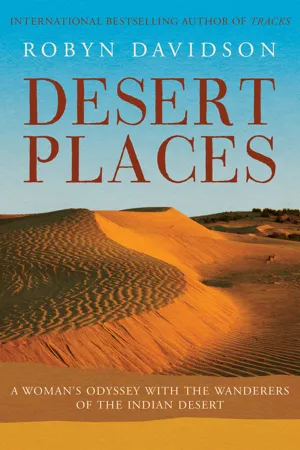
India's Thar Desert has been the home of the Rabari herders for thousands of years. In 1990, Australian Robyn Davidson, "as natural a travel writer as she is an adventurer," spent a year with the Rabari, whose livelihood is increasingly endangered by India's rapid development (
The New Yorker). Enduring the daily hardships of life in the desert while immersed in the austere beauty of the arid landscape, Davidson subsisted on a diet of goat milk, roti, and parasite-infested water. She collided with India's rigid caste system and cultural idiosyncrasies, confronted extreme sleep deprivation, and fought feelings of alienation amid the nation's isolated rural peoples—finding both intense suffering and a renewed sense of beauty and belonging among the Rabari family.
Rich with detail and honest in its depictions of cultural differences,
Desert Places is an unforgettable story of fortitude in the face of struggle and an ode to the rapidly disappearing way of life of the herders of northwestern India. "Davidson will both disturb and exhilarate readers with the acuity of her observations, the sting of her wit, and the candor of her emotions" (
Booklist).
- 280 pages
- English
- ePUB (mobile friendly)
- Available on iOS & Android
eBook - ePub
About this book
Information
Subtopic
Social Science BiographiesIndex
Social SciencesPart One
False Starts

Prelude
MEMORY IS A CAPRICIOUS thing. The India I visited in 1978 consists of images of doubtful authenticity held together in a ground of forgetfulness. I don’t know how or why I ended up in the medieval lanes of Pushkar, in Rajasthan, during one of the most important festivals in the Hindu calendar. But I’m almost sure I was the only European around.
The crowd was a deluge drowning individual will. It unmoored things from their meanings. Turbans and tinsel, cow horns lyre-shaped and painted blue, the fangs of a monkey, eyes thumbed with kohl looking into my own before bobbing under the torrent, a corner of something carved in stone, hands clutching a red veil, a dacoit playing an Arabian scale on his flute, his yards of moustache coiled in concentric circles on his cheeks—all these elements sinking and reappearing, breaking and recombining, borne along by the will of the crowd in which a whirlpool was forming, sucking me to its centre.
A beggar was lying on his back. His legs were broken and folded, permanently, into his groin. He moved sideways along the lane, using the articulations of his spine, through garbage and faeces, drawing his flotsam along with him, rolling his eyes backwards in his head and muttering mantras, or perhaps nonsense. He wore a white dhoti and his body was whitened with ash. His turban was parrot green and I think I remember make-up on his face, though I may have painted it on afterwards. A parrot took coins from the tentacles of arms swirling above it and placed them in a bowl on its master’s stomach. I breasted through the crowd, past the limbs of street sleepers jumbled in shadows, hindered by hands and imprecations, out at last to air.
You can walk for months in Australia without meeting a single human. Thousands of miles empty of footprints, unburdened by history’s mistakes. Through an association with the original inhabitants I had learnt to see that wilderness as a garden—man’s primordial home before the plough. The tracks of the ancestors mapped it and gave it meaning so that however far an individual might travel from the place of origin, in the deepest possible sense he or she was forever at home in the world. In Aboriginal society everyone received a share of goods and the only hierarchy was one based on accumulated knowledge to which everyone could aspire. The Australian desert and the hunter-gatherers who translated it had so informed my spirit that the crowds of Pushkar were unnatural and frightening to me—evidence that agriculture had been my species’ greatest blunder.
Thousands of camels were tethered on hills surrounding the town. Nomads had come here from all over north India to buy and sell their animals. I climbed up to their encampments, away from the river of souls. When I reached the crest of the hill I turned to look back. A full moon had risen. The rumble of the crowd was muffled under a layer of pink dust. There was a sensation of suspension. All around me camels sat peacefully chewing the cud. Groups of men lounged back on the sand sharing chillums. A woman called me over to her fire. Her dress was a sunset of reds, pinks and silver. When she moved, ornaments rattled. A veil was draped over a contraption in her hair so that it peaked like a pixie’s hat. Had she pulled out a wand and offered me three wishes, I would not have found her more fantastic. She flung down a camel-hair mat, tugged me on to it and seemed to be asking if I would swap my necklace for her silver one. I tried to explain that hers would be more valuable than mine and, despite her entreaty to stay longer, wandered away.
But a wish was forming. It took the shape of an image. I was building a little cooking fire in the shelter of soft, pink dunes, far away from anything but a world of sand. It was twilight, the lyrical hour. The nomads were gathering beside me by the fire. There was fluency and lightness between us. We had walked a long way together. The image exalted the spirit with its spareness and its repose. My only excuse for having it is that I was young, and youth is vulnerable to Romantic sentiment.
I made some inquiries. The nomads were called Raika or Rabari and they herded camels and sometimes sheep. There was a folklorist in Jodhpur who knew everything about them and would be happy to answer my queries but was busy entertaining a French journalist that week. I had eight days left in India. French journalist notwithstanding, I had to try my luck.
The only other European on the plane was a French woman. So when she went to shake hands with a personification of elegance dressed in black jodhpurs, black kurta, black sunglasses and black moustache—who, minus the sunglasses, might have stepped out of a Persian miniature on to the tarmac—I buried my reticence, followed her and said, ‘Excuse me. You are the folklorist, Mr Gomal Khotari?’
‘No, but I know Khotari Sahib very well.’ There was a pause, then, ‘Haven’t we met somewhere before?’
Sometimes it seems as if a larger power gives a damn what you do with your life. One minute you are meandering along the road you have chosen, then suddenly you are shoved up a side street where small enticements, like crumbs laid down for a bird, encourage you to believe that you are meant to travel in this direction though you can see nothing familiar up ahead. I glanced at the surrounding strangeness, at this least forgettable of creatures and said, ‘I shouldn’t think so.’
‘But of course, you are the woman who walked across Australia with some camels. I’ve just been reading about you. You must come and stay in my home. My father will be delighted to meet you. How odd that you should arrive here just as I was thinking of writing to you.’
You don’t have to believe in omens to be seduced by them.
He was some sort of nobleman and some sort of politician but he might have been from Sirius, so impenetrably Other did he seem to me then. I perched in the back of his World War Two jeep which bumped through the dust to a large, red-stone house with dark rooms and servants who brought tea at the clap of hands.
The Narendra I know now would not have clapped hands for a servant. Yet I see us sitting in the paradigm of rooms from which all other, inferior rooms derive—a high-ceilinged room containing a punkah, a black telephone and a wall-to-wall mattress covered in embroidered bolsters and cushions. Narendra is half reclined on the bolsters and clapping his hands like something out of The Arabian Nights. Tea does appear and is placed on squat, octagonal tables, one each. The tables are edged in silver. And there is Narendra’s father, the Colonel, dressed in a riding outfit, with an English cap on his shaven head, boasting about what his chest measurement had been when he was young and giving me the secret of his phenomenal health—a cup of hot ghee at four in the morning followed by push-ups and a ten-mile run.
‘I will introduce you to a Raika who can train a camel to bring breakfast in the mornings. We will employ that man and you must come here to live with us and learn everything there is to know about camels. I will be interested to learn also, though I am more fond of horses. But tomorrow you and I will take the jeep to Jaisalmer.’ Another person comes into the room—Narendra’s sister, Minu. She is wrapped in a cocoon of blue silk; there is gold in her nose, on her arms, on her toes. She is one of the most beautiful women I have ever seen. She has spent her married life locked in purdah in a castle. She has been allowed out now to visit her family because she has just married off her only daughter.
The Colonel did drive me to Jaisalmer, a city of carved golden stone set at the edge of the Thar. I was not feeling well—the third world’s revenge on the colonizer’s stomach. But it would not do to admit to any kind of weakness when in the company of the Colonel. Tales of his bravery could be heard in every village from Bikaner to Kota. He was illiterate, wildly eccentric, capable of guiltless cruelty, and the embodiment of the virtues of an ancient warrior class. We stopped that night in a tiny village in the desert. My bones were unhinged by the drive, my ears and nose clogged with grit, my stomach behaving only by an effort of will. The Colonel was as crisp as a spring day. In a dark one-roomed tavern he ordered food
‘Colonel, I don’t think I could…’
‘Nonsense. It will do you good.’
Two bowls were placed by the candle on a wooden table. One vegetable curry, one meat. My spoon knocked against something in the bowl. I pulled the candle towards it. It was an unclipped goat’s hoof. This is what I remember but I do not know how much truth there is in it. I have never since seen a goat’s hoof in a curry. And no Indian eating-houses I’ve been in since have been lit by so soft a light or been as still as a painting. And Jaisalmer, seen several times since then was, that first time, a vision. Later the Colonel bought me a bottle of bootleg liquor from some gypsies. The sediment in the bottom of the bottle, he said, was crushed pearls.
Back in Jodhpur, we all agreed that I would return the following year to travel with and write about the Raika. And a visiting astrologer studied my stars and confirmed that I would arrive in August.
He was wrong.
Years passed and, with them, any desire to live with nomads. But the images of the crippled beggar and the Raika woman by her fire remained juxtaposed in memory because they were illustrations of persistent preoccupations—freedom and restriction, wandering and sedentariness.
This century has witnessed the greatest upheavals of population in man’s history. Yet it is also witnessing the end of traditional nomadism, a description of reality that has been with us since our beginnings—our oldest memory of being. And there are new kinds of nomads, not people who are at home everywhere, but who are at home nowhere. I was one of them.
After the first abandonment of the place of my birth I had lived in England, in America, lost count of the countries I had visited and had several times returned to Australia only to leave again. Somewhere in the midst of that tremendous restlessness I had lost the sense of a gravitational centre, a place with which to compare elsewhere. I now felt as much an anthropologist (mystified, alien, lonely) at a dinner party with my peers, as I did with a family of Aborigines eating witchetty grubs in a creek bed. By 1989 the feeling of being cut off at the source was becoming difficult to tolerate. I made a decision to settle in London and to try to learn to belong.
But when a friend invited me to dinner saying that he had a surprise, and when the surprise turned out to be Narendra who was six inches shorter than I remembered him and not nearly so awesome and who, having greeted me as if we had seen each other just a month ago rather than the eleven years that had passed, reminded me of my promise to write about the Rabari and invited me to India as if it were the most unexceptional thing in the world, what could I do but agree? So it was that serendipity beckoned me again up that side alley of life and doesn’t it restore faith to think that improbable meetings can set a new course, just when you think there is nothing around you but stones?
Narendra assured me that living with the nomads would be easy enough to organize. I could meet a group at the Pushkar festival and complete a year’s migratory cycle with them. Easy perhaps, but it would require money and that would mean getting the sponsorship of a magazine and putting up with a photographer occasionally. If a small voice warned against eating one’s words (I had sworn never to do such a thing again) it was drowned out by a chorus of pragmatisms.
I wrote a proposal; suborned editors with that twilight-and-dune picture that had been mouldering in my mental attic; signed contracts.
1
AND ARRIVED IN INDIA on the day of the worst communal violence since Independence.
The images I retained from the previous visit were tourist images: festivals, chiffon-clad women, decaying castles, peacocks settling in dusty trees. Or they were of ‘old friends,’ stuck in improbable settings like those cardboard carnival cartoons behind which you place your face for the photograph: Narendra being lathered and shaved as he sits on a chair on his lawn; Minu covering her face with blue silk while she talks about the rights of women. The India I had constructed from books was tolerant and rational—a country where algebra, geometry and astronomy had been studied while Europe sank into its Dark Ages, where chess and the decimal system were invented, where great men and women had sacrificed themselves to an ideal and built a functioning democracy on the ruins of colonialism, where different intellectual opinions and religious beliefs could co-exist in peace—an India that bore little relation to what was going on outside this room.
The hotel television showed angry crowds running through streets, lathi-charging policemen, religious fanatics shouting at the camera.
As part of its effort to garner a vote bank, a right-wing Hindu chauvinist party, the Bharatiya Janata Party (BJP), had organized a march across India to Ayodhya, a small northern town revered by Hindus as the legendary birthplace of Lord Ram. There they intended to build a temple on the exact spot where there happened to be a fifteenth-century mosque—the Babri Masjid. The BJP leader Advani, who headed the ten-thousand-kilometre procession, disported himself in a giant saffron-coloured vehicle designed to look like Ram’s chariot. Huge crowds of Hindu devotees had gathered, often attacking Muslim neighbourhoods along the way. Advani was arrested before he arrived at the site where a hundred thousand kar sevaks (Hindu holy volunteers) were waiting. Some of them attempted to storm the mosque. Police opened fire. The country erupted.
Pushkar festival was a fortnight away but people were being advised not to attend populous events and anyway, there was a public transport strike. It was impossible to buy a jeep in Delhi as they had all been requisitioned by the army. I paced the hotel room, devouring newspapers and television reports, until Narendra rang. He had to return to his farm in Jodhpur, two days’ drive west into Rajasthan. He could drop me off in Pushkar on the way. We arrived there just in time to see herds of camels and their Raika owners dispersing in small groups, as ordered by batteries of armed police.
As for the Land of Enchantment…Where once little markets had cobbled together, selling everything from inlaid camel saddles to cantilevered bras, there were now rows of portable western latrines done up to look like maharajahs’ tents and shops selling I’VE BEEN TO PUSHKAR T-shirts. Foreign tourists appeared to outnumber locals, most of whom had to depend on public transport which was still strike-bound. The Agriculture Ministry and the Tourism Ministry had set different dates for the fair. The nomads came early and the pilgrims came late. Any hope of heading off with the Raika was defunct.
Narendra went on to Jodhpur. I waited to meet the photographer Dilip Mehta who had been commissioned by the magazine to illustrate the Raika story. I already knew him and liked him. I also knew that writers and photographers belonged to different species and when push came to shove, which it inevitably did, relations between them could get a little strained. Therefore it was important to establish a rapport with Dilip as soon as possible. I did not have the mentality of a journalist. I liked to take my time, muse, dream—a way of absorbing information that drove real journalists crazy. Dilip had flown in the night before from Hong Kong, or Lapland, or somewhere, and driven straight here, only to find that there was nothing to photograph. Nevertheless he set off with his Nikons, looking like thunder and got into an altercation with some pilgrims who accused him of taking pictures of women bathing in the sacred tank. He returned to Delhi. I fled to Jodhpur in a taxi. There were larger things to worry about than rapport.
The night I arrived eight people were murdered in communal riots and curfew was imposed for the first time in Jodhpur’s history. I wanted to stay in a hotel. The Colonel wanted me to stay with him in the town-house. Minu sent word that I should stay with her in Ghanerao. And Narendra insisted that I stay on his farm where there was a one-room cottage, just for me. I caved in to a hospitality unique to India and chose the farm for its quiet.
Narendra’s house consisted of two round, red-stone jhumpas (vernacular Rajasthan architecture) with two smaller ones off each side, all roofed with conical thatch and joined by stone passages. Inside the cool white rooms a few handsome objects were distributed, simple and lovely. Shuttered windows opened on to views of chilli fields skirting castles or were covered by sticks dripping water—traditional air-conditioning. Surrounding the buildings was a raised mud and dung stoep where squirrels, birds, cobras and stoats came to sun themselves. My own little room, a hundred yards from the house, had for its roof a water tank.
On that first morning I woke to the sound of water plunging down into irrigation ditches and to peacocks, richly dressed and vacuous as maharajahs, howling like cats in the tree outside my window. From my door stretched blue-green fields dotted with trees and the coloured saris of women going to work. Grey cranes lifted their trousers and stalked about in the water like English academics on some esoteric field-trip.
My first task was trying to acquire some reliable information about the nomads. According to a census report from the nineteenth century they were camel thieves, cactus-eaters and stealers of wheat. And a Mr Dutt wrote in 1871 of the glories of Pushkar: ‘We saw camels starting from this place to cross the desert, carrying men and women with their packages and supplies of food and water.’ These, plus a small mention in Annals of Rajasthan by Colonel Todd, were the only references to Rabaris or Raikas I had been able to find in all the libraries of England.
From what I could make out, Rabari was the more generic term, while Raika designated a specific camel-breeding subcaste. But this was not a fixed rule and only later was the significance of naming made clearer to me. In any case, the nomads’ origin outside India was lost in time. They were certainly Indo-European, light-skinned and often green- or blue-eyed. In the annals of the Indus Valley civilizations there was no mention of sheep or camels. Presumably the nomads brought them with them when they came. They had two main divisions, the Maru and Chalkia. Maru traditionally dealt only in camels, the animal with which all Rabari felt most strongly associated, believing its creation to be coeval with their own, whereas the Chalkia kept herds of sheep and goat. Their history began in Jaisalmer in the Thar Desert, from which over the centuries they had spread with their animals into other states, integrating themselves into Hindu cosmology as they went, splintering into sub-castes but retaining, always, their ‘Rabariness,’ their otherness.
Everyone I met had something to say about them but whatever one person stated as fact another refuted. Similarly everyone agreed that travelling with them on migration would be very easy to organize but no one suggested exactly how it could be done.
Oh, those hesitant first steps across alien terrain when you don’t know the rules. You curb your spontaneity in an effort to behave in an acceptable fashion. You do away with any critical faculty which might block absorption. You do not know which advice to take, what information is true. How unstable you feel. To blunder and be forgiven, that is to allow yourself to be what you are, may be a better wa...
Table of contents
- Cover
- Title Page
- Contents
- Epigraph
- Part One: False Starts
- Part Two: Migration
- Part Three: Eternal Return
- Coda
- About the Author
- Copyright
Trusted by 375,005 students
Access to over 1.5 million titles for a fair monthly price.
Study more efficiently using our study tools.
Frequently asked questions
Yes, you can cancel anytime from the Subscription tab in your account settings on the Perlego website. Your subscription will stay active until the end of your current billing period. Learn how to cancel your subscription
No, books cannot be downloaded as external files, such as PDFs, for use outside of Perlego. However, you can download books within the Perlego app for offline reading on mobile or tablet. Learn how to download books offline
Perlego offers two plans: Essential and Complete
- Essential is ideal for learners and professionals who enjoy exploring a wide range of subjects. Access the Essential Library with 800,000+ trusted titles and best-sellers across business, personal growth, and the humanities. Includes unlimited reading time and Standard Read Aloud voice.
- Complete: Perfect for advanced learners and researchers needing full, unrestricted access. Unlock 1.5M+ books across hundreds of subjects, including academic and specialized titles. The Complete Plan also includes advanced features like Premium Read Aloud and Research Assistant.
We are an online textbook subscription service, where you can get access to an entire online library for less than the price of a single book per month. With over 1.5 million books across 990+ topics, we’ve got you covered! Learn about our mission
Look out for the read-aloud symbol on your next book to see if you can listen to it. The read-aloud tool reads text aloud for you, highlighting the text as it is being read. You can pause it, speed it up and slow it down. Learn more about Read Aloud
Yes! You can use the Perlego app on both iOS and Android devices to read anytime, anywhere — even offline. Perfect for commutes or when you’re on the go.
Please note we cannot support devices running on iOS 13 and Android 7 or earlier. Learn more about using the app
Please note we cannot support devices running on iOS 13 and Android 7 or earlier. Learn more about using the app
Yes, you can access Desert Places by Robyn Davidson in PDF and/or ePUB format, as well as other popular books in Social Sciences & Social Science Biographies. We have over 1.5 million books available in our catalogue for you to explore.