With a young king facing death, a warrior of the Knights Templar struggles to maintain Christian control of the Holy Land in this "masterful . . . great read" (
Publishers Weekly).
Non nobis, Domine, non nobis, sed Nomine Tuo da gloriam. "Not to us, O Lord, but to Your Name give glory." This motto highlights the vows of chastity and humility taken by the Knights Templar. But, it also speaks to their role as ferocious warriors, passionately and bloodily seeking out glory for their God.
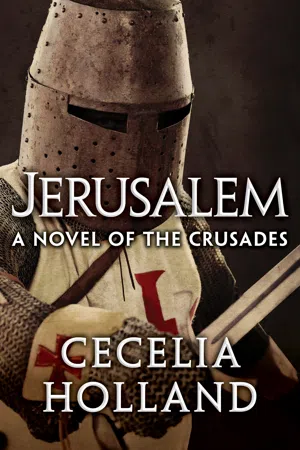
Set in the Holy Land in 1187 A.D., Cecelia Holland's historical novel masterfully explores the conspiracies and political maneuvers leading up to the Third Crusade. Following a stunning victory at the Battle of Ramleh, Norman Templar Rannulf Fitzwilliam must negotiate a truce with the enemy and determine the order of succession to the throne of Baudouin, the young Christian king dying of leprosy. However, Rannulf's instincts are for battle, not diplomacy. Temptation and betrayal await him around every corner. The question is not whether he can survive on the battlefield, but whether he can survive the politics and protocol of the royal court.
"Holland's masterful layering of subplots, historical detail and multiple perspectives makes for a great read." —Publisher's Weekly
"She brings as much suspense to political intrigue as to the sprawling battle scenes at which she excels." —The New York Times Book Review
- 366 pages
- English
- ePUB (mobile friendly)
- Available on iOS & Android
eBook - ePub
Jerusalem
About this book
Information
Chapter I
Halfway through the morning the second horse went lame also.
Right away, riding double behind Mark, Rannulf could feel the hitch and stagger in the animal’s stride, which grew worse with every step, until the horse pulled up and refused to move any more.
Rannulf slid down over its crupper to the ground. The other knight kept to his saddle; with a half-spoken oath he slammed his spurred heels savagely into the horse’s flanks. The beast gave a long weary groan. Rannulf went off a few steps, looking around.
Bleached as an old bone under the piercing blue of the sky, the desert spread away from them, rising in the south to the black barren hills that the local people called Ibrahim’s Anvil. To the north the road wandered off toward an uneven ridge, rippling in the heat. The horse sighed, exhausted, its eyes glazed.
Still in the saddle, Mark said, “This brute’s finished.” He pulled off his hat and wiped his face on his sleeve. “And so are we.”
Rannulf said, “If we ride all night we’ll reach Ascalon by dawn.”
“Yes, but we have no horses. Although in your usual all-knowing way you probably haven’t noticed.”
“There’s a caravanserai up ahead. We can walk there, find fresh mounts.”
At that Mark doubled up the ends of his reins, swearing under his breath, and flogged the horse’s neck and shoulder. Rannulf looked to the south again, wondering if the haze climbing across the sky were the dust of the oncoming Saracens. He did not think Saladin’s army would move so fast as that. Mark’s arm hung slack, the reins useless; then the horse folded at the knees and hocks and collapsed. With a yell the knight sprang clear.
Rannulf said, “We have to take the saddle.”
“The hell with the saddle! There’s a million sandpigs just beyond that hill!” Mark kicked the ground. His voice was shrill with fear and rage. “How far to this inn?”
“The saddle belongs to the Order.” Rannulf stooped over the horse, which was still alive, and tugged the girths loose; the animal’s belly heaved when his hand grazed it. The chances of finding horses at the caravanserai were not good, the chances of finding a saddle almost none.
Mark wheeled toward him. “Forget the saddle, Saint. I’ll walk, but I’m not carrying anything I don’t have to.”
Rannulf’s temper jumped, a spurt of heat behind his eyes; he crossed himself against it and faced Mark, but the other knight had seen the blessing and knew what it meant and backed off a few steps, his hands rising. “All right. All right.” Stooping, he unbuckled the bridle and slipped it off the head of the dying horse, and Rannulf heaved the saddle up over his shoulder, and they walked away along the road.
The summer was over, and the worst heat had broken, but on this broad dry pan the sun cooked the air and the light shimmered like watery veils. Here and there, weeds tufted the thin sand crust of the plain. Paler than the land on either side, the road was not a single path but a zone hundreds of yards across of countless dimpled footprints, crisscrossing ruts and tracks, and ancient piles of dung. Standing stones lined its edge, along with piles of rocks, broken wheels and pack frames and useless rotten harness, and bones.
“How far to this inn?” Mark asked, again.
Rannulf shaded his eyes. “We may not have to go that far. Look.” He pointed across the road. Out beyond the spotty row of stones and debris, a flag of dust trailed away toward the blue hills. Somebody was approaching the road from the east.
“Saracens,” Mark said.
“I don’t think so,” Rannulf said. “They’re ours.”
“You can’t see anything. You’re guessing.”
“No. Look where they’re coming from. The only thing out there is Kerak. They’re ours.” Rannulf looked on ahead of the drifting dust, trying to figure where this approaching train would reach the road. “Come on,” he said, and broke into a trot.
Sibylla said, “I wish you would ride. You slow everything up.” She checked her horse again, keeping to the pace of the cart.
Behind the plodding mules that pulled it, her cousin Alys sprawled on cushions, half-sitting, clutching the edge of the box with one plump hand, while the other beat constantly at the flies humming in the shade of the awning. “If you think this is comfortable, Sibylla, come and join me. But if I had to ride a horse, believe me, we would go even slower.”
Sibylla gave a sigh. They had been travelling across the same blank countryside for two days; she itched to get to the end of it, to be somewhere else, anywhere else. The five knights riding in front of her lifted a haze of dust, which got into her eyes; she had told Guile, who commanded her escort, that she wanted something done about that, that they should ride behind her, and Guile had sneered at her and told her to go sit in the cart and keep the curtains closed.
“You shouldn’t let him talk to you like that,” Alys said.
“No, probably not,” Sibylla said. She did not want to admit that she was afraid of Guile. Then up ahead of them, a shout sounded, and the knights crowded together in front of her and stopped.
Something was going on. The cart halted; Alys leaned forward, peering through the flies, and said, “What’s that?” Sibylla reined her horse away from the cart, and rode off past the knights to the head of the caravan.
In front of the knights, Guile of Kerak had reined in his horse and drawn his sword. He was a burly man, older than she was; under the edge of his cap his hair shagged down bone-white to his shoulders. He called out, “Stand where you are!”
Sibylla reined in behind him, out of his range of vision, and looked where he was looking. Two men were walking toward them across the road. Ragged, dirty, bearded, they seemed like outlaws. At Guile’s command, one stopped, but the other walked straight on, came up to the white-haired knight, and said, “I’m taking your horse. And I want another for my brother.”
Sibylla tossed up her head, startled, and Guile gave a contemptuous laugh. “What? Get out of my way; I’ll cut you down.” He cocked his sword back over his shoulder.
The man in front of him made no move to his own sword, which hung in a black scabbard at his hip. He was carrying a saddle on his shoulder, and he dropped it to the ground, as if he had arrived home. Taking off his hat he wiped his streaming face on the sleeve of his jerkin. His black hair was cut short above his ears. Calmly he stared up at Guile, and said, “I am a Knight of the Jerusalem Temple, and I want your horse. Get off.”
Behind Sibylla, a ripple of excitement went through the men of her escort. “A Templar. A Templar.” Guile lowered his sword. Sibylla rode up closer, staring at the black-haired knight’s chest, and now under the layers of grime she saw the red Cross splayed across his jerkin.
She swung around toward Guile, who was motionless beside her, his sword held across his saddlebow and his jaw bunched with coiled muscle, and she said, “Well? What are you waiting for? Give him your horse.”
Guile glared at her. At her words the Templar who had hung back on the road limped up beside the black-haired man. He said, “Find out if they have anything to eat.”
Sibylla rode in between them and Guile. “We will help you. I am the Princess Sibylla of Jerusalem, my father was King Amalric, and King Baudouin is my brother. Tell me how I can serve.”
She expected some reverence, some proper respect, or at least a little gratitude, but the black-haired Templar never even looked at her. He spoke to the other knight. “Tell her she can get back to Kerak, or wherever she belongs, fast, and leave that cart here.” Guile dismounted and the Templar went around her to take his reins. “Bring a horse also for my brother,” he said to Guile. “Move! Now!”
Sibylla felt the heat rise in her face. She thought she had been courteous enough to a dirty nameless man on the road. The other Templar stepped forward, his face lifted to her, young, brown-bearded, his eyes amazingly blue above the mottled sunburn of his cheeks. “My Princess, please excuse Saint, here. His vow forbids him any commerce with women. Our mission is desperate. Saladin is coming north out of Egypt, with an army of thirty thousand men. We have to get to Ascalon, where he’ll strike first.”
She said, startled, “Saladin. But that’s impossible.” She turned around in her saddle, looking south, into the great barrier of the desert. “They have never attacked from Egypt.”
“He’s coming now,” the brown man said. “And my brother here is right, my lady Princess. You have to get to safety, and the cart can’t move fast enough.”
“My cousin is—she doesn’t ride,” Sibylla said.
The black-haired man swung into Guile’s saddle. “Tie her to the saddle.” He kept his eyes averted from her, as if she were unfit to notice. A squire jogged up, leading another horse, and the brown-haired knight took the reins and mounted.
He said, “I suppose I’m still not going to get anything to eat?”
The black-haired man gave a low bad-tempered growl. Under him Guile’s horse was already dancing, eager, pulling at the hard hand on its reins. Looking over his shoulder, the Templar stared at Guile, on foot still. The knight from Kerak was scowling all over his red face. The Templar said, “Bring the saddle to the Temple in Jerusalem.” He put Guile’s horse into a quick trot away down the road, with the other knight at his stirrup.
“Ugly brute,” Sibylla said, under her breath.
She looked back into the south again, alarmed. If what the Templars said were true, and the Saracens were coming out of Egypt, the Kingdom of Jerusalem lay naked before them: she knew all the Christian armies were far away to the north, near Homs and Aleppo. She had to get to Ascalon, to do whatever she could.
Guile had shortened his glare to focus on her. “Well. You heard him. Get your damned cousin out of the damned cart, and let’s move.”
“Yes,” she said. “I think that’s a very good idea, Guile.” She rode back to the cart, to pack Alys onto a horse.
Chapter II
Well,” Mark said, unnecessarily, “there they are.”
Rannulf pushed his helmet back off his forehead, They sat their sweated horses on the rim of a steep brushy hill; before them the land fell in a long swoop down to the plain that stretched south and west toward Ascalon and the sea. Dust hung thick in the windless air, blurring the dun-green slopes of the hills. Through this churning brown haze the army of the Saracens moved along the low ground like a great river.
Here a wadi broke out of the hills onto the plain, a vast dry watercourse carved across the lowland. The van of Saladin’s army had already crossed it. The rearguard was far out of sight to the south, probably still somewhere near the city of Ramleh, which the Saracens had looted and burned the night before. The enemy kept no order; they knew that for a hundred miles there was no Christian army large enough to face them; if they had noticed the little pack of Franks skulking through the hills between them and Jerusalem, they showed no interest. They moved in waves, long strings of camels, each heaped up with baggage and carrying a pannier on either side, in each pannier an axeman, or a lancer, or an archer. There were horse archers, too, Bedouin, like flights of gulls in their long white robes. Among them all, other soldiers ran on foot, begging rides; sometimes a rider would let them catch hold of a stirrup, and sweep them along a dozen strides through the air.
Mark said, “They’ll be two days crossing the wadi, at least.”
“Could be.” Rannulf knew this place. The gulley was shallow and broad, no real problem, but the southern bank dropped off abruptly some ten or fifteen feet, and the Saracen army was piling up along the high edge, the horses and many of the camels balking at the plunge. Those coming up behind were spreading out to either side, so that now the whole southern bank of the wadi was packed with Saladin’s soldiers. As Rannulf watched, part of the bank collapsed under the weight. A dozen horses slid down with the sand; their screams faintly reached his ears.
Mark said, “Here comes the King. What are you going to tell him? God, this is a disaster.”
Rannulf shook his head, his gaze on the sprawl of men creeping over the plain. There were thousands of them, tens of thousands; he got tired of trying to count them. Between them and Jerusalem and the Tomb ...
Table of contents
- Cover Page
- Dedication
- Epigraphs
- Chapter I
- Chapter II
- Chapter III
- Chapter IV
- Chapter V
- Chapter VI
- Chapter VII
- Chapter VIII
- Chapter IX
- Chapter X
- Chapter XI
- Chapter XII
- Chapter XIII
- Chapter XIV
- Chapter XV
- Chapter XVI
- Chapter XVII
- Chapter XVIII
- Chapter XIX
- Chapter XX
- Chapter XXI
- Chapter XXII
- Chapter XXIII
- Chapter XXIV
- Chapter XXV
- Chapter XXVI
- Chapter XXVII
- Chapter XXVIII
- Chapter XXIX
- Chapter XXX
- Chapter XXXI
- Chapter XXXII
- Chapter XXXIII
- Copyright Page
Trusted by 375,005 students
Access to over 1.5 million titles for a fair monthly price.
Study more efficiently using our study tools.
Frequently asked questions
Yes, you can cancel anytime from the Subscription tab in your account settings on the Perlego website. Your subscription will stay active until the end of your current billing period. Learn how to cancel your subscription
No, books cannot be downloaded as external files, such as PDFs, for use outside of Perlego. However, you can download books within the Perlego app for offline reading on mobile or tablet. Learn how to download books offline
Perlego offers two plans: Essential and Complete
- Essential is ideal for learners and professionals who enjoy exploring a wide range of subjects. Access the Essential Library with 800,000+ trusted titles and best-sellers across business, personal growth, and the humanities. Includes unlimited reading time and Standard Read Aloud voice.
- Complete: Perfect for advanced learners and researchers needing full, unrestricted access. Unlock 1.5M+ books across hundreds of subjects, including academic and specialized titles. The Complete Plan also includes advanced features like Premium Read Aloud and Research Assistant.
We are an online textbook subscription service, where you can get access to an entire online library for less than the price of a single book per month. With over 1.5 million books across 990+ topics, we’ve got you covered! Learn about our mission
Look out for the read-aloud symbol on your next book to see if you can listen to it. The read-aloud tool reads text aloud for you, highlighting the text as it is being read. You can pause it, speed it up and slow it down. Learn more about Read Aloud
Yes! You can use the Perlego app on both iOS and Android devices to read anytime, anywhere — even offline. Perfect for commutes or when you’re on the go.
Please note we cannot support devices running on iOS 13 and Android 7 or earlier. Learn more about using the app
Please note we cannot support devices running on iOS 13 and Android 7 or earlier. Learn more about using the app
Yes, you can access Jerusalem by Cecelia Holland in PDF and/or ePUB format, as well as other popular books in Literature & Literature General. We have over 1.5 million books available in our catalogue for you to explore.