Thomas Aquinas (1225 – 1274) was an Italian Dominican friar, philosopher, Catholic priest, and Doctor of the Church. An immensely influential philosopher, theologian, and jurist in the tradition of scholasticism, he is also known within the latter as the Doctor Angelicus, the Doctor Communis, and the Doctor Universalis. The name Aquinas identifies his ancestral origins in the county of Aquino in present-day Lazio, Italy. Among other things, he was a prominent proponent of natural theology and the father of a school of though (encompassing both theology and philosophy) known as Thomism. He argued that God is the source of both the light of natural reason and the light of faith. His influence on Western thought is considerable, and much of modern philosophy developed or opposed his ideas, particularly in the areas of ethics, natural law, metaphysics, and political theory.
Unlike many currents in the Catholic Church of the time, Thomas embraced several ideas put forward by Aristotle—whom he called "the Philosopher"—and attempted to synthesize Aristotelian philosophy with the principles of Christianity. Translator: Hugh Pope
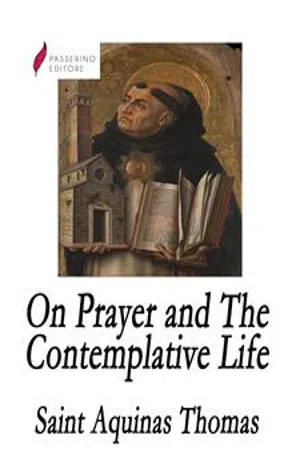
- English
- ePUB (mobile friendly)
- Available on iOS & Android
eBook - ePub
On Prayer and The Contemplative Life
About this book
Information
Topic
Theology & ReligionSubtopic
Christian DenominationsTable of contents
- Cover
- On Prayer and The Contemplative Life
- Table of contents
- PREFACE
- INTRODUCTION
- THE BREVIARY HYMN TO S. AUGUSTINE
- QUESTION LXXXI
- Does the Virtue of Religion direct a Man to God Alone?
- Is Religion a Virtue?
- Is Religion One Virtue?
- Is Religion a Special Virtue Distinct From Others?
- Is Religion One of the Theological Virtues?
- Is Religion to be preferred to the Other Moral Virtues?
- Has Religion, That is Latria, any External Acts?
- Is Religion the Same as Sanctity?
- QUESTION LXXXII
- Is Devotion a Special Kind of Act?
- Is Devotion an Act of the Virtue of Religion?
- Is Contemplation, that is Meditation, the Cause of Devotion?
- Is Joy an Effect of Devotion?
- QUESTION LXXXIII
- Is Prayer an Act of the Appetitive Powers?
- Is It Fitting To Pray?
- Is Prayer an Act of the Virtue of Religion?
- Ought We To Pray To God Alone?
- Should We in our Prayers ask for Anything Definite from God?
- Ought We in our Prayers to ask for Temporal Things from God?
- Ought We To Pray for Others?
- Ought We To Pray for Our Enemies?
- Is Prayer Peculiar to Rational Creatures?
- Do the Saints in Heaven Pray for Us?
- Should Prayer be Vocal?
- Must Prayer necessarily be Attentive?
- Should our Prayers be Long?
- Is Prayer Meritorious?
- Do Sinners gain Anything From God by their Prayers?
- Can We rightly term Supplications," "Prayers," "Intercessions," and "Thanksgivings," parts of Prayer?
- QUESTION CLXXIX
- May Life be fittingly divided into the Active and the Contemplative?
- Is this division of Life into the Active and the Contemplative a sufficient one?
- QUESTION CLXXX
- Is the Contemplative Life wholly confined to the Intellect, or does the Will enter into it?
- Do the Moral Virtues pertain to the Contemplative Life?
- Does the Contemplative Life comprise many Acts?
- Does the Contemplative Life consist solely in the Contemplation of God, or in the Consideration of other Truths as well?
- Can the Contemplative Life attain, according to the State of this Present Life, to the Contemplation of the Divine Essence?
- Is the Act of Contemplation Rightly Distinguished According to the Three Kinds of Motion—Circular, Direct, and Oblique?
- Has Contemplation its Joys?
- Is the Contemplative Life lasting?
- QUESTION CLXXXI
- Do all Acts of the Moral Virtues come under the Active Life?
- Does Prudence pertain to the Active Life?
- Does Teaching Belong to the Active or to the Contemplative Life?
- Does the Active Life continue after this Life?
- QUESTION CLXXXII
- Is the Active Life preferable to the Contemplative?
- Is the Active Life more Meritorious than the Contemplative?
- Is the Active Life a Hindrance to the Contemplative Life?
- Does the Active Life precede the Contemplative?
Trusted by 375,005 students
Access to over 1.5 million titles for a fair monthly price.
Study more efficiently using our study tools.
Frequently asked questions
Yes, you can cancel anytime from the Subscription tab in your account settings on the Perlego website. Your subscription will stay active until the end of your current billing period. Learn how to cancel your subscription
No, books cannot be downloaded as external files, such as PDFs, for use outside of Perlego. However, you can download books within the Perlego app for offline reading on mobile or tablet. Learn how to download books offline
We are an online textbook subscription service, where you can get access to an entire online library for less than the price of a single book per month. With over 1.5 million books across 990+ topics, we’ve got you covered! Learn about our mission
Look out for the read-aloud symbol on your next book to see if you can listen to it. The read-aloud tool reads text aloud for you, highlighting the text as it is being read. You can pause it, speed it up and slow it down. Learn more about Read Aloud
Yes! You can use the Perlego app on both iOS and Android devices to read anytime, anywhere — even offline. Perfect for commutes or when you’re on the go.
Please note we cannot support devices running on iOS 13 and Android 7 or earlier. Learn more about using the app
Please note we cannot support devices running on iOS 13 and Android 7 or earlier. Learn more about using the app
Yes, you can access On Prayer and The Contemplative Life by St. Thomas Aquinas in PDF and/or ePUB format, as well as other popular books in Theology & Religion & Christian Denominations. We have over 1.5 million books available in our catalogue for you to explore.