![]()
RUDYARD GRIFFITHS: Ladies and gentlemen, good evening. My name is Rudyard Griffiths. I’m the co-organizer of this debate series with my colleague, Patrick Luciani. It is my privilege to be your moderator once again.
I want to start by welcoming the worldwide audience who are watching tonight’s debate live online, on web sites including Canada’s leading news source, theglobeandmail.com. A warm hello also to the global TV and radio audience tuning into this debate: in Canada from the Business News Network (BNN), to CBC Radio’s Ideas, or on CPAC (the Cable Public Affairs Channel), and on C-SPAN throughout the continental United States. And finally, hello to the 2,700 people who have once again filled Roy Thomson Hall to capacity for a Munk Debate.
We’ve had some stellar debates in this very hall. Who can forget that evening with Christopher Hitchens and Tony Blair on religion’s impact on the world? A year ago today Dr. Henry Kissinger, at eighty-two years of age, participated in his first public debate on this stage, eloquently arguing against China owning the twenty-first century. And just a matter of months ago, Nobel laureate Paul Krugman and former U.S. treasury secretary Larry Summers went head-to-head on the future of the North American economy.
As entertaining and engaging as those contests were, they did not have the urgency of tonight’s debate. In the last month, the unthinkable has become the thinkable when it comes to the future of Europe. As early as mid-June 2012, Greece will form a new government that will have to decide in the coming months — by choice or out of necessity — if the country leaves the eurozone. Many observers have predicted that a Greek exit from the eurozone could cause a catastrophic spike in the borrowing costs of Spain and Italy — two of the world’s largest debtor nations — and a bank run throughout the region. The result could be an implosion, both political and economic, of the European Union that would most likely plunge not only that continent, but North America and the world, back into recession.
But as dire as the scenarios presented in the media about Europe’s future are right now, they need to be set against a record of real accomplishment and important history. The European Union, born out of the Second World War, now encompasses six decades of continuous history, some twenty-seven member states, twenty-three different languages, and an advanced economy that is responsible for a quarter of the world’s economic output.
In the sweep of human history, Europe’s institutions, its values, and its common goals are rightfully acknowledged as some of humankind’s most important accomplishments. So I think we’re all wondering tonight — we in this room and people around the world, especially people in Europe — whether the considerable strengths that Europe enjoys will allow it to survive its unprecedented crisis, and maybe even emerge from the other side stronger and more united; or, as two of our debaters will make the case this evening, is the eurozone crisis an expression of a series of deep and fatal flaws buried in the core of the euro itself that dooms it to failure?
Tonight, we are going to try and answer these important questions and tackle the big geopolitical question of our time. We will debate the motion: be it resolved, the European experiment has failed. Before introducing the all-star European cast of debaters that we’ve assembled, let me take a moment to recognize the organization that is solely responsible for staging these evenings. It’s really thanks to its generosity and public-spiritedness that we have the opportunity, twice a year, to gather here in Toronto and listen to some of the world’s brightest minds debate the big issues facing our country and the globe. Ladies and gentlemen, please join me in a round of applause for the co-founders of the Aurea Foundation, Peter and Melanie Munk.
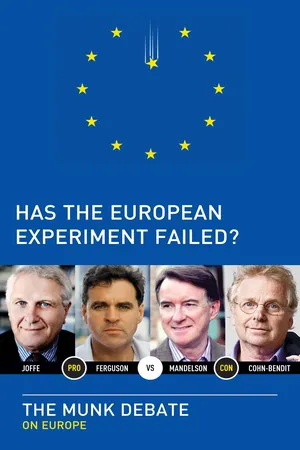
Now, let’s get our debate underway. Can I have a big round of applause for our two debaters arguing for tonight’s motion, Niall Ferguson and Josef Joffe, and their formidable opponents, Daniel Cohn-Bendit and Lord Peter Mandelson.
Peter Munk joked with me earlier that we should rename these events the Ferguson Debates, since this is the third time Niall Ferguson has participated in a Munk Debate. But, brain cell for brain cell, he is one of the most formidable debaters of his generation. He’s also a celebrated Harvard professor, a Daily Beast/Newsweek columnist, a documentary film impresario, and an internationally bestselling author.
Josef Joffe, also speaking in favour of tonight’s motion, brings a vital perspective to this debate — the view of the German people on the fast-moving eurozone crisis. He is the publisher of the prestigious German weekly Die Zeit, Germany’s equivalent of Time magazine or Maclean’s. He is the author of numerous bestselling books on international affairs, including Überpower: The Imperial Temptation of America. His analysis of geopolitical events appears regularly in everywhere from the New York Times to The New Republic to the London Times Literary Supplement.
Let me introduce the debaters arguing against the motion. The life story of Daniel Cohn-Bendit is in many ways synonymous with the European experiment: born in France in 1945 to German-Jewish parents who had fled Nazi Germany, Mr. Cohn-Bendit burst upon the European scene in the 1960s as a key leader of the student revolts in France. Half a century later, he remains fondly known as “Danny the Red,” and a highly influential voice in Europe, where he serves as co-president of the Greens/European Free Alliance Group in the European Parliament. He sits on the EU parliamentary committees on Economic and Monetary Affairs and Constitutional Affairs. He is also co-president of the respected Spinelli Group, a European parliamentary association dedicated to the federalist project in Europe.
Our final debater tonight, Lord Peter Mandelson, is one of Europe’s most prominent and eloquent advocates for the cause of European federalism in the face of the current crisis. He has held numerous senior cabinet positions in the United Kingdom as a Labour MP under prime ministers Tony Blair and Gordon Brown. Most important to us tonight, he was Great Britain’s EU commissioner from 2004 to 2008, a role that gave him an intimate understanding of the internal political and economic workings of Europe. Today he is the chairman of Global Counsel, an international strategic advisory firm. To top off his many talents, he is also a gifted writer. His autobiography, The Third Man, published in 2010, was a Sunday Times number-one bestseller for five consecutive weeks.
All 2,700 of you in attendance voted on the debate’s resolution as you took your seats, which is a critical part of these events. We asked you to consider the motion: be it resolved the European experiment has failed. Your votes should give us a close idea of where public opinion is in this room right now. The numbers are interesting: 41 percent voted in favour of the motion, 37 percent were against it, and 22 percent were undecided. So public opinion is split.
On the second question on your ballot, we asked you whether or not you are open to changing your vote, depending on what you hear at this debate. Wow — this is an undecided audience! Ninety percent of you would change your minds in the next hour and forty-five minutes. Only 10 percent of you have your minds completely made up. Ladies and gentlemen, this debate is very much in play.
One last housekeeping point that we stick to at every debate: our debaters will ...