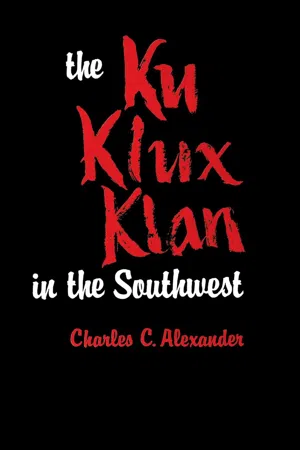
This is a study of a disturbing phenomenon in American society—the Ku Klux Klan—and that eruption of nativism, racism and moral authoritarianism during the 1920s in the four states of the Southwest—Texas, Louisiana, Oklahoma, and Arkansas—in which the Klan became especially powerful. The hooded order is viewed here as a move by frustrated Americans, through anonymous acts of terror and violence, and later through politics), to halt a changing social order and restore familiar orthodox traditions of morality. Entering the Southwest during the post-World War I period of discontent and disillusion, the Klan spread rapidly over the region and by 1922 its tens of thousands of members had made it a potent force in politics.
Charles C. Alexander finds that the Klan in the Southwest, however, functioned more as vigilantes in meting extra-legal punishment to those it deemed moral offenders than as advocates of race and religious prejudice. But the vigilante hysteria vanished almost as suddenly as it had appeared; opposition to its terrorist excesses and its secret politics led to its decline after 1924, when the Klan failed abysmally in most of its political efforts. Especially significant here are the analysis of attitudes which led to this revival of the Klan and the close examination of its internal machinations.
- 304 pages
- English
- ePUB (mobile friendly)
- Available on iOS & Android
eBook - ePub
The Ku Klux Klan in the Southwest
About this book
1.
Brainchild of a Dreamer
IN EARLY DECEMBER of 1915, The Birth of a Nation, David Wark Griffith’s epochal motion picture, came to Atlanta, Georgia, for the first time. The picture was supposed to be a patriotic portrayal of the division and reunion of the United States during and after the Civil War. It also represented a remarkable advancement in the technological development of motion pictures.1 But the most conspicuous feature of the film for nostalgic Southerners was its depiction of white-robed Ku Klux Klansmen riding here and there to save the beleaguered South from the evils of Yankee and Negro domination during the Reconstruction period. The film reinforced the romanticized image most Southerners held of the original “Ku Kluxers,” and the Georgians sat enthralled through the presentation. When the crowd left the theater after a performance of The Birth of a Nation, some Atlantan may have asked his friends if anybody had seen a cross burning on Stone Mountain, outside the city, on Thanksgiving night. What was this he had heard about the Klan being reorganized? Was there anything to the rumor that some Atlanta men were establishing a new Klan?
The rumor was true. On December 4 the state of Georgia granted a charter for a new fraternal order formally named “The Invisible Empire, Knights of the Ku Klux Klan, Inc.” The twelve men who signed the petition for the charter described the society as a “patriotic, military, benevolent, ritualistic, social and fraternal order.”2 The instigator of this order was named William Joseph Simmons. On Thanksgiving night he had led a party of friends up Stone Mountain, burned a crude cross, and delivered a grandiloquently phrased lecture on patriotism, white supremacy, and the virtues of racial purity. That ceremony marked the founding of the second Ku Klux Klan, a creation of Simmons’ dreamy imagination fated to become the largest and most powerful nativist and vigilante organization in American history.3
In 1915 Simmons could look back on a career that was lackluster and a little frustrating. He was born about 1880 in Talladega County, Alabama, the son of a country physician. Simmons was in his early teens when his father died. By that time he was already leading prayer meetings at the community Methodist church. At eighteen he joined the army and served in the Spanish-American War. After his discharge he attended for a time the University of the South at Sewanee, Tennessee, then left school and secured a license as a minister in the Methodist Episcopal Church, South. For several years he was a circuit rider, first in Florida, then in Alabama, but in 1912 he abandoned the ministry in anger after the Methodist Conference of Alabama refused to award him a large church of his own. The ex-preacher now became a fraternal organizer, initially with the Woodmen of the World, and later with other societies. He held the rank of colonel in the Woodmen, and thereafter he referred to himself—and liked others to call him—“Colonel Simmons.”
As a professional fraternalist, Simmons earned twenty-three degrees in seven fraternal orders, including the various stages of Freemasonry, the Knights of Pythias, the Odd Fellows, and the Woodmen. He was doing rather well financially when an automobile struck him as he was crossing an Atlanta street. During three months of hospital confinement he outlined on paper something that had been in his mind for years—a plan for a new fraternity to be called the Knights of the Ku Klux Klan. Simmons drew on his knowledge of the idealized Ku Klux Klan of the Reconstruction years, about which he had read voraciously in his childhood, and his own experience in the fraternal world when he sketched his order. He had in mind the appeal the original Klan held for Southerners, who regarded it as the epitome of heroism, the savior of white supremacy and southern womanhood during a period when both were in danger at the hands of carpetbagging Northerners and unruly Negroes. He labeled his brainchild the authentic lineal descendant of the Reconstruction Klan and pledged it as a “living memorial” to the earlier order.
At the same time, as a good lodge man, he realized the drawing power of secrecy, ritual, mystery, and weird nomenclature. Thus, copying and paraphrasing Reconstruction Klan terminology, he dubbed the Klan’s territory the “Invisible Empire,” over which he ruled as “Imperial Wizard,” with subordinates whose titles included “Kligrapp,” “Klaliff,” “Kludd,“ “Klabee,” and “Nighthawk.” He even wrote a ritual book called the “Kloran,” wherein, along with numerous other instructions, he specified a “Klonversation” using such acrostic passwords as AYAK (“Are You a Klansman”), AKIA (“A Klansman I am”), and KIGY (“Klansman I Greet You”). Membership in the order was limited to native-born white Protestants, eighteen years old and above.
When “Colonel” Simmons left the hospital, he began a campaign of visiting lodges in Atlanta, talking with the members, and trying to get them interested in his fraternal project. He met with some success, and on October 26 he and thirty-four other men met in the office of his attorney, E. R. Clarkson, to discuss the Knights of the Ku Klux Klan idea more thoroughly. Two of those who came were men who had belonged to the original Klan. John W. Bale, speaker of the house of representatives in the Georgia legislature, called the meeting to order. Simmons talked for an hour and convinced the others that “the idea would grow.” He also discussed the problem of the Negroes, who were, according to Simmons, “getting pretty uppity in the South along about that time.” The group voted to apply for a state charter. Then on Thanksgiving night they climbed Stone Mountain, carried out the cross-burning ceremony, and “revived” the Klan. After they secured their charter, Simmons and friends began advertising their order through the newspapers and making personal contacts. The advertisements were shrewdly timed to appear simultaneously with the initial Atlanta showings of The Birth of a Nation, which gave Simmons some valuable free publicity. As a result, ninety-one new members joined the Klan, each paying $10 as an initiation fee and $6.50 for the cheap white robe the Imperial Wizard sold as the official uniform of the society. Moreover, forty-two new Klansmen signed up for a total of $53,000 worth of Klan life insurance. The insurance feature, a bit of practical economics which did not survive the early years of the Klan, nevertheless revealed that Simmons designed his order at least partly as a moneymaking scheme. For many individuals associated with the Klan in later years, the movement would never be anything else.
On a man-to-man basis Simmons was an effective salesman of the Klan. His personal appearance was impressive, for he stood over six feet tall and weighed around two hundred pounds. His other characteristics included: “A grim, set mouth . . . ; a large nose; eyes of a metallic grayish hue; shaggy, reddish eyebrows; good teeth; a square chin; a spacious forehead; a strong, well-rounded voice and slow deliberation in speaking.”4 But Simmons had little talent for organization and expansion, and he had an unfortunate weakness for being duped by his associates. Before the United States entered the First World War, the Klan had escaped the confines of Georgia and established a few chapters in neighboring Alabama. Jonathan Frost, the Imperial Wizard’s most trusted subordinate, then absconded with several thousand dollars from Alabama initiation fees, badly crippling the order’s finances. The Klan wandered on in obscurity. “There were times during those five early years, before the public knew of the Klan,” recalled Simmons, “when I walked the streets with my shoes worn through because I had no money.”
During the war Simmons involved the Klan in the national mania for self-appointed spy hunting. He joined the Citizens Bureau of Investigation in Atlanta and proceeded to make “secret service men” of his Klansmen in Georgia and Alabama. He later bragged: “I was in touch in my wartime secret service work with federal judges, federal attorneys, and federal secret service officials and operatives. The Klan secret service reported to me.” It was during the war that Simmons changed the Klan, originally designed as a public order with members wearing lodge buttons, into a secret organization, which it remained for the duration of its existence. Thus the Klan gained the element that made it unique among contemporary fraternal orders—secrecy of membership.5
By the end of the war the Klan was fairly well known in Atlanta, Birmingham, and Mobile. For the most part it had left behind its original dual character as a white supremacy society and a memorial to the Reconstruction Klan, and had assumed the mien of a militantly moralistic and patriotic order. It was active in getting rid of prostitutes around military bases, idlers, slackers, and “the laborer who is infested with the I. W. W. spirit.”6 Yet the Klan’s membership rolls remained thin; there were only about 5,000 or 6,000 Klansmen scattered through Georgia and Alabama.7 Simmons realized that he was making little progress on his own and that he must have help if his Invisible Empire were ever to encompass more than a small part of the South. In the summer of 1920 he found two people who possessed the organizing genius his fraternal project required.
In Atlanta there was a two-member advertising and publicity company called the Southern Publicity Association, which had conducted “booster” campaigns for such causes as the Salvation Army, the Anti-Saloon League, and the Red Cross. The owners, managers, and sole employees of the firm were Edward Young Clarke and Mrs. Elizabeth Tyler. Clarke, an unimposing figure in his thirties, with thick black hair and black-rimmed spectacles, had gained quite a reputation in the Atlanta area for his fund-raising abilities. His partner, Mrs. Tyler, was a rotund, bluff woman who had married at the age of fourteen, been left a widow at fifteen, and had since survived on her own business acumen. Clarke and Mrs. Tyler had heard of Simmons’ Klan through her son-in-law, who happened to join the order. At the same time, Simmons had watched the two publicity agents for some months, and he wanted them as salesmen for his stunted secret society. In June of 1920 the three got together and talked about the prospects of the Klan. Clarke and Mrs. Tyler finally signed a contract with Simmons to publicize and propagate the order in exchange for eight dollars of every ten-dollar initiation fee or “klectoken” paid by new Klan members. Of their eight-dollar share the two boosters had to pay all of their expenses, including secretarial and clerical help and the fees they allowed their field agents to keep.8
For purposes of administering their publicity campaign and collections they turned the Southern Publicity Association into the “Propagation Department” of the Klan and divided the whole country into what amounted to sales territories—“Domains,” or groups of states; “Realms,” or states; and “Provinces,” or subdivisions of states. They put about 1,100 solicitors, called “Kleagles,” into the field, with instructions to play upon whatever prejudices were most acute in the particular areas the Kleagles were working. Simmons must have sighed wistfully when in later years he remembered how “They made things hum all over America.”9
The organizing Kleagles had plenty of incentive for securing as many new members as quickly as possible. Of the eight-dollar cut of each klectoken which went to the Propagation Department, Clarke let the Kleagle have a commission of four dollars. One dollar and fifty cents went to the “Grand Goblin,” or Domain administrator; $2.50 went directly to Clarke and Mrs. Tyler; and Simmons received the remaining $2.00.10
The application of booster techniques by the two publicity agents brought striking results. In the sixteen-month period from June 1920 to October 1921, the Klan added from 90,000 to 100,000 new members and took in about one-and-a-half million dollars from klectokens and the sale of robes, ritual equipment, and other paraphernalia.11 By the end of 1921 the secret order had spread throughout the South and Southwest, had crossed the Potomac and Ohio rivers and secured strong footholds in several northern states, and had recruited thousands of Klansmen on the Pacific Coast.
During this initial postwar surge the Klan received three windfalls of publicity which greatly benefited its campaign to get itself before the people. The first related to the burning of gins and cotton bales in the southern states in the fall of 1920. Irate southern farmers, desperate over the collapse of cotton prices, resorted to the old practice of night-riding in an effort to check the sale of cotton until prices advanced. The Klan had no part in this economic warfare, and in fact the property-minded Klansmen sometimes stood guard at gins and warehouses to prevent their destruction. But there was some speculation that the organization might be involved, and letters came into Imperial headquarters from all parts of the nation seeking information about the Klan, its membership requirements, and its program. Simmons and Clarke eagerly seized the opportunity to advertise the Klan. To the question whether its membership were confined to southern men, Simmons announced: “Any real man, any native-born white American citizen who is not affiliated with any foreign institution and who loves his country and his flag may become a...
Table of contents
- Cover
- Half title
- Title
- Copyright
- Preface
- Contents
- Ku Klux Klan Terminology Used in This Book
- 1. Brainchild of a Dreamer
- 2. “A Passion for Reform”
- 3. The Klan Moves into the Southwest
- 4. The Klan’s Drive for Law and Order
- 5. Gestures of Peace
- 6. A Taste of Victory
- 7. “Neither Klan nor King”
- 8. A Sortie at Presidential Politics
- 9. Uncertain Victories, Bitter Defeats
- 10. The Road to Obscurity
- 11. The End of the Road
- Bibliographical Notes
- Index
Trusted by 375,005 students
Access to over 1.5 million titles for a fair monthly price.
Study more efficiently using our study tools.
Information
Publisher
The University Press of KentuckyYear
2021Topic
HistoryPrint ISBN
9780813151045
Subtopic
North American HistoryeBook ISBN
9780813183336
Index
HistoryFrequently asked questions
Yes, you can cancel anytime from the Subscription tab in your account settings on the Perlego website. Your subscription will stay active until the end of your current billing period. Learn how to cancel your subscription
No, books cannot be downloaded as external files, such as PDFs, for use outside of Perlego. However, you can download books within the Perlego app for offline reading on mobile or tablet. Learn how to download books offline
Perlego offers two plans: Essential and Complete
- Essential is ideal for learners and professionals who enjoy exploring a wide range of subjects. Access the Essential Library with 800,000+ trusted titles and best-sellers across business, personal growth, and the humanities. Includes unlimited reading time and Standard Read Aloud voice.
- Complete: Perfect for advanced learners and researchers needing full, unrestricted access. Unlock 1.5M+ books across hundreds of subjects, including academic and specialized titles. The Complete Plan also includes advanced features like Premium Read Aloud and Research Assistant.
We are an online textbook subscription service, where you can get access to an entire online library for less than the price of a single book per month. With over 1.5 million books across 990+ topics, we’ve got you covered! Learn about our mission
Look out for the read-aloud symbol on your next book to see if you can listen to it. The read-aloud tool reads text aloud for you, highlighting the text as it is being read. You can pause it, speed it up and slow it down. Learn more about Read Aloud
Yes! You can use the Perlego app on both iOS and Android devices to read anytime, anywhere — even offline. Perfect for commutes or when you’re on the go.
Please note we cannot support devices running on iOS 13 and Android 7 or earlier. Learn more about using the app
Please note we cannot support devices running on iOS 13 and Android 7 or earlier. Learn more about using the app
Yes, you can access The Ku Klux Klan in the Southwest by Charles C. Alexander in PDF and/or ePUB format, as well as other popular books in History & North American History. We have over 1.5 million books available in our catalogue for you to explore.