An intellectual history of the philosophers who grappled with the problem of evil, and the case for why pessimism still holds moral value for us today
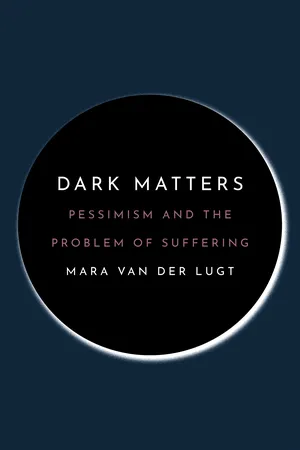
In the seventeenth and eighteenth centuries, philosophers engaged in heated debates on the question of how God could have allowed evil and suffering in a creation that is supposedly good. Dark Matters traces how the competing philosophical traditions of optimism and pessimism arose from early modern debates about the problem of evil, and makes a compelling case for the rediscovery of pessimism as a source for compassion, consolation, and perhaps even hope.
Bringing to life one of the most vibrant eras in the history of philosophy, Mara van der Lugt discusses legendary figures such as Leibniz, Hume, Voltaire, Rousseau, Kant, and Schopenhauer. She also introduces readers to less familiar names, such as Bayle, King, La Mettrie, and Maupertuis. Van der Lugt describes not only how the earliest optimists and pessimists were deeply concerned with finding an answer to the question of the value of existence that does justice to the reality of human suffering, but also how they were fundamentally divided over what such an answer should look like.
A breathtaking work of intellectual history by one of today's leading scholars, Dark Matters reveals how the crucial moral aim of pessimism is to find a way of speaking about suffering that offers consolation and does justice to the fragility of life.
- 432 pages
- English
- ePUB (mobile friendly)
- Available on iOS & Android
eBook - ePub
About this book
Information
Publisher
Princeton University PressYear
2021Print ISBN
9780691226149
9780691206622
eBook ISBN
9780691226156
Topic
PhilosophySubtopic
Ethics & Moral PhilosophyCHAPTER ONE
The Complaint
BAYLE AND MALEBRANCHE ON PHYSICAL EVIL
Bayle knows more than anyone, and so I’ll seek him out:But, balances in hand, Bayle teaches but to doubt …
VOLTAIRE1
It is the only problem. The problem of suffering is the only problem. It all boils down to that.
MURIEL SPARK2
ONE OF THE MOST DEFINING problems of the history of philosophy is the problem of evil: the question of how an all-good, all-knowing, and all-powerful God could permit the existence of evil in the world. Although this question goes back to the dawn of Christianity and further still, throughout the ages there have been striking shifts in how it has been conceived, formulated, and answered. In past decades, there have been several attempts to inscribe the problem of evil into the history of philosophy, either tracing the problem throughout the ages or in a specific period—sometimes leading to bold yet thought-provoking claims, such as Susan Neiman’s suggestion that ‘the problem of evil was the most important question driving modern philosophy’.3 The risk in such approaches—even those that focus on the early modern period alone—is their tendency to treat the problem of evil as a static thing: a problem that has more or less stayed the same throughout the centuries. The idea in the background seems to be that, although the answers and solutions to the problem have differed, it’s the same kind of problem all the way through.4
To some extent, this is a valid assumption. We can indeed describe the problem of evil in roughly the same terms throughout the centuries: as a conflict between God’s divine attributes (omnipotence, omniscience, omnibenevolence) and the existence of evils in his creation. However, even if the same schema loosely fits, this does not mean that the problem of evil is the same kind of problem in all cases. Even among authors writing in a shared context, the ‘problem of evil’ they discuss often corresponds to very distinct concerns, which often but not always overlap. In fact, until sometime in the nineteenth century, the matter is not even framed as the problem of evil, but as a discussion of, for instance, the origins of evil, or simply, evil. Furthermore, in many authors the subject is not seen as a real problem at all, but as a necessary, or even a standard, part of the theological corpus: a part of existence that must (and can) be explained in order for any theology to be complete.
Instead of asking how the problem of evil was treated or answered in this or that age, it is perhaps more productive to begin by asking what kind of problem evil presented in each discussion; what kinds of concerns drove these debates. Was it primarily a problem of sin or of suffering (human or also animal)? A problem of pain or sadness; of monsters or disorders? A problem of suicide or a problem of creation? And: To what extent was it even conceived as a real problem? If we look at the debates on evil with these questions in mind, we find different authors with fundamentally different concerns, some of which overlap while others do not. This results in different problems of evil, which does lead to different answers, but I believe it is in the reframing of the problem itself that the most interesting shifts occur, and in the ongoing inclusion of new aspects of existence that had not been considered quite so problematic before.5
A full archeology of problems of evil would require a book in itself, and so I will offer but a brief introduction by way of two key elements: the categories into which evils were variously divided, and the strategies for answering the problems they posed. I will then trace some of the shifts and reorientations in the debates on evil in the early modern period, especially in the late seventeenth and early eighteenth century, focusing on two seminal philosophers: the Oratorian priest Nicolas Malebranche and the Calvinist dictionnairiste Pierre Bayle. By examining the works of these thinkers in the wider context of this debate, and by tracing the changing role of physical evil, I will argue that this period sees an important shift in thinking about evil: that the problem of evil, as it is usually conceived, is reinvented as an entirely different kind of problem, incorporating different kinds of evil.6
Categories
But what is, in fact, an evil? Let’s take a look at some ‘taxonomies of evil’: that is, the various categories into which evil (malum) was traditionally, or not so traditionally, divided.7 The crucial point of reference for Christian authors was Augustine, who divided evil exclusively into these two categories: sin (peccatum) and punishment for sin (poena peccati).8 This was at the basis of what was to become the standard vocabulary of the scholastics: malum culpae (evil of fault) and malum poenae (evil of penalty or punishment); sin on the one hand, and punishment for sin on the other. Human suffering falls into in the latter category, as punishment for, if not actual individual sin, then certainly original sin. However, the question rose among some authors whether these two categories covered every kind of evil. For instance, what about earthquakes and birth defects—cases where there seems to be an evil, which is not necessarily the result of actual sin: How to categorise those? Some scholastics, such as Francisco Suárez, placed the categories of malum culpae and malum poenae under the header of moral evil, while adding a new category of natural evil for, very roughly speaking, evils that are not connected with moral responsibility. For instance, earthquakes are bad for living beings; pain is bad for animals; a sixth finger is bad for a human.9
These new categories (moral and natural evil, with moral evil comprising Augustine’s categories of sin and punishment) remain more or less stable—until some point in the second half of the seventeenth century, when they start shifting again, and some intriguing conceptual reinventions take place. For instance, neither Bayle nor Malebranche uses the scholastic category of natural evil; in fact, they seem to be sidestepping the scholastic tradition altogether. Instead, Malebranche goes back to Augustine’s two categories, though using a different terminology, substituting moral evil for malum culpae or evil of sin and physical evil for malum poenae or evil of punishment.10 These terms, which Malebranche uses very rarely, correspond to his concept of ‘the moral’ and ‘the physical’; that is, the moral and physical order of things. These have to do with moral actions on the one hand, chosen by man, and the physical results of these actions on the other: things that are not directly done or chosen but happen as a consequence of choice. Thus everything falls ultimately into the moral order, and Malebranche’s philosophy remains firmly within an Augustinian framework where sin accounts for suffering (on which, more later). As Steven Nadler describes Malebranche’s cosmology: ‘This is a world in which justice predominates as much as it can, given the simplest laws, and as many people as possible receive their proper deserts—where rewards and punishments (“the physical”) are closely related to deeds (“the moral”).’11
In Bayle, the matter of mapping categories is more complicated. At times, he also seems to go back to Augustine’s categories, equating moral evil with mal de coulpe and physical evil with mal de peine.12 But these instances are rare and, on closer reading, not resonant with Bayle’s wider discussion of what evil is and how it should be conceived. Bayle does use the categories of moral and physical evil, and does so much more frequently and consistently than Malebranche, but on closer examination, it appears that they are only tangentially related to Augustine’s concepts of malum culpae and malum poenae. For Bayle, moral evil does constitute sin or crime (doing evil), but physical evil is just suffering (experiencing evil), whether or not that suffering was deserved: it is no longer evil of punishment.13
As will be discussed in more detail below, Baylean physical evil consists of either pain or sadness, physical or psychological suffering, such as, on the one hand, the inconveniences of illness and old age, and, on the other, melancholy and personal unhappiness (for instance, by being trapped in a bad marriage).14 The crucial element here is experience: physical evil is evil suffered. There can be no physical evil that is not experienced as an evil; conversely, if something is experienced as an evil, then it is an evil. This is also why the scholastic category of natural evil, which included non-experienced evils, makes no sense for Bayle: it cannot be called an evil that a tree has no leaves or a stone has no weight, since these evils are not experienced by them. According to the scholastics, lacking flight is an evil in a bird but not in man; having six fingers or lacking a leg is an evil in man. To which Bayle might say: if a man is miserable because he cannot fly, then the lack of flight is indeed an evil for him; conversely, if he lacks a leg, but does not miss it, this is not an evil. Only what we experience as good or evil is actually good or evil (RQP.II....
Table of contents
- Cover
- Title Page
- Copyright
- Dedication
- Epigraphs
- Contents
- Introduction: Philosophy in a Minor Chord
- Chapter 1: The Complaint: Bayle and Malebranche on Physical Evil
- Chapter 2: The Optics of Optimism: Leibniz and King Respond to Bayle
- Chapter 3: Of Hope and Consolation: Voltaire and the Deists
- Chapter 4: When Stoicism Meets Pessimism: La Mettrie and Maupertuis
- Chapter 5: The Dispositional Problem of Evil: David Hume
- Chapter 6: The Art of Suffering: Jean-Jacques Rousseau
- Chapter 7: The Failure of Theodicy: Immanuel Kant
- Chapter 8: The Flute-Playing Pessimist: Arthur Schopenhauer
- Chapter 9: Dark Matters: Pessimism as a Moral Source
- Acknowledgements
- Bibliography
- Index
Trusted by 375,005 students
Access to over 1.5 million titles for a fair monthly price.
Study more efficiently using our study tools.
Frequently asked questions
Yes, you can cancel anytime from the Subscription tab in your account settings on the Perlego website. Your subscription will stay active until the end of your current billing period. Learn how to cancel your subscription
No, books cannot be downloaded as external files, such as PDFs, for use outside of Perlego. However, you can download books within the Perlego app for offline reading on mobile or tablet. Learn how to download books offline
Perlego offers two plans: Essential and Complete
- Essential is ideal for learners and professionals who enjoy exploring a wide range of subjects. Access the Essential Library with 800,000+ trusted titles and best-sellers across business, personal growth, and the humanities. Includes unlimited reading time and Standard Read Aloud voice.
- Complete: Perfect for advanced learners and researchers needing full, unrestricted access. Unlock 1.5M+ books across hundreds of subjects, including academic and specialized titles. The Complete Plan also includes advanced features like Premium Read Aloud and Research Assistant.
We are an online textbook subscription service, where you can get access to an entire online library for less than the price of a single book per month. With over 1.5 million books across 990+ topics, we’ve got you covered! Learn about our mission
Look out for the read-aloud symbol on your next book to see if you can listen to it. The read-aloud tool reads text aloud for you, highlighting the text as it is being read. You can pause it, speed it up and slow it down. Learn more about Read Aloud
Yes! You can use the Perlego app on both iOS and Android devices to read anytime, anywhere — even offline. Perfect for commutes or when you’re on the go.
Please note we cannot support devices running on iOS 13 and Android 7 or earlier. Learn more about using the app
Please note we cannot support devices running on iOS 13 and Android 7 or earlier. Learn more about using the app
Yes, you can access Dark Matters by Mara van der Lugt in PDF and/or ePUB format, as well as other popular books in Philosophy & Ethics & Moral Philosophy. We have over 1.5 million books available in our catalogue for you to explore.