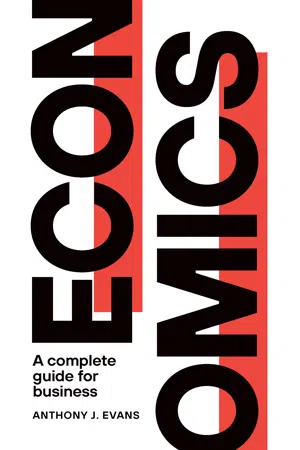
First published as 'Markets for Managers', this book has proved to be a popular way for non-economists to understand and apply the key tools of economics. Professor Anthony J. Evans, one of Europe's leading Managerial Economics instructors, brings the content that works in his classrooms to an even wider audience. Written in an engaging and informal way, whether you are a busy executive or simply an interested amateur this is your go-to guide. In this revised and updated edition, you will be led through the building blocks of economic theory and how they relate to the real world. You will see how thinking like an economist can improve your decision making, and how markets can be used to generate value within organizations and in society at large. The book incorporates the main principles of both micro and macroeconomics and takes a broad and diverse approach. In it you will encounter the most interesting economists and understand their contributions in a historical context. The practical format is perfect for professionals and students who want to gain an applied perspective on today's most pressing economic issues.
- 516 pages
- English
- ePUB (mobile friendly)
- Available on iOS & Android
eBook - ePub
About this book
Information
Publisher
London Publishing PartnershipYear
2021Print ISBN
9781913019105
Edition
1eBook ISBN
9781913019280
Chapter 1
Incentives Matter
The theory of economics does not furnish a body of settled conclusions immediately applicable in policy. It is a method rather than a doctrine, an apparatus of mind, a technique of thinking which helps its possessor to draw correct conclusions.
In early 1998, day care centres around Haifa, in Israel, had a problem. It was a problem common to many of us who have looked after children for a living: late parents. After a long day being responsible for other people’s children, by 4 p.m. the teachers were ready to go home. And they weren’t being paid for staying any longer. But invariably some parents would be late, and someone would have to stay behind, and wait with the child. One day some social scientists turned up (or rather, sent their research assistants), and made a suggestion2: why not fine the parents for being late? It is a solution any economist would give.
Over the next few weeks things carried on as normal, as the researchers gathered data before making any changes. Then, they adopted a policy where any parent who was more than 10 minutes late would pay a $3 fine. But instead of reducing lateness, the number of late pickups more than doubled. The incentive backfired!
As an economist, I’ve heard this example a lot. It’s often used to show economists that assuming people’s behaviour can be manipulated with financial incentives is naive and narrow minded. Indeed there is some truth to this. Just because originally there was no fine doesn’t mean that there was no incentive to be on time. The social norm is to be on time, and late parents probably felt guilty. Once the arrangement moved from the social to a financial realm, parents realized they could “buy” the right to be late. Indeed they weren’t just buying the right to be late, but also the ability to not feel guilty about it. In fact, maybe the lesson of the day care experiment is not that economists overstate their subject matter, but that non-economists understate it. After all, the average monthly cost was about $380. A good economist would suggest that the fine was set at a price that was too low! If the goal was to reduce lateness, raise the fine. And even more importantly, discovering the point at which the fine has an effect will help the day care centre to know just how valuable the parents consider their time to be. This whole experiment might help them to discover which opening hours best suit their customers.3 Clearly, the parents are willing to pay the teachers to stay later. Far from demonstrating the failure of markets, this example is a cursory foray into their magic.
We tend to think that economics is the study of the economy, and indeed this is an important application. But economics isn’t a subject matter; it’s a way of thinking. The essence of the economic way of thinking is to understand how incentives – the relationship between benefits and costs – affect people’s behaviour. Benefits are the value we get from a choice. Costs are the value we give up by making that choice. When those values change, so does our behaviour. In terms of management, economics can give us important clues about why behaviour may be generating bad outcomes. Understanding concepts such as opportunity cost, price elasticity and price discrimination are tools that managers can use to improve a company’s performance. But economics does more than this. It provides us with a way of thinking about human action. Economics is the study of society, and the tools with which we understand social behaviour are of direct relevance to management.
1.1 Managerial individualism
In their excellent textbook Managerial Economics, Luke Froeb and Brian McCann offer the following guide to decision making: when you see an outcome that you deem to be undesirable, ask yourself three questions:4
- Who made the bad decision?
- Did they have the information they needed?
- Did they have the right incentives?All too often the first question isn’t even asked, and failure is put down to some collective problem that is ill defined and impossible to alter. The main insight of managerial economics is to focus on the information and incentive systems that help guide decision-making. If you do not even know who is making the bad decision, there’s little hope of finding out why they did so. This book intends to explore the information channels and incentive mechanisms that create value. It will focus on how markets can be utilized to help solve these problems.The reason why economists make individual choice the centre of analysis is because we posit that only individuals choose.5 This is not the same thing as saying that only individuals matter, or that “society” is nothing more than a group of individuals. It stems from a concept called methodological individualism, which Jon Elster defines as “the doctrine that all social phenomena (their structure and their change) are in principle explicable only in terms of individuals – their properties, goals and beliefs”.6 We can talk about how “Heinz have decided to build a new factory” but according to methodological individualism the literal interpretation that the company itself made the decision is false. Families, businesses and nations might have common interests and work together to achieve shared goals, but it is only as individuals that we make decisions. Indeed what sets humans apart from other creatures is our sense of purposefulness. Many animals have developed language, culture, and even the use of tools. Apes can imitate behaviour but it is highly inefficient, “requiring lots of watching of behaviours that a human could mimic almost immediately by understanding their purpose”.7 This sense of purposefulness is what gives humans our unique ability to be creative.Parrots copy distinctive sounds; apes copy purposeful movements of a certain limited class. But humans do not especially copy any behavior. They use conjecture, criticism and experiment to create good explanations of the meaning of things – other people’s behavior, their own, and that of the world in general. T...
Table of contents
- Preface
- Preface to Markets for Managers
- Introduction
- Chapter 1
- Chapter 2
- Chapter 3
- Chapter 4
- Chapter 5
- Chapter 6
- Chapter 7
- Chapter 8
- Chapter 9
- Chapter 10
- Chapter 11
- Chapter 12
- Global Prosperity
- References
- Index
Trusted by 375,005 students
Access to over 1.5 million titles for a fair monthly price.
Study more efficiently using our study tools.
Frequently asked questions
Yes, you can cancel anytime from the Subscription tab in your account settings on the Perlego website. Your subscription will stay active until the end of your current billing period. Learn how to cancel your subscription
No, books cannot be downloaded as external files, such as PDFs, for use outside of Perlego. However, you can download books within the Perlego app for offline reading on mobile or tablet. Learn how to download books offline
Perlego offers two plans: Essential and Complete
- Essential is ideal for learners and professionals who enjoy exploring a wide range of subjects. Access the Essential Library with 800,000+ trusted titles and best-sellers across business, personal growth, and the humanities. Includes unlimited reading time and Standard Read Aloud voice.
- Complete: Perfect for advanced learners and researchers needing full, unrestricted access. Unlock 1.5M+ books across hundreds of subjects, including academic and specialized titles. The Complete Plan also includes advanced features like Premium Read Aloud and Research Assistant.
We are an online textbook subscription service, where you can get access to an entire online library for less than the price of a single book per month. With over 1.5 million books across 990+ topics, we’ve got you covered! Learn about our mission
Look out for the read-aloud symbol on your next book to see if you can listen to it. The read-aloud tool reads text aloud for you, highlighting the text as it is being read. You can pause it, speed it up and slow it down. Learn more about Read Aloud
Yes! You can use the Perlego app on both iOS and Android devices to read anytime, anywhere — even offline. Perfect for commutes or when you’re on the go.
Please note we cannot support devices running on iOS 13 and Android 7 or earlier. Learn more about using the app
Please note we cannot support devices running on iOS 13 and Android 7 or earlier. Learn more about using the app
Yes, you can access Economics: A Complete Guide for Business by Anthony J. Evans in PDF and/or ePUB format, as well as other popular books in Business & Business General. We have over 1.5 million books available in our catalogue for you to explore.