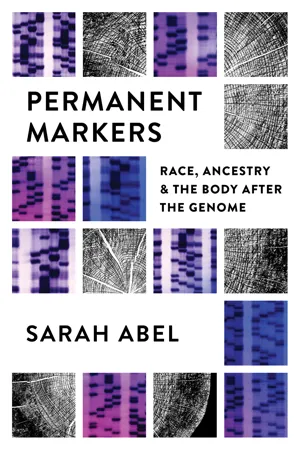
Over the past twenty years, DNA ancestry testing has morphed from a niche market into a booming international industry that encourages members of the public to answer difficult questions about their identity by looking to the genome. At a time of intensified interest in issues of race and racism, the burgeoning influence of corporations like AncestryDNA and 23andMe has sparked debates about the commodification of identity, the antiracist potential of genetic science, and the promises and pitfalls of using DNA as a source of “objective” knowledge about the past.
This book engages these debates by looking at the ways genomic ancestry testing has been used in Brazil and the United States to address the histories and legacies of slavery, from personal genealogical projects to collective racial politics. Reckoning with the struggles of science versus capitalism, “race-blind” versus “race-positive” public policies, and identity fluidity versus embodied experiences of racism, Permanent Markers seeks to explain why societies that have broadly embraced the social construction of race continue to search for, and find, evidence that our bodies are indelibly marked by the past.
- 280 pages
- English
- ePUB (mobile friendly)
- Available on iOS & Android
eBook - ePub
About this book
Information
1 Geno-Myths
Henry Louis Gates Jr. leans one elbow against the upper balcony of the Ellis Island Immigration Museum, his body turned toward the camera. The hall below is empty, but the microphone captures the echo of the voices of hundreds of visitors who have come to pay their respects to the ancestors who disembarked here decades ago, alongside millions of other European immigrants, ready to start their new lives as U.S. citizens. In the background, a U.S. flag hangs stolidly over the quiet hall. Gates’s expression is somber as he announces to his viewers: “I envy my friends who can come here and celebrate their ancestors’ journey and trace them through the records so diligently compiled here. They can even type the name of their ancestor into a computer and access the record of the day of their arrival. Unfortunately, there is no Ellis Island for those of us who are descendants of survivors of the African slave trade.” For generations, Gates explains, African Americans have been unable to gain such information about their African ancestors, who were forcibly transported to the Americas and stripped of their histories and identities by slavery. “But what if we could trace our roots?” continues Gates. “What if we could even travel through time, across the Atlantic Ocean, and find where our ancestors came from in Africa? Now, thanks to miraculous breakthroughs in genealogy and genetics, we can begin to do just that.”1
The PBS documentary miniseries African American Lives began with these lines and aired on U.S. television over the course of two weeks in February 2006. In four episodes, the Harvard professor of African American literature accompanied eight distinguished African American guests on an exploration of their family lineages, beginning with the recent history of the civil rights movement, Jim Crow segregation, and the Harlem Renaissance and traveling back in time through the Civil War to the era of chattel slavery. In the final episode, once the paper trails had been exhausted, each guest, including Gates, was presented with two sets of personalized DNA ancestry test results. The first examined their autosomal DNA (genetic material inherited from all recent direct biological ancestors),2 which conveyed their genomic “admixture” percentages in relation to three continental populations (“European,” “West African,” and “Native American”), a technique that Gates claimed was “turning ideas of racial purity upside down.” The second relayed the names of the African countries and, in some cases, ethnic groups to which each guest had been matched, based on analyses of their maternally inherited mitochondrial DNA (mtDNA) and paternally inherited Y-chromosome DNA (Y-DNA). The show reached its climax as one guest, comedian Chris Tucker, traveled to Angola to meet a community with whom he had been genetically matched. The episode’s title, “Beyond the Middle Passage,” conveyed the symbolic significance of this knowledge. It was, according to Gates, a way to help African Americans find the identities of their ancestors, allowing them to heal the wounds of the Middle Passage and hence “to stake our claim ever more deeply within the American tradition.”3
The following year, a group of Brazilian journalists working for BBC Brasil launched a special feature entitled Raízes Afro-Brasileiras (Afro-Brazilian Roots). The project was intended to explore and celebrate the history of Brazil’s African-descendant populations in commemoration of the 200-year anniversary of the abolition of the British slave trade. The content was published in two parts on a dedicated page of the BBC Brasil website. A first round of articles, published during the first week of May 2007, introduced the special feature and presented a discussion of recent historical and genetic studies into Brazil’s African heritage. Readers were also informed that nine Black Brazilian celebrities had agreed to trace their personal genetic profiles using DNA ancestry tests, and their results would be revealed, one by one, during the last week in May. Like the guests of African American Lives, each celebrity was presented with two sets of results: an estimate of their regional ancestral origins based on mtDNA and Y-DNA analyses, and a description of their genomic admixture, divided into “African,” “European,” and “Amerindian” percentages. Whereas the emotional climax of African American Lives revolved around the revelation of each guest’s African ethnic origins, Raízes Afro-Brasileiras dramatically foregrounded the contrast between the participants’ mixed genetic heritage and their assumed Black identities through headings like “Neguinho da Beija-Flor has mostly European genes,” “Result ‘wrestles’ with what I feel, says Djavan,” and “No one knows how to define me, says actress who is Black and ‘70% European.’ ”4
If the format and inspiration behind these two projects were similar, their reception and impact in their respective countries was markedly different. Viewers attending an official webinar hosted by the creators of African American Lives joined TV critics in complimenting the series for its thought-provoking content on the topics of race and identity.5 As one viewer stated, “I thought the coolest lesson was that one’s ‘heritage’ or ‘cultural identity’ is based not on ‘race’ … but rather one’s own and others’ perceptions.”6 Others enquired eagerly how DNA could help them learn more about their own African origins. As the first major U.S. television program to present DNA testing as a means of tracing family histories, Gates’s formula was successful enough not only to be revived for a second season (2008) and a spin-off special (Oprah’s Roots, 2007), but to inspire an entire franchise of celebrity family history shows, the latest of which, Finding Your Roots, is currently in its seventh season. These and other successful genealogy documentary series like The Learning Channel’s Who Do You Think You Are? have helped familiarize the U.S. public with the concept of genetic ancestry testing; they also endorse the products of particular DNA-testing companies that act as sponsors and scientific consultants for these series. In turn, the rising popularity of the genre has mirrored the growth of the DNA ancestry-testing market itself: while still a cottage industry in 2006, it has since been transformed into a multimillion-dollar international market oriented toward informing customers about their unique “ethnic makeup.”
In Brazil, on the other hand, the initial aim of Raízes Afro-Brasileiras, which was to shed light on the African origins of Black Brazilians, eventually gave way to scrutiny of the relationship between the guests’ genetic ancestry results, their physical appearance, and affirmed racial identities. On the same day that the first profiles were published, the BBC Brasil website opened a web forum that stated that “recent genetic research has shown an intense degree of miscegenation in the Brazilian population” and asked readers whether, based on this information, they felt that the concept of race still made sense in Brazil. Among the more than 400 posts received over the following four months, the largest proportion of respondents replied “no,” with many reasoning that “Brazilians are all mixed,” and some declaring that “racial categories are racist.”7 In the context of an ongoing national polemic about the introduction of racially targeted quotas at prestigious federal universities, meant to tackle the systemic exclusion of dark-skinned Brazilians from the upper echelons of society, some critics seized on the DNA profiles as evidence of impossibility of dividing Brazil into “Blacks” and “Whites.” Many commentators drew special attention to the participants whose genetic profiles appeared to contradict their affirmed racial identity. In particular, the news that Neguinho da Beija-Flor, a dark-skinned Afro-Brazilian samba artist from Rio de Janeiro, had “more European than African” genomic ancestry was used by some pundits to denounce the quotas initiatives.8 In anticipation of these attacks, representatives of the country’s Black movements—including one activist who took part in the feature—branded the BBC Brasil feature an attempt to sabotage the quotas campaigns and questioned the legitimacy of the science used.9 Such was the level of controversy that within a week of the feature’s publication, BBC Brasil editor Rogério Simões released a post on the site’s editorial blog, clarifying that “the BBC has not entered into any the debate over the establishment, or not, of quotas for Blacks, nor any other social policy based on ‘racial’ characteristics, because this was not the aim of the reports.” Nevertheless, Simões remarked, “The genetics carried a surprise: many individuals that seemed to belong to a specific race are also a combination of the various peoples that formed the Brazilian nation. For some, it is a fact to be celebrated, for others it is a source for polemic. But, undeniably, it is a fact.”10
Does DNA testing simply convey “the facts” about ancestry? The radically different interpretations detailed above—relating to two similar sets of genetic data, produced under the same pretext, a year apart in the United States and Brazil—suggest that DNA ancestry information do not simply speak for themselves. Donna Haraway has written of the necessity of treating scientific knowledge as “situated”—that is, as information that draws sense from interwoven histories, myths, and political relations, rather than holding an inherent and irreducible meaning. For Haraway, readings of scientific data are necessarily “engaged and produced: they do not flow naturally from the text,” so that even “the most straightforward readings of any text are also situated arguments about fields of meanings and fields of power.”11 When interpreting DNA ancestry data, family and national histories tend to form our immediate frames of reference. Yet, as Michel-Rolph Trouillot signaled, historical narratives are themselves the fruit of power struggles, involving “the uneven contribution of competing groups and individuals who have unequal access to the means for such production.”12 These two parallel examples offer a starting point for exploring how the cultural and political authority of particular myths and historical narratives of race and national identity stack the odds in favor of particular readings of the links between DNA ancestry and identity, while making other interpretations difficult or impossible to access.
Unequal Ancestries and the Problem of Traceability
As Gates tells it, the inspiration for African American Lives came to him in the small hours, one night in 2003.13 A prominent expert in African American literature who had previously created documentaries about African history and culture,14 Gates had recently taken a DNA test from the newly established company African Ancestry in the hopes of learning about his own African family origins. As it was for many African Americans of his generation, this was a lifelong dream that Gates could clearly trace back to his memories of watching Alex Haley’s Roots as a young man. Both novel and miniseries (released in 1976 and 1977, respectively) recount the story of Haley’s ancestor, Kunta Kinte, a young Mandinka man who grew up in present-day Gambia and was captured and sold into slavery, shortly before the American Revolution. The narrative traces the lives of Kunta Kinte’s descendants from the eighteenth century to the present day, ending with Haley himself learning his family history from an elderly aunt and setting out to locate the origins of his ancestor based on a handful of names and African words passed down within the family for generations. With the help of two Africanist scholars, Haley was able to trace his family origins to a village called Juffure in the Gambia. The community’s historical link to Kunta Kinte and his forebears was confirmed by a local griot, and Haley was welcomed back by the villagers as their long-lost kin.15 The book, which Haley referred to as a work of “faction” (fiction based on fact), was an instant bestseller. It won a Pulitzer Prize in 1977 and was adopted as a course book at 276 colleges and universities over the next decade. A TV miniseries, released in January 1977, attracted a record number of viewers, with an estimated 130 million individuals tuning in to watch the final episode.16 Today, the story has achieved mythical status in U.S. culture.
Roots challenged what anthropologist Melville Herskovits dubbed the “myth of the Negro past”: the idea that African American populations had no history or original culture, having lost their traditions through slavery. In his 1941 book of the same title, Herskovits argued that this was not a social fact but a myth used widely to confirm the inferiority of people of African descent and to justify treating them as degenerative elements within American societies. Contrary to portraits painted by leading sociologists of Black families as “pathological” and “rootless,”17 Haley’s tale chronicled the efforts of the enslaved to maintain kinship ties with their loved ones, as well as a sense of connection to an African origin, even in the most adverse conditions. As suggested by the book’s subtitle, The Saga of an American Family, Haley offered up his family’s account as an example of the “bootstrap” narratives used to embody the core U.S. values of hard work, struggle, and social ascension. At the same time, he predicted, his own ancestors’ story would become “a symbolic saga of all African-descent people—who are without exception the seeds of someone like Kunta who was born and grew up in some Black African village, someone who was captured and chained down in one of those slave ships that sailed them across the same ocean, into some succession of plantations, and since then a struggle for freedom.”18 In fact, Roots inspired a wave of public interest in genealogy, motivating thousands to take to the archives in pursuit of their own family histories—an activity that has only gained popularity in U.S. society ever since. Aside from posing the tantalizing possibility that others might be able to uncover their own African origins in a similarly miraculous manner, many African Americans found that the popularity of the show made it easier to broach the silence around slavery within their families, by alleviating the shame associated with this episode in their collec...
Table of contents
- Cover
- Title Page
- Copyright
- Contents
- Figures
- Note on Language
- Introduction
- 1. Geno-Myths
- 2. The Geneticist’s Dilemma
- 3. Technologies of the Self
- 4. Marked Bodies
- 5. Essential Origins
- Epilogue
- Acknowledgments
- Appendix. Interview Methodology
- Notes
- References
- Index
Trusted by 375,005 students
Access to over 1.5 million titles for a fair monthly price.
Study more efficiently using our study tools.
Frequently asked questions
Yes, you can cancel anytime from the Subscription tab in your account settings on the Perlego website. Your subscription will stay active until the end of your current billing period. Learn how to cancel your subscription
No, books cannot be downloaded as external files, such as PDFs, for use outside of Perlego. However, you can download books within the Perlego app for offline reading on mobile or tablet. Learn how to download books offline
Perlego offers two plans: Essential and Complete
- Essential is ideal for learners and professionals who enjoy exploring a wide range of subjects. Access the Essential Library with 800,000+ trusted titles and best-sellers across business, personal growth, and the humanities. Includes unlimited reading time and Standard Read Aloud voice.
- Complete: Perfect for advanced learners and researchers needing full, unrestricted access. Unlock 1.5M+ books across hundreds of subjects, including academic and specialized titles. The Complete Plan also includes advanced features like Premium Read Aloud and Research Assistant.
We are an online textbook subscription service, where you can get access to an entire online library for less than the price of a single book per month. With over 1.5 million books across 990+ topics, we’ve got you covered! Learn about our mission
Look out for the read-aloud symbol on your next book to see if you can listen to it. The read-aloud tool reads text aloud for you, highlighting the text as it is being read. You can pause it, speed it up and slow it down. Learn more about Read Aloud
Yes! You can use the Perlego app on both iOS and Android devices to read anytime, anywhere — even offline. Perfect for commutes or when you’re on the go.
Please note we cannot support devices running on iOS 13 and Android 7 or earlier. Learn more about using the app
Please note we cannot support devices running on iOS 13 and Android 7 or earlier. Learn more about using the app
Yes, you can access Permanent Markers by Sarah Abel in PDF and/or ePUB format, as well as other popular books in History & African American History. We have over 1.5 million books available in our catalogue for you to explore.